REVIEW 3 major objections 5 minor 42 references
Real-World Cooperative Bimanual Dexterous Grasp of Large Objects from Single-View Observations
T0 review · 3 major / 5 minor · reviewed 2026-08-15 · deepseek-v4-flash
Pith's one-line read A diffusion model trained on teleoperated demonstrations turns one RGB-D view into executable two-hand grasps, lifting unseen large objects in about 62% of physical trials.
desk verdict A real-world bimanual dexterous grasp system from single-view RGB-D that is genuinely new, but the evaluation is too small and scene-constrained to support the broad 'real-world' claim as stated. read the letter →
The pith
A machine-rendered reading of the paper's core claim, the machinery that carries it, and where it could break.
The reading
What carries the argument
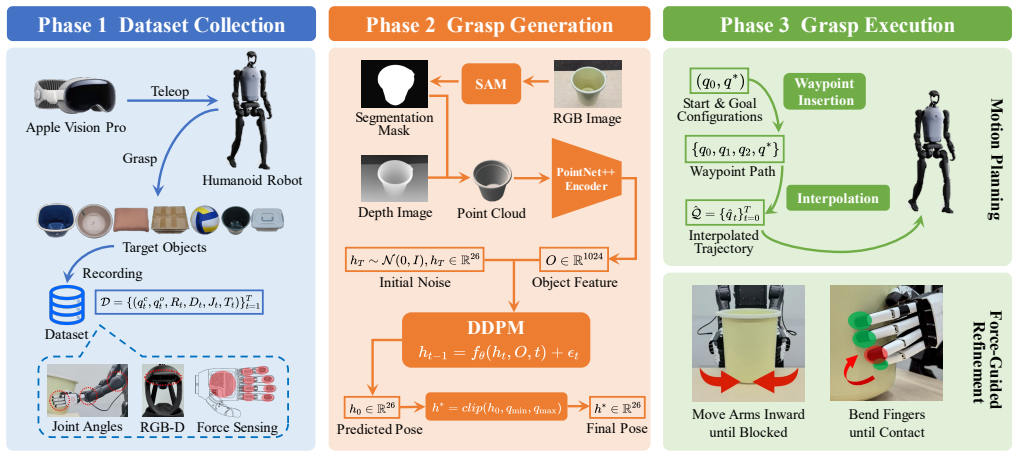
The central object is the predicted bimanual grasp configuration $h^*\in\mathbb{R}^{26}$: the joint angles of two 7-DoF arms and two 6-DoF dexterous hands. The generative engine is a Denoising Diffusion Probabilistic Model (DDPM) that iteratively denoises Gaussian noise into $h^*$, conditioned on a 1024-dimensional object feature produced by a PointNet++ encoder from a SAM-segmented partial point cloud. The execution engine is a two-stage force-guided refinement: first the palms move toward the object's midpoint until relative motion stops, meaning the object is physically blocking the arms; then every finger whose torque or tactile reading stays below threshold keeps bending until contact registers. This loop is what converts a visually plausible pose into a stable real-world grasp, and it is the component the paper identifies as missing in prior simulation-based methods.
What would settle it
Place a second object on the table or shift the target object thirty centimeters off-center, then run the same pipeline. If the success rate collapses to the level of the no-motion-planning ablation (about 22 percent) because segmentation merges the distractor or the torso blocks one arm, the single-view generalization claim is narrower than stated. The paper's own failure case in Figure 7(c) already shows the off-center failure mode; a systematic sweep over lateral placement is the direct test.
Extended reading notes
Core claim
On the paper's own terms, the central discovery is that a diffusion model conditioned on a partial point cloud can generate executable bimanual grasps from a single view, and that the residual errors of that visual prediction can be absorbed by a force-based execution loop. The model outputs a 26-dimensional pose $h^*$ covering two 7-DoF arms and two 6-DoF hands, obtained by denoising Gaussian noise under a 1024-dimensional PointNet++ feature of the segmented object. The execution stage plans a waypoint trajectory, moves the arms inward until the palms are physically blocked by the object, and then bends each finger not yet in contact until joint-torque or tactile thresholds are crossed. In physical trials on seven unseen objects with five poses and three attempts per pose, the method reaches a 61.90 percent average success rate, compared with 28.57 percent for the simulation-trained bimanual baseline, 37.14 percent for the real-world cuboid-only baseline, and below 22 percent for single-hand methods, while the ablations show success falling to 42.86 percent without arm squeezing and 21.90 percent without motion planning.
Load-bearing premise
The whole evaluation rests on a clean, uniformly colored tabletop with the target object centered in the camera's view, because the segmentation keeps only segments near the image center and the robot's torso blocks one arm when the object is placed too far to one side.
Editorial extensions
If this is right
- A robot can generate and execute bimanual grasps for unseen large objects from a single RGB-D frame, eliminating the need for full 3D object models or multi-view reconstruction.
- The force-guided refinement stage is load-bearing: removing arm squeezing drops the average success rate from 61.90% to 42.86%, and removing finger adjustment drops it to 34.29%.
- Motion planning is the difference between a feasible grasp and a failed attempt: without it the success rate falls to 21.90%, with failures caused by tabletop collisions and pushing the object.
- Single-hand grasping methods, whether parallel-jaw or dexterous, fail on large simple shapes such as boxes and balls, which supports the paper's argument that cooperative bimanual enclosure is necessary for such objects.
- The released dataset and code allow the pipeline to be reproduced and extended to other dual-arm platforms.
Reading between the lines
- The paper's scene assumption means the strongest reading is about execution robustness rather than perception in clutter; a natural next step the authors hint at is open-vocabulary detection and collision-aware planning to relax the centered-object condition.
- Because the handcrafted symmetric-pose ablation (29.52%) lands close to the simulation-trained baseline (28.57%), the learned diffusion model seems to contribute mostly the arm-hand coordination and shape-specific contact placement, while the force loop supplies the stability; a testable extension is to retrain the model with force/tactile signals in the conditioning input.
- Feeding force and tactile feedback into the diffusion model itself, rather than using them only at execution time, could let the model anticipate soft contacts and reduce the need for large corrective motions; the paper lists this as future work.
- The per-object results suggest weight and mass distribution matter: the heaviest box has the lowest success (46.67%) and its failure case shows slippage when the grasp center is off the object's centroid, so conditioning on estimated mass or grasp-center offset is a promising extension.
Signed reviews
Editorial analysis
A structured set of objections, weighed in public.
Referee Report
Summary. The paper proposes a full pipeline for real-world cooperative bimanual dexterous grasping of large tabletop objects from a single RGB-D frame. It contributes a teleoperated multimodal dataset collected on a Unitree H1-2 humanoid with Inspire RH56DFTP hands; a DDPM-based module that generates a 26-dimensional joint configuration (two 7-DoF arms and two 6-DoF hands) conditioned on a PointNet++ encoding of a SAM-segmented partial point cloud; and an execution stage that combines waypoint-based motion planning with force- and tactile-guided refinement. The system is evaluated on a real dual-arm robot on 7 unseen objects with 5 poses and 3 attempts each, reporting a 61.9% aggregate success rate, along with ablations against removing arm squeezing, finger adjustment, motion planning, and the learned DDPM. The paper also compares against BimanGrasp-DDPM, ViSiL-HD, GraspNet, and DexGraspAnything.
Significance. If the claims hold, the paper makes a useful step toward real-world bimanual dexterous grasping for large objects: it shows that a single-view partial point cloud can condition a diffusion model to produce executable joint-level grasps, and that force-guided refinement materially improves contact stability. The physical lift-and-hold success criterion, the object-level train/test split, and the release of code and a real-robot dataset are concrete strengths. The main significance is the demonstration that a teleoperated real-world dataset plus diffusion-based synthesis can transfer to unseen objects in a structured tabletop setting. However, the external validity of the headline performance is currently limited by the narrow evaluation protocol, the absence of statistical inference, and a segmentation heuristic that assumes a uniform background with a centered single object.
major comments (3)
- [Section IV-A, Figure 7(c), Section III-C] The segmentation protocol is load-bearing for the real-world generalization claim. The paper isolates the target by discarding the largest image-border segment and merging central segments, which is only reliable for a uniformly colored tabletop with a single object near the image center. Figure 7(c) already shows that a placement too far to one side defeats reachability, and a cluttered scene would corrupt the point cloud that conditions the DDPM. The paper itself acknowledges in Section III-C that the setting assumes relatively simple scenes. To support the generalization implied by the title and abstract, please add stress experiments with distractors, cluttered backgrounds, and varied object positions, and report how often the segmentation heuristic selects the correct region. Alternatively, the scope should be explicitly narrowed in the title and abstract.
- [Section IV-B, Tables II and III] The evaluation uses only 7 test objects with 15 trials each, and the aggregate 61.9% success rate corresponds to 65/105 successes with a 95% Wilson confidence interval of roughly 52-71%. No confidence intervals or significance tests are reported, and per-object counts (e.g., 8/15 vs 6/15) are individually too small to distinguish methods. Please report per-object and aggregate confidence intervals and, where possible, paired or per-configuration significance tests. Without this, the claims of 'high success rates' and of superiority over baselines are not statistically grounded.
- [Section IV-B, Table II] The baseline comparisons appear to disadvantage the comparison methods. ViSiL-HD is trained only on cuboid objects and is evaluated without the under-object support used in its original setup, while BimanGrasp-DDPM is trained on its own simulation dataset and executed without path planning or online adjustment. Consequently, the reported margins over these baselines may reflect implementation choices rather than intrinsic limitations of the baselines. Please either adapt the baselines to use their intended supporting mechanisms (e.g., allowing under-object support for ViSiL-HD) or explicitly frame the comparison as against the implemented baseline variants and discuss how the missing components would likely affect the outcome.
minor comments (5)
- [Tables II-III and Figure 4] The object naming is inconsistent: Table II lists 'basin, barrel, box 1, box 2, box 3, bucket, basketball', while Figure 4 shows only 'Stainless steel basin, Traffic barrel, Storage box, Cardboard box, Basketball'. Please clarify which figure image corresponds to 'box 3' and define all object labels in one place.
- [Section III-A and Section IV-A] The text says the same SAM segmentation method is applied during training and inference, but Section IV-A adds a border-discard/center-merge selection step that is not described in the training pipeline. Please clarify whether the training masks are obtained with this same selection rule or are manually verified.
- [Section III-C, q2 definition] The definition of q2 as 'translating q* backward along the palm's normal vector' is ambiguous. Please specify the reference frame and sign convention so that the waypoint construction is reproducible.
- [Table I, Eq. (8)] The contact condition in Eq. (8) uses thresholds tau_th and delta_th, but Table I lists only the force threshold with units. Please give the value and units of the tactile threshold delta_th.
- [Abstract and conclusion] The phrase 'high success rates across unseen objects with varying geometries and poses' should be qualified by the simple-scene assumption acknowledged in Section III-C, so that the contribution is not overstated relative to the evaluation conditions.
Circularity Check
No significant circularity: the learned synthesis, execution refinement, and physical success metric are independent of the model's inputs.
full rationale
I walked the paper's derivation chain: the DDPM generates a 26-dimensional joint configuration from a PointNet++-encoded partial point cloud (Eq. 2-6), which is standard conditional diffusion; the target joint vector is not used to define the input object feature or the segmentation mask. The success criterion is a physical lift-and-hold test, not a quantity that matches the model output by construction. The force and tactile thresholds in Eq. 8 and Table I are hand-set constants, not fitted to the test set, and the ablation study removes each component to show its contribution. Baselines are trained on their own published datasets or policies, so no load-bearing self-citation appears. The paper explicitly acknowledges its scope limitation in Section III-C ('our setting assumes relatively simple scenes'), which narrows generalizability but does not make the derivation circular. The inference-time segmentation and placement assumptions are real-world constraints, not fitted inputs renamed as predictions. Consequently, no circular step was found, and the score is 0.
Assumptions & free parameters
free parameters (5)
- Force threshold tau_th =
2.9 N
- Tactile threshold delta_th =
not specified
- Arm velocity fast/slow phases =
0.5/0.15 m/s
- Finger angular speed =
1.57 rad/s
- Waypoint lift q1 and pre-grasp offset q2 =
not specified
assumptions (5)
- standard math DDPM training objective Eq. (6) reliably learns a conditional distribution over grasp configurations.
- domain assumption A 1024-dim global PointNet++ feature is a sufficient condition for bimanual grasp synthesis.
- ad hoc to paper The SAM-based segmentation with border-discard and center-merge rule isolates the target object.
- domain assumption Teleoperated demonstrations via Apple Vision Pro provide ground-truth joint configurations accurate enough for supervised learning.
- ad hoc to paper A single global set of contact thresholds (tau_th, delta_th) works across all objects and finger sizes.
Cite this review
Pith. "Pith review of Real-World Cooperative Bimanual Dexterous Grasp of Large Objects from Single-View Observations." pith.science (2026). https://pith.science/paper/ZCTQKO4I
@misc{pith2026260810383,
  author       = {Pith},
  title        = {Pith review of: Real-World Cooperative Bimanual Dexterous Grasp of Large Objects from Single-View Observations},
  year         = {2026},
  howpublished = {\url{https://pith.science/paper/ZCTQKO4I}},
  note         = {Machine review of arXiv:2608.10383}
}
read the original abstract
Bimanual dexterous grasping of large objects is a critical challenge in robotic manipulation. However, most existing studies focus on sequential manipulation rather than cooperative grasping, and methods addressing such bimanual tasks have largely been limited to simulation. These limitations stem from the difficulty of acquiring full 3D object models and generating physically plausible grasping actions. To fill this gap, we propose a real-world bimanual grasping framework that includes: a multimodal dataset capturing joint angles, visual observations and force signals; a Denoising Diffusion Probabilistic Model (DDPM)-based module that generates joint-level grasp configurations from segmented point clouds; and an execution strategy that integrates motion planning with online grasp refinement to ensure physical stability and feasibility. Our approach enables the synthesis of executable bimanual grasps from single-view inputs, reducing dependence on complete 3D object models and ensuring stable real-world performance. Experiments on a dual-arm robot demonstrate high success rates across unseen objects with varying geometries and poses, and ablation studies confirm the contributions of key components of our system.
Figures


Figures from the paper (3 more)


Reference graph
Works this paper leans on
-
[1]
Open x-embodiment: Robotic learning datasets and RT-X models : Open x-embodiment collaboration,
A. O’Neill, A. Rehman, A. Maddukuriet al., “Open x-embodiment: Robotic learning datasets and RT-X models : Open x-embodiment collaboration,” inIEEE International Conference on Robotics and Automation, 2024, pp. 6892–6903
2024
-
[2]
A fractal suction-based robotic gripper for versatile grasping,
P. O’Brien, J. F. Kowalewski, C. C. Kessens, and J. I. Lipton, “A fractal suction-based robotic gripper for versatile grasping,”IEEE Robotics and Automation Letters, vol. 9, no. 7, pp. 6208–6215, 2024
2024
-
[3]
Robot synesthesia: In-hand manipulation with visuotactile sensing,
Y . Yuan, H. Che, Y . Qin, B. Huang, Z. Yin, K. Lee, Y . Wu, S. Lim, and X. Wang, “Robot synesthesia: In-hand manipulation with visuotactile sensing,” inIEEE International Conference on Robotics and Automation, 2024, pp. 6558–6565
2024
-
[4]
A dexterous and compliant (dexco) hand based on soft hydraulic actuation for human- inspired fine in-hand manipulation,
J. Zhou, J. Huang, Q. Dou, P. Abbeel, and Y . Liu, “A dexterous and compliant (dexco) hand based on soft hydraulic actuation for human- inspired fine in-hand manipulation,”IEEE Transactions on Robotics, vol. 41, pp. 666–686, 2025
2025
-
[5]
ContactMPC: Towards online adaptive control for contact-rich dexterous manipulation,
A. Lakshmipathy and N. S. Pollard, “ContactMPC: Towards online adaptive control for contact-rich dexterous manipulation,” inRobotics: Science and Systems Workshops, 2024
2024
-
[6]
The GRASP taxonomy of human grasp types,
T. Feix, J. Romero, H. Schmiedmayer, A. M. Dollar, and D. Kragic, “The GRASP taxonomy of human grasp types,”IEEE Transactions on Human-Machine Systems, vol. 46, no. 1, pp. 66–77, 2016
2016
-
[7]
Bimanual grasp synthesis for dexterous robot hands,
Y . Shao and C. Xiao, “Bimanual grasp synthesis for dexterous robot hands,”IEEE Robotics and Automation Letters, vol. 9, no. 12, pp. 11 377–11 384, 2024
2024
-
[8]
VGGT: visual geometry grounded transformer,
J. Wang, M. Chen, N. Karaev, A. Vedaldi, C. Rupprecht, and D. Novotn ´y, “VGGT: visual geometry grounded transformer,” in IEEE/CVF Conference on Computer Vision and Pattern Recognition, 2025, pp. 5294–5306
2025
Show all 42 references
-
[9]
Synthesizing diverse and physically stable grasps with arbitrary hand structures using differentiable force closure estimator,
T. Liu, Z. Liu, Z. Jiao, Y . Zhu, and S. Zhu, “Synthesizing diverse and physically stable grasps with arbitrary hand structures using differentiable force closure estimator,”IEEE Robotics and Automation Letters, vol. 7, no. 1, pp. 470–477, 2022
2022
-
[10]
R. M. Murray, Z. Li, and S. S. Sastry,A mathematical introduction to robotics manipulation. CRC Press, 1994
1994
-
[11]
On characterizing and computing three- and four-finger force-closure grasps of poly- hedral objects,
J. Ponce, S. Sullivan, J. Boissonnat, and J. Merlet, “On characterizing and computing three- and four-finger force-closure grasps of poly- hedral objects,” inIEEE International Conference on Robotics and Automation, 1993, pp. 821–827
1993
-
[12]
On the syn- thesis of feasible and prehensile robotic grasps,
C. J. Rosales, R. Su ´arez, M. Gabiccini, and A. Bicchi, “On the syn- thesis of feasible and prehensile robotic grasps,” inIEEE International Conference on Robotics and Automation, 2012, pp. 550–556
2012
-
[13]
Deep differen- tiable grasp planner for high-dof grippers,
M. Liu, Z. Pan, K. Xu, K. Ganguly, and D. Manocha, “Deep differen- tiable grasp planner for high-dof grippers,” inRobotics: Science and Systems, 2020
2020
-
[14]
Dexterous grasp transformer,
G. Xu, Y . Wei, D. Zheng, X. Wu, and W. Zheng, “Dexterous grasp transformer,” inIEEE/CVF Conference on Computer Vision and Pattern Recognition, 2024, pp. 17 933–17 942
2024
-
[15]
Hand-object contact consistency reasoning for human grasps generation,
H. Jiang, S. Liu, J. Wang, and X. Wang, “Hand-object contact consistency reasoning for human grasps generation,” inIEEE/CVF International Conference on Computer Vision, 2021, pp. 11 087– 11 096
2021
-
[16]
Unidexgrasp: Universal robotic dexterous grasping via learning diverse proposal generation and goal- conditioned policy,
Y . Xu, W. Wan, J. Zhanget al., “Unidexgrasp: Universal robotic dexterous grasping via learning diverse proposal generation and goal- conditioned policy,” inIEEE/CVF Conference on Computer Vision and Pattern Recognition, 2023, pp. 4737–4746
2023
-
[17]
Diffusion-based generation, optimization, and planning in 3d scenes,
S. Huang, Z. Wang, P. Li, B. Jia, T. Liu, Y . Zhu, W. Liang, and S. Zhu, “Diffusion-based generation, optimization, and planning in 3d scenes,” inIEEE/CVF Conference on Computer Vision and Pattern Recognition, 2023, pp. 16 750–16 761
2023
-
[18]
UGG: unified generative grasping,
J. Lu, H. Kang, H. Li, B. Liu, Y . Yang, Q. Huang, and G. Hua, “UGG: unified generative grasping,” inEuropean Conference on Computer Vision, vol. 15125, 2024, pp. 414–433
2024
-
[19]
Dexgrasp-diffusion: Diffusion-based unified functional grasp synthesis pipeline for multi-dexterous robotic hands,
Z. Zhang, L. Zhou, C. Liu, Z. Liu, C. Yuan, S. Guo, R. Zhao, M. H. A. Jr., and F. E. H. Tay, “Dexgrasp-diffusion: Diffusion-based unified functional grasp synthesis pipeline for multi-dexterous robotic hands,” arXiv:2407.09899, 2024
2024 arXiv
-
[20]
Dexgrasp anything: Towards universal robotic dexterous grasping with physics awareness,
Y . Zhong, Q. Jiang, J. Yu, and Y . Ma, “Dexgrasp anything: Towards universal robotic dexterous grasping with physics awareness,” in IEEE/CVF Conference on Computer Vision and Pattern Recognition, 2025, pp. 22 584–22 594
2025
-
[21]
Graspit! A versatile simulator for robotic grasping,
A. T. Miller and P. K. Allen, “Graspit! A versatile simulator for robotic grasping,”IEEE Robotics & Automation Magazine, vol. 11, no. 4, pp. 110–122, 2004
2004
-
[22]
Isaac gym: High performance GPU based physics simulation for robot learning,
V . Makoviychuk, L. Wawrzyniak, Y . Guo, M. Lu, K. Storey, M. Mack- lin, D. Hoeller, N. Rudin, A. Allshire, A. Handa, and G. State, “Isaac gym: High performance GPU based physics simulation for robot learning,” inAdvances in Neural Information Processing Systems, 2021
2021
-
[23]
Learning joint reconstruction of hands and manipu- lated objects,
Y . Hasson, G. Varol, D. Tzionas, I. Kalevatykh, M. J. Black, I. Laptev, and C. Schmid, “Learning joint reconstruction of hands and manipu- lated objects,” inIEEE Conference on Computer Vision and Pattern Recognition, 2019, pp. 11 807–11 816
2019
-
[24]
DDGC: generative deep dexter- ous grasping in clutter,
J. Lundell, F. Verdoja, and V . Kyrki, “DDGC: generative deep dexter- ous grasping in clutter,”IEEE Robotics and Automation Letters, vol. 6, no. 4, pp. 6899–6906, 2021
2021
-
[25]
Gen- dexgrasp: Generalizable dexterous grasping,
P. Li, T. Liu, Y . Li, Y . Geng, Y . Zhu, Y . Yang, and S. Huang, “Gen- dexgrasp: Generalizable dexterous grasping,” inIEEE International Conference on Robotics and Automation, 2023, pp. 8068–8074
2023
-
[26]
Dexgraspnet: A large-scale robotic dexterous grasp dataset for general objects based on simulation,
R. Wang, J. Zhang, J. Chen, Y . Xu, P. Li, T. Liu, and H. Wang, “Dexgraspnet: A large-scale robotic dexterous grasp dataset for general objects based on simulation,” inIEEE International Conference on Robotics and Automation, 2023, pp. 11 359–11 366
2023
-
[27]
Videodex: Learning dexterity from internet videos,
K. Shaw, S. Bahl, and D. Pathak, “Videodex: Learning dexterity from internet videos,” inConference on Robot Learning, vol. 205, 2022, pp. 654–665
2022
-
[28]
Robotic telekinesis: Learning a robotic hand imitator by watching humans on youtube,
A. Sivakumar, K. Shaw, and D. Pathak, “Robotic telekinesis: Learning a robotic hand imitator by watching humans on youtube,” inRobotics: Science and Systems, 2022
2022
-
[29]
Combo- grasp: Learning constraint-based manipulation for bimanual occluded grasping,
J. Yamada, A. L. Mitchell, J. Collins, and I. Posner, “Combo- grasp: Learning constraint-based manipulation for bimanual occluded grasping,”arXiv:2502.08054, 2025
2025 arXiv
-
[30]
Peract2: Bench- marking and learning for robotic bimanual manipulation tasks,
M. Grotz, M. Shridhar, T. Asfour, and D. Fox, “Peract2: Bench- marking and learning for robotic bimanual manipulation tasks,” arXiv:2407.00278, 2024
2024 arXiv
-
[31]
You only teach once: Learn one-shot bimanual robotic manipulation from video demonstrations,
H. Zhou, R. Wang, Y . Tai, Y . Deng, G. Liu, and K. Jia, “You only teach once: Learn one-shot bimanual robotic manipulation from video demonstrations,”arXiv:2501.14208, 2025
2025 arXiv
-
[32]
Learning dual-arm coordination for grasping large flat objects,
Y . Wang and H. Kasaei, “Learning dual-arm coordination for grasping large flat objects,” inIEEE International Conference on Robotics and Automation, 2025, pp. 7997–8003
2025
-
[33]
Bi-touch: Bimanual tactile manipulation with sim-to-real deep reinforcement learning,
Y . Lin, A. Church, M. Yang, H. Li, J. Lloyd, D. Zhang, and N. F. Lepora, “Bi-touch: Bimanual tactile manipulation with sim-to-real deep reinforcement learning,”IEEE Robotics and Automation Letters, vol. 8, no. 9, pp. 5472–5479, 2023
2023
-
[34]
Oakink2 : A dataset of bimanual hands-object manipulation in complex task completion,
X. Zhan, L. Yang, Y . Zhao, K. Mao, H. Xu, Z. Lin, K. Li, and C. Lu, “Oakink2 : A dataset of bimanual hands-object manipulation in complex task completion,” inIEEE/CVF Conference on Computer Vision and Pattern Recognition, 2024, pp. 445–456
2024
-
[35]
Text2hoi: Text-guided 3d mo- tion generation for hand-object interaction,
J. Cha, J. Kim, J. S. Yoon, and S. Baek, “Text2hoi: Text-guided 3d mo- tion generation for hand-object interaction,” inIEEE/CVF Conference on Computer Vision and Pattern Recognition, 2024, pp. 1577–1585
2024
-
[36]
Asymdex: Leveraging asymmetry and relative motion in learning bimanual dexterity,
Z. Yang, Y . Han, and H. Ravichandar, “Asymdex: Leveraging asymmetry and relative motion in learning bimanual dexterity,” arXiv:2411.13020, 2024
2024 arXiv
-
[37]
Dexmachina: Functional retargeting for bimanual dexterous manipu- lation,
Z. Mandi, Y . Hou, D. Fox, Y . S. Narang, A. Mandlekar, and S. Song, “Dexmachina: Functional retargeting for bimanual dexterous manipu- lation,”arxiv:2505.24853, 2025
2025 arXiv
-
[38]
Sim-to-real reinforcement learning for vision-based dexterous manipulation on humanoids,
T. Lin, K. Sachdev, L. Fan, J. Malik, and Y . Zhu, “Sim-to-real reinforcement learning for vision-based dexterous manipulation on humanoids,”arxiv:2502.20396, 2025
2025 arXiv
-
[39]
Segment anything,
A. Kirillov, E. Mintun, N. Ravi, H. Mao, C. Rolland, L. Gustafson, T. Xiao, S. Whitehead, A. C. Berg, W. Lo, P. Doll ´ar, and R. B. Girshick, “Segment anything,” inIEEE/CVF International Conference on Computer Vision, 2023, pp. 3992–4003
2023
-
[40]
Pointnet++: Deep hierar- chical feature learning on point sets in a metric space,
C. R. Qi, L. Yi, H. Su, and L. J. Guibas, “Pointnet++: Deep hierar- chical feature learning on point sets in a metric space,” inAdvances in Neural Information Processing Systems, 2017, pp. 5099–5108
2017
-
[41]
Denoising diffusion probabilistic models,
J. Ho, A. Jain, and P. Abbeel, “Denoising diffusion probabilistic models,” inAdvances in Neural Information Processing Systems, 2020
2020
-
[42]
Graspnet-1billion: A large- scale benchmark for general object grasping,
H. Fang, C. Wang, M. Gou, and C. Lu, “Graspnet-1billion: A large- scale benchmark for general object grasping,” inIEEE/CVF Confer- ence on Computer Vision and Pattern Recognition, 2020, pp. 11 441– 11 450
2020
Reviewed August 15, 2026 · model on record in the stance chip above.
Discussion (0). Continue with ORCID to comment.