REVIEW 5 major objections 6 minor 60 references
Amulet: Frame Extrapolation Through Sparse Layered Scene Representation and Adaptive Shading
T0 review · 5 major / 6 minor · reviewed 2026-08-15 · deepseek-v4-flash
Pith's one-line read Amulet claims that a sparse, tiled, layered cache of potentially visible geometry lets one shaded frame produce many extrapolated frames without neural networks or ghosting.
desk verdict A credible non-neural frame extrapolation pipeline that deserves peer review, but the 'no hallucination' and 250 Hz claims need to be paired with cache coverage bounds and accurate timings. read the letter →
The pith
A machine-rendered reading of the paper's core claim, the machinery that carries it, and where it could break.
The reading
What carries the argument
The central object is a sparse, tiled, layered screen-space cache: each cache is a frustum divided into froxels, with 64 depth layers spaced logarithmically so near layers are thin and far layers are wide. Each froxel maps through a software page table to a tile holding up to one depth-tested visibility sample per pixel location, and only non-empty tiles are allocated. Frame synthesis is a front-to-back ray traversal of this structure with hierarchical empty-space skipping, so most pixels hit cached geometry in the first layers and disoccluded pixels continue deeper. The complementary mechanism is adaptive shading: every tile carries a time to live computed from a 16x-reduced finite-difference shading gradient, spread to neighbours by a max-convolution, and visible tiles whose lifetime expires are reshaded first, while a predicted background cache is shaded in round-robin over multiple frames.
What would settle it
Render a scene with a large disocclusion event—for example, a camera translating sideways past a wall that hides a detailed room—and measure the FLIP error of the first frame after the wall leaves the view; if the extrapolated frame shows holes or missing surfaces where the room should appear, the finite cache did not contain the newly visible geometry, and the central claim fails in exactly that regime.
Extended reading notes
Core claim
The paper's central claim is that a sparse layered cache is sufficient to extrapolate a shaded frame across several future views at high quality. The cache is built like a k-buffer over froxels (frustum voxels): the view frustum is divided into 64 logarithmically spaced depth layers, each covered by tiles of 16x16 (Full HD) or 32x32 (4K) samples, and only tiles containing geometry are stored. A novel view is produced by casting a ray per pixel through this grid, skipping empty regions with a two-level occupancy mask, and compositing depth-tested samples until the first opaque hit; deeper layers therefore supply correct content where disocclusion would leave a flat G-buffer empty. Shading is amortized by assigning each tile a time to live from finite-difference shading gradients, so tiles whose shading changes rapidly are reshaded immediately while stable tiles persist. The paper reports that in test scenes this approach yields comparable or better visual quality than commercial and neural frame-generation baselines, and can generate nine or more extrapolated frames before error grows linearly.
Load-bearing premise
The load-bearing premise is that the finite layered cache—64 depth layers covering a 25 percent enlarged frustum—already contains every surface that could become visible during the extrapolation interval; if motion exposes geometry that no cache layer captured, the method cannot fill it, and Section 7.7 concedes that non-rigid and animated content must fall back to per-frame shading.
Editorial extensions
If this is right
- A 60 Hz shading rate can drive a 240 Hz display with no extra latency, because future frames never need to wait for a next keyframe.
- Disocclusions—regions revealed by camera motion, object motion, or rotation—are filled with actual cached geometry, eliminating the ghosting and blur that flat-frame reprojection produces around thin structures and moving objects.
- Rasterization, shading, and compositing are decoupled from the display refresh rate, so refresh-rate scaling costs shading work rather than a full re-render per frame.
- Moving shadows and moving reflections are handled by gradient-triggered tile reshading, so dynamic lighting does not require warping static motion vectors.
- For non-rigid or heavily deforming content, the method falls back to per-frame updates, so the acceleration shrinks in exactly those scenes (stated limitation, Section 7.7).
Reading between the lines
- The cache is a general potentially-visible representation: the same traversal that synthesizes views could be reused for visibility queries, occlusion culling, or ray-picking, so the paper's contribution may extend beyond frame generation.
- Because the paper does not combine the cache with spatial upscaling and calls the two orthogonal, a natural next test is stacking both to see whether effective throughput grows multiplicatively.
- If the linear quality decay after the first extrapolated frames (reported for the 9-frame case) is consistent across scenes, the gradient scheduler could be closed-loop: measure per-frame error slope and automatically adjust tile lifetimes or the cache-swap period.
- The admitted weakness that small highlights can be missed by the 16x-reduced gradient suggests a testable fix: a second, saliency-weighted gradient pass at full resolution only in tiles containing high-frequency shading, which would preserve the cost savings where gradients are smooth.
Signed reviews
Editorial analysis
A structured set of objections, weighed in public.
Referee Report
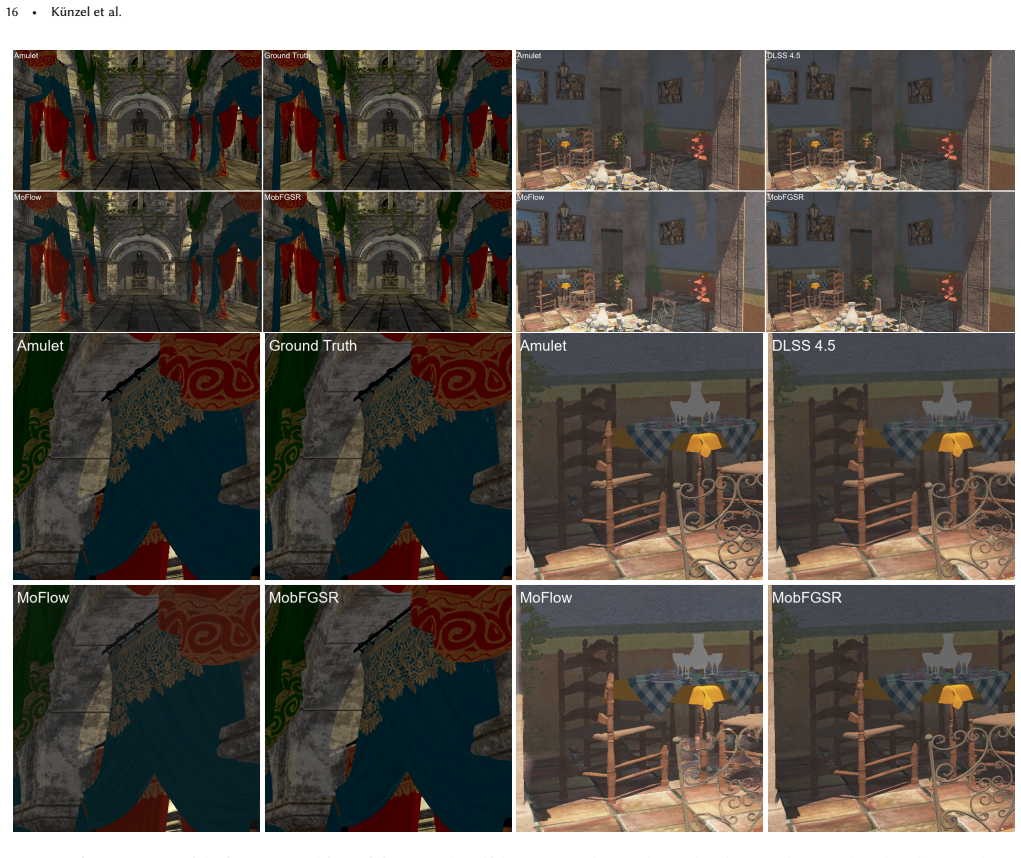
Summary. The paper presents Amulet, a real-time frame extrapolation system that replaces the conventional flat framebuffer with a sparse, tiled, layered cache organized into froxels. Visibility samples (depth and primitive ID) and shading are stored in the cache, and novel views are synthesized by ray-marching through the layers; disocclusions are filled from cached layers rather than by motion-vector warping. Dynamic scenes are handled through multiple object caches with warped view rays, and an adaptive shading scheduler assigns per-tile lifetimes based on gradient estimates to amortize shading cost. The method is evaluated on four scenes at Full HD and 4K against DLSS 4.5, MobFGSR, and MoFlow, reporting PSNR, SSIM, LPIPS, and FLIP for quality and GPU timings for performance. The central claim is that Amulet produces high-quality extrapolated frames without hallucination and without neural networks, at performance competitive with state-of-the-art frame generation methods.
Significance. If the claims hold, Amulet would be a significant contribution to real-time rendering: it offers a non-neural, low-latency alternative to neural frame generation, with explicit handling of disocclusions. The paper is strong in its detailed description of the layered cache structure, the multi-cache warping, and the gradient-based shading scheduler. The evaluation against independent ground truth and multiple external baselines, including interpolation methods that have access to future frames, is a notable strength. However, the central 'without hallucination' claim is conditional on the finite cache containing all potentially visible geometry, a condition that is never measured, and the headline performance claim of 250 Hz at 4K is not supported by the reported timings. The quality comparisons also lack error bars, which weakens the quantitative conclusions.
major comments (5)
- [Sections 4.3, 5, and 7.7]
- [Abstract and Section 7.2, Table 3]
- [Tables 5 and 8]
- [Section 6.1, Section 7.6, and Figure 12 caption]
- [Section 7.7 and Section 7.1]
minor comments (6)
- [Section 7.4, Baselines]
- [Table 8 caption]
- [Section 6.3]
- [Section 6.2]
- [Figure 12 caption]
- [General]
Circularity Check
No significant circularity: the paper's quality claims are measured against independent ground truth and external baselines, and its self-cited components are used as implementation substrates rather than as proofs of the central result.
full rationale
Amulet's central claim is that a sparse layered cache can extrapolate multiple frames with accurate disocclusion filling, and this claim is verified empirically: Section 7.4 compares against ground-truth deferred rendering and external baselines (DLSS 4.5, MobFGSR, MoFlow) using PSNR, SSIM, LPIPS, and FLIP, with results reported in Tables 5-7. The main self-cited dependency, the disocclusion buffer of Künzel et al. [2025], is explicitly described as a substrate that Amulet extends: 'Our cache implementation extends the disocclusion buffer introduced by Künzel et al. [2025] with shading data for frame synthesis, multi-object warping and adaptive on-the-fly reshading' (Section 7). The paper does not derive Amulet's quality from that citation; it evaluates the extended system on prerecorded camera paths. The gradient-based scheduler is likewise an algorithmic component whose threshold is hand-set rather than fitted to the reported error metrics; its behavior is tested in dedicated experiments (Section 7.6, Figure 15), not equated to the target results by construction. The 'without hallucination' claim is conditional on the finite 64-layer, 25%-enlarged cache containing all surfaces that become visible during extrapolation, but this is a stated limitation for non-rigid motion (Section 7.7) and a correctness risk for large rigid motion, not a circularity: the paper never defines 'hallucination' in terms of the cache contents, nor does any equation reduce the prediction to the cache's construction. Self-citations to Künzel et al. [2025], Mueller et al. [2021], and Voglreiter et al. [2023] are context and design-choice references and do not carry the burden of the central empirical claim. No fitted parameter is renamed as a prediction, and no uniqueness theorem is imported from prior work to force the design. Overall, the derivation chain is self-contained against independently rendered ground truth and external competitors, so circularity is minimal.
Assumptions & free parameters
free parameters (6)
- Layer count N =
64
- Tile size m =
16x16 (Full HD), 32x32 (4K)
- Amortization period delta_t =
4 frames
- Gradient threshold =
not reported
- Gradient evaluation resolution =
16x reduced resolution
- Transparency sample cap P =
not reported
assumptions (4)
- domain assumption Dynamic objects can be represented with rigid-body transforms
- domain assumption 64 depth layers suffice to represent all relevant scene geometry
- ad hoc to paper Shading changes are predictable from coarse finite differences
- domain assumption Weighted blended order-independent transparency approximates ground-truth blending
Cite this review
Pith. "Pith review of Amulet: Frame Extrapolation Through Sparse Layered Scene Representation and Adaptive Shading." pith.science (2026). https://pith.science/paper/5RTPZ5CY
@misc{pith2026260810423,
  author       = {Pith},
  title        = {Pith review of: Amulet: Frame Extrapolation Through Sparse Layered Scene Representation and Adaptive Shading},
  year         = {2026},
  howpublished = {\url{https://pith.science/paper/5RTPZ5CY}},
  note         = {Machine review of arXiv:2608.10423}
}
read the original abstract
We introduce Amulet, a rendering method that transforms a scene into a sparse, tiled and layered intermediate scene representation (cache) for high-frequency frame extrapolation. In contrast to reprojection-based techniques, Amulet explicitly rasterizes and stores potentially visible geometry in its layered image-space cache, allowing accurate shading and inpainting of newly disoccluded regions without hallucination. Our key contribution is a cache that is predictively filled with shading information for future views, amortized over multiple current frames. Novel views are synthesized by hierarchically traversing the cache front to back and refining stale or missing shading on the fly. Using a predictive, gradient-based scheduler that assigns lifetimes for each tile, we enable adaptive shading updates under motion and dynamic lighting. Amulet decouples the rasterization and shading rate from the refresh rate of the display. In many scenarios, our cache can use a single shaded frame to synthesize multiple extrapolated frames with only a few localized updates. In a typical application, we extrapolate a 60 Hz shading rate to a 240 Hz display. Amulet achieves up to 250 Hz at 4K resolution and is competitive with state-of-the-art frame generation methods, including DLSS and neural-flow approaches, in multiple metrics. Amulet explores the design space of sparse layered image-space representation. It enables accurate, non-neural multi frame extrapolation with explicit handling of disocclusions. Our findings show that Amulet can extrapolate many more frames than contemporary methods with high quality, rivaling latency-bound frame interpolation methods with similar quality in many scenes.
Figures


Figures from the paper (11 more)



Reference graph
Works this paper leans on
-
[1]
Mark and Leonard McMillan and Gary Bishop , title =
William R. Mark and Leonard McMillan and Gary Bishop , title =. 1997 , numpages =. doi:10.1145/253284.253292 , booktitle =
-
[2]
ExtraSS: A Framework for Joint Spatial Super Sampling and Frame Extrapolation , year =
Wu, Songyin and Kim, Sungye and Zeng, Zheng and Vembar, Deepak and Jha, Sangeeta and Kaplanyan, Anton and Yan, Ling-Qi , booktitle =. ExtraSS: A Framework for Joint Spatial Super Sampling and Frame Extrapolation , year =. doi:10.1145/3610548.3618224 , isbn =
-
[3]
Shade, Jonathan and Gortler, Steven and He, Li-wei and Szeliski, Richard , booktitle =. Layered Depth Images , year =. doi:10.1145/280814.280882 , isbn =
-
[4]
Efficient and Robust From-Point Visibility , year=
Popescu, Voicu and Sacks, Elisha and Cui, Jian and Ashok, Rohan , journal=. Efficient and Robust From-Point Visibility , year=. doi:10.1109/TVCG.2023.3291138 , numpages =
-
[5]
Jaroslav Kravec and Martin K. The Visual Computer , title =. 2023 , number =
work page 2023
-
[6]
Computer Graphics Forum , title =
Hladky, Jozef and Seidel, Hans-Peter and Steinberger, Markus , year =. Computer Graphics Forum , title =. doi:10.1111/cgf.142648 , pages =
-
[7]
and Neff, Thomas and Voglreiter, Philip and Steinberger, Markus and Schmalstieg, Dieter , journal =
Mueller, Joerg H. and Neff, Thomas and Voglreiter, Philip and Steinberger, Markus and Schmalstieg, Dieter , journal =. Temporally Adaptive Shading Reuse for Real-Time Rendering and Virtual Reality , year =. doi:10.1145/3446790 , numpages =
- [8]
Show all 60 references
-
[9]
Eurographics Symposium on Rendering , title =
Baker, Daniel and Jarzynski, Mark , year =. Eurographics Symposium on Rendering , title =
-
[10]
and Yang, Jason C
Hillesland, Karl E. and Yang, Jason C. , pages=. Texel. doi:10.2312/egsh.20161018 , journal =
-
[11]
2002 , booktitle =
Kraus, Martin and Ertl, Thomas , title =. 2002 , booktitle =
2002
-
[12]
Schaufler, Gernot , booktitle =. Per-. 1998 , editor =
1998
-
[13]
and Nehab, Diego , booktitle =
Sitthi-amorn, Pitchaya and Lawrence, Jason and Yang, Lei and Sander, Pedro V. and Nehab, Diego , booktitle =. 2008 , editor =. doi:10.2312/EGGH/EGGH08/095-101 , isbn =
2008 doi
-
[14]
and Lefohn, Aaron and Comba, Jo\
Bavoil, Louis and Callahan, Steven P. and Lefohn, Aaron and Comba, Jo\. Proceedings of the 2007 Symposium on Interactive 3D Graphics and Games , title =. 2007 , address =. doi:10.1145/1230100.1230117 , isbn =
2007
-
[15]
Proceedings of the International Conference in Central Europe on Computer Graphics, Visualization and Computer Vision , pages =
Diepstraten, Joachim and Weiskopf, Daniel and Kraus, Martin and Ertl, Thomas , title =. Proceedings of the International Conference in Central Europe on Computer Graphics, Visualization and Computer Vision , pages =
-
[16]
Computer Graphics Forum , volume =
Schaufler, Gernot and Stürzlinger, Wolfgang , title =. Computer Graphics Forum , volume =. doi:https://doi.org/10.1111/1467-8659.1530227 , year =
-
[17]
Proceedings of SIGGRAPH , title =
Briedis, Karlis Martins and Djelouah, Abdelaziz and Ortiz, Rapha\". Proceedings of SIGGRAPH , title =. 2023 , address =. doi:10.1145/3588432.3591497 , isbn =
2023
-
[18]
ExtraNet: Real-time Extrapolated Rendering for Low-latency Temporal Supersampling , year =
Guo, Jie and Fu, Xihao and Lin, Liqiang and Ma, Hengjun and Guo, Yanwen and Liu, Shiqiu and Yan, Ling-Qi , journal =. ExtraNet: Real-time Extrapolated Rendering for Low-latency Temporal Supersampling , year =. doi:10.1145/3478513.3480531 , numpages =
-
[19]
Mob-FGSR: Frame Generation and Super Resolution for Mobile Real-Time Rendering , year =
Yang, Sipeng and Zhu, Qingchuan and Zhuge, Junhao and Qiu, Qiang and Li, Chen and Yan, Yuzhong and Xu, Huihui and Yan, Ling-Qi and Jin, Xiaogang , booktitle =. Mob-FGSR: Frame Generation and Super Resolution for Mobile Real-Time Rendering , year =. doi:10.1145/3641519.3657424 , isbn =
-
[20]
, booktitle =
Torborg, Jay and Kajiya, James T. , booktitle =. Talisman: Commodity Realtime 3D Graphics for the PC , year =. doi:10.1145/237170.237274 , isbn =
-
[21]
and Steinberger, Markus and Schmalstieg, Dieter , journal =
Neff, Thomas and Mueller, Joerg H. and Steinberger, Markus and Schmalstieg, Dieter , journal =. Meshlets and How to Shade Them: A Study on Texture-Space Shading , year =. doi:https://doi.org/10.1111/cgf.14474 , selected =
-
[22]
and Voglreiter, Philip and Dokter, Mark and Neff, Thomas and Makar, Mina and Steinberger, Markus and Schmalstieg, Dieter , journal =
Mueller, Joerg H. and Voglreiter, Philip and Dokter, Mark and Neff, Thomas and Makar, Mina and Steinberger, Markus and Schmalstieg, Dieter , journal =. Shading Atlas Streaming , year =. doi:10.1145/3272127.3275087 , numpages =
-
[23]
Burns and Warren A
Christopher A. Burns and Warren A. Hunt , journal =. The Visibility Buffer: A Cache-Friendly Approach to Deferred Shading , year =
-
[24]
and Winter, Martin and Steinberger, Markus , journal =
Tatzgern, Wolfgang and Weinrauch, Alexander and Stadlbauer, Pascal and Mueller, Joerg H. and Winter, Martin and Steinberger, Markus , journal =. Radiance Caching with On-Surface Caches for Real-Time Global Illumination , year =. doi:10.1145/3675382 , numpages =
-
[25]
and Moore, Jeremy and Gross, Markus , year =
Bowles, Huw and Mitchell, Kenny and Sumner, Robert W. and Moore, Jeremy and Gross, Markus , year =. Iterative Image Warping , volume =. doi:10.1111/j.1467-8659.2012.03002.x , journal =
2012
-
[26]
Spatio-Temporal Upsampling on the GPU , year =
Herzog, Robert and Eisemann, Elmar and Myszkowski, Karol and Seidel, Hans-Peter , booktitle =. Spatio-Temporal Upsampling on the GPU , year =. doi:10.1145/1730804.1730819 , isbn =
-
[27]
2018 , isbn =
Marrs, Adam and Spjut, Josef and Gruen, Holger and Sathe, Rahul and McGuire, Morgan , title =. 2018 , isbn =. doi:10.1145/3231578.3231579 , booktitle =
2018
-
[28]
2016 , publisher =
Reinert, Bernhard and Kopf, Johannes and Ritschel, Tobias and Cuervo, Eduardo and Chu, David and Seidel, Hans-Peter , title =. 2016 , publisher =
2016
-
[29]
Computer Graphics Forum , year =
Tessellated Shading Streaming , author=. Computer Graphics Forum , year =. doi:10.1111/cgf.13780 , number =
-
[30]
Proceedings of Computer Graphics and Interactive Techniques , title =
Andersson, Pontus and Nilsson, Jim and Akenine-M\". Proceedings of Computer Graphics and Interactive Techniques , title =. 2020 , number =. doi:10.1145/3406183 , numpages =
2020 doi
-
[31]
GFFE: G-buffer Free Frame Extrapolation for Low-latency Real-time Rendering , year =
Wu, Songyin and Vembar, Deepak and Sochenov, Anton and Panneer, Selvakumar and Kim, Sungye and Kaplanyan, Anton and Yan, Ling-Qi , journal =. GFFE: G-buffer Free Frame Extrapolation for Low-latency Real-time Rendering , year =. doi:10.1145/3687923 , issue_date =
-
[32]
ACM Transactions on Graphics , title =
Ragan-Kelley, Jonathan and Lehtinen, Jaakko and Chen, Jiawen and Doggett, Michael and Durand, Fr\'. ACM Transactions on Graphics , title =. 2011 , issn =. doi:10.1145/1966394.1966396 , issue_date =
2011
-
[33]
Potentially Visible Hidden-Volume Rendering for Multi-View Warping , year =
Kim, Janghun and Lee, Sungkil , journal =. Potentially Visible Hidden-Volume Rendering for Multi-View Warping , year =. doi:10.1145/3592108 , url =
-
[34]
Trim Regions for Online Computation of From-Region Potentially Visible Sets , year =
Voglreiter, Philip and Kerbl, Bernhard and Weinrauch, Alexander and Mueller, Joerg Hermann and Neff, Thomas and Steinberger, Markus and Schmalstieg, Dieter , journal =. Trim Regions for Online Computation of From-Region Potentially Visible Sets , year =. doi:10.1145/3592434 , url =
-
[35]
The Camera Offset Space: Real-Time Potentially Visible Set Computations for Streaming Rendering , year =
Hladky, Jozef and Seidel, Hans-Peter and Steinberger, Markus , journal =. The Camera Offset Space: Real-Time Potentially Visible Set Computations for Streaming Rendering , year =. doi:10.1145/3355089.3356530 , url =
-
[36]
and Ortiz-Cayon, Rodrigo and Kalantari, Nima Khademi and Ramamoorthi, Ravi and Ng, Ren and Kar, Abhishek , journal =
Mildenhall, Ben and Srinivasan, Pratul P. and Ortiz-Cayon, Rodrigo and Kalantari, Nima Khademi and Ramamoorthi, Ravi and Ng, Ren and Kar, Abhishek , journal =. Local Light Field Fusion: Practical View Synthesis with Prescriptive Sampling Guidelines , year =. doi:10.1145/330634...
-
[37]
Clarberg, Petrik and Munkberg, Jacob , journal =. Deep. 2014 , number =. doi:10.1145/2661229.2661245 , publisher =
2014
-
[38]
, journal =
Tole, Parag and Pellacini, Fabio and Walter, Bruce and Greenberg, Donald P. , journal =. Interactive Global Illumination in Dynamic Scenes , year =. doi:10.1145/566654.566613 , publisher =
-
[39]
Proceedings of SIGGRAPH Asia , publisher =
Potentially Visible Set Generation with the Disocclusion Buffer , author=. Proceedings of SIGGRAPH Asia , publisher =. 2025 , series =. doi:10.1145/3757377.3763981 , articleno =
2025
-
[40]
Game Developers Conference , year=
FidelityFX Super Resolution 2.0 , author=. Game Developers Conference , year=
-
[41]
Journal of Computer Graphics Techniques , volume =
Weighted Blended Order-Independent Transparency , author=. Journal of Computer Graphics Techniques , volume =
-
[42]
Proceedings of VRST , publisher =
Impostor-based Rendering Acceleration for Virtual, Augmented, and Mixed Reality , author=. Proceedings of VRST , publisher =. doi:10.1145/3489849.3489865 , articleno =
-
[43]
Computer Graphics Forum , volume=
Reshadable Impostors with Level-of-Detail for Real-Time Distant Objects Rendering , author=. Computer Graphics Forum , volume=. 2025 , doi=
2025
-
[44]
and Lawrence, Jason and Nehab, Diego and Hoppe, Hugues and Wilkins, Clara L
Yang, Lei and Tse, Yu-Chiu and Sander, Pedro V. and Lawrence, Jason and Nehab, Diego and Hoppe, Hugues and Wilkins, Clara L. , title =. 2011 , volume =. doi:10.1145/2070781.2024184 , journal =
2011
-
[45]
ACM Transactions on Graphics , volume=
MoFlow: Motion-Guided Flows for Recurrent Rendered Frame Prediction , author=. ACM Transactions on Graphics , volume=. 2025 , publisher=. doi:10.1145/3730400 , articleno =
2025 doi
-
[46]
Proceedings of I3D , pages=
Decoupled Deferred Shading for Hardware Rasterization , author=. Proceedings of I3D , pages=. doi:10.1145/2159616.2159640 , year=
-
[47]
2018 , pages=
The Unreasonable Effectiveness of Deep Features as a Perceptual Metric , author=. 2018 , pages=. doi:10.1109/CVPR.2018.00068 , booktitle=
2018
-
[48]
IEEE Transactions on Image Processing , volume=
Image quality assessment: from error visibility to structural similarity , author=. IEEE Transactions on Image Processing , volume=. doi:10.1109/TIP.2003.819861 , year=
2003
-
[49]
Kallweit, Simon and Clarberg, Petrik and Kolb, Craig and Davidovi. The. 2022 , month =
2022
-
[50]
2018 , url=
Ben Lang , title=. 2018 , url=
2018
-
[51]
ACM Transactions on Graphics , volume =
Wu, Zhizhen and Cao, Zhe and Yuan, Yazhen and Yuan, Zhilong and Wang, Rui and Huo, Yuchi , title =. ACM Transactions on Graphics , volume =. 2025 , doi =
2025
-
[52]
Proceedings of SIGGRAPH Asia , numpages =
Zuo, Chenyu and Yuan, Yazhen and Wu, Zhizhen and Liu, Zhijian and Lan, Jingzhen and Fu, Ming and Huo, Yuchi and Wang, Rui , title =. Proceedings of SIGGRAPH Asia , numpages =. 2025 , doi =
2025
-
[53]
Computer Graphics Forum , volume =
Vining, Nicholas and Majercik, Alexander and Gu, Floria and Takikawa, Towaki and Trusty, Ty and Lalonde, Paul and McGuire, Morgan and Sheffer, Alla , title =. Computer Graphics Forum , volume =. doi:https://doi.org/10.1111/cgf.70010 , year =
-
[54]
Learning from
Evans, Alex , month = aug, year =. Learning from
-
[55]
2022 , volume =
Hladky, Jozef and Stengel, Michael and Vining, Nicholas and Kerbl, Bernhard and Seidel, Hans-Peter and Steinberger, Markus , title =. 2022 , volume =. doi:10.1145/3550454.3555524 , journal =
2022
-
[56]
2025 , volume =
Lu, Edward and Rowe, Anthony , title =. 2025 , volume =. doi:10.1145/3731213 , journal =
2025 doi
-
[57]
Scher , title =
Bishop, Gary and Fuchs, Henry and McMillan, Leonard and Zagier, Ellen J. Scher , title =. 1994 , isbn =. doi:10.1145/192161.192195 , booktitle =
1994
-
[58]
2018 , publisher =
Franke, Linus and Hofmann, Nikolai and Stamminger, Marc and Selgrad, Kai , title =. 2018 , publisher =. doi:10.1145/3203200 , journal =
2018 doi
-
[59]
Computer Graphics Forum , volume =
Zeng, Zheng and Xu, Zilin and Wang, Lu and Wu, Lifan and Yan, Ling-Qi , title =. Computer Graphics Forum , volume =. doi:10.1111/cgf.14882 , year =
-
[60]
2025 , volume =
Yang, Sipeng and Ji, Jiayu and Zhuge, Junhao and Zhao, Jinzhe and Qiu, Qiang and Li, Chen and Yan, Yuzhong and Wang, Kerong and Yan, Lingqi and Jin, Xiaogang , title =. 2025 , volume =. doi:10.1145/3763348 , journal =
2025 doi
Reviewed August 15, 2026 · model on record in the stance chip above.
Discussion (0). Continue with ORCID to comment.