Non-LTE analysis of K I in late-type stars
Pith reviewed 2026-05-25 19:47 UTC · model grok-4.3
The pith
Non-LTE corrections for the 7698 Å potassium line reduce abundance scatter and align low-metallicity trends with galactic chemical evolution models that include rotating massive star yields.
A machine-rendered reading of the paper's core claim, the machinery that carries it, and where it could break.
Core claim
A model atom for KI that incorporates inelastic electron collision cross-sections from convergent close-coupling and B-Spline R-matrix calculations plus hydrogen collisions from the two-electron model yields large negative non-LTE corrections for the 7698 Å line; when these corrections are applied across a literature sample the scatter decreases and the low-metallicity [K/Fe] trend agrees with galactic chemical evolution models that adopt yields from rotating massive stars.
What carries the argument
A 39-level KI model atom with updated inelastic e+K and H+K collision rates that is used to compute a grid of non-LTE abundance corrections over 4000-8000 K, 0.5-5.0 in log g, and -5 to +0.5 in [Fe/H].
If this is right
- Literature potassium abundances change their overall trend with metallicity once non-LTE corrections are applied.
- At [Fe/H] ≲ -1 the non-LTE abundances match the galactic chemical evolution model that uses yields from rotating massive stars.
- Scatter among solar-twin potassium abundances decreases after the non-LTE corrections are applied.
- Three-dimensional effects are required for the correct shape of the resonance line but produce a line strength similar to one-dimensional non-LTE.
Where Pith is reading between the lines
- The same collision-rate methodology could be applied to other alkali resonance lines to test whether non-LTE effects resolve similar abundance discrepancies.
- Improved potassium constraints at low metallicity would tighten the allowed range of nucleosynthetic yields from massive stars in chemical evolution calculations.
- Line-by-line differential techniques in solar twins still leave systematic modeling errors that non-LTE calculations can reduce further.
Load-bearing premise
The inelastic electron and hydrogen collision rates are accurate enough that the resulting non-LTE level populations and abundance corrections for the 7698 Å line are reliable.
What would settle it
An independent calculation or measurement that shows the dominant collision rates for the 4p-4s transition differ by more than a factor of two from the values adopted in the model atom.
Figures




read the original abstract
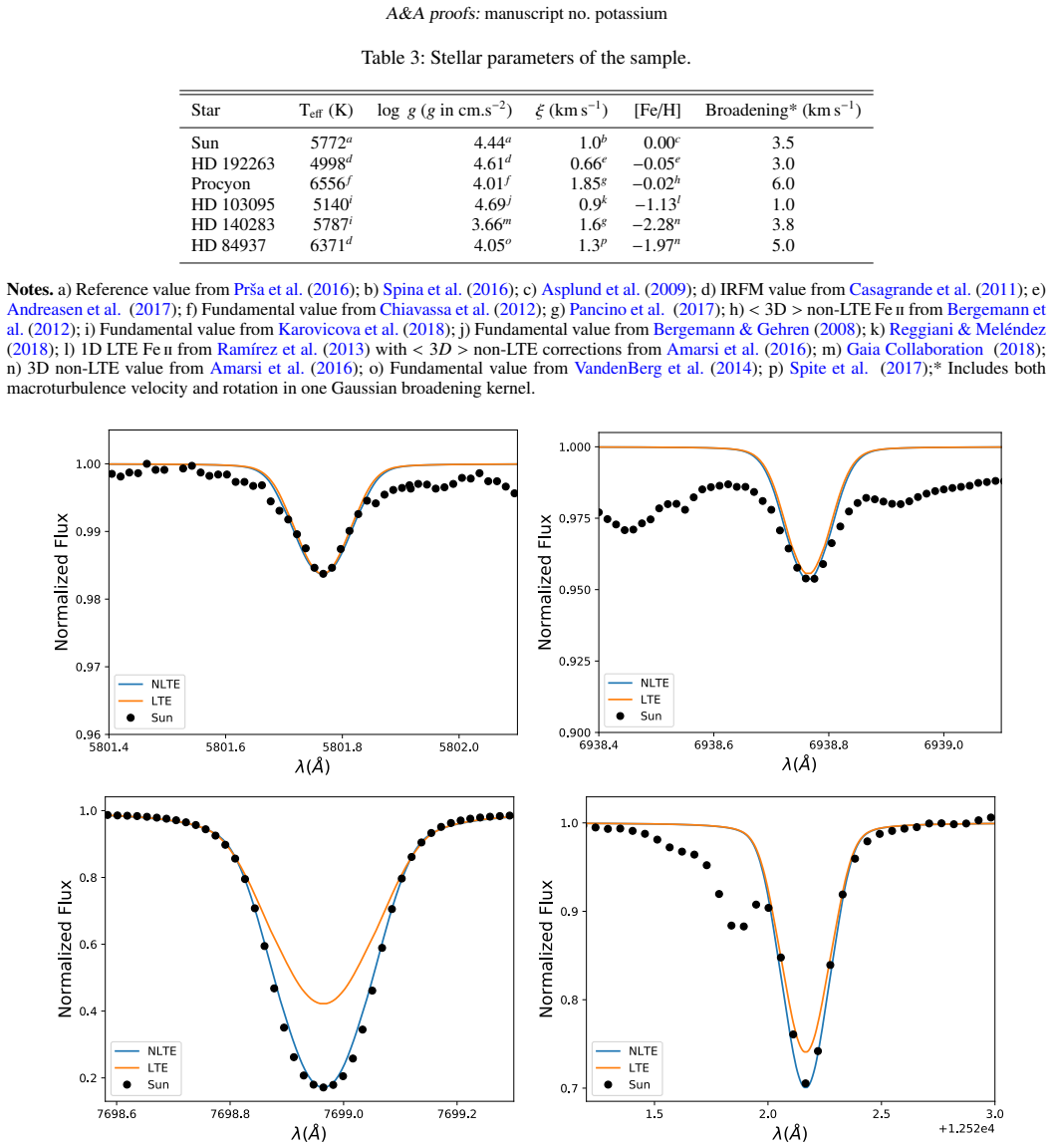
Older GCE models predict [K/Fe] ratios as much as 1 dex lower than those inferred from stellar observations. Abundances of potassium are mainly based on analyses of the 7698 $\AA$ resonance line, and the discrepancy between models and observations is in part caused by the LTE assumption. We study the statistical equilibrium of KI, focusing on the non-LTE effects on the $7698 \ \AA$ line. We aim to determine how non-LTE abundances of K can improve the analysis of its chemical evolution, and help to constrain the yields of models. We construct a model atom that employs the most up-to-date data. In particular, we calculate and present inelastic e+K collisional excitation cross-sections from the convergent close-coupling and the $B$-Spline $R$-matrix methods, and H+K collisions from the two-electron model. We constructed a fine grid of non-LTE abundance corrections that span $4000<\teff / \rm{K}<8000$, $0.50<\lgg<5.00$, $-5.00<\feh<+0.50$, and applied the corrections to abundances from the literature. In concordance with previous studies, we find severe non-LTE effects in the $7698 \ \AA$ line, which is stronger in non-LTE with abundance corrections that can reach $\sim-0.7\,\dex$. We explore the effects of atmospheric inhomogeneity by computing a full 3D non-LTE stellar spectrum of KI for a test star. We find that 3D is necessary to predict a correct shape of the resonance 7698 $\AA$ line, but the line strength is similar to that found in 1D non-LTE. Our non-LTE abundance corrections reduce the scatter and change the cosmic trends of literature K abundances. In the regime [Fe/H]$\lesssim-1.0$ the non-LTE abundances show a good agreement with the GCE model with yields from rotating massive stars. The reduced scatter of the non-LTE corrected abundances of a sample of solar twins shows that line-by-line differential analysis techniques cannot fully compensate for systematic modelling errors.
Editorial analysis
A structured set of objections, weighed in public.
Referee Report
Summary. The manuscript performs a non-LTE analysis of the K I 7698 Å resonance line in late-type stars. It builds a model atom using newly computed inelastic electron collision rates (via convergent close-coupling and B-spline R-matrix methods) and hydrogen collision rates (via the two-electron model). A grid of abundance corrections spanning 4000 < Teff < 8000 K, 0.5 < log g < 5.0, -5.0 < [Fe/H] < +0.5 is derived and applied to literature abundances. Non-LTE effects strengthen the line with corrections reaching -0.7 dex; the corrected abundances show reduced scatter and improved agreement with GCE models incorporating yields from rotating massive stars at [Fe/H] ≲ -1. A 3D non-LTE test for one star indicates that line strength is comparable to 1D non-LTE while the profile requires 3D treatment.
Significance. If the new collision rates are reliable, the work supplies practical non-LTE corrections that can refine K abundance trends and help reconcile stellar data with GCE predictions. Explicit computation of rates with modern methods (CCC, B-spline R-matrix) and the 3D non-LTE spectrum calculation are clear strengths that support the 1D grid results for equivalent width. The demonstration that differential LTE analysis cannot fully remove systematic errors for this line is a useful cautionary result.
major comments (1)
- [Model atom construction] Model atom construction (abstract and methods description): The inelastic e- and H collision rates computed with CCC, B-spline R-matrix, and two-electron model methods are adopted as the basis for the statistical equilibrium solution, yet no sensitivity study, comparison to independent rate calculations, or external benchmark is reported. Because H I collisions dominate the level populations for the 7698 Å line at low metallicity, any systematic error in these rates propagates directly into the derived corrections (up to -0.7 dex) and the claimed agreement with rotating-star GCE models at [Fe/H] ≲ -1.0.
minor comments (2)
- [Abstract] The abstract states that corrections reach ~ -0.7 dex but does not identify the specific combination of Teff, log g, and [Fe/H] at which the maximum occurs; adding this information would aid users of the grid.
- [3D test] The 3D non-LTE test is performed for only a single test star; a brief statement on the choice of atmospheric parameters or extension to additional models would clarify the generality of the finding that line strength is similar to 1D non-LTE.
Simulated Author's Rebuttal
We thank the referee for their thorough review and constructive feedback on our manuscript. We address the major comment point by point below and propose revisions to strengthen the paper.
read point-by-point responses
-
Referee: [Model atom construction] Model atom construction (abstract and methods description): The inelastic e- and H collision rates computed with CCC, B-spline R-matrix, and two-electron model methods are adopted as the basis for the statistical equilibrium solution, yet no sensitivity study, comparison to independent rate calculations, or external benchmark is reported. Because H I collisions dominate the level populations for the 7698 Å line at low metallicity, any systematic error in these rates propagates directly into the derived corrections (up to -0.7 dex) and the claimed agreement with rotating-star GCE models at [Fe/H] ≲ -1.0.
Authors: The referee correctly notes that no sensitivity study was presented. The electron collision rates are from first-principles CCC and B-spline R-matrix calculations, which represent the current state-of-the-art and have been benchmarked against experiments for other atoms. For hydrogen collisions, the two-electron model is the standard approach used in the field (e.g., for Na, Mg, etc.). Independent rate calculations for K+H do not yet exist for comparison. However, to address the concern about potential systematic errors, we will include a new subsection in the revised manuscript performing a sensitivity analysis by varying the H collision rates by factors of 2 and 10, demonstrating that the main conclusions remain robust. revision: yes
Circularity Check
No significant circularity; corrections derived from explicit statistical equilibrium solution
full rationale
The paper computes inelastic e- and H collision rates via convergent close-coupling, B-spline R-matrix, and two-electron model methods, inserts them into a model atom, and solves the statistical equilibrium equations plus radiative transfer to obtain non-LTE abundance corrections for the 7698 Å line. These corrections are applied directly to literature abundances; no parameter is fitted to the stellar K abundances themselves, no self-citation supplies a uniqueness theorem or ansatz that forces the result, and the reported reduction in scatter plus agreement with GCE models is an output of the calculation rather than a re-expression of the inputs. The derivation chain is therefore self-contained against external benchmarks.
Axiom & Free-Parameter Ledger
axioms (2)
- domain assumption Statistical equilibrium for the potassium level populations can be solved using the supplied radiative and collisional rates in 1D model atmospheres.
- domain assumption The 7698 Å line is the dominant diagnostic and its formation is adequately captured by the constructed model atom.
Forward citations
Cited by 1 Pith paper
-
The chemical make-up of the Sun: A 2020 vision
Revised solar photospheric abundances yield Z/X = 0.0187 with C, N, O at 8.46, 7.83, 8.69, preserving the solar modeling discrepancy and revealing a modest volatile-refractory offset from CI chondrites.
Reference graph
Works this paper leans on
-
[1]
W.\ 1976, Astrophysical Quantities, London: Athlone (3rd edition), 1976,
Allen, C. W.\ 1976, Astrophysical Quantities, London: Athlone (3rd edition), 1976,
work page 1976
-
[2]
M., Lind, K., Asplund, M., Barklem, P
Amarsi, A. M., Lind, K., Asplund, M., Barklem, P. S., & Collet, R.\ 2016, , 463, 1518
work page 2016
-
[3]
Amarsi, A. M., Barklem, P. S., Asplund, M., Collet, R., & Zatsarinny, O.\ 2018, , 616, A89
work page 2018
- [4]
-
[5]
Andrievsky, S. M., Spite, M., Korotin, S. A., et al.\ 2010, , 509, A88
work page 2010
- [6]
-
[7]
Asplund, M., Nordlund, ., Trampedach, R., Allende Prieto, C., & Stein, R. F.\ 2000, , 359, 729
work page 2000
-
[8]
J., Allende Prieto, C., & Kiselman, D.\ 2004, , 417, 751
Asplund, M., Grevesse, N., Sauval, A. J., Allende Prieto, C., & Kiselman, D.\ 2004, , 417, 751
work page 2004
-
[9]
Asplund, M., Lambert, D. L., Nissen, P. E., Primas, F., & Smith, V. V.\ 2006, , 644, 229
work page 2006
-
[10]
J., & Scott, P.\ 2009, , 47, 481
Asplund, M., Grevesse, N., Sauval, A. J., & Scott, P.\ 2009, , 47, 481
work page 2009
-
[11]
Badnell, N. R., Bautista, M. A., Butler, K., et al.\ 2005, , 360, 458
work page 2005
- [12]
- [13]
- [14]
-
[15]
Barklem, P. S., Osorio, Y., Fursa, D. V., et al.\ 2017, , 606, A11
work page 2017
-
[16]
L., Mel \'e ndez, J., et al.\ 2018, , 865, 68
Bedell, M., Bean, J. L., Mel \'e ndez, J., et al.\ 2018, , 865, 68
work page 2018
-
[17]
Bergemann, M., & Gehren, T.\ 2008, , 492, 823
work page 2008
-
[18]
Bergemann, M., Lind, K., Collet, R., Magic, Z., & Asplund, M.\ 2012, , 427, 27
work page 2012
-
[19]
Biemont, E., & Grevesse, N.\ 1973, , 27, 163
work page 1973
-
[20]
Bond, H. E., Nelan, E. P., VandenBerg, D. A., Schaefer, G. H., & Harmer, D.\ 2013, , 765, L12
work page 2013
- [21]
-
[22]
Bray, I, 1994, Phys. Rev. A 49, 1066
work page 1994
-
[23]
T.\ 1995, Computer Physics Communications, 85, 1
Bray, I., & Stelbovics, A. T.\ 1995, Computer Physics Communications, 85, 1
work page 1995
-
[24]
Bruls, J. H. M. J., Rutten, R. J., & Shchukina, N. G.\ 1992, , 265, 237
work page 1992
-
[25]
Casagrande, L., Sch \"o nrich, R., Asplund, M., et al.\ 2011, , 530, A138
work page 2011
-
[26]
Carlsson, M.\ 1986, Uppsala Astronomical Observatory Reports, 33,
work page 1986
-
[27]
Carlsson, M.\ 1992, Cool Stars, Stellar Systems, and the Sun, 26, 499
work page 1992
-
[28]
Cayrel, R., Depagne, E., Spite, M., et al.\ 2004, , 416, 1117
work page 2004
- [29]
-
[30]
Chiavassa, A., Bigot, L., Kervella, P., et al.\ 2012, , 540, A5
work page 2012
-
[31]
Clayton, D.\ 2007, Handbook of Isotopes in the Cosmos, by Donald Clayton, Cambridge, UK: Cambridge University Press, 2007
work page 2007
-
[32]
Dravins, D., Lindegren, L., & Nordlund, A.\ 1981, , 96, 345
work page 1981
-
[33]
Drawin, H. W. 1968, Zeitschrift fur Physik, 211, 404
work page 1968
-
[34]
Drawin, H. W. 1969, Zeitschrift für Physik, 225, 483
work page 1969
-
[35]
Gaia Collaboration 2018, VizieR Online Data Catalog, 1345,
work page 2018
-
[36]
F.\ 2005, ``The Observation and Analysis of Stellar Photospheres``, 3rd Edition, by D.F
Gray, D. F.\ 2005, ``The Observation and Analysis of Stellar Photospheres``, 3rd Edition, by D.F. Gray. ISBN 0521851866., UK: Cambridge University Press, 2005.'',
work page 2005
-
[37]
Gustafsson, B., Edvardsson, B., Eriksson, K., et al.\ 2008, , 486, 951
work page 2008
- [38]
-
[39]
Lind, K., Asplund, M., Barklem, P. S., & Belyaev, A. K.\ 2011, , 528, A103
work page 2011
- [40]
-
[41]
Kaulakys, B.\ 1991, Journal of Physics B Atomic Molecular Physics, 24, L127
work page 1991
-
[42]
Kobayashi, C., Umeda, H., Nomoto, K., Tominaga, N., & Ohkubo, T.\ 2006, , 653, 1145
work page 2006
-
[43]
Kobayashi, C., Izutani, N., Karakas, A. I., et al.\ 2011, , 739, L57
work page 2011
-
[44]
R., Nordlander, T., et al.\ 2018, , 475, L81
Karovicova, I., White, T. R., Nordlander, T., et al.\ 2018, , 475, L81
work page 2018
-
[45]
Lind, K., Melendez, J., Asplund, M., Collet, R., & Magic, Z.\ 2013, , 554, A96
work page 2013
-
[46]
Lodders, K., & Palme, H.\ 2009, Meteoritics and Planetary Science Supplement, 72, 5154
work page 2009
-
[47]
Magic, Z., Collet, R., & Asplund, M.\ 2013, EAS Publications Series, 63, 367
work page 2013
-
[48]
Marmolino, C., Roberti, G., & Severino, G.\ 1987, , 108, 21
work page 1987
-
[49]
Moutou, C., Vigan, A., Mesa, D., et al.\ 2017, , 602, A87
work page 2017
-
[50]
E., Asplund, M., Hill, V., & D'Odorico, S.\ 2000, , 357, L49
Nissen, P. E., Asplund, M., Hill, V., & D'Odorico, S.\ 2000, , 357, L49
work page 2000
-
[51]
NIST Atomic Spectra Database (ver
Kramida, A., Ralchenko, Yu., Reader, J., and NIST ASD Team (2018). NIST Atomic Spectra Database (ver. 5.6.1), . Available: https://physics.nist.gov/asd (2018, December 10). National Institute of Standards and Technology, Gaithersburg, MD. DOI: https://doi.org/10.18434/T4W30F
-
[52]
S., Lind, K., & Asplund, M.\ 2011, , 529, A31
Osorio, Y., Barklem, P. S., Lind, K., & Asplund, M.\ 2011, , 529, A31
work page 2011
-
[53]
Pancino, E., Lardo, C., Altavilla, G., et al.\ 2017, , 598, A5
work page 2017
-
[54]
Park, C.\ 1971, , 11, 7
work page 1971
- [55]
-
[56]
Prantzos, N., Abia, C.x, Limongi, M., Chieffi, A., & Cristallo, S.\ 2018, ,
work page 2018
-
[57]
Pr s a, A., Harmanec, P., Torres, G., et al.\ 2016, , 152, 41
work page 2016
-
[58]
Ram \' rez, I., Allende Prieto, C., & Lambert, D. L.\ 2013, , 764, 78
work page 2013
-
[59]
Reggiani, H., Mel \'e ndez, J., Kobayashi, C., Karakas, A., & Placco, V.\ 2017, , 608, A46
work page 2017
-
[60]
Reggiani, H., & Mel \'e ndez, J.\ 2018, , 475, 3502
work page 2018
-
[61]
Roederer, I. U., Preston, G. W., Thompson, I. B., et al.\ 2014, , 147, 136
work page 2014
-
[62]
I., Tosi, M., & Matteucci, F.\ 2010, , 522, A32
Romano, D., Karakas, A. I., Tosi, M., & Matteucci, F.\ 2010, , 522, A32
work page 2010
-
[63]
Sandage, A.\ 2000, , 112, 293
work page 2000
-
[64]
Sansonetti, J.E., J. Phys. Chem. Ref. Data 37 (7) (2008) 8 - 93
work page 2008
-
[65]
Schweinzer, J., Brandenburg, R., Bray, I., et al.\ 1999, Atomic Data and Nuclear Data Tables, 72, 239
work page 1999
-
[66]
Scott, P., Grevesse, N., Asplund, M., et al.\ 2015, , 573, A25
work page 2015
-
[67]
Seaton, M.\ 1996, The Observatory, 116, 177
work page 1996
-
[68]
Sitnova, T., Zhao, G., Mashonkina, L., et al. 2015, ApJ, 808, 148
work page 2015
-
[69]
V., Vargas-Ferro, O., Lambert, D
Smith, V. V., Vargas-Ferro, O., Lambert, D. L., & Olgin, J. G.\ 2001, , 121, 453
work page 2001
-
[70]
Sneden, C. A. 1973, Ph.D. Thesis, Univ. Texas
work page 1973
-
[71]
J., Kobayashi, C., et al.\ 2016, , 817, 53
Sneden, C., Cowan, J. J., Kobayashi, C., et al.\ 2016, , 817, 53
work page 2016
-
[72]
Spina, L., Mel \'e ndez, J., Karakas, A. I., et al.\ 2016, , 593, A125
work page 2016
-
[73]
Spite, M., Peterson, R. C., Gallagher, A. J., Barbuy, B., & Spite, F.\ 2017, , 600, A26
work page 2017
- [74]
-
[75]
Stockman, K. A.,Karaganov, V., Bray, I. , and Teubner, P. J. O., J. Phys. B: At. Mol. Opt. Phys. 31 , L867 (1998)
work page 1998
-
[76]
A., Karaganov, V., Bray, I., and Teubner, P
Stockman, K. A., Karaganov, V., Bray, I., and Teubner, P. J. O., J. Phys. B: At. Mol. Opt. Phys. 32 , 3003 (1999)
work page 1999
-
[77]
Stockman, K .A., Karaganov, V., Bray, I., and Teubner, P. J. O., J. Phys. B: At. Mol. Opt. Phys. 34 , 1105 (2001)
work page 2001
-
[78]
G., Ilyin I., Weber M., 2018, A&A, 612, A45
Strassmeier K. G., Ilyin I., Weber M., 2018, A&A, 612, A45
work page 2018
-
[79]
Sugar, J., & Corliss, C.\ 1985, Washington: American Chemical Society, 1985,
work page 1985
-
[80]
Takeda, Y., Kato, K.-I., Watanabe, Y., & Sadakane, K.\ 1996, , 48, 511
work page 1996
discussion (0)
Sign in with ORCID, Apple, or X to comment. Anyone can read and Pith papers without signing in.