Wavelet-based Edge Multiscale Finite Element Method for Helmholtz problems in perforated domains
Pith reviewed 2026-05-25 19:46 UTC · model grok-4.3
The pith
The wavelet-based edge multiscale finite element method achieves O(H) convergence for Helmholtz problems in perforated domains on regular coarse meshes.
A machine-rendered reading of the paper's core claim, the machinery that carries it, and where it could break.
Core claim
For Helmholtz problems in perforated domains, the WEMsFEM algorithm achieves an O(H) error bound on a regular coarse mesh of size H when the resolution assumption holds and the level parameter is large enough. The method is tested numerically in two dimensions on problems motivated by photonic crystals.
What carries the argument
The Wavelet-based Edge Multiscale Finite Element Method (WEMsFEM) adapted to Helmholtz problems in perforated domains, which builds multiscale basis functions from wavelets along coarse-mesh edges to capture fine-scale perforation effects.
If this is right
- Solutions can be computed accurately on meshes whose size H is independent of the wavenumber.
- The approach applies to wave propagation through materials containing periodic perforations.
- Two-dimensional numerical experiments confirm the predicted convergence rate on photonic-crystal-type geometries.
- The scheme remains efficient when the wavenumber becomes large.
Where Pith is reading between the lines
- Verifying or relaxing the resolution assumption would widen the range of perforated structures the method can treat.
- Similar wavelet constructions on edges could be tested for other time-harmonic wave equations in domains with holes.
- Adapting the edge-based basis functions to faces would be needed for a three-dimensional version.
Load-bearing premise
The resolution assumption holds and the original WEMsFEM framework extends directly to Helmholtz problems in perforated domains.
What would settle it
A numerical test on a perforated domain with a known exact solution in which the observed error fails to decrease proportionally to H once the level parameter is increased and the resolution assumption is satisfied.
Figures





read the original abstract
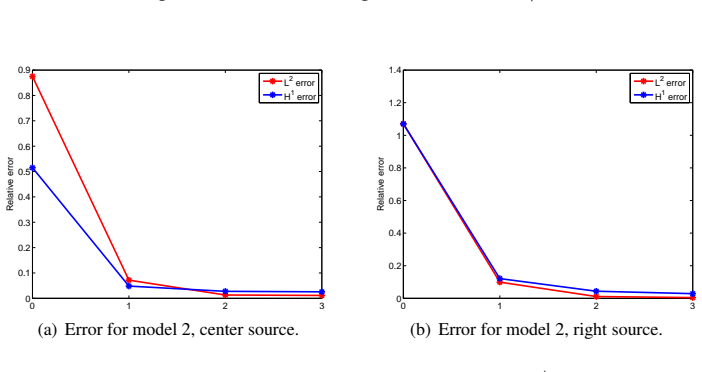
We introduce a new efficient algorithm for Helmholtz problems in perforated domains with the design of the scheme allowing for possibly large wavenumbers. Our method is based upon the Wavelet-based Edge Multiscale Finite Element Method (WEMsFEM) as proposed recently in [14]. For a regular coarse mesh with mesh size H, we establish O(H) convergence of this algorithm under the resolution assumption, and with the level parameter being sufficiently large. The performance of the algorithm is demonstrated by extensive 2-dimensional numerical tests including those motivated by photonic crystals.
Editorial analysis
A structured set of objections, weighed in public.
Referee Report
Summary. The paper introduces a Wavelet-based Edge Multiscale Finite Element Method (WEMsFEM) for Helmholtz problems in perforated domains, extending the framework of reference [14]. For a regular coarse mesh of size H the central claim is an O(H) convergence rate under an unspecified resolution assumption together with a sufficiently large level parameter. The method is intended to accommodate possibly large wavenumbers, and its performance is illustrated by 2-D numerical experiments including photonic-crystal examples.
Significance. If the O(H) rate can be shown to hold with constants independent of the wavenumber k, the result would be a useful contribution to multiscale methods for high-frequency wave propagation in complex perforated geometries. Such problems arise in photonics and acoustics, where standard FEMs suffer from pollution and fine-mesh requirements; a coarse-mesh method with controlled error would therefore be of practical interest.
major comments (2)
- [Abstract] Abstract: the O(H) convergence statement is conditioned on an unspecified 'resolution assumption.' Because the central claim rests on this assumption, its precise formulation (including any implicit dependence on the wavenumber k) must be stated explicitly; without it the reader cannot verify whether the estimate controls the pollution terms that appear in standard Helmholtz a-priori bounds.
- [Analysis section (convergence theorem)] Analysis section (convergence theorem): the direct transfer of the WEMsFEM construction and error analysis from the coercive elliptic setting of [14] to the indefinite Helmholtz operator must be justified. Any hidden constants that grow with k would invalidate the advertised O(H) rate on a fixed coarse mesh; the proof must therefore exhibit the k-dependence (or k-independence) of all constants.
minor comments (1)
- [Abstract] The phrase 'level parameter being sufficiently large' is used without a quantitative bound; a concrete condition on this parameter in terms of H and k would improve readability.
Simulated Author's Rebuttal
We thank the referee for the constructive comments on our manuscript. We address each major comment below and will revise the paper to improve clarity on the resolution assumption and the k-dependence in the analysis.
read point-by-point responses
-
Referee: [Abstract] Abstract: the O(H) convergence statement is conditioned on an unspecified 'resolution assumption.' Because the central claim rests on this assumption, its precise formulation (including any implicit dependence on the wavenumber k) must be stated explicitly; without it the reader cannot verify whether the estimate controls the pollution terms that appear in standard Helmholtz a-priori bounds.
Authors: We agree that the resolution assumption should be stated explicitly in the abstract. The assumption (detailed in Assumption 3.1) requires that the coarse mesh size H is sufficiently small relative to the wavelength 1/k to ensure the error bound holds without pollution dominating. In the revised version we will add a concise formulation of this assumption to the abstract, including its dependence on k. revision: yes
-
Referee: [Analysis section (convergence theorem)] Analysis section (convergence theorem): the direct transfer of the WEMsFEM construction and error analysis from the coercive elliptic setting of [14] to the indefinite Helmholtz operator must be justified. Any hidden constants that grow with k would invalidate the advertised O(H) rate on a fixed coarse mesh; the proof must therefore exhibit the k-dependence (or k-independence) of all constants.
Authors: We acknowledge that the transfer requires explicit justification. The proof of Theorem 4.1 adapts the arguments from [14] using a Gårding-type inequality for the Helmholtz operator and invokes the resolution assumption to absorb the indefinite terms and control pollution. Under this assumption the constants in the O(H) estimate are independent of k. To make this transparent we will add a remark in the analysis section that explicitly tracks the k-dependence and confirms independence when the resolution assumption holds. revision: yes
Circularity Check
No circularity; convergence established by analysis under explicit assumptions
full rationale
The paper extends the WEMsFEM method from reference [14] and proves an O(H) convergence rate for the Helmholtz problem under a stated resolution assumption plus sufficiently large level parameter. The derivation chain consists of standard multiscale finite-element analysis applied to the perforated-domain Helmholtz operator; no equation reduces by construction to a fitted parameter, self-referential definition, or load-bearing self-citation whose validity is presupposed rather than re-proved. The result remains falsifiable by direct numerical counter-example on the coarse mesh and is therefore self-contained.
Axiom & Free-Parameter Ledger
axioms (1)
- domain assumption Resolution assumption
Lean theorems connected to this paper
-
IndisputableMonolith/Cost/FunctionalEquation.leanwashburn_uniqueness_aczel unclear?
unclearRelation between the paper passage and the cited Recognition theorem.
We establish O(H) convergence of this algorithm under the resolution assumption, and with the level parameter being sufficiently large. Assumption 3.1: max C_poin^{1/2}(ωi) H k < 1.
-
IndisputableMonolith/Foundation/AbsoluteFloorClosure.leanabsolute_floor_iff_bare_distinguishability unclear?
unclearRelation between the paper passage and the cited Recognition theorem.
The sesquilinear form a satisfies boundedness and Gårding’s inequality; well-posedness via Cap(k).
What do these tags mean?
- matches
- The paper's claim is directly supported by a theorem in the formal canon.
- supports
- The theorem supports part of the paper's argument, but the paper may add assumptions or extra steps.
- extends
- The paper goes beyond the formal theorem; the theorem is a base layer rather than the whole result.
- uses
- The paper appears to rely on the theorem as machinery.
- contradicts
- The paper's claim conflicts with a theorem or certificate in the canon.
- unclear
- Pith found a possible connection, but the passage is too broad, indirect, or ambiguous to say the theorem truly supports the claim.
Reference graph
Works this paper leans on
- [1]
-
[2]
L. Berlyand and H. Owhadi. Flux norm approach to finite dimensional homogenization approximations with non-separated scales and high contrast. Arch. Ration. Mech. Anal., 198(2):677–721, 2010
work page 2010
-
[3]
D. N. Chigrin, S. Enoch, C. M. S. Torres, and G. Tayeb. Self-guiding in two-dimensional photonic crystals. Optics Express, 11:1203–1211, 2003
work page 2003
-
[4]
F. Collino and C. Tsogka. Application of the perfectly matched absorbing layer model to the linear elastodynamic problem in anisotropic heterogeneous media. Geophysics, 66(1):294–307, 2001
work page 2001
- [5]
-
[6]
R. V . Craster and S. Guenneau, editors. Acoustic Metamaterials. Springer-Verlag, 2012
work page 2012
-
[7]
R. V . Craster, J. Kaplunov, and A. V . Pichugin. High frequency homogenization for periodic media. Proc R Soc Lond A, 466:2341–2362, 2010
work page 2010
-
[8]
T. J. Cui, D. Smith, and R. Liu, editors. Metamaterials. Springer, Boston MA, 2010. 24
work page 2010
- [9]
-
[10]
W. E and B. Engquist. The heterogeneous multiscale methods. Commun. Math. Sci. , 1(1):87–132, 2003
work page 2003
-
[11]
Y . Efendiev, J. Galvis, and T. Hou. Generalized multiscale finite element methods. J. Comput. Phys., 251:116–135, 2013
work page 2013
-
[12]
Y . Efendiev, J. Galvis, and X.-H. Wu. Multiscale finite element methods for high-contrast problems using local spectral basis functions. J. Comput. Phys., 230(4):937–955, 2011
work page 2011
-
[13]
B. Engquist and L. Ying. Sweeping preconditioner for the helmholtz equation: hierarchical matrix representation. Communications on pure and applied mathematics, 64(5):697–735, 2011
work page 2011
- [14]
-
[15]
R. Hiptmair, A. Moiola, and I. Perugia. A survey of Trefftz methods for the Helmholtz equation. In Building bridges: connections and challenges in modern approaches to numerical partial differential equations, volume 114 of Lect. Notes Comput. Sci. Eng., pages 237–278. Springer, [Cham], 2016
work page 2016
-
[16]
T. Hou and X.-H. Wu. A multiscale finite element method for elliptic problems in composite materials and porous media. J. Comput. Phys., 134(1):169–189, 1997
work page 1997
- [17]
-
[18]
J. D. Joannopoulos, S. G. Johnson, R. D. Meade, and J. N. Winn. Photonic Crystals (2nd Edition) . Princeton University Press, Princeton, 2008
work page 2008
-
[19]
S. G. Johnson and J. D. Joannopoulos. Block-iterative frequency-domain methods for Maxwell’s equations in a planewave basis. Optics Express, 8:173–190, 2001
work page 2001
-
[20]
A. Lavrinenko, P. I. Borel, L. H. Frandsen, M. Thorhauge, A. Harpøth, M. Kristensen, T. Niemi, and H. M. H. Chong. Comprehensive FDTD modelling of photonic crystal waveguide components.Optics Express, 12:234–248, 1 2004
work page 2004
-
[21]
G. Li. On the convergence rates of GMsFEMs for heterogeneous elliptic problems without oversam- pling techniques. https://arxiv.org/abs/1802.08873, 2018
work page internal anchor Pith review Pith/arXiv arXiv 2018
-
[22]
G. Li, D. Peterseim, and M. Schedensack. Error analysis of a variational multiscale stabilization for convection-dominated diffusion equations in two dimensions. IMA J. Numer. Anal., 38(3):1229–1253, 2018
work page 2018
-
[23]
L. Lu, J. D. Joannopoulos, and M. Soljacic. Topological photonics. Nature Photonics, 8:821–829, 2014
work page 2014
- [24]
-
[25]
S. A. Maier, editor. World Scientific Handbook of Metamaterials and Plasmonics . World Scientific Series in Nanoscience and Nanotechnology, 2017
work page 2017
- [26]
-
[27]
A. M ˚alqvist and D. Peterseim. Localization of elliptic multiscale problems. Math. Comp. , 83(290):2583–2603, 2014
work page 2014
-
[28]
J. Melenk and I. Babu ˇska. The partition of unity finite element method: basic theory and applications. Comput. Methods Appl. Mech. Engrg., 139(1-4):289–314, 1996
work page 1996
-
[29]
J. M. Melenk. On generalized finite element methods. PhD thesis, 1995
work page 1995
-
[30]
J. M. Melenk, A. Parsania, and S. Sauter. General DG-methods for highly indefinite Helmholtz prob- lems. J. Sci. Comput., 57(3):536–581, 2013
work page 2013
-
[31]
J. M. Melenk and S. Sauter. Wavenumber explicit convergence analysis for Galerkin discretizations of the Helmholtz equation. SIAM J. Numer. Anal., 49(3):1210–1243, 2011
work page 2011
- [32]
-
[33]
D. Peterseim and B. Verf ¨urth. Computational high frequency scattering from high contrast heteroge- neous media. arXiv preprint arXiv:1902.09935, 2019
-
[34]
D. W. Prather, S. Shi, J. Murakowski, G. J. Schneider, A. Sharkawy, C. Chen, B. Miao, and R. Martin. Self-collimation in photonic crystal structures: a new paradigm for applications and device develop- ment. Journal of Physics D: Applied Physics, 40(9):2635, 2007
work page 2007
-
[35]
S. A. Ramakrishna and T. Grzegorczyk. Physics and Applications of Negative Refractive Index Mate- rials. CRC Press and SPIE Press, 2008
work page 2008
-
[36]
K. C. T. Strouboulis, I. Babu ˇska. The design and analysis of the generalized finite element method. Comput. Methods Appl. Mech. Engrg., 181:43–69, 2000
work page 2000
- [37]
discussion (0)
Sign in with ORCID, Apple, or X to comment. Anyone can read and Pith papers without signing in.