Traceability of Connected Domination Critical Graphs
Pith reviewed 2026-05-25 19:24 UTC · model grok-4.3
The pith
k-γ_c-critical graphs have a Hamiltonian path precisely when the number of cut-vertices is k-3 or k-2.
A machine-rendered reading of the paper's core claim, the machinery that carries it, and where it could break.
Core claim
For k ≥ 4 and 0 ≤ ζ ≤ k-2, every k-γ_c-critical graph with ζ cut-vertices has a Hamiltonian path if and only if k-3 ≤ ζ ≤ k-2. The argument uses the definition that the connected domination number equals k and drops upon addition of any missing edge, together with the known upper bound on cut-vertices.
What carries the argument
The k-γ_c-critical property, which requires connected domination number exactly k and that this number decreases for every added edge; this property bounds cut-vertices at most k-2 and supplies the structural control needed to decide the Hamiltonian path condition.
If this is right
- Every k-γ_c-critical graph with exactly k-2 cut-vertices contains a Hamiltonian path.
- Every k-γ_c-critical graph with exactly k-3 cut-vertices contains a Hamiltonian path.
- Every k-γ_c-critical graph with at most k-4 cut-vertices lacks a Hamiltonian path.
- The upper bound of k-2 cut-vertices is the value at which traceability is guaranteed at the high end of the range.
Where Pith is reading between the lines
- The same cut-vertex threshold might serve as a test for other path or cycle properties once the criticality definition is relaxed to nearby graph classes.
- Graphs meeting the ζ = k-3 or k-2 condition could be checked for stronger traceability features such as Hamiltonian cycles under mild extra assumptions.
- The result positions the cut-vertex count as a practical invariant for deciding long-path existence inside critical domination graphs.
Load-bearing premise
The critical property under edge addition is enough by itself to guarantee that a Hamiltonian path exists exactly when the number of cut-vertices meets or exceeds k-3.
What would settle it
A k-γ_c-critical graph for some k ≥ 4 with exactly k-4 cut-vertices that contains a Hamiltonian path would falsify the claim.
Figures


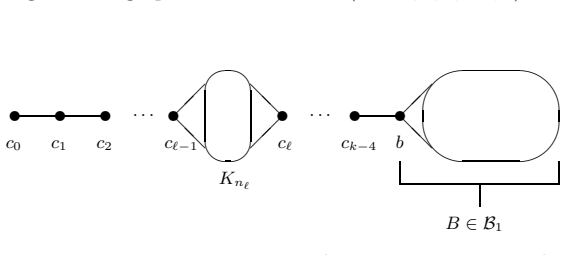


read the original abstract
A dominating set in a graph $G$ is a set $S$ of vertices of $G$ such that every vertex outside $S$ is adjacent to a vertex in $S$. A connected dominating set in $G$ is a dominating set $S$ such that the subgraph $G[S]$ induced by $S$ is connected. The connected domination number of $G$, $\gamma_c(G)$, is the minimum cardinality of a connected dominating set of $G$. A graph $G$ is said to be $k$-$\gamma_{c}$-critical if the connected domination number $\gamma_{c}(G)$ is equal to $k$ and $\gamma_{c}(G + uv) < k$ for every pair of non-adjacent vertices $u$ and $v$ of $G$. Let $\zeta$ be the number of cut-vertices of $G$. It is known that if $G$ is a $k$-$\gamma_{c}$-critical graph, then $G$ has at most $k - 2$ cut-vertices, that is $\zeta \le k - 2$. In this paper, for $k \ge 4$ and $0 \le \zeta \le k - 2$, we show that every $k$-$\gamma_{c}$-critical graph with $\zeta$ cut-vertices has a hamiltonian path if and only if $k - 3 \le \zeta \le k - 2$.
Editorial analysis
A structured set of objections, weighed in public.
Referee Report
Summary. The manuscript claims to prove that for k ≥ 4 and 0 ≤ ζ ≤ k-2, every k-γ_c-critical graph with ζ cut-vertices has a Hamiltonian path if and only if k-3 ≤ ζ ≤ k-2. This uses the known global bound that ζ ≤ k-2 for such graphs.
Significance. If correct, the result supplies a precise if-and-only-if threshold linking traceability directly to the number of cut-vertices in connected-domination-critical graphs, sharpening existing bounds in domination theory.
major comments (1)
- Abstract: the central if-and-only-if claim is stated precisely, but the full derivation is not supplied; without the argument steps it is impossible to confirm that the criticality condition alone forces a Hamiltonian path exactly on the interval [k-3, k-2] and rules it out for smaller ζ, for all k ≥ 4.
Simulated Author's Rebuttal
We thank the referee for their comments on our manuscript. We respond point-by-point to the major comment below.
read point-by-point responses
-
Referee: Abstract: the central if-and-only-if claim is stated precisely, but the full derivation is not supplied; without the argument steps it is impossible to confirm that the criticality condition alone forces a Hamiltonian path exactly on the interval [k-3, k-2] and rules it out for smaller ζ, for all k ≥ 4.
Authors: Abstracts are intended to state results concisely; full derivations appear in the body of the paper. Sections 3 and 4 contain the complete proofs: sufficiency that ζ ≥ k-3 implies a Hamiltonian path (via induction on block structure and criticality), and necessity via explicit constructions of non-traceable k-γ_c-critical graphs for each ζ < k-3 (k ≥ 4). These use the known global bound ζ ≤ k-2. The abstract therefore requires no change. revision: no
Circularity Check
No significant circularity; derivation is self-contained
full rationale
The abstract cites the bound ζ ≤ k-2 as a known external result and states the new if-and-only-if traceability theorem as a result proved in the paper for k ≥ 4. No equation, definition, or step reduces the central claim to a self-definition, a fitted parameter renamed as prediction, or a load-bearing self-citation chain. The criticality condition is used to derive the Hamiltonian-path property on the upper end of the interval, with the lower bound on ζ serving only as a premise rather than being smuggled in or redefined. This matches the default case of an independent mathematical proof building on prior facts without circular reduction.
Axiom & Free-Parameter Ledger
axioms (2)
- standard math Standard definitions of dominating set, connected dominating set, cut-vertex, and k-γ_c-critical graphs.
- domain assumption Every k-γ_c-critical graph satisfies ζ ≤ k-2.
Reference graph
Works this paper leans on
-
[1]
Ananchuen, On domination critical graphs with cut vertices ha ving connected domination number 3
N. Ananchuen, On domination critical graphs with cut vertices ha ving connected domination number 3. Int. Math. Forum 2 (2007), 3041–3052
work page 2007
-
[2]
N. Ananchuen, W. Ananchuen, and M. D. Plummer, Matching prop erties in connected domina- tion critical graphs. Discrete Math. 308 (2008), 1260–1267
work page 2008
-
[3]
D. Binkele-Raible and H. Fernau, A parameterized measure-and- conquer analysis for finding a k-leaf spanning tree in an undirected graph. Discrete Math. Theor. Comput. Sci. 16(1) (2014), 179–200
work page 2014
-
[4]
Y. Caro, D. B. West, and R. Yuster, Connected domination and s panning trees with many leaves. SIAM J. Discrete Math. 13(2) (2000), 202–211
work page 2000
-
[5]
X. G. Chen, L. Sun, and D. X. Ma, Connected domination critical g raphs. Applied Math. Letters 17 (2004), 503–507
work page 2004
-
[6]
Chv´ atal, Tough graphs and hamiltonian circuits
V. Chv´ atal, Tough graphs and hamiltonian circuits. Discrete Math. 5 (1973), 215–228
work page 1973
-
[7]
C. J. Colbourn and L. K. Stewart, Permutation graphs: connec ted domination and Steiner trees. Discrete Math. 86 (1990), 179–189
work page 1990
-
[8]
A. D’Atri and M. Moscarini, Distance-hereditary graphs, Steine r trees, and connected domina- tion. SIAM J. Comput. 17(3) (1988), 521–538
work page 1988
-
[9]
W. J. Desormeaux, T. W. Haynes, and M. A. Henning, Bounds on t he connected domination number of a graph. Discrete Appl. Math. 161(18) (2013), 2925–2931
work page 2013
-
[10]
W. Duckworth and B. Mans, Connected domination of regular gr aphs. Discrete Math. 309(8) (2009), 2305–2322
work page 2009
-
[11]
O. Favaron, F. Tian and Lei. Zhang, Independence and hamilton icity in 3-domination-critical graphs. J. Graph Theory 25 (1997), 173–184
work page 1997
-
[12]
M. Fellows, D. Lokshtanov, N. Misra, M. Mnich, F. Rosamond, an d S. Saurabh, The complexity ecology of parameters: an illustration using bounded max leaf numbe r. Theory Comput. Systems 45(4) (2009), 822–848
work page 2009
-
[13]
E. Flandrin, F. Tian, B. Wei and L. Zhang, Some properties of 3- domination-critical graphs. Discrete Math. 205 (1999), 65–76
work page 1999
-
[14]
G. Galbiati, F. Maffioli, and A. Morzenti, A short note on the appro ximability of the maximum leaves spanning tree problem. Inf. Process. Lett. 52(1) (1994), 45–49
work page 1994
-
[15]
T. W. Haynes, S. T. Hedetniemi and P. J. Slater, Fundamentals of Domination in Graphs , Marcel Dekker, Inc., New York, 1998
work page 1998
-
[16]
T. W. Haynes, S. T. Hedetniemi and P. J. Slater (eds), Domination in Graphs: Advanced Topics , Marcel Dekker, Inc. New York, 1998
work page 1998
-
[17]
M. A. Henning and A. Yeo, Total Domination in Graphs (Springer Monographs in Mathema tics)
-
[18]
ISBN: 978-1-4614-6524-9 (Print) 978-1-4614-6525-6 ( Online)
-
[19]
Kaemawichanurat, Connected domination critical graphs
P. Kaemawichanurat, Connected domination critical graphs. P h.D. Thesis. PhD supervisor: Louis Caccetta. Curtin University (2016). 25
work page 2016
-
[20]
Kaemawichanurat, Connected domination critical graphs wit h k − 3 cut vertices, submitted
P. Kaemawichanurat, Connected domination critical graphs wit h k − 3 cut vertices, submitted
-
[21]
P. Kaemawichanurat and N. Ananchuen, On 4- γc-critical graphs with cut vertices. Utilitas Math. 82 (2010), 253–268
work page 2010
-
[22]
P. Kaemawichanurat and N. Ananchuen, Connected domination critical graphs with cut vertices. To appear in Discuss. Math. Graph Theory
-
[23]
P. Kaemawichanurat and L. Caccetta, Hamiltonicity of dominatio n critical claw-free graphs. To appear in J. Combin. Comput. Combin. Math
-
[24]
P. Kaemawichanurat, L. Caccetta and W. Ananchuen, Hamilton icity of connected domination critical graphs. Ars Combin. 136 (2018), 127–151
work page 2018
-
[25]
P. Kaemawichanurat and T. Jiarasuksakun, Some results on th e independence number of con- nected domination critical graphs. AKCE Int. J. Graphs Comb. 15 ( 2018), no. 2, 190–196
work page 2018
- [26]
-
[27]
T. Liu, Z. Lu, and K. Xu, Tractable connected domination for re stricted bipartite graphs. J. Comb. Optim. 29(1) (2015), 247–256
work page 2015
-
[28]
E. Sampathkumar and H. B. Walikar, The connected domination n umber of a graph. J. Math. Phys. Sci. 13(6) (1979), 607–613
work page 1979
-
[29]
L. A. Sanchis, Maximum number of edges in connected graphs wit h a given domination number. Discrete Math. 8(1) (1991), 65–72
work page 1991
-
[30]
D. P. Sumner and P. Blitch, Domination critical graphs. J. COmbin. Theory B 34 (1983) 65–76
work page 1983
-
[31]
F. Tian, B. Wei and L. Zhang, Hamiltonicity in 3-domination critical graphs with α = δ + 2. Discrete Appl. Math. 92 (1999), 57–70
work page 1999
-
[32]
Wojcicka, Hamiltonian properties of domination critical graph s
E. Wojcicka, Hamiltonian properties of domination critical graph s. J. Graph Theory 14 (1990), 205–215
work page 1990
- [33]
-
[34]
Y. Yuansheng, Z. Chengye, L. Xiaohui, J. Yongsong and H. Xin, Some 3-connected 4-edge critical non-Hamiltonian graphs J. Graph Theory 50 (2005), 316–320. 26
work page 2005
discussion (0)
Sign in with ORCID, Apple, or X to comment. Anyone can read and Pith papers without signing in.