An alternative approach to the calculation of fundamental groups based on labeled natural deduction
Pith reviewed 2026-05-25 19:47 UTC · model grok-4.3
The pith
A labelled deduction system based on computational paths computes the fundamental groups of the Klein bottle, torus and two-holed torus using the Seifert-Van Kampen theorem.
A machine-rendered reading of the paper's core claim, the machinery that carries it, and where it could break.
Core claim
The central claim is that a labelled deduction system treating computational paths as equalities, equipped with a term rewriting system for path equalities, permits the calculation of the fundamental groups of K², T² and M₂ via the Seifert-Van Kampen theorem in a manner less complex than conventional mathematical proofs or homotopy type theory techniques.
What carries the argument
Labelled deduction system in which computational paths are sequences of rewrites serving as equalities between terms of the same type, together with a term rewriting system that computes equalities between equalities.
Load-bearing premise
The labelled deduction rules and their rewriting system correctly encode the homotopy relations and path compositions needed for the Seifert-Van Kampen theorem to produce the actual topological fundamental groups.
What would settle it
Performing the labelled deduction calculation for the torus and obtaining a group other than the known fundamental group Z × Z would show the encoding does not match topology.
Figures




read the original abstract
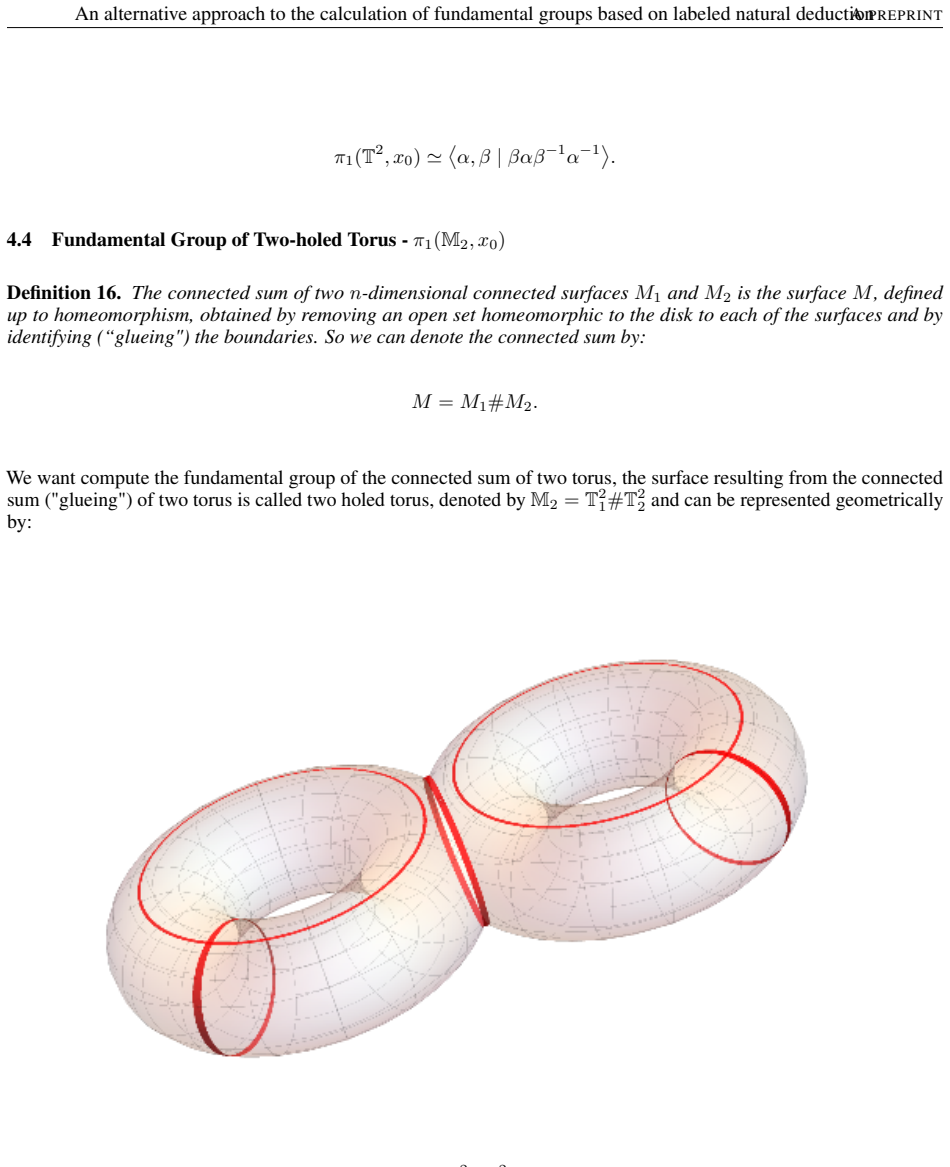
In this work, we use a labelled deduction system based on the concept of computational paths (sequence of rewrites) as equalities between two terms of the same type. We also define a term rewriting system that is used to make computations between these computational paths, establishing equalities between equalities. We use a labelled deduction system based on the concept of computational paths (sequence of rewrites) to obtain some results of algebraic topology and with support of the Seifet-Van Kampen Theorem we will calculate, in a way less complex than the one made in mathematics \cite{Munkres} and the technique of homotopy type theory \cite{hott}, the fundamental group of Klein Blottle $\mathbb{K}^2$, of the Torus $\mathbb{T}^2$ and Two holed Torus $\mathbb{M}_2=\mathbb{T}^2\# \mathbb{T}^2$ (the connected sum two torus).
Editorial analysis
A structured set of objections, weighed in public.
Referee Report
Summary. The manuscript introduces a labeled natural deduction system based on computational paths (sequences of rewrites treated as equalities) together with an associated term-rewriting system. It claims that this framework, used in conjunction with the Seifert–Van Kampen theorem, yields the fundamental groups of the Klein bottle K², the torus T², and the two-holed torus M₂ = T²#T² in a manner less complex than the classical treatment in Munkres or the homotopy-type-theory approach.
Significance. If the rewriting rules on computational paths can be shown to enforce precisely the same relations that arise from the inclusions in the Seifert–Van Kampen pushout, the work would supply a purely logical calculus for a standard family of fundamental-group computations. No machine-checked proofs, parameter-free derivations, or reproducible code are supplied, so the significance remains conditional on verification of the encoding.
major comments (2)
- [Abstract] Abstract: the central claim that the labeled deduction system produces the fundamental groups “with support of the Seifert-Van Kampen Theorem” is not accompanied by any explicit translation between the term-rewriting rules on computational paths and the amalgamated-product construction or the attaching maps of the theorem; without this translation it is impossible to confirm that the computed presentations coincide with the known topological groups (e.g., ⟨a,b | aba⁻¹b⁻¹⟩ for T²).
- [Abstract] Abstract: the repeated assertion of “less complex” calculations relative to Munkres or HoTT is unsupported by any concrete rewriting derivations, length comparisons, or side-by-side examples; the claim is therefore unevaluable from the given text.
minor comments (1)
- [Abstract] Abstract: typographical errors include “Seifet-Van Kampen”, “Klein Blottle”, and inconsistent notation for the surfaces (K² vs. ℂ²).
Simulated Author's Rebuttal
We thank the referee for the careful reading and constructive comments on the manuscript. We respond to each major comment below and indicate the changes planned for the revised version.
read point-by-point responses
-
Referee: [Abstract] Abstract: the central claim that the labeled deduction system produces the fundamental groups “with support of the Seifert-Van Kampen Theorem” is not accompanied by any explicit translation between the term-rewriting rules on computational paths and the amalgamated-product construction or the attaching maps of the theorem; without this translation it is impossible to confirm that the computed presentations coincide with the known topological groups (e.g., ⟨a,b | aba⁻¹b⁻¹⟩ for T²).
Authors: We agree that an explicit translation is required to make the connection verifiable. The revised manuscript will add a dedicated subsection that maps the term-rewriting rules on computational paths to the relations induced by the inclusions in the Seifert–Van Kampen pushout, thereby confirming that the resulting presentations match the standard ones such as ⟨a, b | aba⁻¹b⁻¹⟩ for the torus. revision: yes
-
Referee: [Abstract] Abstract: the repeated assertion of “less complex” calculations relative to Munkres or HoTT is unsupported by any concrete rewriting derivations, length comparisons, or side-by-side examples; the claim is therefore unevaluable from the given text.
Authors: We acknowledge that the claim of reduced complexity lacks supporting derivations or comparisons in the current text. The revision will incorporate explicit rewriting derivations for the torus (and, space permitting, the other spaces) together with a brief side-by-side comparison of derivation length or number of steps against the classical treatment and the HoTT approach. revision: yes
Circularity Check
No circularity: external Seifert-Van Kampen theorem invoked as independent support
full rationale
The paper's approach applies a labeled deduction system with term rewriting on computational paths, then invokes the Seifert-Van Kampen theorem (external, cited via Munkres) to obtain fundamental group presentations for K², T² and M₂. No step defines a result in terms of itself, renames a fitted parameter as a prediction, or relies on a load-bearing self-citation whose content is unverified. The rewriting rules are presented as a computational tool whose correctness is assumed to align with the topological theorem rather than being derived from the target groups. This is a standard non-circular application of an external theorem.
Axiom & Free-Parameter Ledger
axioms (1)
- domain assumption Seifert-Van Kampen Theorem can be applied inside the labeled deduction system
Lean theorems connected to this paper
-
IndisputableMonolith/Foundation/AlexanderDuality.leanalexander_duality_circle_linking unclear?
unclearRelation between the paper passage and the cited Recognition theorem.
we use a labelled deduction system based on the concept of computational paths (sequence of rewrites) ... with support of the Seifert-Van Kampen Theorem we will calculate ... the fundamental group of Klein Bottle K², of the Torus T²
-
IndisputableMonolith/Cost/FunctionalEquation.leanwashburn_uniqueness_aczel unclear?
unclearRelation between the paper passage and the cited Recognition theorem.
LNDEQ-TRS ... 39 rules ... rw-equality is transitive, symmetric and reflexive
What do these tags mean?
- matches
- The paper's claim is directly supported by a theorem in the formal canon.
- supports
- The theorem supports part of the paper's argument, but the paper may add assumptions or extra steps.
- extends
- The paper goes beyond the formal theorem; the theorem is a base layer rather than the whole result.
- uses
- The paper appears to rely on the theorem as machinery.
- contradicts
- The paper's claim conflicts with a theorem or certificate in the canon.
- unclear
- Pith found a possible connection, but the passage is too broad, indirect, or ambiguous to say the theorem truly supports the claim.
Reference graph
Works this paper leans on
-
[1]
Homotopy Type Theory: Univalent Foundations of Mathematics, Institute for Advanced Study, 2013
The Univalent Foundations Program. Homotopy Type Theory: Univalent Foundations of Mathematics, Institute for Advanced Study, 2013. https://homotopytypetheory.org/book
work page 2013
-
[2]
Hindley, J. Roger and Seldin, Jonathan P. Lambda-calculus and combinators: an introduction, 2008. Cambridge University Press
work page 2008
-
[3]
de Oliveira, A. G. Proof transformations for labelled natural deduction via term rewriting. Master’s thesis, Depto. de Informática, Universidade Federal de Pernambuco, Recife, Brazil, April 1995
work page 1995
-
[4]
de Oliveira, A. G. and de Queiroz, R. J. G. B. A New Basic Set of Proof Transformations. In We Will Show Them! Essays in Honour of Dov Gabbay. South American Journal of Logic V olume 2 (2), p.499-528. S. Artemov, H. Barringer, A. Garcez, L. Lamb and J. Woods (eds.), 2005. College Publications, London, ISBN 1904987125
work page 2005
-
[5]
de Queiroz, R. J. G. B. and de Oliveira, A. G. and Ramos, A. F. Propositional equality, identity types, and direct computational paths. South American Journal of Logic, 2(2). p.245-296, 2016. Special Issue A Festschrift for Francisco Miraglia, M. E. Coniglio, H. L. Mariano and V . C. Lopes (Guest Editors)
work page 2016
-
[6]
de Queiroz, R. J. G. B. and de Oliveira, A. G. Term rewriting systems with labelled deductive systems. Proceedings of Brazilian Symposium on Artificial Intelligence (SBIA’94),p.59-74,1994
work page 1994
-
[7]
de Oliveira, A. G. and de Queiroz, R. J. G. B. A normalization procedure for the equational fragment of labelled natural deduction. Logic Journal of IGP.Oxford Univ Press. V ol 7 (2):173-215
-
[8]
de Queiroz, R. J. G. B. and Gabbay, D. M. Equality in Labelled Deductive Systems and the Functional Interpretation of Propositional Equality. p.547-565,1994. ILLC/Department of Philosophy, University of Amsterdam
work page 1994
-
[9]
Curry, Haskell B. 1900-1982,Hindley, J. Roger. and Seldin, Jonathan P. To H. B. Curry: Essays on Combinatory Logic Lambda Calculus and Formalism. edited by J.P. Seldin, J.R. Hindley. p.xxv+606pp,1980. London by Academic press
work page 1900
-
[10]
P. Martin-Löf. An intuitionistic theory of types: predicative part, in H. E. Rose and J.C.Shepherdson (eds.) Logic Colloquium ’73, V ol. 80 of Studies in Logic and The Foundations of Mathematics, pp 73 -– 118, North-Holland, Amsterdam,1975. p.viii+513pp, Proceedings of the Colloquium held in Bristol,UK,1973
work page 1975
-
[11]
P. Martin-Löf. Constructive Mathematics and Computer Programming, in L. J. Cohen, J. Los, H.Pfeiffer, and K.-P. Podewski (eds.). Logic, Methodology and Philosophy of Science VI, Series Studies in Logic and The Foundations of Mathematics,pp 153—175, North-Holland, Amsterdam. p.xiii+738pp, 1992. Proceedings of the International Congress held in Hannover, Au...
work page 1992
-
[12]
de Queiroz, R. J. G. B. and Gabbay,D. M. The Functional Interpretation of the Existential Quantifier. Bulletin of the Interest Group in Pure and Applied Logics, 3(2 and 3). p.243–290, 1995. Abstract in JSL 58(2):753–754,
work page 1995
-
[13]
Presented at Logic Colloquium ’91, Uppsala, August 9–16
-
[14]
de Queiroz, R. J. G. B. and Gabbay,D. M. Labelled Natural Deduction. InLogic, Language and Reasoning. Essays in Honor of Dov Gabbay’s 50th Anniversary, H.J. Ohlbach and U. Reyle (eds.). Kluwer Academic Publishers, June 1999. pp. 173-–250
work page 1999
-
[15]
de Queiroz, R. J. G. B; Gabbay, D. M. and de Oliveira, A.G. The Functional Interpretation of Logical Deduction. World Scientific, 2012
work page 2012
-
[16]
de Queiroz, R. J. G. B. and de Oliveira, A. G. Natural deduction for equality: The missing entity. Advances in Natural Deduction - A Celebration of Dag Prawitz’s Work, p.63-91. Springer,2014
work page 2014
-
[17]
de Queiroz, R. J. G. B. and de Oliveira, A. G. Propositional Equality, Identity Types and Reversible Rewriting Sequences as Homotopies. Palestra ministrado no Workshop de Lógica, Universidade Federal do Ceará, Fortaleza, CE. 2014
work page 2014
-
[18]
de Queiroz, R. J. G. B. and de Oliveira, A. G. and Gabbay, D. M. The Functional Interpretation of Logical Deduction. World Scientifi, 2011
work page 2011
-
[19]
V . V oevodsky. Univalent Foundations and Set Theory, 2014. Lecture at IAS, Princeton, New Jersey, Mar 2014
work page 2014
-
[20]
P. Martin-Löf. Intuitionistic Type Theory. Series Studies in Proof Theory. Bibliopolis Naples, iv+91pp, 1980.Notes by Giovanni Sambi of a series of lectures given in Padova
work page 1980
-
[21]
On the Identity Type as the Type of Computational Paths
Ramos, Arthur F. and de Queiroz, R. J. G. B. and de Oliveira, A. G. On the Identity Type as the Type of Computational Paths. http://arxiv.org/abs/1504.04759, 2015
work page internal anchor Pith review Pith/arXiv arXiv 2015
-
[22]
Ramos, Arthur F. and De Queiroz, Ruy J. G. B. and De Oliveira, Anjolina G. On the identity type as the type of computational paths. Logic Journal of the IGPL,vol.25 (4), p.562-584, 2017
work page 2017
-
[23]
Topology (2nd Edition), Chapter 9, Topic 54 - The fundamental group of circle, Pearson, 2000
Munkres, James R. Topology (2nd Edition), Chapter 9, Topic 54 - The fundamental group of circle, Pearson, 2000. Institute for Advanced Study
work page 2000
-
[24]
Licata, Daniel and Shulman, Michael
R. Licata, Daniel and Shulman, Michael. Calculating the Fundamental Group of the Circle in Homotopy Type Theory, 28th Annual ACM/IEEE Symposium on Logic in Computer Science (LICS), 2013. ACM/IEEE
work page 2013
-
[25]
Vladimir V oevodsky to Martin Escardo, In the vein of bringing to public record things that Vladimir said, here is a short interview. http://plato.stanford.edu/archives/win2014/entries/category-theory/, interview published in google discussion group of Homotopy Type Theory, by Martin H. Escardo On Thursday, 12 October 2017 20:24:26, in response to an inte...
work page 2017
-
[26]
P. Martin-Löf. Intuitionistic Type Theory. Series Studies in Proof Theory. Bibliopolis Naples, iv+91pp, 1980. Notes by Giovanni Sambi of a series of lectures given in Padova. 26 An alternative approach to the calculation of fundamental groups based on labeled natural deductionA PREPRINT A Subterm Substitution In Equational Logic, the sub-term substitution...
work page 1980
-
[27]
τ(C[r],C[σ(r)])⊿trC[ρ]
-
[28]
τ(C[σ(r)],C[r])⊿tsrC[ρ]
-
[29]
τ(C[r],C[ρ])⊿trrC[r]
-
[30]
τ(C[ρ],C[r])⊿tlrC[r]
-
[31]
subL(C[r],C[ρ])⊿slrC[r]
-
[32]
subR(C[ρ],C[r])⊿srrC[r]
-
[33]
subL(subL(s,C[r]),C[σ(r)])⊿slss
-
[34]
subL(subL(s,C[σ(r)]),C[r])⊿slsss
-
[35]
subR(C[s], subR(C[σ(s)],r ))⊿srsr
-
[36]
subR(C[σ(s)], subR(C[s],r ))⊿srrr r
-
[37]
µ(t,ξ 1(r),ξ 2(s))⊿mxxt
-
[38]
σ(τ(r,s ))⊿stssτ(σ(s),σ (r))
-
[39]
σ(subL(r,s ))⊿ssbl subR(σ(s),σ (r))
-
[40]
σ(subR(r,s ))⊿ssbr subL(σ(s),σ (r))
-
[41]
σ(ξ(s,r ))⊿sxssξ(σ(s),σ (r))
-
[42]
σ(µ(s,r ))⊿smssµ(σ(s),σ (r))
-
[43]
σ(µ(r,u,v ))⊿smsssµ(σ(r),σ (u),σ (v))
-
[44]
τ(r, subL(ρ,s ))⊿tsbll subL(r,s )
-
[45]
τ(r, subR(s,ρ ))⊿tsbrl subL(r,s )
-
[46]
τ(subL(r,s ),t )⊿tsblrτ(r, subR(s,t ))
-
[47]
τ(subR(s,t ),u )⊿tsbrr subR(s,τ (t,u ))
-
[48]
τ(τ(t,r ),s )⊿ttτ(t,τ (r,s ))
-
[49]
τ(C[u],τ (C[σ(u)],v ))⊿ttsv
-
[50]
τ(C[σ(u)],τ (C[u],v ))⊿tstu 28
discussion (0)
Sign in with ORCID, Apple, or X to comment. Anyone can read and Pith papers without signing in.