A Reliability-Oriented Cost Optimisation Method for Capacity Planning of a Multi-Carrier Micro-Grid: A Case Study of Stewart Island, New Zealand
Pith reviewed 2026-05-25 18:17 UTC · model grok-4.3
The pith
A reliability-oriented optimization method determines the lowest-cost capacities for a stand-alone micro-grid supplying electricity, hot water, and fuel.
A machine-rendered reading of the paper's core claim, the machinery that carries it, and where it could break.
Core claim
The paper puts forward a reliability-oriented cost optimisation method for capacity planning of a stand-alone multiple energy carrier micro-grid equipped with wind turbines, a hydrogen sub-system, hybrid storage, hot water storage, and converters, demonstrated through numerical evaluation on Stewart Island to meet electricity, hot water, and transportation fuel demands.
What carries the argument
The reliability-oriented cost optimisation method, which jointly minimises investment and operating costs subject to reliability constraints and the physical interrelations among multiple energy carriers.
If this is right
- Component capacities for similar remote micro-grids can be obtained by solving a single optimisation problem that respects all carrier interactions.
- The method produces solutions that meet reliability targets at lower total cost than sizing each energy carrier independently.
- Hydrogen sub-systems can be sized together with electricity and heat storage to serve transportation fuel demand without separate infrastructure.
- The approach can be rerun with updated cost or demand data to revise capacities as technology prices change.
Where Pith is reading between the lines
- The same optimisation structure could be tested on other islands or remote sites by swapping local wind and demand profiles while keeping the carrier-interaction constraints fixed.
- If the method is implemented, comparing predicted versus measured hydrogen production and storage utilisation would show whether the modelled carrier couplings hold in practice.
Load-bearing premise
The optimisation model accurately captures the real interrelations, constraints, and context-specific conditions of the multi-carrier system without requiring post-hoc adjustments.
What would settle it
After building the sized system on Stewart Island, the observed total cost or reliability level deviates substantially from the values predicted by the optimisation for the same load and resource profiles.
Figures
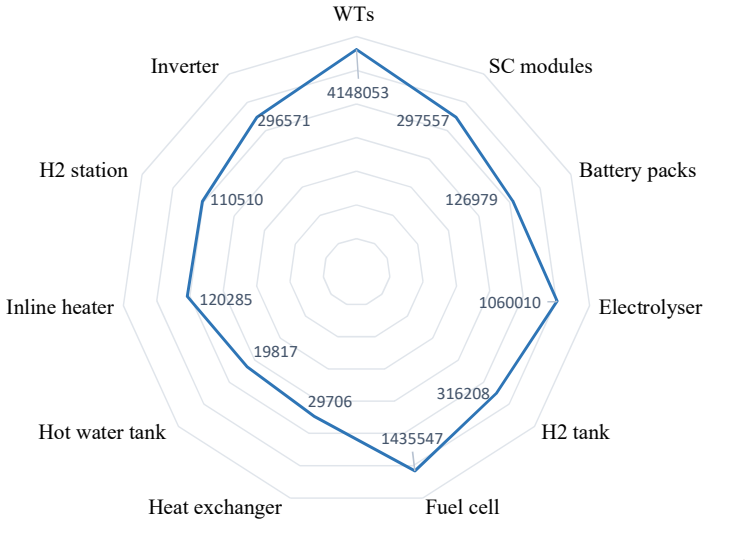
read the original abstract
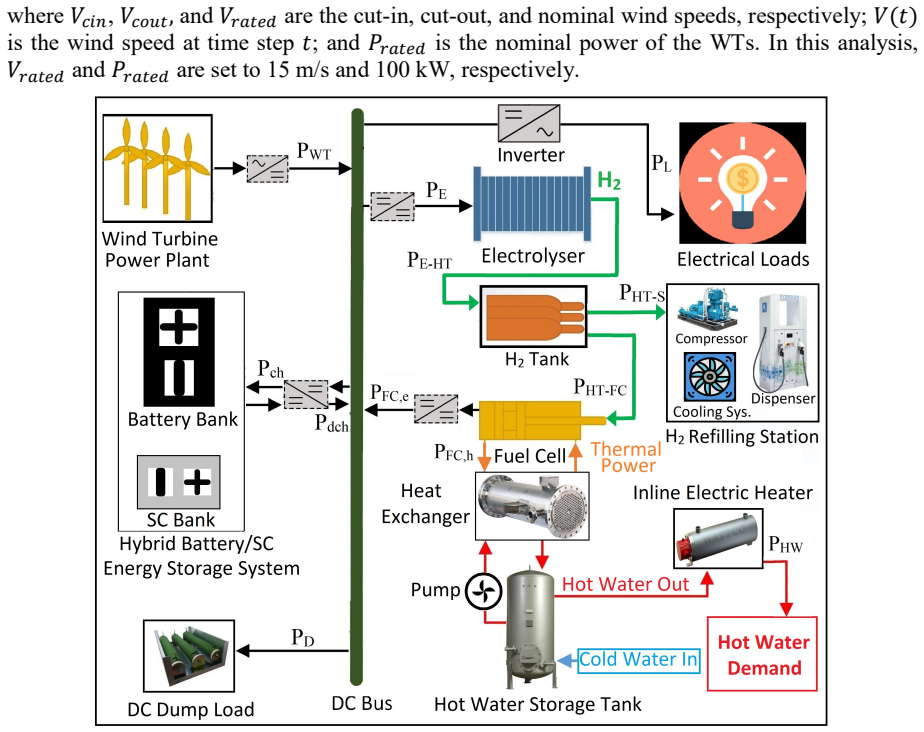
Nearly all types of energy systems (such as power systems, natural gas supply systems, fuel supply systems, and so forth) are going through a major transition from centralised, top-down structures to distributed, clean energy approaches in order to address the concerns regarding climate change, air quality, depletion of natural resources, and energy security, whilst also enabling the supply of energy to communities in line with the goals of sustainable development. Accordingly, the establishment of the concept of sustainable, decentralised, multi-carrier energy systems, together with the declining costs of renewable energy technologies, has proposed changes in the energy industry towards the development of integrated energy systems. Notwithstanding the potential benefits, the optimal capacity planning of these systems with multiple energy carriers (such as electricity, heat, hydrogen, and biogas) is exceedingly complex due to the concurrent goals and interrelated constraints that must be satisfied, as well as the heavily context-dependent nature of such schemes. This paper puts forward an innovative optimal capacity planning method for a cutting-edge, stand-alone multiple energy carrier micro-grid (MECM) serving the electricity, hot water, and transportation fuel demands of remote communities. The proposed MECM system is equipped with wind turbines, a hydrogen sub-system (including an electrolyser, a hydrogen reservoir, and a fuel cell), a hybrid super-capacitor/battery energy storage system, a hot water storage tank, a heat exchanger, an inline electric heater, a hydrogen refuelling station, and some power converters. A numerical case study for the optimal capacity planning of the suggested MECM configuration, to be realised on Stewart Island, New Zealand, is presented to evaluate the effectiveness of the proposed optimisation method.
Editorial analysis
A structured set of objections, weighed in public.
Referee Report
Summary. The paper proposes a reliability-oriented cost optimization method for capacity planning of a stand-alone multi-carrier energy micro-grid (MECM) serving electricity, hot water, and transportation fuel demands in remote communities. The MECM configuration includes wind turbines, a hydrogen subsystem (electrolyser, reservoir, fuel cell), hybrid supercapacitor/battery storage, hot water storage, heat exchanger, electric heater, hydrogen refuelling station, and power converters. A numerical case study applies the method to Stewart Island, New Zealand, to demonstrate effectiveness.
Significance. If the optimization formulation and case study results hold, the work contributes a concrete application of integrated multi-carrier planning to a real remote location, highlighting trade-offs between reliability and cost in systems with electricity, heat, and hydrogen vectors. The explicit inclusion of transportation fuel demand via hydrogen adds practical relevance for off-grid communities.
major comments (2)
- [§4] §4 (Optimization formulation): The objective function and constraints are not shown to be independent of post-hoc parameter tuning; the reliability-oriented weighting appears to require site-specific calibration that is not derived from first principles or external data, weakening the claim that the method is generally applicable without adjustment.
- [Table 5] Table 5 (Case study results): The reported cost and reliability metrics for the optimal configuration lack comparison against a baseline (e.g., separate single-carrier systems or rule-based sizing); without this, it is unclear whether the MECM configuration delivers measurable improvement over simpler alternatives.
minor comments (2)
- [Abstract] The abstract and introduction use 'innovative' without a clear statement of the novel technical contribution relative to prior multi-carrier sizing literature; a dedicated paragraph contrasting the formulation would improve clarity.
- [§3] Notation for energy carrier conversion efficiencies (e.g., electrolyser and fuel cell) is introduced without a consolidated table; readers must cross-reference multiple sections.
Simulated Author's Rebuttal
We thank the referee for the detailed and constructive review. The comments highlight important aspects for strengthening the presentation of the optimization method and the case study results. We address each major comment below and indicate the revisions we will make.
read point-by-point responses
-
Referee: [§4] §4 (Optimization formulation): The objective function and constraints are not shown to be independent of post-hoc parameter tuning; the reliability-oriented weighting appears to require site-specific calibration that is not derived from first principles or external data, weakening the claim that the method is generally applicable without adjustment.
Authors: We acknowledge that the reliability weighting factor in the objective function is a tunable parameter reflecting the desired trade-off between cost and reliability. The formulation itself is general, but the specific value of the weight is application-dependent. In the revised manuscript, we will expand §4 to include a dedicated discussion on weight selection, supported by references to reliability targets for remote micro-grids (e.g., from IEEE or IEC standards) and a sensitivity analysis showing how different weights affect the optimal capacities. This will clarify the method's applicability while making explicit that the weight requires calibration to the decision-maker's priorities. revision: yes
-
Referee: [Table 5] Table 5 (Case study results): The reported cost and reliability metrics for the optimal configuration lack comparison against a baseline (e.g., separate single-carrier systems or rule-based sizing); without this, it is unclear whether the MECM configuration delivers measurable improvement over simpler alternatives.
Authors: We agree that direct comparison to a baseline would better demonstrate the value of the integrated multi-carrier approach. In the revised manuscript, we will add a new table or subsection in the case study section that compares the proposed MECM results against (i) separately optimized single-carrier systems for electricity, heat, and hydrogen and (ii) a simple rule-based sizing heuristic. This will quantify the cost and reliability improvements attributable to the joint optimization. revision: yes
Circularity Check
No significant circularity detected
full rationale
The paper describes a standard reliability-oriented optimization formulation for multi-carrier microgrid capacity planning, followed by a single numerical case study on Stewart Island. The abstract and provided material contain no equations or derivation steps that reduce by construction to fitted parameters, self-definitions, or self-citation chains. The central claim (an optimization method evaluated on given demands and components) remains independent of its inputs and does not invoke load-bearing self-citations or ansatzes smuggled from prior author work. This is the expected honest non-finding for a methods-plus-case-study paper whose derivation is self-contained against external benchmarks.
Axiom & Free-Parameter Ledger
Reference graph
Works this paper leans on
-
[1]
About New Zealand’s emissions reduction targets,
Ministry for the Environment, “About New Zealand’s emissions reduction targets,” 2019. [Online]. Available: http://www.mfe.govt.nz/climate-change/climate-change-and-government/emissions- reduction-targets/about-our-emissions/. [Accessed: 17-May-2019]
work page 2019
-
[2]
S. Mohseni and A. Brent, “Smart Grid and Zero-Emissions Energy Systems: The Need for a Multi- Dimensional Investment Planning Perspective,” IEEE Smart Grid eNewsl., June 2018
work page 2018
-
[3]
Optimal energy management of a grid-connected multiple energy carrier micro-grid,
S. M. Moghaddas-Tafreshi, S. Mohseni, M. E. Karami, and S. Kelly, “Optimal energy management of a grid-connected multiple energy carrier micro-grid,” Appl. Therm. Eng., vol. 152, pp. 796–806, 2019
work page 2019
-
[4]
A multi-agent system for optimal sizing of a cooperative self-sustainable multi-carrier microgrid,
S. Mohseni and S. M. Moghaddas-Tafreshi, “A multi-agent system for optimal sizing of a cooperative self-sustainable multi-carrier microgrid,” Sustain. Cities Soc., vol. 38, pp. 452–465, 2018
work page 2018
-
[5]
S. Mohseni, A. Brent, and D. Burmester “The Role of Artificial Intelligence in the Transition from Conventional Power Systems to Modernized Smart Grids,” IEEE Smart Grid eNewsl., April 2019
work page 2019
-
[6]
A Multi-Agent Approach to Optimal Sizing of a Combined Heating and Power Microgrid
S. Mohseni and S.M. Moghaddas-Tafreshi, “A multi-agent approach to optimal sizing of a combined heating and power microgrid,” arXiv preprint, arXiv:1812.11076, 2018
work page internal anchor Pith review Pith/arXiv arXiv 2018
-
[7]
S. M. Moghaddas-Tafreshi, M. Jafari, S. Mohseni, and S. Kelly, “Optimal operation of an energy hub considering the uncertainty associated with the power consumption of plug-in hybrid electric vehicles using information gap decision theory,” Int. J. Electr. Power Energy Syst., vol. 112, pp. 92–108, 2019
work page 2019
-
[8]
J. Assaf and B. Shabani, “A novel hybrid renewable solar energy solution for continuous heat and power supply to standalone-alone applications with ultimate reliability and cost effectiveness,” Renew. Energy, vol. 138, pp. 509–520, 2019
work page 2019
-
[9]
Sizing of hybrid energy storage system for a PV based microgrid through design space approach,
A. S. Jacob, R. Banerjee, and P. C. Ghosh, “Sizing of hybrid energy storage system for a PV based microgrid through design space approach,” Appl. Energy, vol. 212, pp. 640–653, 2018
work page 2018
-
[10]
Development of a Multi-Agent System for Optimal Sizing of a Commercial Complex Microgrid
S. Mohseni and S.M. Moghaddas-Tafreshi, “Development of a multiagent system for optimal sizing of a commercial complex microgrid,” arXiv preprint, arXiv:1811.12553, 2018
work page internal anchor Pith review Pith/arXiv arXiv 2018
-
[11]
E. Ofry and A. Braunstein, “The Loss of Power Supply Probability as a Technique for Designing Stand- Alone Solar Electrical (Photovoltaic) Systems,” IEEE Power Eng. Rev., vol. PER-3, pp. 34–35, 1983
work page 1983
-
[12]
J. Kennedy and R. C. Eberhart, “Particle swarm optimization,” in Proceedings of the 1995 IEEE Int. Conf. Neural Networks, Perth, WA, Australia, 27 Nov.–1 Dec. 1995, vol. 4, pp. 1942–1948
work page 1995
-
[13]
Edging towards sustainability-a 100% renewable electricity system for Stewart Island,
I. G. Mason and R. G. McNeill, “Edging towards sustainability-a 100% renewable electricity system for Stewart Island,” in Proceedings of the EEA Conf. and Exhib., Wellington, New Zealand, 22–24 Jun. 2016, pp. 1–10
work page 2016
-
[14]
CliFlo: NIWA’s National Climate Database on the Web. [Data Collection]. Available: http://cliflo.niwa.co.nz/. [Retrieved: 27-Apr.-2019]
work page 2019
-
[15]
Anderson et al., New Zealand GREEN Grid Household Electricity Demand Study 2014-2018
B. Anderson et al., New Zealand GREEN Grid Household Electricity Demand Study 2014-2018. [Data Collection]. Colchester, Essex: UK Data Service
work page 2014
-
[16]
J. Assaf and B. Shabani, “Transient simulation modelling and energy performance of a standalone solar- hydrogen combined heat and power system integrated with solar-thermal collectors,” Appl. Energy, vol. 178, pp. 66–77, 2016
work page 2016
-
[17]
Could hydrogen turn Taranaki into the Norway of the Pacific?,
M. Watson, “Could hydrogen turn Taranaki into the Norway of the Pacific?,” 2018. [Online]. Available: https://www.stuff.co.nz/environment/105601987/could-hydrogen-turn-taranaki-into-the-norway-of-the- pacific. [Accessed: 17-May-2019]
-
[18]
Available: http://www.concept.co.nz/uploads/2/5/5/4/25542442/h2_report1_summary_v4.pdf
Concept Consulting Group Ltd., Hydrogen in New Zealand Report 1 – Summary, 2019. Available: http://www.concept.co.nz/uploads/2/5/5/4/25542442/h2_report1_summary_v4.pdf
work page 2019
-
[19]
How much does a litre of hot water really cost?,
Sibelga SCRL Company, “How much does a litre of hot water really cost?,” 2018. [Online]. Available: https://www.energuide.be/en/questions-answers/how-much-does-a-litre-of-hot-water-really-cost/2127/. [Accessed: 17-May-2019]
work page 2018
discussion (0)
Sign in with ORCID, Apple, or X to comment. Anyone can read and Pith papers without signing in.