A New Solution to Market Definition: An Approach Based on Multi-dimensional Substitutability Statistics
Pith reviewed 2026-05-25 16:43 UTC · model grok-4.3
The pith
A market definition model groups products by maximizing multi-dimensional substitutability of their features.
A machine-rendered reading of the paper's core claim, the machinery that carries it, and where it could break.
Core claim
The paper claims that a model based directly on multi-dimensional substitutability between products, optimized to maximize the substitutability of product features within each group, can define markets in a way that avoids the problems of the SSNIP test and CLA while still satisfying the requirements of the 2010 Horizontal Merger Guidelines.
What carries the argument
The multi-dimensional substitutability statistics model that groups products by maximizing within-group feature substitutability.
If this is right
- The model supplements existing methods to display substitutive relations more clearly.
- It produces a more stable market definition than the CLA under the 2010 Guidelines.
- It avoids the narrow-market tendency that arises from incorrect CLA implementation.
- It satisfies the data and analytic requirements set by the 2010 Horizontal Merger Guidelines.
Where Pith is reading between the lines
- The method could be tested by applying it to historical merger cases and comparing predicted market boundaries against observed competitive effects.
- If the optimization routine can be made operational with public data, regulators might adopt it for routine screening of proposed mergers.
- The approach might extend to non-merger antitrust questions such as monopolization claims where market boundaries also matter.
Load-bearing premise
Multi-dimensional substitutability statistics can be measured and optimized to avoid the unresolvable problems of the SSNIP test and CLA.
What would settle it
A side-by-side application of the new model and the CLA to the same set of products that produces materially different market boundaries, followed by checking which boundary better predicts post-merger price or output changes in real cases.
Figures
read the original abstract
Market definition is an important component in the premerger investigation, but the models used in the market definition have not developed much in the past three decades since the Critical Loss Analysis (CLA) was proposed in 1989. The CLA helps the Hypothetical Monopolist Test to determine whether the hypothetical monopolist is going to profit from the small but significant and non-transitory increase in price (SSNIP). However, the CLA has long been criticized by academic scholars for its tendency to conclude a narrow market. Although the CLA was adopted by the 2010 Horizontal Merger Guidelines (the 2010 Guidelines), the criticisms are likely still valid. In this dissertation, we discussed the mathematical deduction of CLA, the data used, and the SSNIP defined by the Agencies. Based on our research, we concluded that the narrow market conclusion was due to the incorrect implementation of the CLA; not the model itself. On the other hand, there are other unresolvable problems in the CLA and the Hypothetical Monopolist Test. The SSNIP test and the CLA are bright resolutions for market definition problem during their time, but we have more advanced tools to solve the task nowadays. In this dissertation, we propose a model which is based directly on the multi-dimensional substitutability between the products and is capable of maximizing the substitutability of product features within each group. Since the 2010 Guidelines does not exclude the use of models other than the ones mentioned by the Guidelines, our method can hopefully supplement the current models to show a better picture of the substitutive relations and provide a more stable definition of the market.
Editorial analysis
A structured set of objections, weighed in public.
Referee Report
Summary. The manuscript argues that the Critical Loss Analysis (CLA) tends to produce narrow market definitions due to incorrect implementation rather than flaws in the model itself, identifies unresolvable problems in the SSNIP test and Hypothetical Monopolist Test, and proposes a new model based directly on multi-dimensional substitutability statistics between products that maximizes substitutability of product features within each group. This approach is offered as a supplement to the 2010 Horizontal Merger Guidelines since those guidelines do not exclude other models.
Significance. If a rigorously specified and validated multi-dimensional substitutability model could be shown to produce stable market definitions while complying with the 2010 Guidelines and avoiding the documented issues with SSNIP/CLA, it would represent a meaningful advance in antitrust market definition tools. The abstract alone provides no basis for assessing whether this potential is realized.
major comments (2)
- [Abstract] Abstract: the claim that 'the narrow market conclusion was due to the incorrect implementation of the CLA; not the model itself' is load-bearing for the paper's critique of existing methods, yet the promised 'mathematical deduction of CLA, the data used, and the SSNIP defined by the Agencies' are absent from the manuscript, leaving the claim unevaluated.
- [Abstract] Abstract: the central proposal of 'a model which is based directly on the multi-dimensional substitutability between the products and is capable of maximizing the substitutability of product features within each group' is the paper's main contribution, but no equations, optimization procedure, substitutability statistics, or empirical validation are supplied, so it is impossible to assess whether the model avoids the unresolvable problems identified in SSNIP/CLA or meets the 2010 Guidelines requirements.
minor comments (1)
- [Abstract] Abstract: the text refers to 'this dissertation' while the submission is framed as a paper; clarify the intended document type and scope.
Simulated Author's Rebuttal
We thank the referee for their thoughtful comments. We address each major comment below and will revise the manuscript to make the supporting analysis and model specification more explicit and accessible.
read point-by-point responses
-
Referee: [Abstract] Abstract: the claim that 'the narrow market conclusion was due to the incorrect implementation of the CLA; not the model itself' is load-bearing for the paper's critique of existing methods, yet the promised 'mathematical deduction of CLA, the data used, and the SSNIP defined by the Agencies' are absent from the manuscript, leaving the claim unevaluated.
Authors: The abstract summarizes our analysis of the CLA implementation issues. The full manuscript contains the mathematical deduction, data, and SSNIP discussion referenced in the abstract. To address the concern that these elements are difficult to locate or evaluate, we will revise by adding a dedicated subsection or appendix that explicitly presents the deduction, data sources, and SSNIP definitions used by the Agencies, with clear cross-references from the abstract and introduction. revision: yes
-
Referee: [Abstract] Abstract: the central proposal of 'a model which is based directly on the multi-dimensional substitutability between the products and is capable of maximizing the substitutability of product features within each group' is the paper's main contribution, but no equations, optimization procedure, substitutability statistics, or empirical validation are supplied, so it is impossible to assess whether the model avoids the unresolvable problems identified in SSNIP/CLA or meets the 2010 Guidelines requirements.
Authors: We agree that explicit formalization is needed for readers to evaluate the model's properties. The manuscript introduces the multi-dimensional substitutability approach conceptually as a supplement to existing methods. We will revise to include the specific equations defining the substitutability statistics, the optimization procedure for clustering products to maximize within-group feature substitutability, and any empirical illustrations or validation steps, along with a discussion of how the approach complies with the 2010 Guidelines and sidesteps the identified SSNIP/CLA limitations. revision: yes
Circularity Check
No circularity identifiable; abstract lacks equations or derivation chain
full rationale
The input provides only the abstract, which describes a proposed multi-dimensional substitutability model without any equations, fitting procedures, data details, or explicit derivation steps. No load-bearing claims reduce to self-citations, fitted inputs, or self-definitional constructs because no such elements are present. The paper's central claim remains a high-level proposal that cannot be inspected for circularity under the specified patterns.
Axiom & Free-Parameter Ledger
Reference graph
Works this paper leans on
-
[1]
• Adriaan Ten Kate & Gunnar Niels, The Concept of Critical Loss for a Group of Differentiated Products, J. Compet. Law Econ. 6, 321-333 (2009). • Agresti, Alan. Categorical data analysis. V ol
work page 2009
-
[2]
• Angus Deaton & John Muellbauer, An Almost Ideal Demand System, The American Economic Review 70, 312-326 (1980). • Anil Kanagala et al, A Probabilistic Approach of Hirschman-Herfindahl Index (HHI) to Determine Possibility of Market Power Acquisition, IEEE PES Power Systems Conference and Exposition (2004). • Aviv Nevo, A Practitioner's Guide to Estimatio...
work page 1980
-
[3]
S. Ct. 484 (Dec. 9, 1986). See also United States v. Virginia National Bank-Shares. Inc., 1982-2 Trade Cas. (CCH $ 64,871 (W.D. Va. 1982). • N. G. Mankiw, Principles of microeconomics (4th ed.) (2006) !252 A New Solution to Market Definition • National Association of Insurance Commissioners, Auto Insurance Database Annual Report 2 0 1 3 / 2 0 1 4 , ( D e ...
work page 1986
-
[4]
/Users/YanYang/code/ Car_Insurance_Example/2014 Auto Insurance Average Premium Data.csv
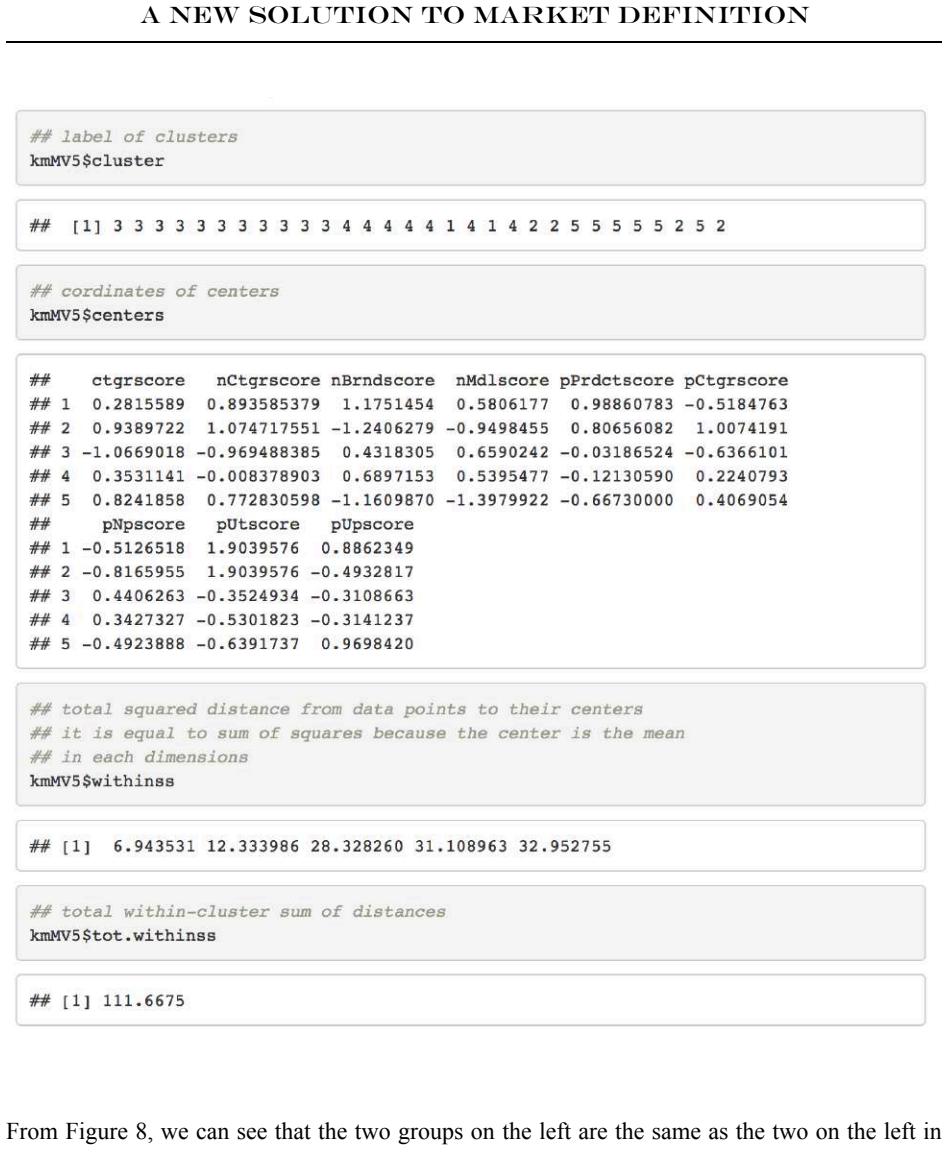
111.6675 !266 A New Solution to Market Definition K-means example 2: Example of Insurance Carriers and Related Activities Industry Group: Car Insurance Genetic K-means clustering with two-steps approach Read in data. Adjust it into the required form. Normalize the data cidata <- read.csv(file = "/Users/YanYang/code/ Car_Insurance_Example/2014 Auto Insuran...
work page 2014
discussion (0)
Sign in with ORCID, Apple, or X to comment. Anyone can read and Pith papers without signing in.