Galactic Rotation Based on OB Stars from the Gaia DR2 Catalogue
Pith reviewed 2026-05-25 16:58 UTC · model grok-4.3
The pith
Gaia DR2 OB stars yield Galactic rotation angular velocity Ω₀ of 29.70 km s⁻¹ kpc⁻¹ and circular speed V₀ of 238 km s⁻¹
A machine-rendered reading of the paper's core claim, the machinery that carries it, and where it could break.
Core claim
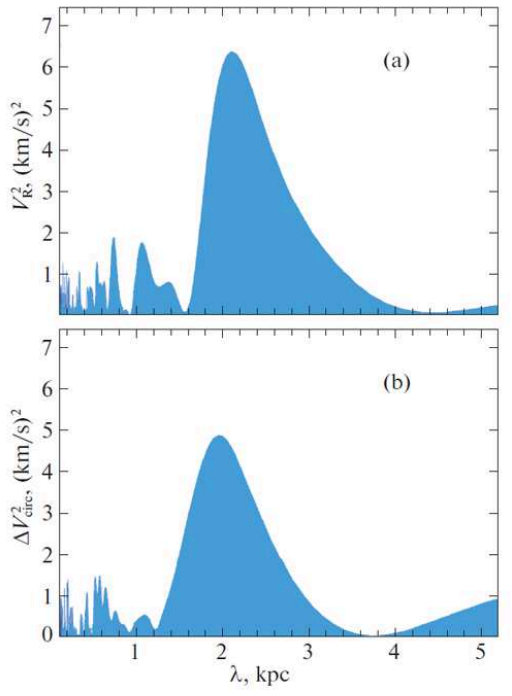
From the sample of about 6000 OB stars, the angular velocity of Galactic rotation is found to be Ω₀=29.70±0.11 km s⁻¹ kpc⁻¹, Ω'₀=-4.035±0.031 km s⁻¹ kpc⁻², and Ω''₀=0.620±0.014 km s⁻¹ kpc⁻³. Adopting R₀=8.0±0.15 kpc gives a circular rotation velocity V₀=238±5 km s⁻¹. The spiral density wave produces tangential and radial velocity perturbations with amplitudes f_θ=4.4±1.4 km s⁻¹ and f_R=5.1±1.2 km s⁻¹, wavelengths λ_θ=1.9±0.5 kpc and λ_R=2.1±0.5 kpc, and places the Sun at phase χ_⊙=-178°±12°.
What carries the argument
Least-squares fitting of observed stellar velocities to a model of differential Galactic rotation combined with periodic perturbations from a four-armed spiral density wave.
If this is right
- The derived rotation parameters describe the motion of the solar neighborhood around the Galactic center.
- The spiral wave amplitudes and wavelengths constrain the strength and scale of density waves in the disk.
- The Sun's phase indicates its location relative to the spiral arms in the adopted model.
- These values can be used to model the orbits of other objects in the Galactic disk.
Where Pith is reading between the lines
- The parameters imply a particular enclosed mass inside the solar radius when interpreted through a rotation curve model.
- Applying the same fitting procedure to other young stellar tracers could test for consistency across different populations.
- More precise future data might allow detection of higher-order rotation effects or alternative spiral patterns.
Load-bearing premise
The derivation assumes both a four-armed spiral pattern and the specific Galactocentric distance of the Sun equal to 8.0 kpc.
What would settle it
A direct measurement of the Sun's distance to the Galactic center differing substantially from 8 kpc, or kinematic data indicating a different number of major spiral arms, would alter the scaled velocities and wave parameters.
Figures



read the original abstract
We have studied a sample containing about 6000 OB stars with proper motions and trigonometric parallaxes from the Gaia DR2 catalogue. The following parameters of the angular velocity of Galactic rotation have been found: $\Omega_0=29.70\pm0.11$ km s$^{-1}$ kpc$^{-1}$, $\Omega'_0=-4.035\pm0.031$ km s$^{-1}$ kpc$^{-2}$, and $\Omega''_0= 0.620\pm0.014$ km s$^{-1}$ kpc$^{-3}$. The circular rotation velocity of the solar neighborhood around the Galactic center is $V_0=238\pm5$ km s$^{-1}$ for the adopted Galactocentric distance of the Sun $R_0=8.0\pm0.15$ kpc. The amplitudes of the tangential and radial velocity perturbations produced by the spiral density wave are $f_\theta=4.4\pm1.4$ km s$^{-1}$ and $f_R=5.1\pm1.2$ km s$^{-1}$, respectively; the perturbation wavelengths are $\lambda_\theta=1.9\pm0.5$ kpc and $\lambda_R=2.1\pm0.5$ kpc for the adopted four-armed spiral pattern. The Sun's phase in the spiral density wave is $\chi_\odot=-178^\circ\pm12^\circ$.
Editorial analysis
A structured set of objections, weighed in public.
Referee Report
Summary. The paper analyzes proper motions and trigonometric parallaxes for a sample of ~6000 OB stars from Gaia DR2 to derive Galactic rotation parameters via least-squares fitting: Ω₀=29.70±0.11 km s⁻¹ kpc⁻¹, Ω'₀=-4.035±0.031 km s⁻¹ kpc⁻², Ω''₀=0.620±0.014 km s⁻¹ kpc⁻³. It reports V₀=238±5 km s⁻¹ using adopted R₀=8.0±0.15 kpc, and extracts spiral density-wave amplitudes (f_θ=4.4±1.4 km s⁻¹, f_R=5.1±1.2 km s⁻¹) and wavelengths (λ_θ=1.9±0.5 kpc, λ_R=2.1±0.5 kpc) together with the Sun's phase χ_⊙=-178°±12° under a fixed four-armed (m=4) pattern.
Significance. If the central fits hold after addressing the conditioning on external assumptions, the work supplies updated, high-precision constraints on the local Galactic rotation curve and density-wave perturbations from one of the larger Gaia DR2 OB-star samples then available. The direct use of trigonometric parallaxes avoids some photometric-distance systematics common in earlier studies.
major comments (2)
- [Abstract] Abstract: V₀ is obtained strictly as R₀×Ω₀ with R₀ fixed at 8.0±0.15 kpc; the quoted ±5 km s⁻¹ uncertainty is therefore dominated by the external R₀ prior rather than the Gaia least-squares fit to Ω₀ from the ~6000 stars. This must be stated explicitly, and the formal uncertainty on Ω₀ alone should be propagated separately.
- [Abstract] Abstract: The reported spiral-wave amplitudes f_R, f_θ and wavelengths λ_R, λ_θ are extracted only after fixing m=4 in the density-wave phase term χ; a change in m alters both the inferred λ and χ_⊙. No refits with m=2 or other patterns are presented, so the numerical values and their uncertainties are conditional on this choice.
minor comments (1)
- [Abstract] Abstract: The data-selection criteria, outlier rejection, and exact functional form of the velocity model (including how the spiral terms are parameterized) are not summarized; these details are required to assess whether the formal uncertainties fully capture systematic contributions.
Simulated Author's Rebuttal
We thank the referee for the detailed and constructive report. We address each major comment below and agree that clarifications are needed in the abstract and text.
read point-by-point responses
-
Referee: [Abstract] Abstract: V₀ is obtained strictly as R₀×Ω₀ with R₀ fixed at 8.0±0.15 kpc; the quoted ±5 km s⁻¹ uncertainty is therefore dominated by the external R₀ prior rather than the Gaia least-squares fit to Ω₀ from the ~6000 stars. This must be stated explicitly, and the formal uncertainty on Ω₀ alone should be propagated separately.
Authors: We agree that the quoted uncertainty on V₀ is dominated by the adopted R₀ prior. In the revised manuscript we will explicitly state in the abstract that V₀ = R₀ × Ω₀ and that the ±5 km s⁻¹ uncertainty is driven by the external R₀ = 8.0 ± 0.15 kpc uncertainty. We will also report the formal uncertainty propagated from the Gaia fit to Ω₀ alone (≈ ±0.9 km s⁻¹). revision: yes
-
Referee: [Abstract] Abstract: The reported spiral-wave amplitudes f_R, f_θ and wavelengths λ_R, λ_θ are extracted only after fixing m=4 in the density-wave phase term χ; a change in m alters both the inferred λ and χ_⊙. No refits with m=2 or other patterns are presented, so the numerical values and their uncertainties are conditional on this choice.
Authors: The analysis is performed under the standard four-armed (m=4) pattern commonly adopted for the Milky Way. We will add an explicit statement in the abstract and in the methods section that the reported f_R, f_θ, λ_R, λ_θ and χ_⊙ are conditional on the choice m=4. A full re-analysis for m=2 is beyond the scope of the present work, but we can note the dependence in the text. revision: partial
Circularity Check
No significant circularity; parameters are direct least-squares fits under explicit external assumptions
full rationale
The paper reports fitted values of Ω0, Ω'0, Ω''0, fR, fθ, λR, λθ and χ⊙ obtained by least-squares analysis of Gaia DR2 velocities for ~6000 OB stars. V0 is computed directly as R0 × Ω0 with R0 adopted externally at 8.0 kpc; the spiral terms use an adopted m=4 pattern. These are standard modeling assumptions stated in the abstract, not reductions of outputs to inputs by construction. No self-citations, uniqueness theorems, or renamings of known results appear in the provided text. The derivation chain consists of fitting model parameters to data and is self-contained against external benchmarks.
Axiom & Free-Parameter Ledger
free parameters (1)
- R₀ =
8.0 kpc
axioms (2)
- domain assumption Four-armed spiral density wave pattern
- domain assumption OB stars trace the large-scale Galactic rotation and spiral perturbations without major selection bias
Lean theorems connected to this paper
-
IndisputableMonolith/Foundation/RealityFromDistinction.leanreality_from_one_distinction unclear?
unclearRelation between the paper passage and the cited Recognition theorem.
The following parameters of the angular velocity of Galactic rotation have been found: Ω₀=29.70±0.11 km s⁻¹ kpc⁻¹, Ω'₀=-4.035±0.031 km s⁻¹ kpc⁻², and Ω''₀=0.620±0.014 km s⁻¹ kpc⁻³. ... for the adopted four-armed spiral pattern.
-
IndisputableMonolith/Cost/FunctionalEquation.leanwashburn_uniqueness_aczel unclear?
unclearRelation between the paper passage and the cited Recognition theorem.
λm cot(i) = 2πR0; χ = m[cot(i) ln(R/R0) − θ] + χ⊙
What do these tags mean?
- matches
- The paper's claim is directly supported by a theorem in the formal canon.
- supports
- The theorem supports part of the paper's argument, but the paper may add assumptions or extra steps.
- extends
- The paper goes beyond the formal theorem; the theorem is a base layer rather than the whole result.
- uses
- The paper appears to rely on the theorem as machinery.
- contradicts
- The paper's claim conflicts with a theorem or certificate in the canon.
- unclear
- Pith found a possible connection, but the passage is too broad, indirect, or ambiguous to say the theorem truly supports the claim.
Reference graph
Works this paper leans on
- [1]
- [2]
-
[3]
A. T. Bajkova and V. V. Bobylev, Astron. Lett. 38, 549 (2012 )
work page 2012
-
[4]
V. V. Bobylev and A. T. Bajkova, Mon. Not. R. Astron. Soc. 43 7, 1549 (2014)
work page 2014
-
[5]
V. V. Bobylev and A. T. Bajkova, Mon. Not. R. Astron. Soc. 44 7, L50 (2015)
work page 2015
-
[6]
V. V. Bobylev and A. T. Bajkova, Astron. Lett. 44, 184 (2018 a)
work page 2018
-
[7]
V. V. Bobylev and A. T. Bajkova, Astron. Lett. 44, 675 (2018 b)
work page 2018
-
[8]
V. V. Bobylev, Astron. Lett. 45, 10 (2019)
work page 2019
-
[9]
V. V. Bobylev and A. T. Bajkova, Astron. Lett. 45, 109 (2019 )
work page 2019
-
[10]
A. G. A. Brown, A. Vallenari, T. Prusti, J. de Bruijne, F. M ignard, R. Drimmel, et al. (Gaia Collab.), Astron. Astrophys. 595, 2 (2016)
work page 2016
-
[11]
A. G. A. Brown, A. Vallenari, T. Prusti, J. de Bruijne, C. B abusiaux, C. A. L. Bailer-Jones, M. Biermann, D. W. Evans, et al. (Gaia Collab.), Astron. Astr ophys. 616, 1 (2018)
work page 2018
-
[12]
W. B. Burton, Astron. Astrophys. 10, 76 (1971)
work page 1971
- [13]
-
[14]
T. Camarillo, M. Varun, M. Tyler, and R. Bharat, Publ. Ast ron. Soc. Pacif. 130, 4101 (2018)
work page 2018
-
[15]
T. Cantat-Gaudin, C. Jordi, A. Vallenari, A. Bragaglia, L. Balaguer-Nu´ n´ ez, C. Soubiran, et al., Astron. Astrophys. 618, 93 (2018)
work page 2018
-
[16]
A. K. Dambis, L. N. Berdnikov, Yu. N. Efremov, A. Yu. Knyaz ev, A. S. Rastorguev, E. V. Glushkova, V. V. Kravtsov, D. G. Turner, D. J. Majaess, and R. Sefako, Astron. Lett. 41, 489 (2015). 13
work page 2015
-
[17]
E. Franciosini, G. G. Sacco, R. D. Jeffries, F. Damiani, V. R occatagliata, D. Fedele, and S. Randich, Astron. Astrophys. 616, 12 (2018)
work page 2018
-
[18]
Y. M. Georgelin and Y. P. Georgelin, Astron. Astrophys. 4 9, 57 (1976)
work page 1976
- [19]
- [20]
-
[21]
M. Kounkel, K. Covey, G. Su´ arez, C. Rom´ an-Zu´ niga, J. H ernandez, K. Stassun, K. O. Jaehnig, E. D. Feigelson, et al., Astron. J. 156, 84 (2018)
work page 2018
-
[22]
C. C. Lin and F. H. Shu, Astrophys. J. 140, 646 (1964)
work page 1964
-
[23]
L. Lindegren, J. Hernandez, A. Bombrun, S. Klioner, U. Ba stian, M. Ramos-Lerate, A. de Torres, H. Steidelmuller, et al. (Gaia Collab.), Astron. As trophys. 616, 2 (2018)
work page 2018
-
[24]
A. V. Loktin and M. E. Popova, Astrophys. Bull. 74 (2019, i n press)
work page 2019
- [25]
-
[26]
T. Muraveva, H. E. Delgado, G. Clementini, L. M. Sarro, an d A. Garofalo, Mon. Not. R. Astron. Soc. 481, 1195 (2018)
work page 2018
-
[27]
M. H. Pinsonneault, Y. P. Elsworth, J. Tayar, A. Serenell i, D. Stello, J. Zinn, S. Mathur, R. Garcia, et al., Astrophys. J. Suppl. Ser. 239, 32 (2018)
work page 2018
-
[28]
A. S. Rastorguev, M. V. Zabolotskikh, A. K. Dambis, N. D. U tkin, V. V. Bobylev, and A. T. Bajkova, Astrophys. Bull. 72, 122 (2017)
work page 2017
-
[29]
A. G. Riess, S. Casertano, W. Yuan, L. Macri, B. Bucciarel li, M. G. Lattanzi, J. W. MacKenty, J. B. Bowers, et al., Astrophys. J. 861, 126 (2018)
work page 2018
-
[30]
V. Roccatagliata, G. G. Sacco, E. Franciosini, and S. Ran dich, Astron. Astrophys. 617, L4 (2018)
work page 2018
- [31]
-
[32]
C. Soubiran, T. Cantat-Gaudin, M. Romero-Gomez, L. Casa miquela, C. Jordi, A. Vallenari, T. Antoja, L. Balaguer-Nu´ nez, et al., Astron. Astrophys. 6 19, 155 (2018)
work page 2018
-
[33]
K. G. Stassun and G. Torres, Astrophys. J. 862, 61 (2018)
work page 2018
-
[34]
J. P. Vall´ ee, Astrophys. Space Sci. 362, 79 (2017a)
-
[35]
J. P. Vall´ ee, New Astron. Rev. 79, 49 (2017b)
-
[36]
Y. Xu, S. B. Bian, M. J. Reid, J. J. Li, B. Zhang, Q. Z. Yan, T. M. Dame, K. M. Menten, et al., Astron. Astrophys. 616, L15 (2018)
work page 2018
-
[37]
L. N. Yalyalieva, A. A. Chemel’, E. V. Glushkova, A. K. Dam bis, and A. D. Klinichev, Astrophys. Bull. 73, 335 (2018)
work page 2018
-
[38]
M. V. Zabolotskikh, A. S. Rastorguev, and A. K. Dambis, As tron. Lett. 28, 454 (2002)
work page 2002
-
[39]
E. Zari, H. Hashemi, A. G. A. Brown, K. Jardine, and P. T. de Zeeuw, Astron. Astrophys. 620, 172 (2018)
work page 2018
-
[40]
J. C. Zinn, M. H. Pinsonneault, D. Huber, and D. Stello, ar Xiv: 1805.02650 (2018). 14
work page internal anchor Pith review Pith/arXiv arXiv 2018
discussion (0)
Sign in with ORCID, Apple, or X to comment. Anyone can read and Pith papers without signing in.