Design of a 1x4 CPW Microstrip Antenna Array on PET Substrate for Biomedical Applications
Pith reviewed 2026-05-25 17:07 UTC · model grok-4.3
The pith
A 1x4 CPW microstrip antenna array on flexible PET substrate using adhesive copper foil resonates at 2.68 GHz with 10 dBi gain for body-worn biomedical use.
A machine-rendered reading of the paper's core claim, the machinery that carries it, and where it could break.
Core claim
The authors present a 1x4 CPW microstrip patch antenna array fabricated on PET substrate using adhesive copper foil. The structure resonates at 2.68 GHz with a simulated peak gain of 10 dBi. A prototype was built and measured results match the simulations, supporting the claim that this low-profile cost-efficient design can be used in wearable biomedical applications including wireless powering of implants.
What carries the argument
The 1x4 CPW-fed microstrip patch array realized on PET substrate with adhesive copper foil patterns.
Load-bearing premise
The adhesive copper foil maintains conductivity and adhesion when exposed to moisture, flexing, and skin contact in biomedical settings.
What would settle it
Fabricate the array and re-measure resonance frequency and gain after 24-hour exposure to saline solution or 100 bending cycles to determine whether performance remains at 2.68 GHz and near 10 dBi.
Figures
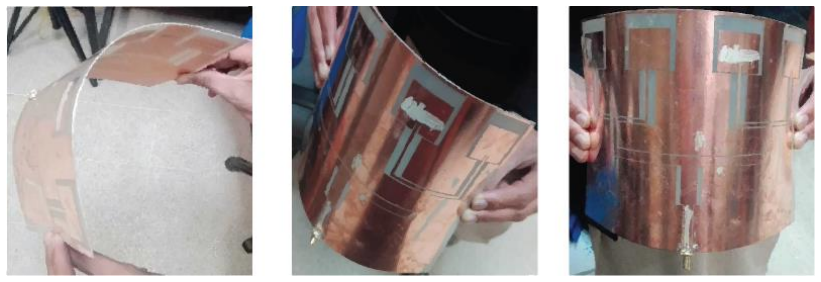
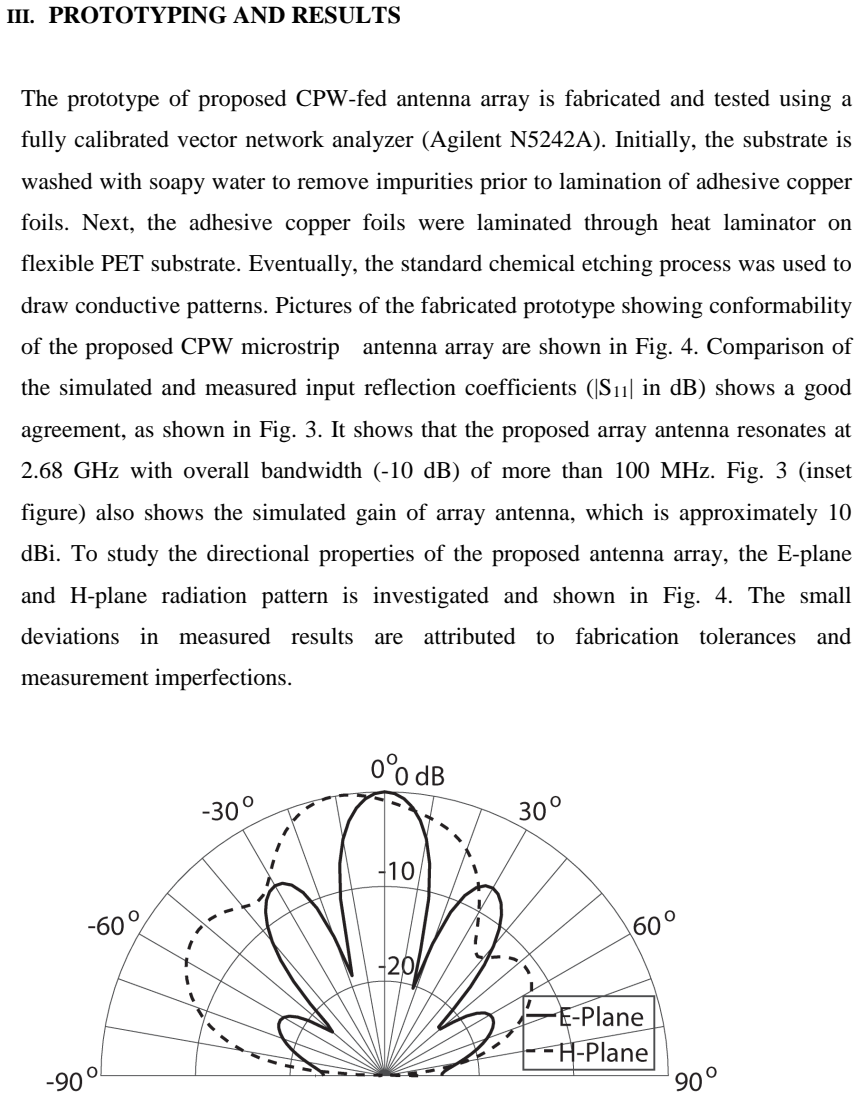
read the original abstract
In this paper, a single layer Coplanar Waveguide-fed microstrip patch antenna array is presented for biomedical applications. The proposed antenna array is realized on a transparent and flexible Polyethylene Terephthalate substrate, has 1x4 radiating elements and measures only 280 x 192 mm2. The antenna array resonates at 2.68 GHz and has a peak-simulated gain of 10 dBi. A prototype is also fabricated, and the conductive patterns are drawn using cost-efficient adhesive copper foils instead of conventional copper or silver nanoparticle ink. The corresponding measured results agree well with the simulated results. The proposed low profile and cost-efficient transmit antenna array has the potential for wearable born-worn applications, including wireless powering of implantable medical devices.
Editorial analysis
A structured set of objections, weighed in public.
Referee Report
Summary. The manuscript presents the design, simulation, and fabrication of a 1x4 CPW-fed microstrip patch antenna array on a flexible PET substrate using adhesive copper foil. The array measures 280 x 192 mm², resonates at 2.68 GHz, achieves a simulated peak gain of 10 dBi, and the fabricated prototype shows measured S-parameters and radiation patterns that agree with simulations. The authors conclude that the low-profile, cost-efficient design has potential for wearable body-worn biomedical applications, including wireless powering of implantable medical devices.
Significance. If the material stability in biomedical environments is confirmed, the work would demonstrate a practical, low-cost fabrication route for flexible antennas suitable for body-worn telemetry. The direct simulation-to-measurement agreement provides basic validation of the design at 2.68 GHz, but the lack of environmental or on-body testing limits the significance for the stated biomedical claims.
major comments (2)
- [Abstract] Abstract and conclusion: the central claim that the array 'has the potential for wearable body-worn applications, including wireless powering of implantable medical devices' rests on the unverified assumption that adhesive copper foil conductivity and adhesion remain stable under moisture, repeated flexing, and skin contact. The manuscript reports only standard laboratory S-parameter and pattern measurements with no material characterization, environmental aging, or on-body tests, leaving the biomedical applicability unsupported.
- [Results] Results section (comparison of simulated vs. measured data): the statement that 'measured results agree well with the simulated results' is presented without error bars, fabrication tolerance analysis, or quantified discrepancy metrics, which weakens the support for the performance claim under realistic deployment conditions.
minor comments (2)
- [Abstract] Abstract: 'wearable born-worn' appears to be a typographical error and should read 'wearable body-worn'.
- [Simulation] The manuscript would benefit from explicit discussion of the PET substrate dielectric properties and copper foil conductivity values used in the simulation model, including any sensitivity analysis.
Simulated Author's Rebuttal
We thank the referee for the constructive comments. We address each major comment below, indicating where revisions to the manuscript are planned.
read point-by-point responses
-
Referee: [Abstract] Abstract and conclusion: the central claim that the array 'has the potential for wearable body-worn applications, including wireless powering of implantable medical devices' rests on the unverified assumption that adhesive copper foil conductivity and adhesion remain stable under moisture, repeated flexing, and skin contact. The manuscript reports only standard laboratory S-parameter and pattern measurements with no material characterization, environmental aging, or on-body tests, leaving the biomedical applicability unsupported.
Authors: We agree that the manuscript contains no material characterization, environmental aging, or on-body tests. The suggestion of potential for wearable biomedical use is based on the known flexibility and low cost of the PET substrate and adhesive copper foil fabrication method. To better align the text with the presented data, we will revise the abstract and conclusion to qualify the applicability statement, noting that further validation of material performance under relevant conditions would be needed. revision: yes
-
Referee: [Results] Results section (comparison of simulated vs. measured data): the statement that 'measured results agree well with the simulated results' is presented without error bars, fabrication tolerance analysis, or quantified discrepancy metrics, which weakens the support for the performance claim under realistic deployment conditions.
Authors: The referee is correct that the comparison is presented qualitatively without error bars or quantified metrics. The agreement is based on visual correspondence of the S-parameter and radiation pattern curves. In the revised manuscript we will add a discussion of observed discrepancies (e.g., any resonant frequency shift or gain difference) together with an estimate of fabrication tolerances arising from manual placement of the adhesive copper foil. revision: yes
Circularity Check
No circularity; standard antenna design and measurement with independent sim/meas comparison
full rationale
The paper describes a CPW microstrip array design on PET, fabricated with adhesive copper foil, simulated at 2.68 GHz with 10 dBi gain, and validated by prototype measurements that agree with simulation. No equations, fitted parameters, predictions, or derivation chain are present. Claims rest on direct fabrication and testing rather than any self-referential reduction. No self-citations or ansatzes are invoked in a load-bearing way. This is a self-contained engineering report against external benchmarks (measured S-parameters and patterns).
Axiom & Free-Parameter Ledger
Reference graph
Works this paper leans on
-
[1]
A Wideband Implantable Antenna for Continuous Health Monitoring in the MedRadio and ISM Bands,
J. Ung and T. Karacolak, "A Wideband Implantable Antenna for Continuous Health Monitoring in the MedRadio and ISM Bands," IEEE Antennas Wireles. Propag. Lett., vol. 11, pp. 1642-1645, 2012
work page 2012
-
[2]
Design of a compact implan table rectenna for wireless pacing applications,
S. M. Asif and B. D. Braaten, "Design of a compact implan table rectenna for wireless pacing applications, " Proc. IEEE Int. Symp. Antennas Propag., Fajardo, PR, USA, Jun. 26 -Jul. 1, 2016, pp. 167–168
work page 2016
-
[3]
A low -cost microstrip antenna array for 60 GHz applications,
D. J. Pimentel and B. A. Cetiner, "A low -cost microstrip antenna array for 60 GHz applications," Proc. IEEE Int . Symp. Antennas Propag. Fajardo, PR, USA, Jun. 26 -Jul. 1, 2016, pp. 397–398
work page 2016
-
[4]
S. M. Asif, et al., "A Novel RF -Powered Wireless Pacing via a Rectenna -Based Pacemaker and a Wearable Transmit-Antenna Array," IEEE Access, vol. 7, pp. 1139-1148, 2019
work page 2019
-
[5]
UWB antenna on 3D printed flexible substrate and foot phantom,
S. Jun, B . Sanz -Izquierdo and M. Summerfield, "UWB antenna on 3D printed flexible substrate and foot phantom," Loughborough Antennas & Propag. Conf. (LAPC), Loughborough, 2015, pp. 1-5
work page 2015
-
[6]
S. M. Asif et al., ‘‘Design and in vivo test of a batteryless and fully wireles s implantable asynchronous pacing system,’’ IEEE Trans. Biomed. Eng., vol. 63, no. 5, pp. 1070 –1081, May 2015
work page 2015
-
[7]
Applicability of Metallic Nanoparticle Inks in RFID Applications,
M. L. Allen, K. Jaakkola, K. Nummila and H. Seppa, "Applicability of Metallic Nanoparticle Inks in RFID Applications," IEEE Trans. Comp. Packag. Tech., vol. 32, no. 2, pp. 325 -332, June 2009
work page 2009
-
[8]
UWB coplanar waveguide -fed-coplanar strips spiral antenna,
A. Omar and R. Shubair, “UWB coplanar waveguide -fed-coplanar strips spiral antenna,” in 2016 10th European Conference on Antennas and Propagation (EuCAP), Apr. 2016, pp. 1 –2
work page 2016
-
[9]
Terahertz spectroscopy and imaging for the detection and identification of illicit drugs,
M. O. AlNabooda, R. M. Shubair, N. R. Rishani, and G. Aldabbagh, “Terahertz spectroscopy and imaging for the detection and identification of illicit drugs,” in Sensors Networks Smart and Emerging Technologies (SENSET), 2017, 2017, pp. 1–4. 36
work page 2017
-
[10]
Ultra-compact dual-polarised UWB MIMO antenna with meandered feeding lines,
M. S. Khan, A. -D. Capobianco, A. Iftikhar, R. M. Shubair, D. E. Anagnostou, and B. D. Braaten, “Ultra-compact dual-polarised UWB MIMO antenna with meandered feeding lines,” IET Microwaves, Antennas & Propagation, vol. 11, no. 7, pp. 997–1002, Feb. 2017
work page 2017
-
[11]
A Compact CSRR -Enabled UWB Diversity Antenna,
M. S. Khan, A. Capobianco, S. M. Asif, D. E. Anagnostou, R. M. Shubair, and B. D. Braaten, “A Compact CSRR -Enabled UWB Diversity Antenna,” IEEE Antennas and Wireless Propagation Letters, vol. 16, pp. 808–812, 2017
work page 2017
-
[12]
Novel miniature wearable microstrip antennas for ISM -band biomedical telemetry,
R. M. Shubair, A. M. AlShamsi, K. Khalaf, and A. Kiourti, “Novel miniature wearable microstrip antennas for ISM -band biomedical telemetry,” in 2015 Loughborough Antennas Propagation Conference (LAPC), 2015, pp. 1–4
work page 2015
-
[13]
Robust adaptive beamforming using LMS algorithm with SMI initialization,
R. M. Shubair, “Robust adaptive beamforming using LMS algorithm with SMI initialization,” in 2005 IEEE Antennas and Propagation Society International Symposium, vol. 4A, Jul. 2005, pp. 2–5 vol. 4A
work page 2005
-
[14]
A simple comparative evaluation of adaptive beam forming algorithms,
G. Nwalozie, V. Okorogu, S. Maduadichie, and A. Adenola, “A simple comparative evaluation of adaptive beam forming algorithms,” International Journal of Engineering and Innovative Technology (IJEIT), vol. 2, no. 7, 2013
work page 2013
-
[15]
Eigen structure based direction of arrival estimation algorithms for smart antenna systems,
M. Bakhar and D. P. Hunagund, “Eigen structure based direction of arrival estimation algorithms for smart antenna systems,” IJCSNS International Journal of Computer Science and Network Security, vol. 9, no. 11, pp. 96–100, 2009. Page 10 of 11
work page 2009
-
[16]
M. Al -Nuaimi, R. Shubair, and K. Al -Midfa, “Direction of arrival estimation in wireless mobile communications using minimum variance distortionless response,” in The Second International Conference on Innovations in Information Technology (IIT’05), 2005
work page 2005
-
[17]
Performance analysis of optimum SMI beamformers for spatial interference rejection,
R. M. Shubair and W. Jassmi, “Performance analysis of optimum SMI beamformers for spatial interference rejection,” in 2006 IEEE International Symposium on Circuits and Systems, May 2006, pp. 4 pp.–4746
work page 2006
-
[18]
Performance a nalysis of SMI adaptive beamforming arrays for smart antenna systems,
R. M. Shubair and W. Jessmi, “Performance a nalysis of SMI adaptive beamforming arrays for smart antenna systems,” in 2005 IEEE Antennas and Propagation Society International Symposium, vol. 1B, 2005, pp. 311–314 vol. 1B
work page 2005
-
[19]
Robust algorithms for direction finding and ad aptive beamforming: performance and optimization,
R. M. Shubair and A. Al -Merri, “Robust algorithms for direction finding and ad aptive beamforming: performance and optimization,” in The 2004 47th Midwest Symposium on Circuits and Systems, 2004. MWSCAS ’04, vol. 2, Jul. 2004, pp. II –589–II–592 vol.2. 25
work page 2004
-
[20]
A convergence study of adaptive beamformin g algorithms used in smart antenna systems,
R. M. Shubair and A. Merri, “A convergence study of adaptive beamformin g algorithms used in smart antenna systems,” in 11th International Symposium on Antenna Technology and Applied Electromagnetics [ANTEM 2005], Jun. 2005, pp. 1–5
work page 2005
-
[21]
Improved smart antenna design using displaced sensor array configuration,
R. M. Shubair, “Improved smart antenna design using displaced sensor array configuration,” Applied Computational Electromagnetics Society Journal, vol. 22, no. 1, p. 83, 2007. 27
work page 2007
-
[22]
R. M. Shubair and R. S. A. Nuaimi, “A Displaced Sensor Array Configuration for Estimating Angles of Arrival of Narrowband Sources under Grazing Incidence Conditions,” in 2007 IEEE International Conference on Signal Processing and Communications, Nov. 2007, pp. 432–435
work page 2007
-
[23]
Accurate detection and estimation of radio signals using a 2d novel smart antenna array,
A. Hakam and R. M. Shubair, “Accurate detection and estimation of radio signals using a 2d novel smart antenna array,” in 2013 IEEE 20th International Confe rence on Electronics, Circuits, and Systems (ICECS), Dec. 2013, pp. 807–810
work page 2013
-
[24]
Robust algorithms for doa estimation and adaptive beamforming in wireless mobile communications,
R. M. Shubair, K. AlMidfa, A. Al -Marri, and M. Al -Nuaimi, “Robust algorithms for doa estimation and adaptive beamforming in wireless mobile communications,” International Journal of Business Data Communications and Networking (IJBDCN), vol. 2, no. 4, pp. 34 – 45, 2006
work page 2006
-
[25]
On MMSE Methods for blind identification of OFDM based SIMO systems,
F. O. Alayyan, R. M. Shubair, Y. H. Leung, A. M. Zoubir, and O. Alketbi, “On MMSE Methods for blind identification of OFDM based SIMO systems,” in 2009 IFIP Internatio nal Conference on Wireless and Optical Communications Networks, Apr. 2009, pp. 1 –5
work page 2009
-
[26]
In vivo wireless body communications: State -of-the-art and future directions,
R. M. Shubair and H. Elayan, “In vivo wireless body communications: State -of-the-art and future directions,” in 2015 Loughborough Antennas & Propagation Conference (LAPC), PP. 1-5
work page 2015
-
[27]
A Simple Comparative Evaluation of Adaptive Beam forming Algorithms,
G. Nwalozie, V. Okorogu, S. Maduadichie, and A. Adenola, “A Simple Comparative Evaluation of Adaptive Beam forming Algorithms,” in International Journal of Engineering and Innovative Technology (IJEIT), 2013
work page 2013
-
[28]
Deployment c hallenges of femtocells in future indoor wireless networks,
L. Mohjazi, M. Al -Qutayri, H. Barada, K. Poon, and R. Shubair, “Deployment c hallenges of femtocells in future indoor wireless networks,” in 2011 IEEE GCC Conference and Exhibition (GCC), pp. 405-408, 2011
work page 2011
-
[29]
W. Che, C. Li, P. Russer, and Y. L. Chow, “P ropagation and band broadening effect of planar integrated ridged waveguide in multilayer dielectric substrates,” in 2008 IEEE MTT -S International Microwave Symposium Digest, pp. 217-220, 2008
work page 2008
-
[30]
Direction of arrival estimation in a multipath environment: an overview and a new contribution,
E. M. Al -Ardi, R. M. Shubair, and M. E. Al -Mualla, “Direction of arrival estimation in a multipath environment: an overview and a new contribution,” in Applied Computational Electromagnetics Society Journal, vol. 21, no. 3, pp. 226-239, 2006. Page 11 of 11
work page 2006
-
[31]
M. A. Al -Nuaimi, R. M. Shubair, and K. O. Al -Midfa, “Direction of arrival e stimation in wireless mobile communications using minimum variance distortionless response,” in The Second International Conference on Innovations in Information Technology, 2005
work page 2005
-
[32]
Comparative study of machine learning algorithms for breast cancer detection and diagnosis,
D. Bazazeh and R. Shubair, “Comparative study of machine learning algorithms for breast cancer detection and diagnosis,” in 2016 5th International Conference on Electronic Devices, Systems and Applications, 2016
work page 2016
discussion (0)
Sign in with ORCID, Apple, or X to comment. Anyone can read and Pith papers without signing in.