N-Body Simulations of Gas-free Disc Galaxies with SMBH Seed in Binary Systems
Pith reviewed 2026-05-25 15:56 UTC · model grok-4.3
The pith
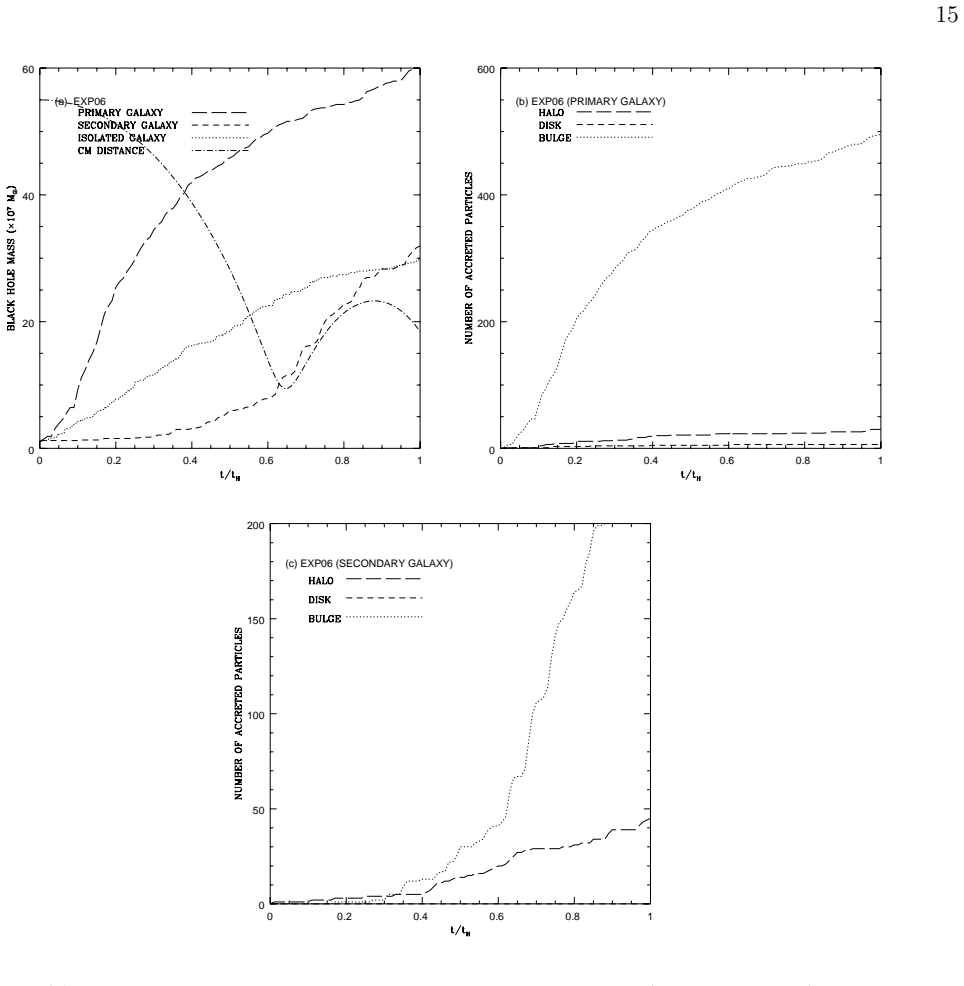
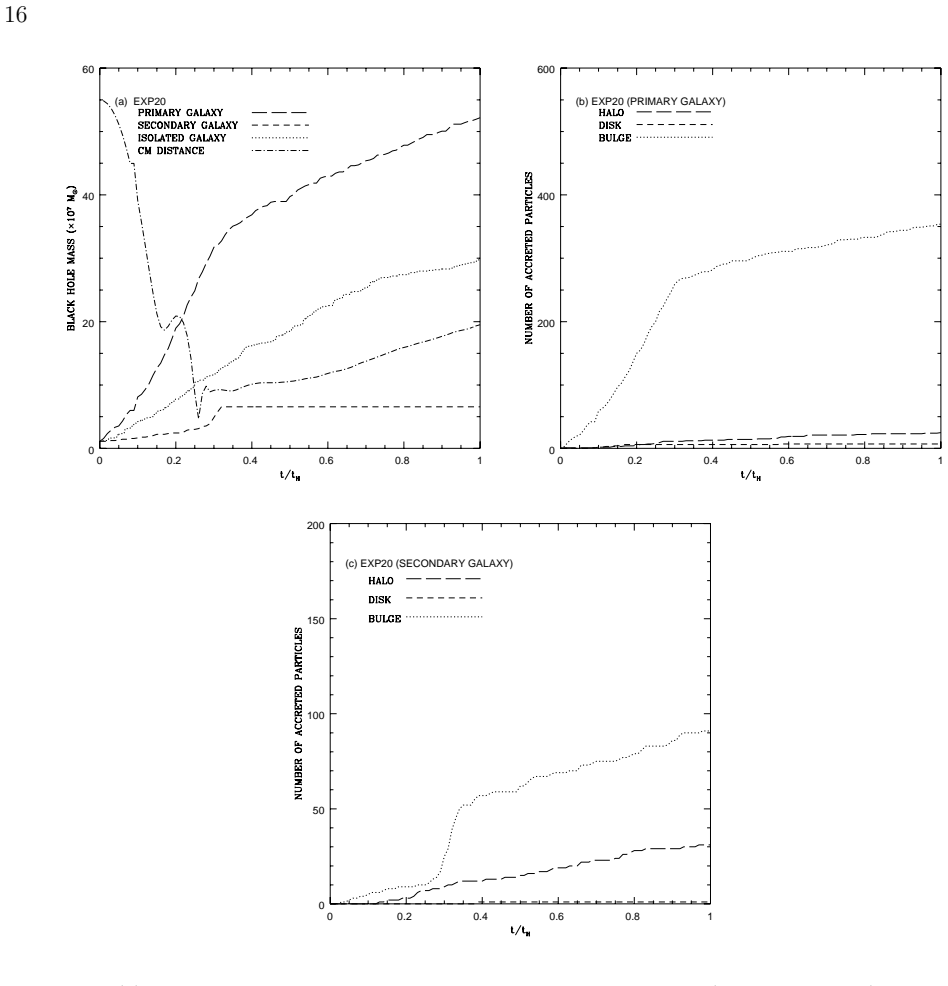
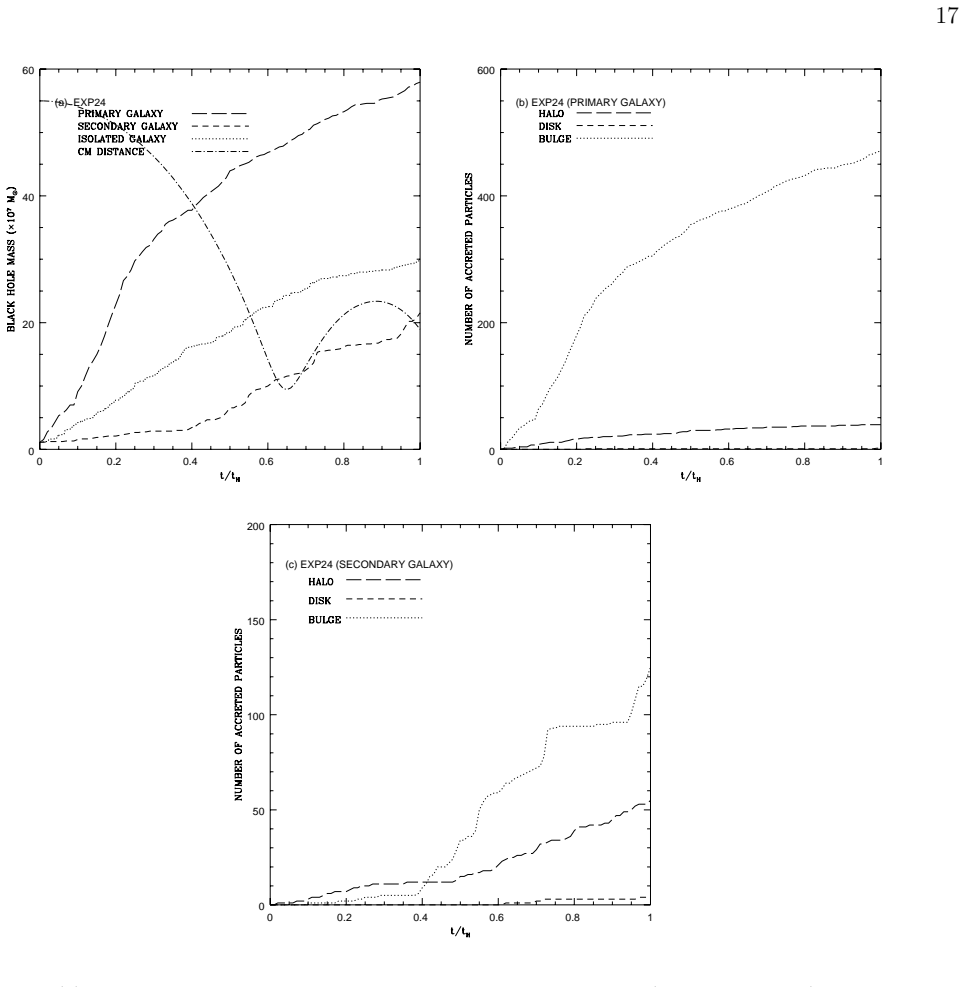
N-body simulations of merging gas-free galaxies show the primary SMBH seed growing 52 to 64 times its initial mass while the secondary grows 6 to 33 times.
A machine-rendered reading of the paper's core claim, the machinery that carries it, and where it could break.
Core claim
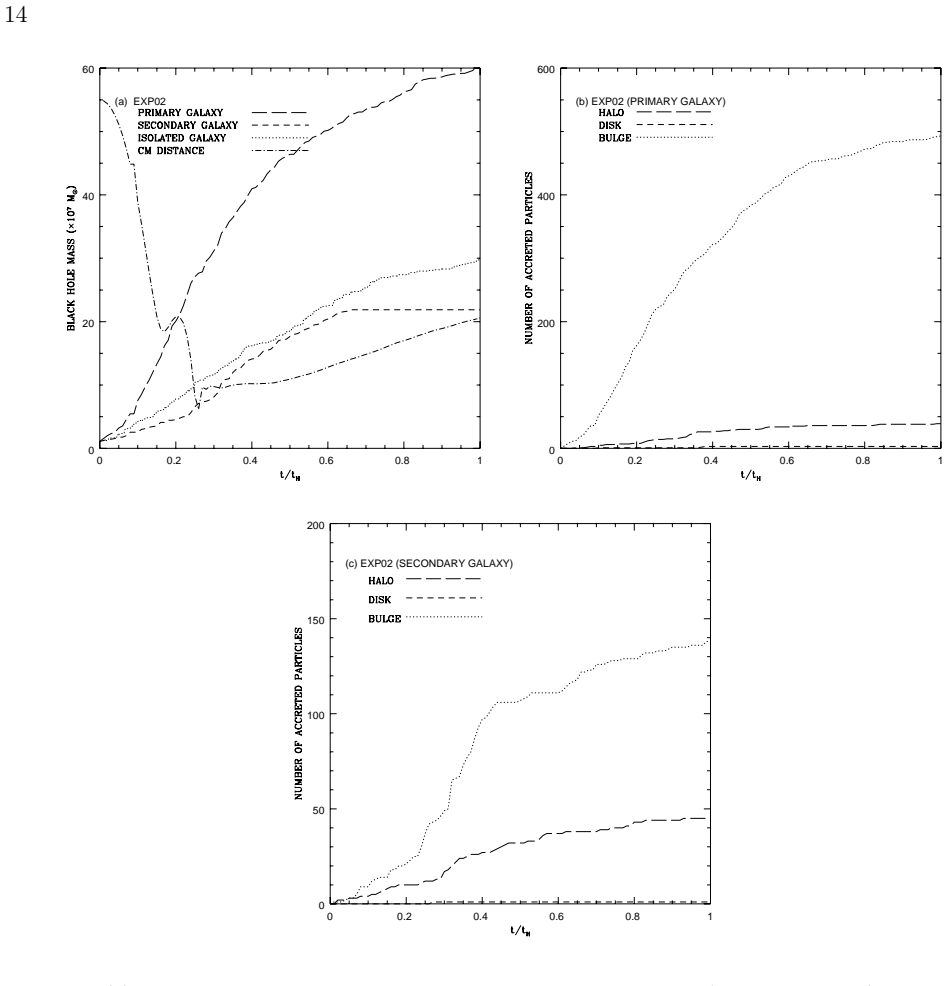
In these simulations the merger of the primary and secondary discs can result in a final normal disc or a final warped disc that is thicker and larger than the initial disc. The tidal effects modify the evolution of the SMBH in the primary and secondary galaxy differently, with the primary SMBH mass increasing by a factor of 52 to 64 and the secondary by 6 to 33, most accreted particles coming from the bulge and halo.
What carries the argument
N-body particle accretion onto central SMBH seeds during galaxy merger, driven by tidal forces from the interaction of two Milky Way-mass disc galaxies on eccentric prograde orbits.
If this is right
- The final galaxy disc is thicker and larger than the initial discs.
- Most accreted mass for the SMBHs comes from the bulge and halo, depleting those components.
- The merger can produce either a normal or a warped final disc.
- In some cases the secondary SMBH is ejected from the merged galaxy.
- This growth pattern from stellar and dark matter particles may account for SMBHs observed in bulgeless galaxies.
Where Pith is reading between the lines
- If real mergers follow similar dynamics, the mass ratio of black holes in post-merger galaxies would reflect the primary-secondary asymmetry seen here.
- The depletion of bulge particles by accretion could contribute to the formation of bulgeless galaxies hosting SMBHs.
- Testing different initial mass ratios or orbit parameters could reveal how sensitive the growth factors are to those choices.
- Ejected SMBHs might appear as offset or wandering black holes in some galaxies.
Load-bearing premise
The specific initial conditions including equal galaxy masses, eccentric prograde orbits, and coplanar or polar disc orientations accurately represent the typical conditions of real galaxy mergers.
What would settle it
Detection of post-merger galaxies where the central black hole masses do not show growth factors in the 52-64 range for the more massive progenitor and 6-33 for the less massive one, or where bulges are not depleted in proportion to black hole growth.
Figures
read the original abstract
We have shown the outcome of N-body simulations of the interactions of two disc galaxies without gas with the same mass. Both disc galaxies have halos of dark matter, central bulges and initial supermassive black hole (SMBH) seeds at their centers. The purpose of this work is to study the mass and dynamical evolution of the initial SMBH seed during a Hubble cosmological time. It is a complementation of our previous paper with different initial orbit conditions and by introducing the SMBH seed in the initial galaxy. The disc of the secondary galaxy has coplanar or polar orientation in relation to the disc of the primary galaxy and their initial orbit are eccentric and prograde. The primary and secondary galaxies have mass and size of Milky Way with an initial SMBH seed. We have found that the merger of the primary and secondary discs can result in a final normal disc or a final warped disc. After the fusion of discs, the final one is thicker and larger than the initial disc. The tidal effects are very important, modifying the evolution of the SMBH in the primary and secondary galaxy differently. The mass of the SMBH of the primary galaxy have increased by a factor ranging from 52 to 64 times the initial seed mass, depending on the experiment. However, the mass of the SMBH of the secondary galaxy have increased by a factor ranging from 6 to 33 times the initial SMBH seed mass, depending also on the experiment. Most of the accreted particles have come from the bulge and from the halo, depleting their particles. This could explain why the observations show that the SMBH with masses of approximately $10^6 M_\odot$ are found in many bulgeless galaxies. Only a small number of the accreted particles has come from the disc. In some cases of final merging stage of the two galaxies, the final SMBH of the secondary galaxy was {ejected out of the galaxy}.
Editorial analysis
A structured set of objections, weighed in public.
Referee Report
Summary. The paper reports N-body simulations of the merger over a Hubble time of two gas-free Milky Way-mass disc galaxies, each with a central SMBH seed, on eccentric prograde orbits with either coplanar or polar disc orientations. It finds that the primary SMBH grows by factors of 52–64 and the secondary by 6–33, with most accreted particles originating from the bulge and halo components; the merged remnant is a thicker, larger disc that may be warped or normal, and the secondary SMBH is sometimes ejected.
Significance. If the numerical results are robust, the work quantifies substantial SMBH seed growth via stellar accretion in dry mergers and offers a dynamical explanation for the observed population of ~10^6 M_⊙ SMBHs in bulgeless galaxies. The differential growth between primary and secondary and the reported ejection cases add concrete dynamical outcomes that complement earlier simulations with different orbital setups.
major comments (2)
- [Methods/Simulation Setup] Simulation setup (methods section): the manuscript provides no information on particle number per component, gravitational softening lengths, time-stepping criteria, or any convergence tests. These parameters are load-bearing for the central claim that the quoted growth factors (52–64× and 6–33×) are physical rather than numerical artifacts.
- [Results/SMBH mass evolution] Results on mass growth (abstract and § on SMBH evolution): the reported accretion is stated to come mostly from bulge and halo, yet no quantitative breakdown (e.g., fraction of accreted mass per component or time evolution of the density profiles) is supplied to support the claim that disc particles contribute only a small number.
minor comments (2)
- [Abstract] Abstract contains subject-verb agreement errors ('the mass ... have increased') and awkward phrasing that should be corrected for clarity.
- [Results/Disc evolution] The statement that the final disc is 'thicker and larger than the initial disc' would benefit from a quantitative comparison (e.g., scale-height or radial extent before/after merger) rather than a qualitative description.
Simulated Author's Rebuttal
We thank the referee for the detailed and constructive report. We address each major comment below. Both points identify genuine omissions in the current manuscript that we will correct in revision.
read point-by-point responses
-
Referee: [Methods/Simulation Setup] Simulation setup (methods section): the manuscript provides no information on particle number per component, gravitational softening lengths, time-stepping criteria, or any convergence tests. These parameters are load-bearing for the central claim that the quoted growth factors (52–64× and 6–33×) are physical rather than numerical artifacts.
Authors: We agree that the methods section is incomplete on these points. The original submission omitted the particle counts (N_halo, N_bulge, N_disc per galaxy), Plummer softening lengths, integration time-step criteria, and any resolution or convergence tests. In the revised manuscript we will add a dedicated subsection with these parameters together with a brief statement on the tests performed to verify that the reported SMBH growth factors are not dominated by numerical effects. revision: yes
-
Referee: [Results/SMBH mass evolution] Results on mass growth (abstract and § on SMBH evolution): the reported accretion is stated to come mostly from bulge and halo, yet no quantitative breakdown (e.g., fraction of accreted mass per component or time evolution of the density profiles) is supplied to support the claim that disc particles contribute only a small number.
Authors: The manuscript currently states only that “most” accreted particles originate from bulge and halo and that “only a small number” come from the disc, without supplying the actual fractions or supporting density-profile time series. We will add, in the revised results section, a table giving the percentage of accreted mass contributed by each component for every run and, where space permits, a figure showing the evolution of the component density profiles. This will make the quantitative support for the claim explicit. revision: yes
Circularity Check
No circularity: results are direct numerical outputs
full rationale
The paper consists of N-body simulation experiments whose reported SMBH mass growth factors (52-64× primary, 6-33× secondary) are explicit outputs of the runs under author-chosen initial conditions. No analytical derivation chain exists that reduces by construction to fitted parameters, self-citations, or renamed inputs. The single reference to a prior paper is described only as complementary and does not support any load-bearing claim. The central results remain independent of the inputs once the simulations are executed.
Axiom & Free-Parameter Ledger
free parameters (3)
- initial SMBH seed mass
- galaxy mass and size
- initial orbit eccentricity and orientation
axioms (2)
- standard math Newtonian gravity and collisionless dynamics govern the N-body evolution
- domain assumption No gas is present and therefore no dissipative processes or star formation occur
Reference graph
Works this paper leans on
- [1]
- [2]
-
[3]
Tremmel, M., Governato, F., Volonteri, M., Quinn, T. R. & Pontzen, A., 2018, MNRAS 475, 4967
work page 2018
-
[4]
Wadsley, J., 2018, AJ, 860, 20
work page 2018
- [5]
-
[6]
Oh, S.H., Kim, W., Lee, H. M. & Kim, J. 2008, ApJ 683, 94
work page 2008
- [7]
-
[8]
Lotz, J.M., Jonsson, P., Cox, T.J. & Primack, J.R. 2010, MNRAS, 404, 575
work page 2010
- [9]
- [10]
-
[11]
& Junqueira, S., 2001, A & A, 366, 418
Chan, R. & Junqueira, S., 2001, A & A, 366, 418
work page 2001
- [12]
-
[13]
& Junqueira, S., 2014, A& A 567, 17 21
Chan, R. & Junqueira, S., 2014, A& A 567, 17 21
work page 2014
-
[14]
& Dubinski, J., 1995 MNRAS 277, 1341
Kuijken, K. & Dubinski, J., 1995 MNRAS 277, 1341
work page 1995
-
[15]
& White, S.D.M., 2001, New Astronomy 6, 79
Springel, V., Yoshida, N. & White, S.D.M., 2001, New Astronomy 6, 79
work page 2001
-
[16]
and Spurzen, R., 2017 ApJ, 834, 195
Li, S., Liu, F.K., Berczik, P. and Spurzen, R., 2017 ApJ, 834, 195
work page 2017
-
[17]
and Wadsley, J., 2007 Science 316, 1874
Quinn, T. and Wadsley, J., 2007 Science 316, 1874
work page 2007
-
[18]
Cox, T.J., Robertson, B., and Li, Y., 2006 ApJ 652, 864
work page 2006
-
[19]
Springel, V., 2005 ApJ 630, 705
work page 2005
-
[20]
and Frigo, M., 2018 ApJ 864, 113
Rantala, A., Johansson, P.H., Naab, T., Thomas, J. and Frigo, M., 2018 ApJ 864, 113
work page 2018
-
[21]
and Callegari, S., 2012 ApJ 756, 30
Mayer, L., Nitadori, K. and Callegari, S., 2012 ApJ 756, 30
work page 2012
-
[22]
and Wadsley, J., 2009 ApJ, 696, L89
Callegari, S., Mayer, L., Kazantzidis, S., Colpi, M., Governato, F., Quinn, T. and Wadsley, J., 2009 ApJ, 696, L89
work page 2009
-
[23]
and Teyssier, R., 2013 MNRAS 429, 3114
Chapon, D., Mayer, L. and Teyssier, R., 2013 MNRAS 429, 3114
work page 2013
-
[24]
and Okumura, S.K., 1991, Nature 354, 212
Ebisuzaki, T., Makino, J. and Okumura, S.K., 1991, Nature 354, 212
work page 1991
-
[25]
and Ebisuzaki, T., 1996, ApJ 465, 527
Makino, J. and Ebisuzaki, T., 1996, ApJ 465, 527
work page 1996
-
[26]
Ebisuzaki, T., 1993 PASJ 45, 303
work page 1993
-
[27]
and Maraschi, L.,1994 MNRAS 271, 317
Governato, F., Colpi, M. and Maraschi, L.,1994 MNRAS 271, 317
work page 1994
-
[28]
and Berczik, P., 2018 ApJ 868, 97
Khan, F.M., Capelo, P.R., Mayer, L. and Berczik, P., 2018 ApJ 868, 97
work page 2018
-
[29]
Quinn, T., 2016 A&A 592, 62 Di Matteo,T., Colberg, J., Springel, V., Hernquist, L. and Sijacki, D. 2008 ApJ 676, 33
work page 2016
- [30]
discussion (0)
Sign in with ORCID, Apple, or X to comment. Anyone can read and Pith papers without signing in.