A decoupled staggered scheme for the shallow water equations
Pith reviewed 2026-05-25 15:23 UTC · model grok-4.3
The pith
A staggered-grid scheme for the shallow water equations with topography preserves water height positivity, constant states, and is consistent with the entropy inequality.
A machine-rendered reading of the paper's core claim, the machinery that carries it, and where it could break.
Core claim
We present a first order scheme based on a staggered grid for the shallow water equations with topography in two space dimensions, which enjoys several properties: positivity of the water height, preservation of constant states, and weak consistency with the equations of the problem and with the associated entropy inequality.
What carries the argument
The decoupled staggered-grid discretization that separates the updates to achieve positivity, steady-state preservation, and weak consistency at once.
If this is right
- The scheme can simulate flows without producing negative water heights.
- It preserves still-water equilibria exactly, even with varying topography.
- The method remains consistent with the continuous equations in a weak sense.
- It satisfies a discrete version of the entropy inequality.
Where Pith is reading between the lines
- If the decoupling works in 2D, similar staggered approaches might extend to three dimensions or other hyperbolic systems with source terms.
- Practical implementations might benefit from combining this with higher-order reconstructions while retaining the base properties.
- Tests on standard benchmarks like dam-break problems would verify the listed properties numerically.
Load-bearing premise
The staggered-grid discretization can be constructed and decoupled in two space dimensions so that positivity, steady-state preservation, and weak consistency hold simultaneously.
What would settle it
A specific two-dimensional test case with varying topography where the computed water height becomes negative at some cell or a constant state is not preserved to machine precision.
Figures
read the original abstract
We present a first order scheme based on a staggered grid for the shallow water equations with topography in two space dimensions, which enjoys several properties: positivity of the water height, preservation of constant states, and weak consistency with the equations of the problem and with the associated entropy inequality.
Editorial analysis
A structured set of objections, weighed in public.
Referee Report
Summary. The manuscript presents a first-order decoupled staggered-grid finite-volume scheme for the two-dimensional shallow water equations with topography. It establishes three properties: positivity of the water height under a CFL restriction, exact preservation of constant (lake-at-rest) states via cancellation of pressure and topography gradients on staggered interfaces, and weak consistency with the integral form of the equations and the entropy inequality obtained through summation-by-parts identities.
Significance. If the stated properties hold, the work supplies a simple, fully decoupled scheme that simultaneously satisfies positivity, steady-state preservation, and weak consistency without additional corrections or limiters. This is useful for practical geophysical simulations. The manuscript supplies explicit proofs of the three properties together with numerical verification, which strengthens the contribution to the literature on structure-preserving discretizations for hyperbolic balance laws.
minor comments (3)
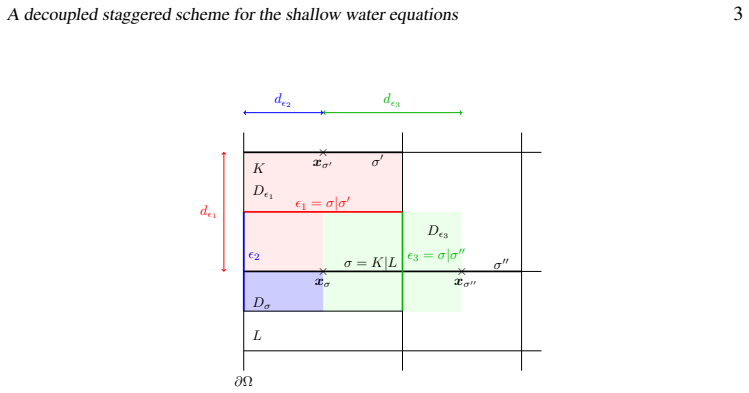
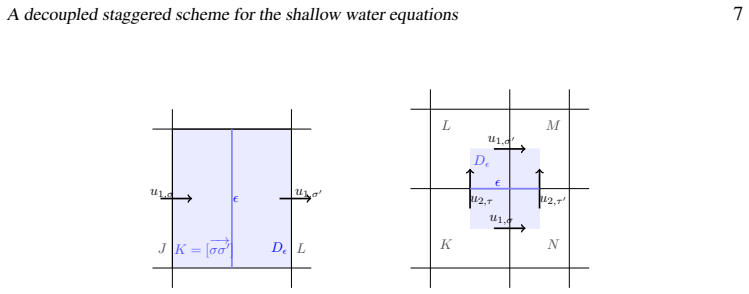
- [§2] §2: The placement of the staggered variables (velocity on edges, height at centers) is described in text only; a single schematic diagram would improve readability of the 2D construction.
- [§3.2] Eq. (3.12) and the subsequent summation-by-parts argument: the boundary terms arising from the decoupled updates are stated to vanish, but the precise treatment of the domain boundary conditions is not repeated in this section; a short cross-reference would help.
- [Table 1] Table 1 (convergence rates): the L1 errors for the lake-at-rest test are reported to machine precision, but the table caption does not explicitly note that the test uses the exact steady-state initial data; this is a minor clarity point.
Simulated Author's Rebuttal
We thank the referee for the careful reading and positive assessment of our manuscript. The recommendation for minor revision is noted. No specific major comments appear in the report, so we have no points requiring rebuttal or clarification at this time. We will address any minor comments or suggestions in the revised version.
Circularity Check
No circularity: properties derived from explicit discretization and standard identities
full rationale
The scheme is constructed explicitly via staggered placement, well-balanced flux definitions for topography, and decoupled updates. Positivity follows from CFL restriction on the explicit update; lake-at-rest preservation follows from exact cancellation of pressure and topography terms at interfaces; weak consistency follows from discrete summation-by-parts identities that recover the integral form. These steps are independent of the target properties and do not reduce to self-definition, fitted inputs renamed as predictions, or load-bearing self-citations. No equations or proofs in the manuscript collapse the claimed results to the inputs by construction.
Axiom & Free-Parameter Ledger
Reference graph
Works this paper leans on
-
[1]
A potential enstrophy and energy conserving scheme for the shallow water equations
A rakaw a, A., and Lamb, V . A potential enstrophy and energy conserving scheme for the shallow water equations. Monthly Weather Review 109 (1981), 18–36
work page 1981
-
[2]
B ona ventura, L., and Ringler, T. Analysis of discrete shallow-water models on geodesic delaunay grids with c-type staggering.Monthly Weather Review 133, 8 (2005), 2351–2373
work page 2005
-
[3]
Nonlinear Stability of finite volume methods for hyperbolic conservation laws
B ouchut, F. Nonlinear Stability of finite volume methods for hyperbolic conservation laws. Birkhauser, 2004
work page 2004
-
[4]
A software components library for the computation of fluid flows
CALIF 3S. A software components library for the computation of fluid flows. https://gforge.irsn.fr/gf/project/califs
-
[5]
An explicit staggered finite volume scheme for the shallow water equations
D oyen, D., and Gunaw an, H. An explicit staggered finite volume scheme for the shallow water equations. In Finite volumes for complex applications. VII. Methods and theoret- ical aspects, vol. 77 of Springer Proc. Math. Stat. Springer, Cham, 2014, pp. 227–235
work page 2014
-
[6]
On the weak consistency of finite volumes schemes for conservation laws on general meshes
G allou¨et, T., H erbin, R., and Latch´e. On the weak consistency of finite volumes schemes for conservation laws on general meshes. under revision (2019). Available from: https://hal.archives-ouvertes.fr/hal-02055794
work page 2019
-
[7]
G allou¨et, T., Herbin, R., L atch´e, J.-C., and Mallem, K. Convergence of the marker- and-cell scheme for the incompressible Navier-Stokes equations on non-uniform grids. Foundations of Computational Mathematics 18 (2018), 249–289
work page 2018
-
[8]
Numerical simulation of shallow water equations and related models
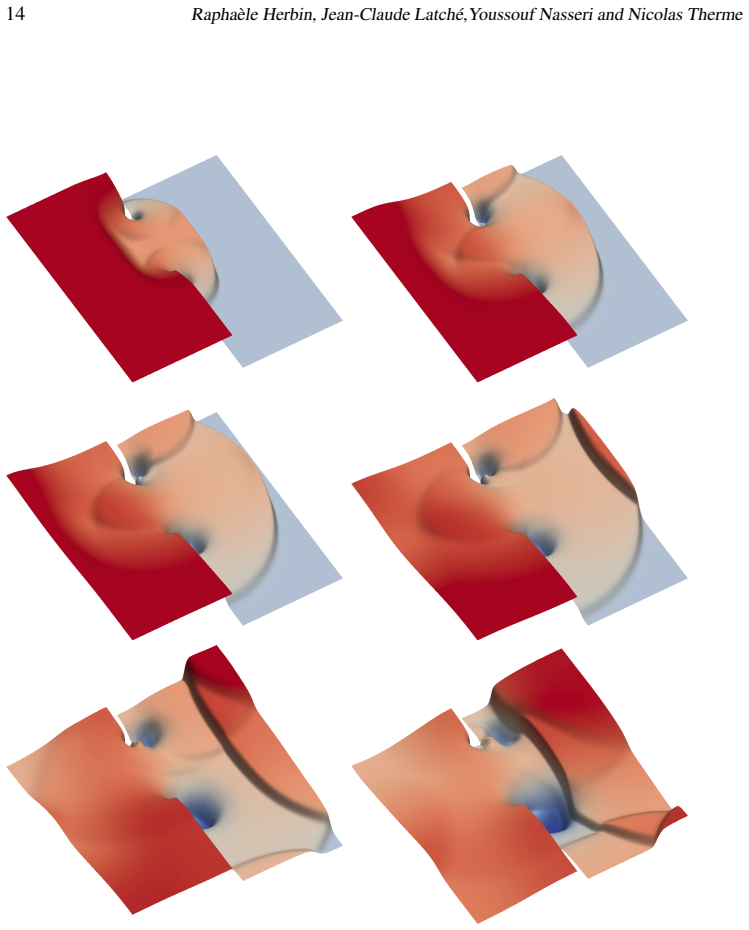
G unaw an, H. Numerical simulation of shallow water equations and related models . PhD thesis, Université Paris-Est and Institut Teknologi Bandung, 2015. 14 Raphaèle Herbin, Jean-Claude Latché,Y oussouf Nasseri and Nicolas Therme Figure 4: Partial dam break – Height obtained at t = 4, t = 8, t = 10, t = 12, t = 16 and t = 20 with a mesh obtained (by supre...
work page 2015
-
[9]
On some implicit and semi-implicit staggered schemes for the shallow water and Euler equations
H erbin, R., Kheriji, W.,and Latch´e, J.-C. On some implicit and semi-implicit staggered schemes for the shallow water and Euler equations. ESAIM: Mathematical Modelling and Numerical Analysis 48 (2014), 1807–1857
work page 2014
-
[10]
Explicit staggered schemes for the compress- ible Euler equations
H erbin, R., Latch´e, J.-C., and Nguyen, T. Explicit staggered schemes for the compress- ible Euler equations. ESAIM: Proceedings 40 (2013), 83–102
work page 2013
-
[11]
H erbin, R., L atch´e, J.-C., and Nguyen, T. Consistent segregated staggered schemes with explicit steps for the isentropic and full Euler equations. ESAIM: Mathematical Modelling and Numerical Analysis 52 (2018), 893–944
work page 2018
-
[12]
A staggered conservative scheme for every Froude number in rapidly varied shallow water flows
S telling, G., and Duinmeijer, S. A staggered conservative scheme for every Froude number in rapidly varied shallow water flows. International Journal for Numerical Methods in Fluids 43 (2003), 1329–1354. Raphaèle Herbin and Youssouf Nasseri Aix-Marseille Université, Institut de Mathématiques de Marseille, 39 rue Joliot Curie 13453 Marseille raphaele.herbi...
work page 2003
discussion (0)
Sign in with ORCID, Apple, or X to comment. Anyone can read and Pith papers without signing in.