Re-annotation of cough events in the AMI corpus
Pith reviewed 2026-05-25 14:14 UTC · model grok-4.3
The pith
Re-annotating cough locations in the AMI corpus yields 1369 events released with an open annotation tool.
A machine-rendered reading of the paper's core claim, the machinery that carries it, and where it could break.
Core claim
A reusable re-annotation workflow implemented through a custom MATLAB GUI produces a corrected set of cough location labels for the AMI corpus containing 1369 individual cough events, with both the labels and the annotation tool released for public download and use in audio event detection research.
What carries the argument
A purpose-built MATLAB GUI for importing audio signals and marking cough event locations according to a defined reusable methodology.
If this is right
- Developers can train and benchmark new machine-learning models for cough detection directly on the released 1369-event set.
- The public labels remove the need for each research group to repeat the annotation effort on the same source material.
- The released GUI and workflow can be applied to other audio corpora that contain similar non-speech events.
- Standardized evaluation of detection algorithms becomes possible because all groups start from the same annotated events.
Where Pith is reading between the lines
- The dataset may support studies that combine cough counts with meeting metadata already present in the AMI recordings.
- Releasing the tool lowers the barrier for groups that want to correct annotations in other meeting or conversation corpora.
- If the labels prove stable under further review, they could serve as a baseline for testing automated pre-labeling methods before human correction.
Load-bearing premise
The single manual pass through the recordings by the authors correctly identifies genuine cough events without independent checks from other listeners or clinicians.
What would settle it
An independent listening test on a random sample of the annotated segments that reports a substantial fraction of the 1369 events as either non-coughs or missed coughs.
Figures



read the original abstract
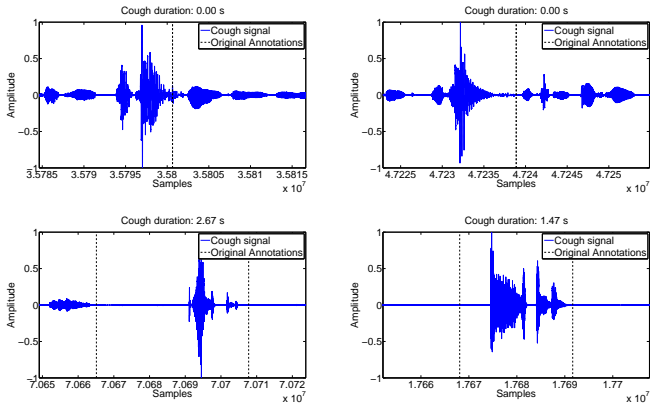
Cough sounds act as an important indicator of an individual's physical health, often used by medical professionals in diagnosing a patient's ailments. In recent years progress has been made in the area of automatically detecting cough events and, in certain cases, automatically identifying the ailment associated with a particular cough sound. Ethical and sensitivity issues associated with audio recordings of coughs makes it more difficult for this data to be made publicly available. However, without the public availability of a reliable database of cough sounds, developments in the area of audio event detection are likely to be hampered. The purpose of this paper is to spread awareness of a database containing a large amount of naturally occurring cough sounds that can be used for the implementation, evaluation, and comparison of new machine learning algorithms that allow for audio event detection associated with cough sounds. Using a purpose built GUI designed in MATLAB, the re-annotation procedure followed a reusable methodology that allowed for quick and efficient importing and marking of audio signals, resulting in a re-annotated version of the Augmented Multi-party Interaction (AMI) corpus' cough location annotations, with 1369 individual cough events. All cough annotations and the re-annotation tool are made available for download and public use.
Editorial analysis
A structured set of objections, weighed in public.
Referee Report
Summary. The manuscript describes a re-annotation of cough events in the Augmented Multi-party Interaction (AMI) corpus. Using a purpose-built MATLAB GUI, the authors followed a reusable procedure to mark cough locations in the audio signals, producing annotations for 1369 individual cough events. The resulting annotations and the re-annotation tool are released publicly to support development of audio event detection algorithms for cough sounds.
Significance. If the annotations prove accurate, the work is significant for providing one of the larger publicly available collections of naturally occurring cough events. This directly addresses the scarcity of such datasets caused by ethical and privacy constraints, enabling reproducible training, evaluation, and comparison of machine-learning methods for cough detection in health-monitoring applications.
major comments (1)
- [Abstract] Abstract: the claim that the release constitutes a 'reliable database' of cough sounds is not supported by any quantitative checks on annotation consistency, inter-annotator agreement, error rates, or agreement with the original AMI labels; the methodology is described only at a high level without such validation.
minor comments (2)
- [Abstract] The abstract states that 1369 events were identified but does not report how this count was obtained, whether it differs from the original AMI annotations, or any summary statistics on the re-annotated set (e.g., duration distribution or per-meeting breakdown).
- The manuscript would benefit from a short section or paragraph explicitly comparing the new annotations to the original AMI cough locations to quantify the extent of the re-annotation effort.
Simulated Author's Rebuttal
We thank the referee for the review and the recommendation for minor revision. We address the single major comment below.
read point-by-point responses
-
Referee: [Abstract] Abstract: the claim that the release constitutes a 'reliable database' of cough sounds is not supported by any quantitative checks on annotation consistency, inter-annotator agreement, error rates, or agreement with the original AMI labels; the methodology is described only at a high level without such validation.
Authors: We agree that the abstract's phrasing of a 'reliable database' is not supported by quantitative validation such as inter-annotator agreement, error rates, or comparison to the original AMI labels. The re-annotation was performed by following a consistent single-annotator procedure with the MATLAB GUI, but no such metrics were computed or reported. We will revise the abstract to remove the word 'reliable' and instead describe the release as a publicly available re-annotation of 1369 cough events produced via the documented GUI-based procedure. The methodology section already provides the procedural details at the level implemented; we do not claim additional validation beyond that. revision: yes
Circularity Check
No significant circularity identified
full rationale
The paper describes a manual re-annotation of cough events in the AMI corpus using a purpose-built MATLAB GUI, resulting in 1369 annotated events with public release of the annotations and tool. No equations, derivations, fitted parameters, predictions, or self-citation chains appear in the abstract or described content. The central claim is production and release of the re-annotated data, which is satisfied directly by the reported procedure without any reduction to inputs by construction or load-bearing self-references. This is a data-release paper with no mathematical or modeling elements that could exhibit the enumerated circularity patterns.
Axiom & Free-Parameter Ledger
axioms (1)
- domain assumption Manual annotation by the authors accurately identifies cough events in the audio
Reference graph
Works this paper leans on
-
[1]
Survey on speech emot ion recog- nition: Features, classification schemes, and databases,
M. El Ayadi, M. S. Kamel, and F. Karray, “Survey on speech emot ion recog- nition: Features, classification schemes, and databases,” Pattern Recogni- tion, vol. 44, no. 3, pp. 572–587, 2011
work page 2011
-
[2]
S. M. Schappert and C. W. Burt, “Ambulatory care visits to phys ician of- fices, hospital outpatient departments, and emergency depart ments: United states, 2001-02.” Vital and Health Statistics. Series 13, Data from the Na- tional Health Survey , no. 159, pp. 1–66, 2006
work page 2001
-
[3]
Classification of human cough sig- nals using spectro-temporal gabor filterbank features,
J. Schr¨ oder, J. Anemiiller, and S. Goetze, “Classification of human cough sig- nals using spectro-temporal gabor filterbank features,” in 2016 IEEE Inter- national Conference on Acoustics, Speech and Signal Proces sing (ICASSP) , March 2016, pp. 6455–6459
work page 2016
-
[4]
Unleashing the killer corpus: experiences in creatin g the multi-everything ami meeting corpus,
J. Carletta, “Unleashing the killer corpus: experiences in creatin g the multi-everything ami meeting corpus,” Language Resources and Evaluation , vol. 41, no. 2, pp. 181–190, 2007
work page 2007
-
[5]
paulleamy/ami-cough-annotations,
P. Leamy, “paulleamy/ami-cough-annotations,” Mar 2019. [Online ]. Available: https://github.com/paulleamy/AMI-Cough-Annotations .git 4 0 2000 4000 6000 8000−1 −0.5 0 0.5 EN2001a.Lapel−2 Sample Amplitude Figure 4: GUI created to carry out the re-annotation procedure of coug h events in the AMI corpus. 5
work page 2019
discussion (0)
Sign in with ORCID, Apple, or X to comment. Anyone can read and Pith papers without signing in.