Effect of different polarity solvents on total phenols and flavonoids content, and In-vitro antioxidant properties of flowers extract from Aurea Helianthus
Pith reviewed 2026-05-25 14:05 UTC · model grok-4.3
The pith
Ethyl acetate extract of Aurea Helianthus flowers yields the highest phenols and flavonoids and the strongest in-vitro antioxidant activity among tested solvents.
A machine-rendered reading of the paper's core claim, the machinery that carries it, and where it could break.
Core claim
Different polarity solvent extracts from Aurea Helianthus flowers contain high levels of phenols and flavonoids, with ethyl acetate extract showing the maximum content and antioxidant effects that correlate well with those levels, supporting their potential as natural antioxidants.
What carries the argument
Solvent fractionation by polarity (hexane, chloroform, ethyl acetate, butanol, water) combined with FCR for phenols, AlCl3 for flavonoids, and FRAP, TAA, DPPH assays for antioxidant activity.
Load-bearing premise
The standard laboratory assays accurately reflect antioxidant properties without significant interference from other extract components.
What would settle it
An experiment showing that removing phenols and flavonoids from the extracts eliminates the antioxidant activity measured by DPPH or FRAP would support the claim; the opposite result would falsify it.
Figures
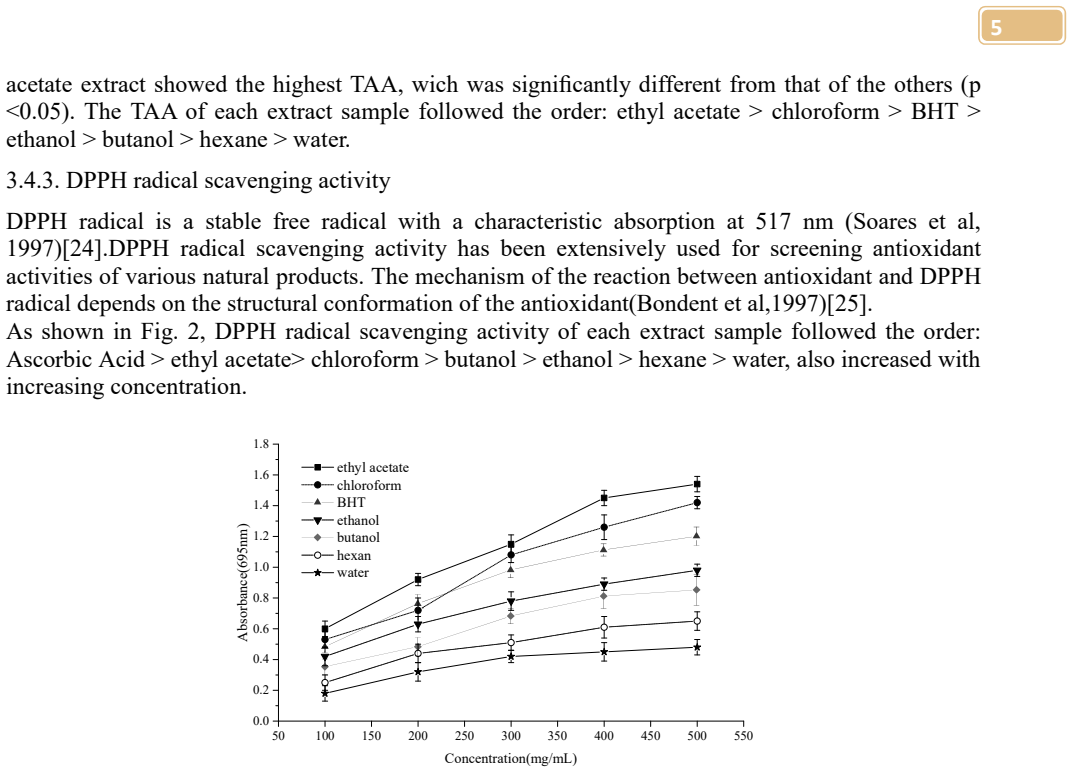
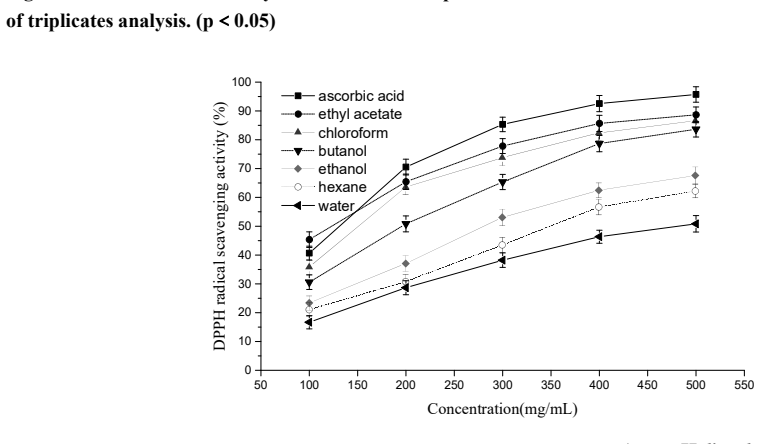
read the original abstract
The total phenols and flavonoids content of different polar solvent extracts from Aurea Helianthus flowers, and their antioxidant activity were determined. The ethanol extract of Aurea Helianthus flowers were suspended in water and fractionated using different polar solvents; hexane, chloroform, ethyl acetate, butanol and water. The parameters of each extract mentioned above were determined using Floin-ciocalteu reagent(FCR) method, AlCl3 colorimetry method, ferric reducing ability of plasma(FRAP) assay, total antioxidant activity(TAA) assay and DPPH radical scavenging assay. The highest total phenols content(516.21 mg GAE/g) and flavonoids content(326.06 mg QCE/g) were obtained in ethyl acetate extract, the correlation between TPC and TFC assay was founded to be 0.967. All polar solvent extracts of Aurea Helianthus flowers showed significant antioxidant effects, the hightest inhibition was obtained in ethyl acetate and choroform extracts and the lowest inhibition in the water extract. There is a good correlation of total phenols and flavonoids content with antioxidant activity. This work indicated that the polar solvent extracts of Aurea Helianthus flowers contain high phenols and flavonoids content and exhibited antioxidant activities in vitro, therefore, could be candidates for use as natural antioxidant.
Editorial analysis
A structured set of objections, weighed in public.
Referee Report
Summary. The manuscript reports total phenolic content (TPC) and total flavonoid content (TFC) measured by Folin-Ciocalteu and AlCl3 methods, together with in-vitro antioxidant activity assessed by FRAP, total antioxidant activity (TAA), and DPPH assays, for five solvent fractions (hexane, chloroform, ethyl acetate, butanol, water) obtained from ethanol extracts of Aurea Helianthus flowers. It states that the ethyl acetate fraction yielded the highest TPC (516.21 mg GAE/g) and TFC (326.06 mg QCE/g), that TPC and TFC are correlated at r = 0.967, and that all fractions exhibit significant antioxidant effects (highest in ethyl acetate and chloroform, lowest in water) with good correlation between compound content and activity, concluding that the extracts are candidates for natural antioxidants.
Significance. If the reported rankings and correlations prove statistically robust, the work supplies routine but usable baseline phytochemical data that could guide solvent selection for subsequent isolation or bioactivity work on this species. The study applies only established assays and does not introduce new methodology, theoretical models, or in-vivo validation.
major comments (4)
- [Materials and Methods] Materials and Methods: The description of the FCR, AlCl3, FRAP, TAA and DPPH protocols names the reagents and general procedures but supplies no information on the number of independent replicates, technical replicates, or the statistical tests used to support claims of 'significant' differences or 'highest' values.
- [Results] Results: The numerical values (e.g., ethyl-acetate TPC = 516.21 mg GAE/g, TFC = 326.06 mg QCE/g) are reported as single point estimates without standard deviations, coefficients of variation, or replicate counts, so the reliability of the ranking among the five fractions cannot be evaluated.
- [Results] Results: The TPC–TFC correlation coefficient of 0.967 is stated without the underlying number of observations, p-value, confidence interval, or indication that multiple-testing correction was applied across the five extracts and multiple assay endpoints.
- [Results] Results: Assertions that 'all polar solvent extracts showed significant antioxidant effects' and that inhibition was 'highest' in ethyl acetate and chloroform fractions are not accompanied by the specific statistical comparisons, thresholds, or software used to reach these conclusions.
minor comments (3)
- [Abstract] Abstract: Typographical errors include 'Floin-ciocalteu' (should be Folin-Ciocalteu), 'founded' (should be found), 'hightest' (should be highest), and 'choroform' (should be chloroform).
- [Abstract] Abstract and throughout: The binomial 'Aurea Helianthus' is non-standard; confirm whether this is intended as a cultivar or species name and provide the correct authority if appropriate.
- [Discussion] Discussion: A short comparison of the observed TPC/TFC ranges with published values for other Helianthus species or common medicinal plants would help place the results in context.
Simulated Author's Rebuttal
We are grateful to the referee for the thorough review and valuable suggestions. We have prepared point-by-point responses below and will make the necessary revisions to improve the statistical rigor and transparency of the manuscript.
read point-by-point responses
-
Referee: [Materials and Methods] Materials and Methods: The description of the FCR, AlCl3, FRAP, TAA and DPPH protocols names the reagents and general procedures but supplies no information on the number of independent replicates, technical replicates, or the statistical tests used to support claims of 'significant' differences or 'highest' values.
Authors: We thank the referee for this comment. We will revise the Materials and Methods section to include that all measurements were performed in triplicate (n = 3), and that data were analyzed using one-way ANOVA followed by Tukey's post hoc test using SPSS software, with p < 0.05 considered statistically significant. revision: yes
-
Referee: [Results] Results: The numerical values (e.g., ethyl-acetate TPC = 516.21 mg GAE/g, TFC = 326.06 mg QCE/g) are reported as single point estimates without standard deviations, coefficients of variation, or replicate counts, so the reliability of the ranking among the five fractions cannot be evaluated.
Authors: We agree that reporting variability is important. In the revised manuscript, we will present the data as mean ± SD from the three replicates and explicitly state the number of replicates for each assay. revision: yes
-
Referee: [Results] Results: The TPC–TFC correlation coefficient of 0.967 is stated without the underlying number of observations, p-value, confidence interval, or indication that multiple-testing correction was applied across the five extracts and multiple assay endpoints.
Authors: The correlation was based on the five fractions (n=5). We will add the p-value (p < 0.01) and note that this was the only correlation tested, so no correction was needed. A 95% confidence interval for the correlation coefficient will also be provided. revision: yes
-
Referee: [Results] Results: Assertions that 'all polar solvent extracts showed significant antioxidant effects' and that inhibition was 'highest' in ethyl acetate and chloroform fractions are not accompanied by the specific statistical comparisons, thresholds, or software used to reach these conclusions.
Authors: We will include the results of the statistical tests, such as the F-statistic and p-values from ANOVA, and specify the software used, to substantiate the claims regarding significant effects and the ranking of fractions. revision: yes
Circularity Check
No circularity; direct experimental reporting only
full rationale
The paper consists solely of experimental measurements using standard assays (FCR for TPC, AlCl3 for TFC, FRAP, TAA, DPPH) on five solvent fractions of Aurea Helianthus flowers, with reported values (e.g., ethyl acetate TPC 516.21 mg GAE/g, TFC 326.06 mg QCE/g) and a correlation coefficient (0.967) following immediately from those protocols. No equations, derivations, fitted parameters, predictions, or self-citations are present that could reduce claims to inputs by construction. The work is self-contained against external benchmarks of assay validity and requires no internal circular steps.
Axiom & Free-Parameter Ledger
axioms (2)
- domain assumption Folin-Ciocalteu and AlCl3 methods accurately quantify total phenols and flavonoids in these extracts
- domain assumption FRAP, TAA, and DPPH assays measure biologically relevant antioxidant capacity
Reference graph
Works this paper leans on
-
[1]
S. Bahramikia, A. Ardestani, R. Yazdanparast, Protective effects of four Iranian medicinal plants against free radical mediated protein oxidation, Food Chem. 115 (2009) 37-42
work page 2009
-
[2]
Nadkarni, Indian Materia Medica, third ed., vol
K.M. Nadkarni, Indian Materia Medica, third ed., vol. 2, Popular Prakasan, India, 1994, pp. 84-96
work page 1994
-
[3]
Polypenols: chemistry, dietary sources, metabolism and nutritionalsignificance
Bravol, L., 1998. Polypenols: chemistry, dietary sources, metabolism and nutritionalsignificance. Nutr. Rev. 56, 317– 333
work page 1998
-
[4]
R. Kumar, R.J. Sharma, K. Bairwa, R.K. Roy, A. Kumar, Pharmacological review on natural antidiarrhoel agents, Pharm. Chem. 2 (2) (2010) 66-93
work page 2010
-
[5]
S.S. Handa, S.P.S. Khanuja, G. Longo, D.D. Rakesh, Extraction technologies for medicinal and aromatic plants, Inter. Cent. Sci. High Tech. Trieste (2004) 21-25
work page 2004
-
[6]
Asma Hamood Al-Saeedi, Moza Talib Humaid Al- Ghafri, Mohammad Amzad Hossain, Comparative evaluation of total phenols, flavonoids content and antioxidant potential of leaf and fruit extracts of Omani Ziziphus jujuba L, 7 Pacific Science Review A: Natural Science and Engineering 18 (2016) 78-83
work page 2016
-
[7]
Lampiasi, N., Montana, G., 2016. The molecular events behind ferulic acid mediatedmodulation of IL-6 expression in LPS-activated RAW 264.7 cell. Immunobiology221, 486–493
work page 2016
-
[8]
Research progress on Chinese medicinal material aurea helianthus
Lu, D., Jia, R.B., 2015. Research progress on Chinese medicinal material aurea helianthus. Chin. J. Drug Eval. 02
work page 2015
-
[9]
Hak-Jae Kim, Chun-Geon Park, Rakesh Varghese et al, In-vitro antioxidative, antiinflammatory properties of Aurea helianthus leaf extract a Korean traditional medicinal plant, Saudi Journal of Biological Sciences 24 (2017) 1943– 1947
work page 2017
-
[10]
Separation and Purification Technology 175 (2017) 203–212
Peng Huang, Qing Zhang, Hongye Pan, Lianjun Luan, Xuesong Liu, Yongjiang Wu, Optimization of integrated extraction-adsorption process for the extraction and purification of total flavonoids from Scutellariae barbataeherba,J. Separation and Purification Technology 175 (2017) 203–212
work page 2017
-
[11]
Asma Hamood Al-Saeedi, Moza Talib Humaid Al- Ghafri, Mohammad Amzad Hossain ,Comparative evaluation of total phenols, flavonoids content andantioxidant potential of leaf and fruit extracts of OmaniZiziphus jujuba L, J.Pacific Science Review A: Natural Science and Engineering 18 (2016) 78-83
work page 2016
-
[12]
Phenolic content and antioxidant activity of olive extracts
Mc Donald S, Prenzler PD, Antolovich M, et al. Phenolic content and antioxidant activity of olive extracts. Food Chem2001;73:73-84
-
[13]
Zhishen, J., Mengcheng, T., Jianming, W., 1999. The determination of flavonoidcontents in mulberry and their scavenging effects on superoxide radicals. Food Chem. 64, 555–559
work page 1999
-
[14]
Benzie IF, Strain JJ. The ferric reducing ability of plasma (FRAP) as a measure of "antioxidant power": the FRAP assay. Anal Biochem. 1996 Jul 15;239(1):70-76
work page 1996
-
[15]
Pilar Prieto, et al, Spectrophotometric Quantitation of Antioxidant Capacity through the Formation of a Phosphomolybdenum Complex: Specific Application to the Determination of Vitamin E1, Analytical Biochemistry 269, 337–341 (1999)
work page 1999
-
[16]
Gow-Chin Yen, Hui-Yin Chen, Antioxidant Activity of Various Tea Extracts in Relation to Their Antimutagenicity, J.Agrie.Food Chem. 1995, 43, 27-32。
work page 1995
-
[17]
Extraction, separation, and detection methods for phenolic acids and flavonoids
Stalikas CD. Extraction, separation, and detection methods for phenolic acids and flavonoids. J Sep Sci 2007;30:3268-95
work page 2007
-
[18]
Asma Hamood et al, Comparative evaluation of total phenols, flavonoids content andantioxidant potential of leaf and fruit extracts of OmaniZiziphus jujuba L, Pacific Science Review A: Natural Science and Engineering 18 (2016) 78-83
work page 2016
-
[19]
Quy Diem Do et al, Effect of extraction solvent on total phenol content, total flavonoid content, and antioxidant activity of Limnophila aromatica, journal of food and drug analysis 22 (2014) 296 -302
work page 2014
-
[20]
Quy Diem Do et al, Effect of extraction solvent on total phenol content,total flavonoid content, and antioxidant activity of Limnophila aromatic, journal of food and drug a n a l y s i s 2 2 ( 2 0 1 4 ) 296 -302
-
[21]
Hak-Jae Kim et al, In-vitro antioxidative, antiinflammatory properties of Aurea helianthusleaf extract a Korean traditional medicinal plant, Saudi Journal of Biological Sciences 24 (2017) 1943–1947
work page 2017
-
[22]
BAI Yun, ZHU Ruichao, LI Jin, MA Lin et al, Simultaneous determination of five flavonoids in the flowers of Aurea helianthus by ultra performance liquidchromatography method, Tianjin Journal of Traditional Chinese Medicine,2018,35(2);147-150
work page 2018
-
[23]
Jing-En Li et al, Total flavonoids content, antioxidant and antimicrobial activities of extracts from Mosla chinensis Maxim. cv. Jiangxiangru, LWT - Food Science and Technology 64 (2015) 1022-1027
work page 2015
-
[24]
Soares, J. R., Dinis, T. C., Cunha, A. P., & Almeida, L. M. (1997). Antioxidant activity ofsome extracts of Thymus zygis. Free Radical Research, 26, 469-478
work page 1997
-
[25]
Bondent, V ., Brand-Williams, W., & Bereset, C. (1997). Kinetic and mechanism ofantioxidant activity using the DPPH free radical methods. LWT-Food Science andTechnology, 30, 609-615
work page 1997
-
[26]
Bonoli, M., Marconi, E., Caboni, M.F., 2004. Free and bound phenolic compounds in barley (Hordeum vulgare L.) flour evaluation of extraction capability of different solvent mixtures and pressurized liquid methods by micellar electrokinetic chromatography and spectrophotometry. J. Chromatogr. A 1057, 1-12
work page 2004
-
[27]
Zhao, H., Dong, J., Lu, J., Chen, J., Li, Y ., Shan, L., Lin, Y ., Fan, W., Gu, G., 2006. Effects of extraction solvent mixtures on antioxidant activity evaluation and their extraction capacity and selectivity for free phenolic compounds in barley (Hordeum vulgare L.). J. Agric. Food Chem. 54, 7277-7286
work page 2006
-
[28]
Antioxidant properties ofvarious solvent extracts from lychee (Litchi chinenesis sonn.)flowers
Liu SC, Lin JT, Wang CK, et al. Antioxidant properties ofvarious solvent extracts from lychee (Litchi chinenesis sonn.)flowers. Food Chem 2009;114:577-81
work page 2009
-
[30]
Interaction amongphenols in food fortification: negative synergism onantioxidant capacity
Pinelo M, Manzocco L, Nun˜ ez MJ, et al. Interaction amongphenols in food fortification: negative synergism onantioxidant capacity. J Agric Food Chem 2004;52:1177-80
work page 2004
-
[31]
Strategies for the determination of bioactivephenols in plants, fruit and vegetables
Robards K. Strategies for the determination of bioactivephenols in plants, fruit and vegetables. J Chromatogr A2003;1000:657-91
discussion (0)
Sign in with ORCID, Apple, or X to comment. Anyone can read and Pith papers without signing in.