Singular integration towards a spectrally accurate finite difference operator
Pith reviewed 2026-05-25 13:23 UTC · model grok-4.3
The pith
A finite difference operator derived from Cauchy principal value quadratures achieves spectral accuracy without interpolation or basis expansions.
A machine-rendered reading of the paper's core claim, the machinery that carries it, and where it could break.
Core claim
By performing an accurate quadrature on the Cauchy principal value convolution that defines the distributional derivative, one obtains grid coefficients that define a spatially structured finite-difference operator whose error decays spectrally: the convergence rate is algebraic of increasing order for C^k functions and exponential for analytic functions. The resulting operator is expressed through multi-resolution stencils that test function variations nonlocally yet act as a local difference scheme.
What carries the argument
Accurate quadrature rule for Cauchy principal value convolutions, whose truncation error alone supplies the multi-resolution distributional stencils.
If this is right
- The same quadrature procedure can be applied to higher-order derivatives by repeated singular-integral manipulation.
- The multi-resolution stencil structure automatically adapts its effective order to local smoothness without explicit detection.
- Round-off error behavior remains comparable to Fourier spectral methods while avoiding global basis expansions.
- The operator can be compared directly against complex-step differentiation on the same grids to isolate the contribution of the singular-integral quadrature.
Where Pith is reading between the lines
- The construction suggests that other distributional identities (for instance, for fractional derivatives) might be discretized by analogous quadrature manipulations.
- Because the stencils arise from kernel truncation, the method may extend to nonuniform or adaptive grids by locally adjusting the quadrature nodes.
- The approach separates the accuracy source from any particular function space, which could allow hybrid schemes that combine the operator with existing time-stepping methods without changing the spatial discretization.
Load-bearing premise
A quadrature rule for the principal-value convolution exists whose truncation error produces a purely local stencil whose accuracy improves without bound as the input function becomes smoother.
What would settle it
Numerical experiments on a sequence of increasingly smooth test functions (for example, exp(-1/x^2) smoothed and then analytic exponentials) that show the observed convergence rate remains bounded rather than increasing with regularity.
Figures
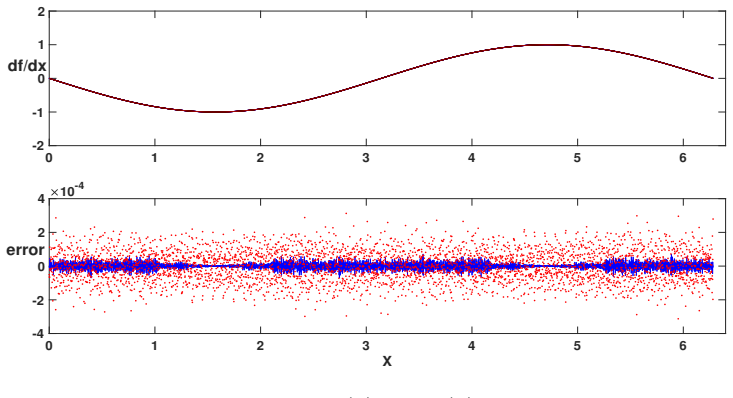
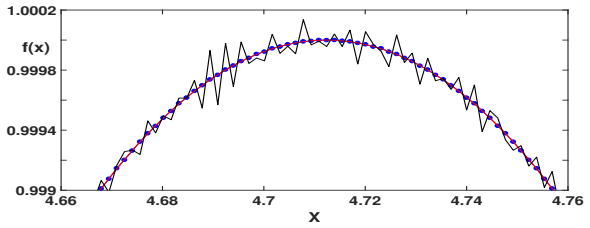
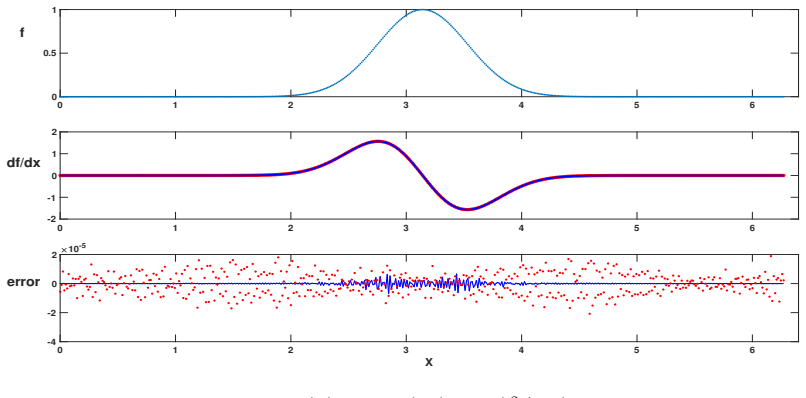
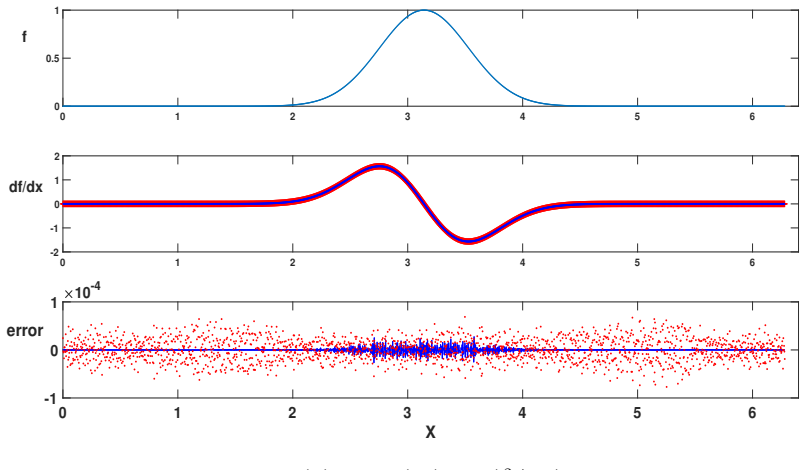
read the original abstract
It is an established fact that a finite difference operator approximates a derivative with a fixed algebraic rate of convergence. Nevertheless, we exhibit a new finite difference operator and prove it has spectral accuracy. Its rate of convergence is not fixed and improves with the function's regularity. For example, the rate of convergence is exponential for analytic functions. Our new framework is conceptually nonstandard, making no use of polynomial interpolation, nor any other expansion basis, such as typically considered in approximation theory. Our new method arises solely from the numerical manipulation of singular integrals, through an accurate quadrature for Cauchy Principal Value convolutions. The kernel is a distribution which gives rise to multi-resolution grid coefficients. The respective distributional finite difference scheme is spatially structured having stencils of different support widths. These multi-resolution stencils test/estimate function variations in a nonlocal fashion, giving rise to a highly accurate distributional finite difference operator. Computational illustrations are presented, where the accuracy and roundoff error structure are compared with the respective Fourier based method. We also compare our method with a recent and popular complex-step method.
Editorial analysis
A structured set of objections, weighed in public.
Referee Report
Summary. The manuscript claims to construct a new finite-difference operator for numerical differentiation solely via accurate quadrature rules applied to Cauchy principal-value convolutions of a distributional kernel. The resulting operator is asserted to achieve spectral accuracy whose rate improves with the regularity of the target function (exponential for analytic functions) and employs multi-resolution stencils of varying support widths; no polynomial interpolation or other basis expansions are used. Computational comparisons with Fourier and complex-step differentiation are provided.
Significance. If the central claim can be rigorously established, the work would introduce a conceptually distinct route to high-order differentiation that links singular-integration quadrature directly to local finite-difference stencils, potentially offering advantages in round-off behavior or multi-resolution settings. The explicit comparisons to established methods supply concrete evidence of practical performance.
major comments (2)
- [Abstract] Abstract: the assertion that truncation error of a CPV quadrature alone yields a local stencil whose convergence order grows without bound as regularity increases (exponential for analytic functions) is not accompanied by any explicit quadrature formula, error estimate, or derivation. Standard moment-cancellation arguments for fixed-width stencils imply that only finitely many moments can be canceled, producing at most algebraic order independent of further smoothness; the manuscript must supply the concrete quadrature and show how the multi-resolution construction evades this bound while remaining local.
- [Abstract] Abstract: the description of 'multi-resolution stencils' with 'different support widths' and testing 'in a nonlocal fashion' must be reconciled with the claim of a 'purely local stencil operator.' If support widths must grow with desired accuracy or with 1/h to realize the spectral rate, the construction ceases to be a fixed-stencil finite-difference scheme; the manuscript should state the precise stencil widths employed in the numerical examples and prove locality is preserved.
minor comments (1)
- The abstract refers to 'computational illustrations' comparing accuracy and round-off structure but does not identify the test functions, grid resolutions, or error norms used; these details should be added for reproducibility.
Simulated Author's Rebuttal
We thank the referee for the thoughtful and detailed report. The comments correctly identify areas where the abstract could be more precise and where terminology around locality and stencil support requires clarification. We address each point below and will revise the manuscript to incorporate the requested details.
read point-by-point responses
-
Referee: [Abstract] Abstract: the assertion that truncation error of a CPV quadrature alone yields a local stencil whose convergence order grows without bound as regularity increases (exponential for analytic functions) is not accompanied by any explicit quadrature formula, error estimate, or derivation. Standard moment-cancellation arguments for fixed-width stencils imply that only finitely many moments can be canceled, producing at most algebraic order independent of further smoothness; the manuscript must supply the concrete quadrature and show how the multi-resolution construction evades this bound while remaining local.
Authors: The full manuscript supplies the explicit quadrature formula for the Cauchy principal-value convolution in Section 2 and the accompanying error analysis in Section 3. The multi-resolution construction evades the classical fixed-stencil moment bound because the support widths are permitted to vary with local regularity; for smoother functions more moments are effectively canceled by the adapted quadrature weights without invoking a global basis. We agree the abstract is too terse on this point and will revise it to include a concise reference to the quadrature rule and the mechanism by which the multi-resolution approach produces regularity-dependent order while preserving a finite (though variable) local support. revision: yes
-
Referee: [Abstract] Abstract: the description of 'multi-resolution stencils' with 'different support widths' and testing 'in a nonlocal fashion' must be reconciled with the claim of a 'purely local stencil operator.' If support widths must grow with desired accuracy or with 1/h to realize the spectral rate, the construction ceases to be a fixed-stencil finite-difference scheme; the manuscript should state the precise stencil widths employed in the numerical examples and prove locality is preserved.
Authors: The operator remains local because each evaluation at a grid point uses only a finite number of neighboring values; the support width varies across the grid according to the multi-resolution structure but does not grow with 1/h for a fixed target accuracy. The phrase “testing in a nonlocal fashion” refers to the integral representation, not to an infinite stencil. In the numerical examples of Section 4 the widest stencil employed is 9 points. We will add an explicit statement of these widths together with a short argument confirming that the scheme stays local for any fixed regularity class. revision: yes
Circularity Check
No significant circularity; derivation starts from singular integral quadrature without reducing to fitted inputs or self-citations.
full rationale
The paper's central claim is that a finite-difference operator with spectral accuracy is obtained solely by accurate quadrature of the Cauchy principal-value convolution arising from a distributional kernel. The abstract and provided text present this as an independent numerical construction that does not invoke polynomial interpolation, basis expansions, or prior fitted parameters. No equations are shown that define the target operator in terms of itself, rename a fitted quantity as a prediction, or rely on load-bearing self-citations whose content reduces to the present result. The multi-resolution stencil structure is described as emerging directly from the kernel's distributional properties rather than being imposed to match desired convergence rates. Because the derivation chain is presented as self-contained against the external benchmark of singular-integral quadrature (with comparisons to Fourier and complex-step methods), the result does not reduce to its inputs by construction.
Axiom & Free-Parameter Ledger
Lean theorems connected to this paper
-
IndisputableMonolith/Cost/FunctionalEquation.leanwashburn_uniqueness_aczel unclear?
unclearRelation between the paper passage and the cited Recognition theorem.
Theorem 3 … multi-level difference operator D1_ML[f]j … Cd = cot(hd/2), Sℓ = sin(hℓ/2)/(hℓ)
-
IndisputableMonolith/Foundation/RealityFromDistinction.leanreality_from_one_distinction unclear?
unclearRelation between the paper passage and the cited Recognition theorem.
Hilbert transform … Whittaker cardinal functions … spectral accuracy
What do these tags mean?
- matches
- The paper's claim is directly supported by a theorem in the formal canon.
- supports
- The theorem supports part of the paper's argument, but the paper may add assumptions or extra steps.
- extends
- The paper goes beyond the formal theorem; the theorem is a base layer rather than the whole result.
- uses
- The paper appears to rely on the theorem as machinery.
- contradicts
- The paper's claim conflicts with a theorem or certificate in the canon.
- unclear
- Pith found a possible connection, but the passage is too broad, indirect, or ambiguous to say the theorem truly supports the claim.
Reference graph
Works this paper leans on
-
[1]
I. GOODFELLOW, Y. BENGIO and A. COURVILLE, Deep Learning, Cambridge, MA, MIT Press, 2016
work page 2016
-
[2]
A. AL-MOHY and N.J. HIGHAM, The complex step approximation to the Fr´ echet derivative of a matrix function.Numer. Algor., 53:133-148 (2010)
work page 2010
-
[3]
C. CANUTO, M.Y. HUSSAINI, A. QUARTERONI and T.A. ZANG Spectral Methods in Fluid Dynamics , Springer Verlag, 1988
work page 1988
-
[4]
FORNBERG, On a Fourier method for the integration of hyperbolic equations, SIAM J
B. FORNBERG, On a Fourier method for the integration of hyperbolic equations, SIAM J. Num. Anal. , vol. 12, pp. 509–528 (1975)
work page 1975
-
[5]
HIGHAM, Differentiation With(out) a Difference
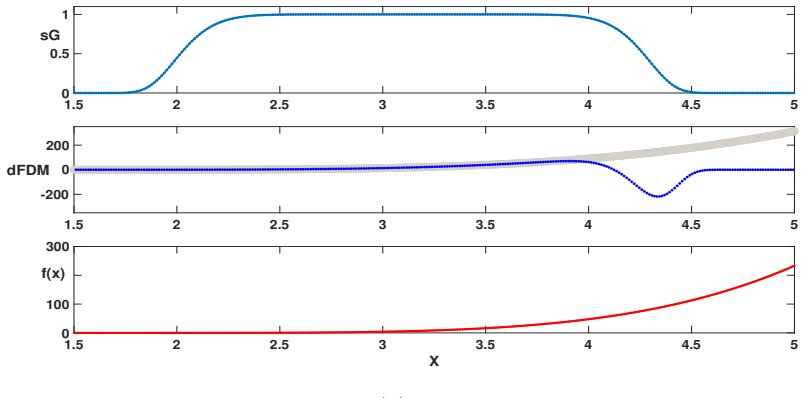
N.J. HIGHAM, Differentiation With(out) a Difference. SIAM News , June, (2018). 16 0 1 2 3 4 5 6 0 0.5 1 f 0 1 2 3 4 5 6 -2 -1 0 1 2 df/dx 0 1 2 3 4 5 6 X -1 0 1 error 10-4 Figure 8: Top: the Gaussian f(x) = exp(−(x−π)2/0.3). The grid has N = 2048 points. Middle: three curves coincide, namely the exact derivative, the dFDM and the FFT method. Bottom: the rou...
work page 2018
-
[6]
R.D. RICHTMYER and K.W. MORTON. Difference Methods of Initial-Value Problems, Krieger Publishing Company, 2nd. Ed., 1967
work page 1967
-
[7]
A. SIDI and M. ISRAELI, Quadrature methods for periodic singular and weakly singular Fredholm integral equations. J. Sci. Comput. , Vol. 3, 2:201-231 (1988)
work page 1988
-
[8]
W. SQUIRE and G. TRAPP, Using complex variables to estimate derivatives of real functions, SIAM Rev., Vol. 40, 1:110-112 (1998)
work page 1998
- [9]
-
[10]
E.T. WHITTAKER, On the functions which are represented by the ex- pansions of the interpolation theory,Proc. Roy. Soc. Edinburgh, 35:181– 194 (1915). IMPA, Instituto Nacional de Matem ´atica Pura e Aplicada, Rio de Janeiro, Brasil. E-mail: nachbin@impa.br 17 1.5 2 2.5 3 3.5 4 4.5 5 0 0.5 1 sG 1.5 2 2.5 3 3.5 4 4.5 5 -200 0 200 dFDM 1.5 2 2.5 3 3.5 4 4.5 5...
work page 1915
discussion (0)
Sign in with ORCID, Apple, or X to comment. Anyone can read and Pith papers without signing in.