Energy-efficient Wireless Analog Sensing for Persistent Underwater Environmental Monitoring
Pith reviewed 2026-05-25 12:50 UTC · model grok-4.3
The pith
Analog biodegradable sensors compress data with one transistor, skipping ADCs for low-power underwater monitoring.
A machine-rendered reading of the paper's core claim, the machinery that carries it, and where it could break.
Core claim
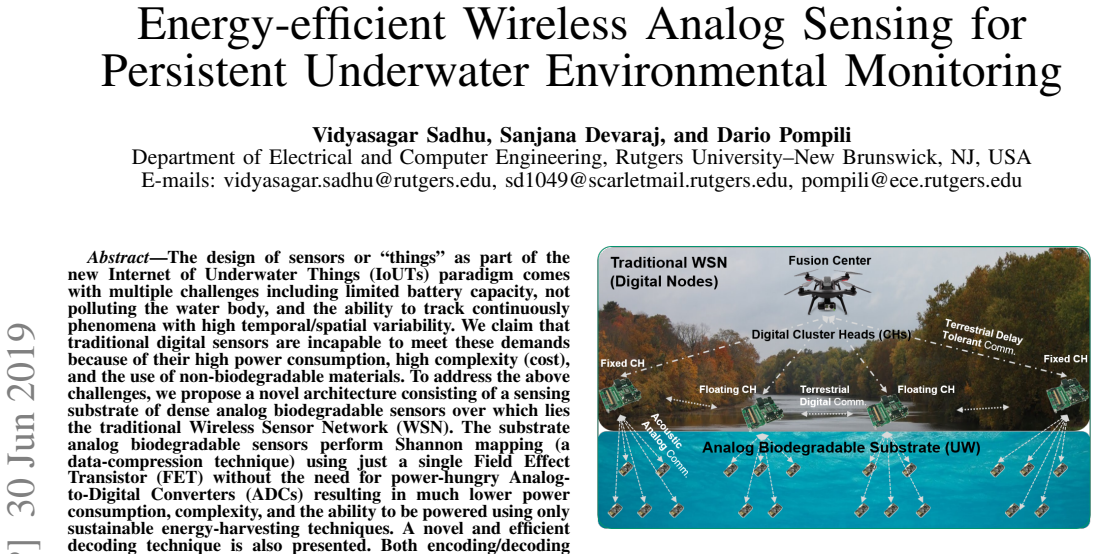
The substrate analog biodegradable sensors perform Shannon mapping using just a single Field Effect Transistor without the need for power-hungry Analog-to-Digital Converters resulting in much lower power consumption, complexity, and the ability to be powered using only sustainable energy-harvesting techniques.
What carries the argument
Shannon mapping executed by a single FET on a biodegradable sensing substrate that feeds a conventional wireless sensor network layer.
If this is right
- Continuous tracking of phenomena with high temporal or spatial variability becomes feasible without frequent battery replacement.
- Sensor nodes avoid polluting the water body because the sensing substrate is biodegradable.
- Overall system complexity and cost drop because no ADCs or high-resolution digital processing are required at the sensing layer.
- The architecture supports dense deployment of the analog layer beneath a sparser traditional WSN.
Where Pith is reading between the lines
- The same single-FET mapping approach could be tested in other harsh environments where power and material constraints are similar.
- If the decoding technique proves robust, it might allow the analog layer to operate at higher densities than digital equivalents.
- Integration questions remain about how the traditional WSN layer would schedule access to the compressed analog outputs.
Load-bearing premise
A single FET circuit built on biodegradable material can compress high-variability underwater signals accurately enough that the compressed waveform survives transmission over the acoustic channel.
What would settle it
A physical test in which the single-FET circuit, fabricated on biodegradable substrate, produces output waveforms whose reconstruction error exceeds acceptable limits when driven by real underwater sensor data and passed through measured acoustic channel distortions.
Figures

read the original abstract
The design of sensors or "things" as part of the new Internet of Underwater Things (IoUTs) paradigm comes with multiple challenges including limited battery capacity, not polluting the water body, and the ability to track continuously phenomena with high temporal/spatial variability. We claim that traditional digital sensors are incapable to meet these demands because of their high power consumption, high complexity (cost), and the use of non-biodegradable materials. To address the above challenges, we propose a novel architecture consisting of a sensing substrate of dense analog biodegradable sensors over which lies the traditional Wireless Sensor Network (WSN). The substrate analog biodegradable sensors perform Shannon mapping (a data-compression technique) using just a single Field Effect Transistor (FET) without the need for power-hungry Analog-to-Digital Converters (ADCs) resulting in much lower power consumption, complexity, and the ability to be powered using only sustainable energy-harvesting techniques. A novel and efficient decoding technique is also presented. Both encoding/decoding techniques have been verified via Spice and MATLAB simulations accounting for underwater acoustic channel variations.
Editorial analysis
A structured set of objections, weighed in public.
Referee Report
Summary. The paper claims that digital sensors are unsuitable for persistent IoUT monitoring due to high power, complexity, and non-biodegradability, and proposes instead a dense analog biodegradable sensor substrate that performs Shannon mapping (analog compression) via a single FET without ADCs. This enables low-power operation powered solely by energy harvesting, together with a novel efficient decoding technique; both are verified through Spice and MATLAB simulations that incorporate underwater acoustic channel variations.
Significance. If the central claim holds, the approach would enable sustainable, long-term underwater monitoring with drastically reduced power and environmental impact. The simulation-based verification of encoding/decoding under channel variations is a positive element, though the absence of hardware validation or biodegradable-specific modeling limits the strength of the evidence for the claimed operating regime.
major comments (2)
- [Verification section] Verification section (Spice/MATLAB simulations): the simulations account for acoustic channel variations but provide no modeling of biodegradable-substrate effects such as threshold-voltage drift, conductivity changes over time, or substrate-induced non-idealities. Because the single-FET Shannon mapping depends on precise device characteristics for the required nonlinear function, this omission directly affects the fidelity claims for persistent monitoring.
- [Abstract and architecture section] Abstract and § on proposed architecture: the claim that a single FET on biodegradable material implements Shannon mapping without ADCs is load-bearing for the power and complexity advantages, yet no device-level equations or parameter values are supplied to show how the FET's I-V curve realizes the required mapping function under realistic underwater conditions.
minor comments (2)
- [Abstract] The abstract states quantitative advantages ('much lower power consumption') without providing any numerical comparison to baseline digital sensors or energy-harvesting budgets.
- [Decoding technique section] Notation for the novel decoding technique is introduced without a clear block diagram or pseudocode, making it difficult to assess computational complexity.
Simulated Author's Rebuttal
Thank you for the constructive review. We address each major comment below and note the corresponding revisions.
read point-by-point responses
-
Referee: [Verification section] Verification section (Spice/MATLAB simulations): the simulations account for acoustic channel variations but provide no modeling of biodegradable-substrate effects such as threshold-voltage drift, conductivity changes over time, or substrate-induced non-idealities. Because the single-FET Shannon mapping depends on precise device characteristics for the required nonlinear function, this omission directly affects the fidelity claims for persistent monitoring.
Authors: We agree the simulations employ standard FET models in SPICE and do not incorporate biodegradable-specific effects such as threshold-voltage drift or time-varying conductivity. The focus was verification of encoding/decoding performance under acoustic channel variations. We will revise the Verification section to state these modeling assumptions explicitly, discuss the potential impact of substrate non-idealities on mapping fidelity, and identify them as important topics for future hardware studies. revision: yes
-
Referee: [Abstract and architecture section] Abstract and § on proposed architecture: the claim that a single FET on biodegradable material implements Shannon mapping without ADCs is load-bearing for the power and complexity advantages, yet no device-level equations or parameter values are supplied to show how the FET's I-V curve realizes the required mapping function under realistic underwater conditions.
Authors: The single-FET implementation exploits the nonlinear I-V relationship of the device to realize the analog compression. While the architecture is described at the system level, we acknowledge that explicit device equations would strengthen the presentation. We will add a short subsection (or appendix) containing the relevant MOSFET equations together with the parameter values used in the SPICE simulations to illustrate how the mapping is obtained under the modeled underwater conditions. revision: yes
Circularity Check
No circularity: proposal applies known Shannon mapping in new hardware context
full rationale
The paper proposes a novel sensor architecture that applies the established Shannon mapping technique via a single FET on biodegradable substrates, verified through independent Spice/MATLAB simulations of the acoustic channel. No equations, predictions, or central claims reduce by construction to fitted parameters, self-definitions, or self-citation chains. The derivation chain is self-contained against external benchmarks (known compression method + channel simulation), with no load-bearing steps that equate outputs to inputs.
Axiom & Free-Parameter Ledger
axioms (1)
- domain assumption Underwater acoustic channel variations can be adequately modeled in Spice and MATLAB simulations for validation purposes.
invented entities (2)
-
Dense analog biodegradable sensor substrate using single-FET Shannon mapping
no independent evidence
-
Novel efficient decoding technique
no independent evidence
Reference graph
Works this paper leans on
-
[1]
An overview of the internet of underwater things,
M. C. Domingo, “An overview of the internet of underwater things,” Journal of Network and Computer Applications, vol. 35, no. 6, pp. 1879–1890, nov
-
[2]
Available: https://www.sciencedirect
[Online]. Available: https://www.sciencedirect. com/science/article/pii/S1084804512001646
-
[3]
Toward Wireless Health Monitoring via an Analog Signal Compression-Based Biosensing Platform,
X. Zhao, V . Sadhu, T. Le, D. Pompili, and M. Javanmard, “Toward Wireless Health Monitoring via an Analog Signal Compression-Based Biosensing Platform,” IEEE Transactions on Biomedical Circuits and Systems , vol. 12, no. 3, pp. 461–470, jun 2018. [Online]. Available: https://ieeexplore.ieee.org/document/8368324/
-
[4]
Communication in the presence of noise,
C. Shannon, “Communication in the presence of noise,” Proceedings of the IRE , 1949
work page 1949
-
[5]
Using 2:1 Shan- non mapping for joint source-channel coding,
F. Hekland, G. Oien, and T. Ramstad, “Using 2:1 Shan- non mapping for joint source-channel coding,” in Data Compression Conference (DCC) , March 2005, pp. 223– 232
work page 2005
-
[6]
Energy-efficient analog sensing for large-scale, high-density persistent wireless monitoring,
V . Sadhu, X. Zhao, and D. Pompili, “Energy-efficient analog sensing for large-scale, high-density persistent wireless monitoring,” in 2017 13th Annual Conference on Wireless On-Demand Network Systems and Services, WONS 2017 - Proceedings , 2017
work page 2017
-
[7]
X. Zhao, V . Sadhu, A. Yang, and D. Pompili, “Improved Circuit Design of Analog Joint Source Channel Coding for Low-Power and Low-Complexity Wireless Sensors,” IEEE Sensors Journal , vol. 18, no. 1, pp. 281–289, jan 2018. [Online]. Available: http://ieeexplore.ieee.org/document/8063881/
-
[8]
C.-C. Kao, Y .-S. Lin, G.-D. Wu, and C.-J. Huang, “A comprehensive study on the internet of underwater things: Applications, challenges, and channel models,” Sensors, vol. 17, no. 7, 2017. [Online]. Available: http://www.mdpi.com/1424-8220/17/7/1477
work page 2017
-
[9]
Underwater energy harvesting system based on plucked-driven piezoelectrics,
D. M. Toma, J. del Rio, M. Carbonell-Ventura, and J. M. Masalles, “Underwater energy harvesting system based on plucked-driven piezoelectrics,” in OCEANS 2015 - Genova, May 2015, pp. 1–5
work page 2015
-
[10]
10 uw converter for energy harvesting from sedimentary microbial fuel cells,
A. Capitaine, G. Pillonnet, T. Chailloux, O. Ondel, and B. Allard, “10 uw converter for energy harvesting from sedimentary microbial fuel cells,” in 2017 IEEE 60th In- ternational Midwest Symposium on Circuits and Systems (MWSCAS), Aug 2017, pp. 337–340
work page 2017
-
[11]
Ultra low-power transceiver SoC designs for IoT, NB-IoT applications,
O. Khan, A. Niknejad, and K. Pister, “Ultra low-power transceiver SoC designs for IoT, NB-IoT applications,” in IEEE Custom Integrated Circuits Conference (CICC) . IEEE, apr 2018, pp. 1–77
work page 2018
-
[12]
Green electronics: biodegradable and biocompatible materials and devices for sustainable future,
M. Irimia-Vladu, “Green electronics: biodegradable and biocompatible materials and devices for sustainable future,” Chem. Soc. Rev. , vol. 43, no. 2, pp. 588–610, dec 2014. [Online]. Available: http://xlink.rsc.org/?DOI= C3CS60235D
work page 2014
-
[13]
T. Lei, M. Guan, J. Liu, H.-C. Lin, R. Pfattner, L. Shaw, A. F. McGuire, T.-C. Huang, L. Shao, K.-T. Cheng, J. B.-H. Tok, and Z. Bao, “Biocompatible and totally disintegrable semiconducting polymer for ultrathin and ultralightweight transient electronics,” Proceedings of the National Academy of Sciences , vol. 114, no. 20, pp. 5107–5112, 2017. [Online]. A...
work page 2017
-
[14]
Water- stable organic transistors and their application in chemi- cal and biological sensors
M. E. Roberts, S. C. B. Mannsfeld, N. Queralt ´o, C. Reese, J. Locklin, W. Knoll, and Z. Bao, “Water- stable organic transistors and their application in chemi- cal and biological sensors.” Proceedings of the National Academy of Sciences of the United States of America , no. 34, pp. 12 134–9, aug 2008
work page 2008
-
[15]
An Ultra-Low-Power RF Energy-Harvesting Transceiver for Multiple-Node Sensor Application,
Y .-J. Kim, H. S. Bhamra, J. Joseph, and P. P. Ira- zoqui, “An Ultra-Low-Power RF Energy-Harvesting Transceiver for Multiple-Node Sensor Application,” IEEE Transactions on Circuits and Systems II: Express Briefs, vol. 62, no. 11, pp. 1028–1032, nov 2015
work page 2015
-
[16]
An energy harvested ultra-low power transceiver for Internet of Medical Things,
Y . Rajavi, M. Taghivand, K. Aggarwal, A. Ma, and A. S. Y . Poon, “An energy harvested ultra-low power transceiver for Internet of Medical Things,” in ESSCIRC Conference 2016: 42nd European Solid-State Circuits Conference. IEEE, sep 2016, pp. 133–136. [Online]. Available: http://ieeexplore.ieee.org/document/7598260/
-
[17]
Development of mems us- ing biodegradable polymer material,
S. Amaya and S. Sugiyama, “Development of mems us- ing biodegradable polymer material,” in 2013 Transduc- ers Eurosensors XXVII: The 17th International Confer- ence on Solid-State Sensors, Actuators and Microsystems (TRANSDUCERS EUROSENSORS XXVII) , June 2013, pp. 1322–1325
work page 2013
-
[18]
Tran- sistor circuits for MEMS based transceiver,
S. Mantha, D. Yu, Y . Xu, K. Liang, and K. Hui, “Tran- sistor circuits for MEMS based transceiver,” Tech. Rep., 2015
work page 2015
-
[19]
Analog joint source-channel coding for ofdm systems,
O. Fresnedo, F. Vazquez-Araujo, L. Castedo, and J. Garcia-Frias, “Analog joint source-channel coding for ofdm systems,” in IEEE 14th Workshop on Signal Pro- cessing Advances in Wireless Communications (SPA WC), June 2013, pp. 704–708
work page 2013
-
[20]
Spatial diver- sity using analog joint source channel coding in wire- less channels,
G. Brante, R. Souza, and J. Garcia-Frias, “Spatial diver- sity using analog joint source channel coding in wire- less channels,” IEEE Transactions on Communications , vol. 61, no. 1, pp. 301–311, January 2013
work page 2013
-
[21]
MOSFET Channel Length Modulation,
“MOSFET Channel Length Modulation,” https://en. wikipedia.org/wiki/Channel length modulation
-
[22]
Analog Signal Compression and Multiplexing Techniques for Health- care Internet of Things,
X. Zhao, V . Sadhu, and D. Pompili, “Analog Signal Compression and Multiplexing Techniques for Health- care Internet of Things,” in Proceedings - 14th IEEE International Conference on Mobile Ad Hoc and Sensor Systems, MASS 2017 , 2017
work page 2017
discussion (0)
Sign in with ORCID, Apple, or X to comment. Anyone can read and Pith papers without signing in.