Time delays from one-photon transitions in the continuum
Pith reviewed 2026-05-25 00:38 UTC · model grok-4.3
The pith
One-photon transitions between continuum states add angular-momentum-dependent delays up to 12 as near threshold.
A machine-rendered reading of the paper's core claim, the machinery that carries it, and where it could break.
Core claim
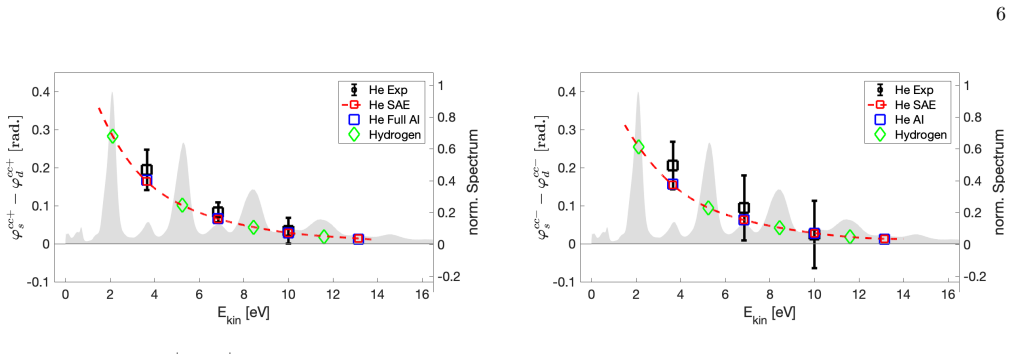
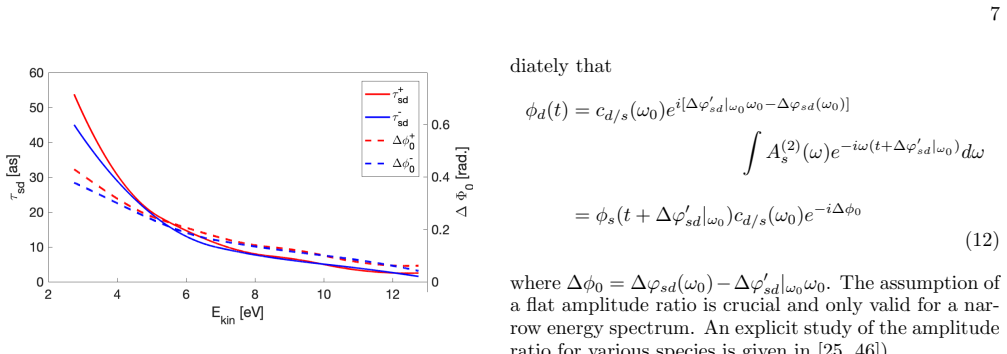
The authors experimentally quantify the dependence of the time delay on the angular momentum of the liberated photoelectrons. For continuum-continuum transitions they measure a delay between outgoing s- and d-electrons as large as 12 as close to the ionization threshold in helium. Both single-active-electron and first-principles ab initio simulations confirm this observation for helium and hydrogen, demonstrating the universality of the observed delays.
What carries the argument
Fitting of angle-dependent interference spectra from a two-color attosecond pump-probe experiment to separate the relative phases of four quantum pathways, isolating the continuum-continuum contribution.
If this is right
- The total photoionization delay extracted from attosecond pump-probe data must include this angular-momentum-dependent continuum-continuum term.
- The effect grows larger near the ionization threshold and is independent of the specific target atom or ion.
- Simulations that omit or misrepresent continuum-continuum phases will mispredict the observed delays.
- The measured delays supply a direct experimental benchmark for theoretical models of continuum wave-packet propagation.
Where Pith is reading between the lines
- The same fitting approach could be applied to other noble gases to test whether the delay scales with atomic number.
- Accounting for this delay may tighten the uncertainty in extracting bound-state or scattering-phase information from attosecond chronoscopy.
- In molecules the angular-momentum dependence might couple to vibrational or rotational degrees of freedom and produce additional observable structure.
Load-bearing premise
The fitting procedure applied to the angle-dependent interference pattern correctly disentangles the relative phases of the four contributing quantum pathways without significant crosstalk or unaccounted contributions.
What would settle it
An experiment near the helium ionization threshold that finds no measurable delay difference between s- and d-electrons, or a value inconsistent with 12 as after the same fitting procedure, would falsify the reported continuum-continuum delay.
Figures
read the original abstract
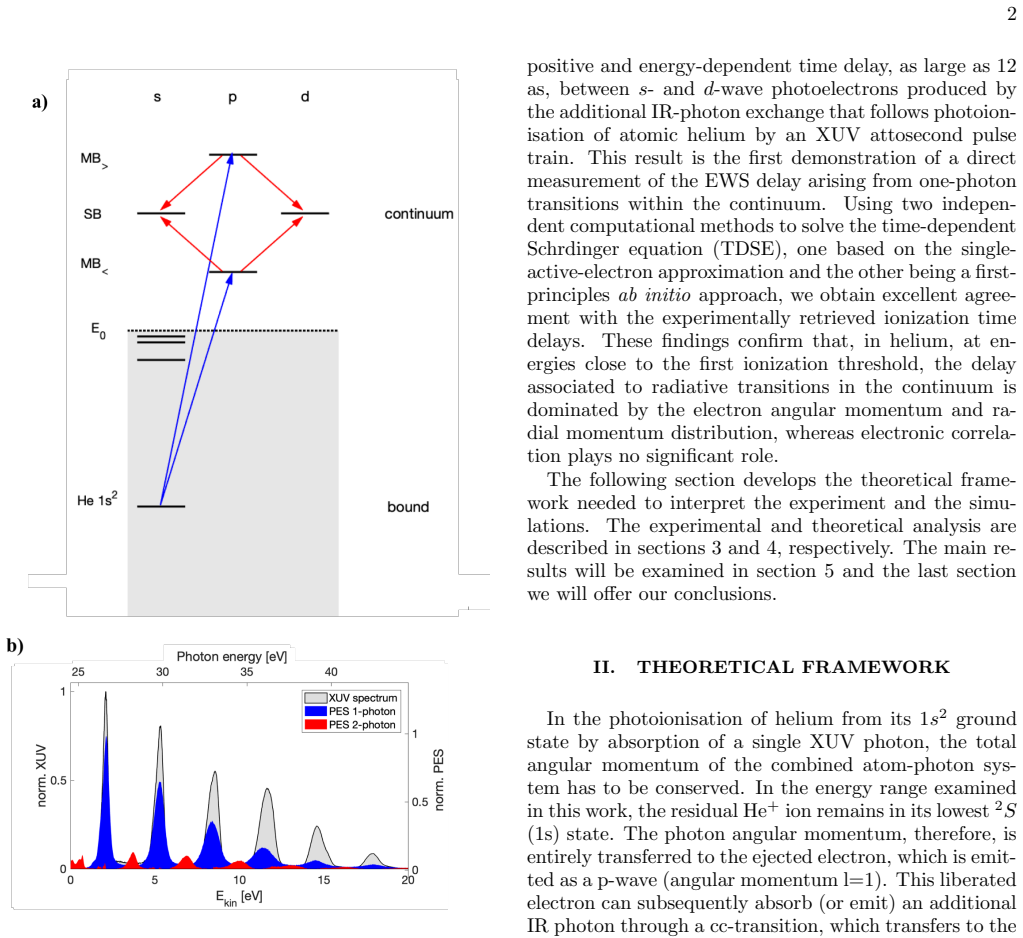
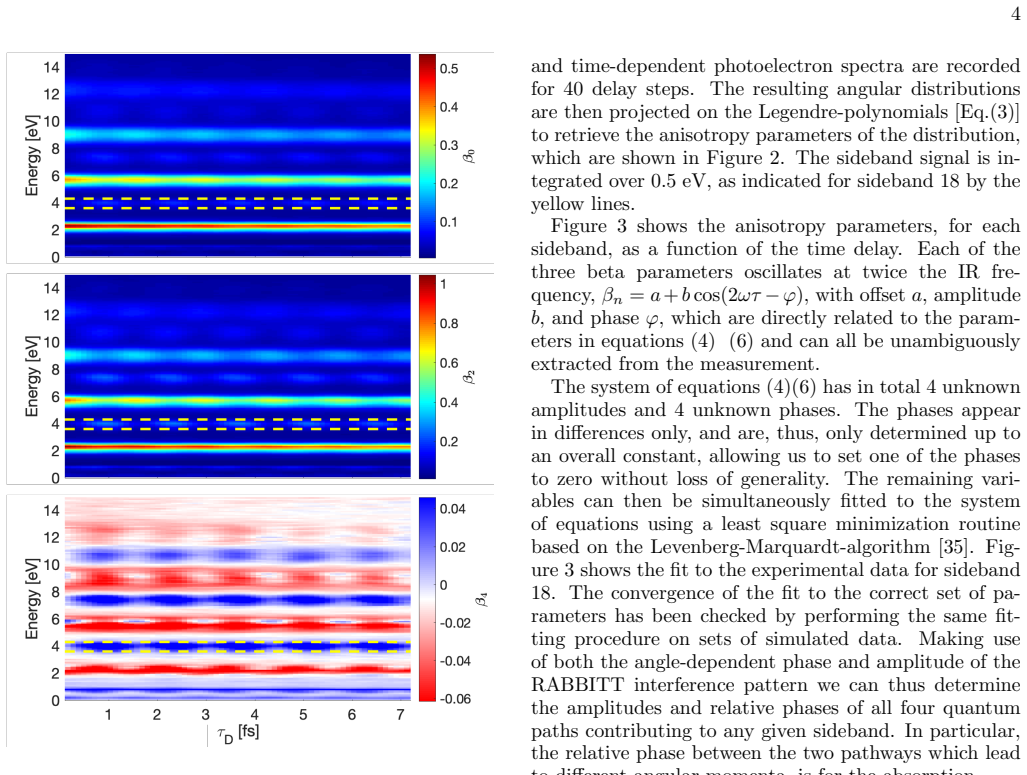
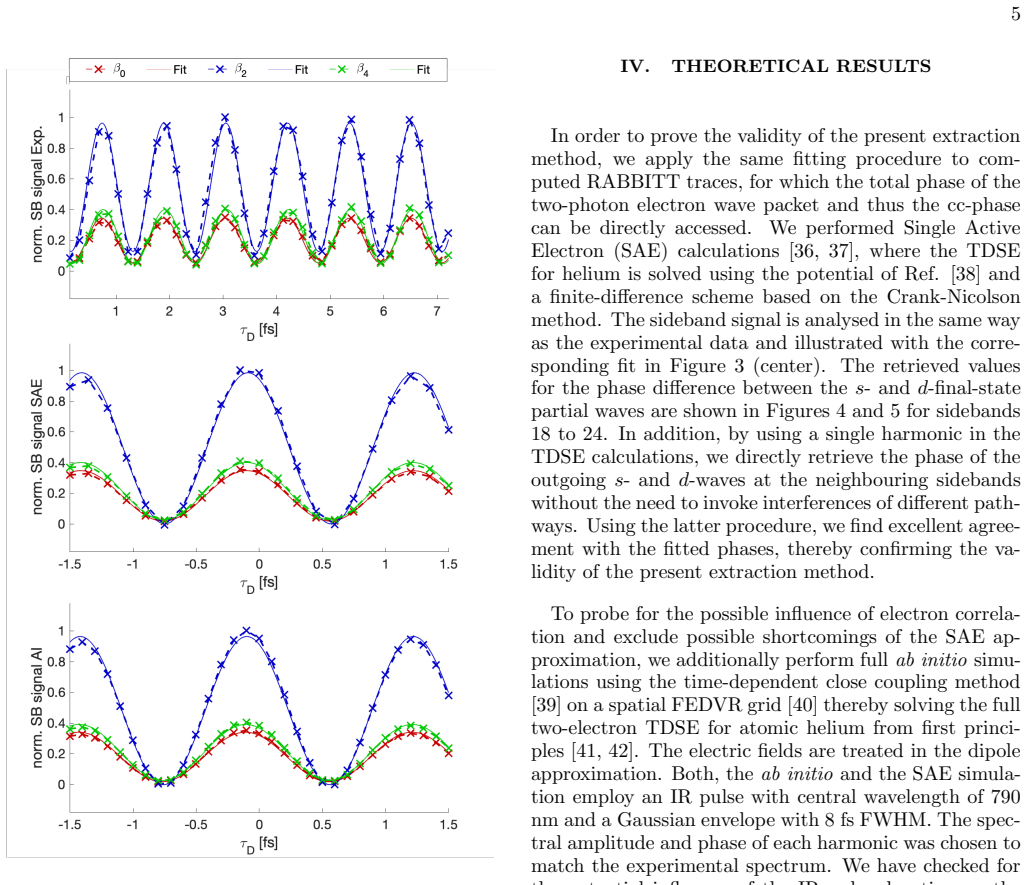
Attosecond photoionisation time delays reveal information about the potential energy landscape an outgoing electron wavepacket probes upon ionisation. In this study we experimentally quantify, for the first time, the dependence of the time delay on the angular momentum of the liberated photoelectrons. For this purpose, electron quantum-path interference spectra have been resolved in energy and angle using a two-color attosecond pump-probe photoionisation experiment in helium. A fitting procedure of the angle-dependent interference pattern allows us to disentangle the relative phase of all four quantum pathways that are known to contribute to the final photoelectron signal. In particular, we resolve the dependence on the angular momentum of the delay of one-photon transitions between continuum states, which is an essential and universal contribution to the total photoionization delay observed in attosecond pump-probe measurements. For such continuum-continuum transitions, we measure a delay between outgoing s- and d-electrons as large as 12 as close to the ionisation threshold in helium. Both single-active-electron and first-principles ab initio simulations confirm this observation for helium and hydrogen, demonstrating the universality of the observed delays.
Editorial analysis
A structured set of objections, weighed in public.
Referee Report
Summary. The manuscript reports the first experimental quantification of the angular-momentum dependence of one-photon continuum-continuum time delays in helium using angle- and energy-resolved two-color attosecond pump-probe photoionization. A fitting procedure applied to the measured interference patterns is used to disentangle the relative phases of the four contributing quantum pathways, yielding a delay between outgoing s- and d-electrons as large as 12 as near the ionization threshold. Single-active-electron and ab initio simulations for helium and hydrogen are presented in support of the result and its claimed universality.
Significance. If the phase extraction holds, the result isolates a previously unmeasured universal contribution to attosecond photoionization delays and demonstrates its angular-momentum dependence, with direct implications for the interpretation of RABBITT and similar measurements. The provision of both SAE and first-principles simulations that reproduce the extracted delay adds weight to the claim of universality across targets.
major comments (2)
- [Abstract and fitting procedure description] The central 12 as s–d delay is obtained exclusively from a four-amplitude, four-phase fit to the angle-dependent interference spectra. No information is given on the condition number of the design matrix, the covariance of the fitted phases, or recovery tests on synthetic data that include realistic noise levels and possible higher-order pathways. Without these, it is not possible to assess whether the reported relative phase (and therefore the extracted delay) is unique or robust against crosstalk. This directly affects the load-bearing claim in the abstract.
- [Results and discussion of experimental data] The manuscript states agreement between experiment and ab initio simulations but supplies neither the raw angle-resolved spectra, the precise functional form of the fit (including any constraints or regularization), nor a quantitative error analysis or χ² landscape for the extracted phases. These omissions prevent independent verification of the quoted 12 as value and its uncertainty.
minor comments (2)
- [Abstract] The abstract refers to “all four quantum pathways that are known to contribute,” but does not explicitly list the pathways or their angular-momentum assignments; a short enumeration would improve clarity.
- [Figures] Figure captions and axis labels should explicitly state the photon energies or sideband orders used for the delay extraction to allow direct comparison with the simulations.
Simulated Author's Rebuttal
We thank the referee for their careful reading and constructive comments on our manuscript. We address each major comment below.
read point-by-point responses
-
Referee: [Abstract and fitting procedure description] The central 12 as s–d delay is obtained exclusively from a four-amplitude, four-phase fit to the angle-dependent interference spectra. No information is given on the condition number of the design matrix, the covariance of the fitted phases, or recovery tests on synthetic data that include realistic noise levels and possible higher-order pathways. Without these, it is not possible to assess whether the reported relative phase (and therefore the extracted delay) is unique or robust against crosstalk. This directly affects the load-bearing claim in the abstract.
Authors: We agree that additional details on the fitting procedure are needed to demonstrate robustness. In the revised manuscript we will report the condition number of the design matrix, the covariance matrix of the fitted phases, and the outcomes of recovery tests on synthetic data that include realistic noise levels together with an assessment of possible higher-order pathways. These additions will confirm that the extracted relative phase and the reported 12 as delay are stable against crosstalk. revision: yes
-
Referee: [Results and discussion of experimental data] The manuscript states agreement between experiment and ab initio simulations but supplies neither the raw angle-resolved spectra, the precise functional form of the fit (including any constraints or regularization), nor a quantitative error analysis or χ² landscape for the extracted phases. These omissions prevent independent verification of the quoted 12 as value and its uncertainty.
Authors: We acknowledge that greater transparency is required. The revised manuscript will include the raw angle-resolved spectra (in the supplement), the exact functional form of the fit with all constraints and regularization, and a quantitative error analysis that presents the χ² landscape for the extracted phases. These changes will enable independent verification of the 12 as value and its uncertainty. revision: yes
Circularity Check
No circularity: experimental fit extracts measured delay; result not forced by definition or self-citation
full rationale
The paper reports a direct experimental measurement of s-d continuum-continuum delays (up to 12 as) obtained by fitting angle-resolved interference spectra to a four-pathway model. The abstract and description present this as data analysis that disentangles phases, with independent single-active-electron and ab initio simulations confirming the result for He and H. No quoted equations reduce the extracted delay to a fitted input by construction, no self-citation chain supplies a uniqueness theorem, and no ansatz is smuggled in. The central claim therefore remains an independent empirical observation rather than a tautological renaming or self-referential prediction.
Axiom & Free-Parameter Ledger
axioms (1)
- standard math Standard atomic photoionization theory and quantum path interference apply to the helium system under the experimental conditions.
Reference graph
Works this paper leans on
-
[1]
The convergence of the fit to the correct set of pa- rameters has been checked by performing the same fit- ting procedure on sets of simulated data. Making use of both the angle-dependent phase and amplitude of the RABBITT interference pattern we can thus determine the amplitudes and relative phases of all four quantum paths contributing to any given sideba...
-
[2]
The electric fields are treated in the dipole approximation
on a spatial FEDVR grid [40] thereby solving the full two-electron TDSE for atomic helium from first princi- ples [41, 42]. The electric fields are treated in the dipole approximation. Both, the ab initio and the SAE simula- tion employ an IR pulse with central wavelength of 790 nm and a Gaussian envelope with 8 fs FWHM. The spec- tral amplitude and phase o...
-
[3]
with respect to the scattering phase is due to the fact that, unlike for the bc-transition, the cc-transition in the two-photon scenario probes the potential landscape not for the full half-scattering but only at large distances where the centrifugal potential is weaker, yet still leads to clearly resolvable effects at low energies. Observation (ii) then c...
work page 2016
-
[4]
E. P. Wigner, Phys. Rev. 98, 145 (1955)
work page 1955
-
[5]
F. T. Smith, Phys. Rev. 118, 349 (1960)
work page 1960
-
[6]
J. M. Dahlstr¨ om, D. Gu´ enot, K. Kl¨ under, M. Gissel- brecht, J. Mauritsson, A. L’Huillier, A. Maquet, and R. Ta¨ ıeb, Chem. Phys.414, 53 (2013)
work page 2013
-
[7]
R. Pazourek, S. Nagele, and J. Burgd¨ orfer, Rev. Mod. Phys. 87, 765 (2015)
work page 2015
- [8]
-
[9]
M. Huppert, I. Jordan, D. Baykusheva, A. von Conta, and H. J. W¨ orner, Phys. Rev. Lett.117, 093001 (2016)
work page 2016
-
[10]
Er- ratum: Resonance Effects in Photoemission Time Delays [Phys. Rev. Lett. 115, 133001 (2015),
M. Sabbar, S. Heuser, R. Boge, M. Lucchini, T. Carette, E. Lindroth, L. Gallmann, C. Cirelli, and U. Keller, “Er- ratum: Resonance Effects in Photoemission Time Delays [Phys. Rev. Lett. 115, 133001 (2015),” (2017)
work page 2015
-
[11]
A. L. Cavalieri, N. M¨ uller, T. Uphues, V. S. Yakovlev, A. Baltuˇ ska, B. Horvath, B. Schmidt, L. Bl¨ umel, R. Holzwarth, S. Hendel, M. Drescher, U. Kleineberg, P. M. Echenique, R. Kienberger, F. Krausz, and U. Heinzmann, Nature 449, 1029 (2007)
work page 2007
-
[12]
M. Schultze, M. Fiess, N. Karpowicz, J. Gagnon, M. Korbman, M. Hofstetter, S. Neppl, A. L. Cavalieri, Y. Komninos, T. Mercouris, C. A. Nicolaides, R. Pa- zourek, S. Nagele, J. Feist, J. Burgd¨ orfer, A. M. Azzeer, R. Ernstorfer, R. Kienberger, U. Kleineberg, E. Gouliel- makis, F. Krausz, and V. S. Yakovlev, Science 328, 1658 (2010)
work page 2010
-
[13]
G. Sansone, F. Kelkensberg, J. F. P´ erez-Torres, F. Morales, M. F. Kling, W. Siu, O. Ghafur, P. Johnsson, M. Swoboda, E. Benedetti, F. Ferrari, F. L´ epine, J. L. Sanz-Vicario, S. Zherebtsov, I. Znakovskaya, A. Lhuillier, M. Y. Ivanov, M. Nisoli, F. Mart´ ın, and M. J. Vrakking, Nature 465, 763 (2010)
work page 2010
-
[14]
M. Ossiander, F. Siegrist, V. Shirvanyan, R. Pazourek, A. Sommer, T. Latka, A. Guggenmos, S. Nagele, J. Feist, J. Burgd¨ orfer, R. Kienberger, and M. Schultze, Nat. Phys. 13, 280 (2017)
work page 2017
-
[15]
J. Vos, L. Cattaneo, S. Patchkovskii, T. Zimmermann, C. Cirelli, M. Lucchini, A. Kheifets, A. S. Landsman, and U. Keller, Science (80-. ). 360, 1326 (2018)
work page 2018
-
[16]
L. Cattaneo, J. Vos, R. Y. Bello, A. Palacios, S. Heuser, L. Pedrelli, M. Lucchini, C. Cirelli, F. Mart´ ın, and U. Keller, Nat. Phys. 14, 733 (2018)
work page 2018
-
[17]
S. Heuser, ´A. Jim´ enez Gal´ an, C. Cirelli, C. Marante, M. Sabbar, R. Boge, M. Lucchini, L. Gallmann, I. Ivanov, A. S. Kheifets, J. M. Dahlstr¨ om, E. Lindroth, L. Ar- genti, F. Mart´ ın, and U. Keller, Phys. Rev. A94, 063409 (2016). 9
work page 2016
-
[18]
C. Cirelli, C. Marante, S. Heuser, C. L. Petersson, ´A. J. Gal´ an, L. Argenti, S. Zhong, D. Busto, M. Isinger, S. Nandi, S. MacLot, L. Rading, P. Johnsson, M. Gis- selbrecht, M. Lucchini, L. Gallmann, J. M. Dahlstr¨ om, E. Lindroth, A. L’Huillier, F. Mart´ ın, and U. Keller, Nat. Commun. 9, 955 (2018)
work page 2018
-
[19]
L. Miaja-Avila, C. Lei, M. Aeschlimann, J. L. Gland, M. M. Murnane, H. C. Kapteyn, and G. Saathoff, Phys. Rev. Lett. 97, 113604 (2006)
work page 2006
-
[20]
Y. Mairesse, D. de Bohan, L. J. Frasinski, H. Merdji, L. C. Dinu, P. Monchicourt, P. Breger, M. Kovacev, R. Taieb, B. Carre, H. G. Muller, P. Agostini, and P. Salieres, Science (80-. ). 302, 1540 (2003)
work page 2003
-
[21]
L. Cattaneo, J. Vos, M. Lucchini, L. Gallmann, C. Cirelli, and U. Keller, Opt. Express 24, 29060 (2016)
work page 2016
-
[22]
J. M. Dahlstr¨ om, A. L’Huillier, and A. Maquet, J. Phys. B At. Mol. Opt. Phys. 45, 183001 (2012)
work page 2012
-
[23]
K. Kl¨ under, J. M. Dahlstr¨ om, M. Gisselbrecht, T. Fordell, M. Swoboda, D. Gu´ enot, P. Johnsson, J. Caillat, J. Mauritsson, A. Maquet, R. Ta¨ ıeb, and A. L’Huillier, Phys. Rev. Lett. 106, 143002 (2011)
work page 2011
-
[24]
I. A. Ivanov and A. S. Kheifets, Phys. Rev. A 96, 13408 (2017)
work page 2017
- [25]
-
[26]
J. W¨ atzel, A. S. Moskalenko, Y. Pavlyukh, and J. Berak- dar, J. Phys. B At. Mol. Opt. Phys. 48, 025602 (2015)
work page 2015
- [27]
- [28]
-
[29]
A. W. Bray, F. Naseem, and A. S. Kheifets, Phys. Rev. A 97, 63404 (2018)
work page 2018
-
[30]
X. Zhao, H. Wei, W.-W. Yu, and C. D. Lin, Phys. Rev. A 98, 053404 (2018)
work page 2018
-
[31]
P. M. Paul, E. S. Toma, P. Breger, G. Mullot, F. Auge, P. Balcou, H. G. Muller, and P. Agostini, Science 292, 1689 (2001)
work page 2001
- [32]
-
[33]
´A. Jim´ enez-Gal´ an, F. Mart´ ın, and L. Argenti, Phys. Rev. A 93, 023429 (2016)
work page 2016
-
[34]
G. Laurent, W. Cao, H. Li, Z. Wang, I. Ben-Itzhak, and C. L. Cocke, Phys. Rev. Lett. 109, 083001 (2012)
work page 2012
-
[35]
R. D¨ orner, V. Mergel, O. Jagutzki, L. Spielberger, J. Ull- rich, R. Moshammer, and H. Schmidt-B¨ ocking, “Cold Target Recoil Ion Momentum Spectroscopy: A ’momen- tum microscope’ to view atomic collision dynamics,” (2000)
work page 2000
-
[36]
M. Lewenstein, P. Balcou, M. Y. Ivanov, A. L’Huillier, and P. B. Corkum, Phys. Rev. A 49, 2117 (1994)
work page 1994
- [37]
-
[38]
J. J. Mor´ e, in Numer. Anal. (Springer, Berlin, Heidel- berg, 2006) pp. 105–116
work page 2006
-
[39]
A. N. Grum-Grzhimailo, M. N. Khaerdinov, and K. Bartschat, Phys. Rev. A - At. Mol. Opt. Phys. 88, 055401 (2013)
work page 2013
-
[40]
N. Douguet, A. N. Grum-Grzhimailo, E. V. Gryzlova, E. I. Staroselskaya, J. Venzke, and K. Bartschat, Phys. Rev. A 93, 033402 (2016)
work page 2016
-
[41]
X. M. Tong and C. D. Lin, J. Phys. B At. Mol. Opt. Phys. 38, 2593 (2005)
work page 2005
-
[42]
M. S. Pindzola, F. Robicheaux, S. D. Loch, J. C. Berengut, T. Topcu, J. Colgan, M. Foster, D. C. Griffin, C. P. Ballance, D. R. Schultz, T. Minami, N. R. Badnell, M. C. Witthoeft, D. R. Plante, D. M. Mitnik, J. A. Lud- low, and U. Kleiman, J. Phys. B At. Mol. Opt. Phys. 40, R39 (2007)
work page 2007
-
[43]
T. N. Rescigno and C. W. McCurdy, Phys. Rev. A 62, 032706 (2000)
work page 2000
- [44]
- [45]
-
[46]
U. Heinzmann and J. H. Dil, J. Phys. Condens. Matter 24, 173001 (2012)
work page 2012
-
[47]
U. Heinzmann, Springer Ser. Opt. Sci. , edited by L. Plaja, R. Torres, and A. Za¨ ır, Springer Series in Opti- cal Sciences, Vol. 177 (Springer Berlin Heidelberg, Berlin, Heidelberg, 2013) pp. 231–253
work page 2013
-
[48]
M. Fanciulli, H. Volfov´ a, S. Muff, J. Braun, H. Ebert, J. Min´ ar, U. Heinzmann, and J. H. Dil, Phys. Rev. Lett. 118, 067402 (2017)
work page 2017
-
[49]
L. H. Haber, B. Doughty, and S. R. Leone, Phys. Rev. A 84, 013416 (2011)
work page 2011
-
[50]
M. Lucchini, A. Ludwig, T. Zimmermann, L. Kasmi, J. Herrmann, A. Scrinzi, A. S. Landsman, L. Gallmann, and U. Keller, Phys. Rev. A 91, 063406 (2015)
work page 2015
discussion (0)
Sign in with ORCID, Apple, or X to comment. Anyone can read and Pith papers without signing in.