Enabling Microsoft OneDrive Integration with HTCondor
Pith reviewed 2026-05-25 00:48 UTC · model grok-4.3
The pith
HTCondor now acquires, renews, and transfers OneDrive OAuth credentials automatically so users skip manual credential handling for distributed jobs.
A machine-rendered reading of the paper's core claim, the machinery that carries it, and where it could break.
Core claim
By leveraging HTCondor's scheduler to handle acquisition, renewal, and secure transfer of OAuth credentials, OneDrive can serve as an easy-to-use data distribution method for distributed computing. Users no longer perform multiple manual steps with unfamiliar tools; the system takes care of access on their behalf. The paper presents this integration through descriptions of OneDrive capabilities and a comparison to existing national cyberinfrastructure practices.
What carries the argument
HTCondor scheduler-managed OAuth credential handling that acquires, renews, and transfers tokens without user intervention for OneDrive access.
If this is right
- Users avoid copying credentials along with job submissions.
- The scheduler handles credential renewal and secure transfer automatically.
- OneDrive desktop clients can provide automatic synchronization to computing resources.
- Researchers spend less time learning specialized cyberinfrastructure tools for data access.
Where Pith is reading between the lines
- The same credential automation could apply to other OAuth-based storage services.
- Wider adoption might increase use of distributed computing among researchers who previously found setup too cumbersome.
- National cyberinfrastructure operators could evaluate similar integrations for additional cloud providers.
Load-bearing premise
That a description of OneDrive features and a comparison to other data distribution methods suffices to establish improved ease of use.
What would settle it
A timed user study comparing setup duration for data distribution with and without the OneDrive-HTCondor integration.
Figures


read the original abstract
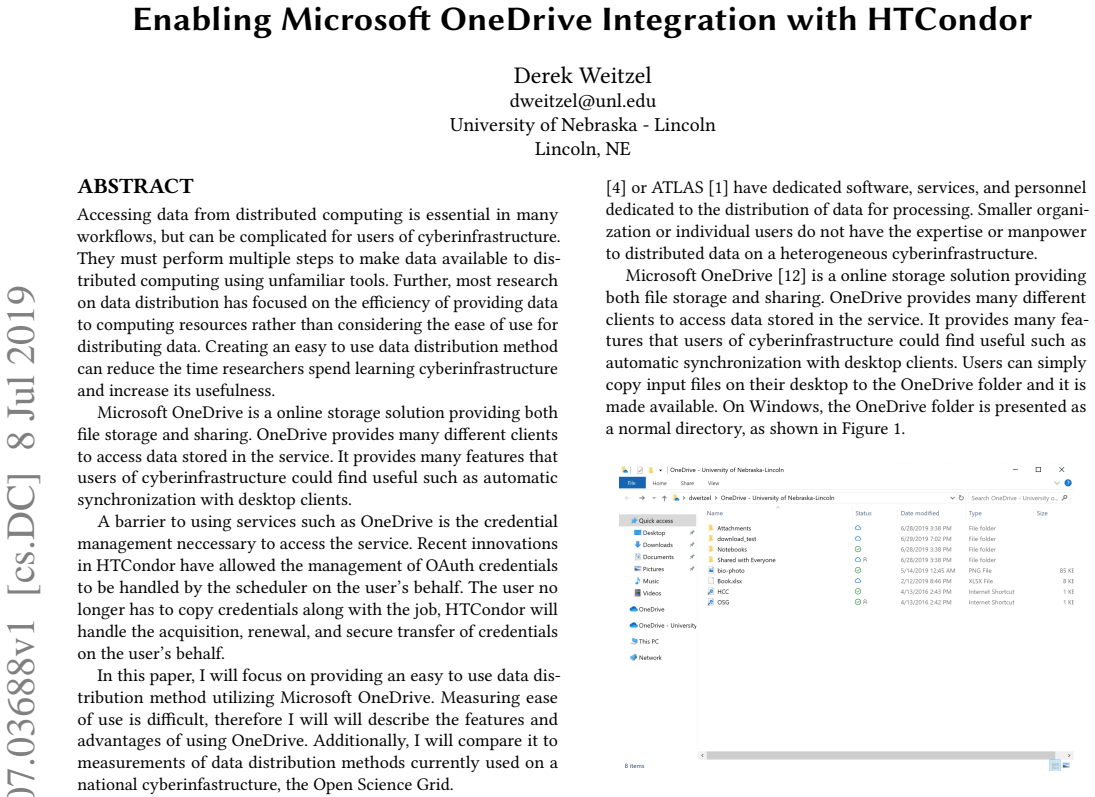
Accessing data from distributed computing is essential in many workflows, but can be complicated for users of cyberinfrastructure. They must perform multiple steps to make data available to distributed computing using unfamiliar tools. Further, most research on data distribution has focused on the efficiency of providing data to computing resources rather than considering the ease of use for distributing data. Creating an easy to use data distribution method can reduce the time researchers spend learning cyberinfrastructure and increase its usefulness. Microsoft OneDrive is a online storage solution providing both file storage and sharing. OneDrive provides many different clients to access data stored in the service. It provides many features that users of cyberinfrastructure could find useful such as automatic synchronization with desktop clients. A barrier to using services such as OneDrive is the credential management necessary to access the service. Recent innovations in HTCondor have allowed the management of OAuth credentials to be handled by the scheduler on the user's behalf. The user no longer has to copy credentials along with the job, HTCondor will handle the acquisition, renewal, and secure transfer of credentials on the user's behalf. In this paper, I will focus on providing an easy to use data distribution method utilizing Microsoft OneDrive. Measuring ease of use is difficult, therefore I will will describe the features and advantages of using OneDrive. Additionally, I will compare it to measurements of data distribution methods currently used on a national cyberinfastructure, the Open Science Grid.
Editorial analysis
A structured set of objections, weighed in public.
Referee Report
Summary. The paper describes an integration between Microsoft OneDrive and HTCondor that leverages recent HTCondor innovations in OAuth credential management. The scheduler handles credential acquisition, renewal, and secure transfer on the user's behalf, eliminating the need for users to copy credentials with jobs. OneDrive features such as automatic desktop synchronization are presented as advantages for cyberinfrastructure users. The central claim is that this yields an easy-to-use data distribution method that reduces researcher time on cyberinfrastructure; the paper explicitly notes the difficulty of measuring ease of use and therefore limits itself to feature descriptions plus a qualitative comparison to data distribution methods on the Open Science Grid.
Significance. If the integration demonstrably simplifies access, it could provide a practical systems contribution by bridging familiar consumer cloud storage with HTC workflows, reducing the learning curve for distributed computing. The description of HTCondor's credential-handling mechanism is a clear, useful systems detail. However, the complete absence of any empirical validation, timing data, or user studies means the significance of the usability claim cannot be assessed from the manuscript.
major comments (2)
- [Abstract] Abstract: The central claim that the integration provides an 'easy to use data distribution method' that reduces researcher time is unsupported by any quantitative evidence. The manuscript states that 'Measuring ease of use is difficult' and therefore offers only feature descriptions and a qualitative comparison; this leaves the primary motivation unsubstantiated.
- [Abstract] Abstract: The text promises to 'compare it to measurements of data distribution methods currently used on a national cyberinfrastructure, the Open Science Grid,' yet no measurements, tables, step counts, or analysis of OSG methods appear in the manuscript.
minor comments (2)
- [Abstract] Typo: 'I will will describe' should read 'I will describe'.
- [Abstract] Grammar: 'Microsoft OneDrive is a online storage solution' should be 'an online storage solution'.
Simulated Author's Rebuttal
We thank the referee for their review and comments. We address the major comments point by point below, with proposed revisions to the abstract to ensure consistency with the manuscript content.
read point-by-point responses
-
Referee: [Abstract] Abstract: The central claim that the integration provides an 'easy to use data distribution method' that reduces researcher time is unsupported by any quantitative evidence. The manuscript states that 'Measuring ease of use is difficult' and therefore offers only feature descriptions and a qualitative comparison; this leaves the primary motivation unsubstantiated.
Authors: We agree that the manuscript provides no quantitative evidence supporting the ease-of-use claim, consistent with the explicit statement that measuring ease of use is difficult. The contribution is a description of the HTCondor-OneDrive integration, its credential management features, and a qualitative comparison to existing practices. We will revise the abstract to remove or qualify the unsubstantiated claim about reducing researcher time and instead focus on the technical integration and features provided. revision: yes
-
Referee: [Abstract] Abstract: The text promises to 'compare it to measurements of data distribution methods currently used on a national cyberinfrastructure, the Open Science Grid,' yet no measurements, tables, step counts, or analysis of OSG methods appear in the manuscript.
Authors: The abstract does promise a comparison involving measurements from the Open Science Grid. The manuscript instead delivers a qualitative discussion of differences in credential handling and data distribution practices. This is an inconsistency between the abstract and the body. We will revise the abstract to state that the comparison is qualitative, based on feature descriptions and current OSG practices, without reference to quantitative measurements. revision: yes
Circularity Check
No circularity; purely descriptive systems report with no derivations or predictions
full rationale
The paper contains no equations, predictions, fitted parameters, or derivation chains of any kind. It is a feature-description document that acknowledges the difficulty of measuring ease of use and therefore restricts itself to qualitative description of OneDrive and HTCondor capabilities plus a non-quantitative comparison to OSG methods. No self-citations, ansatzes, or uniqueness claims appear, and the central statements are not shown to reduce to their own inputs by construction.
Axiom & Free-Parameter Ledger
axioms (1)
- domain assumption HTCondor scheduler can acquire, renew, and securely transfer OAuth credentials on behalf of users
Reference graph
Works this paper leans on
-
[1]
Georges Aad, JM Butterworth, J Thion, U Bratzler, PN Ratoff, RB Nickerson, JM Seixas, I Grabowska-Bold, F Meisel, S Lokwitz, et al. 2008. The ATLAS experiment at the CERN large hadron collider. Jinst 3 (2008), S08003
work page 2008
-
[2]
Barry Blumenfeld, David Dykstra, Lee Lueking, and Eric Wicklund. 2008. CMS conditions data access using FroNTier. In Journal of Physics: Conference Series , Vol. 119. IOP Publishing, 072007
work page 2008
-
[3]
Box. 2019. Box. https://www.box.com/
work page 2019
-
[4]
Serguei Chatrchyan, EA de Wolf, et al. 2008. The CMS experiment at the CERN LHC. Journal of instrumentation.-Bristol, 2006, currens 3 (2008), S08004–1
work page 2008
-
[5]
Dropbox. 2019. Dropbox. https://www.dropbox.com/
work page 2019
-
[6]
Ian Foster. 2011. Globus Online: Accelerating and democratizing science through cloud-based services. IEEE Internet Computing 15, 3 (2011), 70–73
work page 2011
-
[7]
James Frey. 2002. Condor DAGMan: Handling inter-job dependencies
work page 2002
-
[8]
GO. 2019. The Go Programming Language . https://golang.org/
work page 2019
-
[9]
Internet2. 2019. Internet2. https://www.internet2.edu/
work page 2019
-
[10]
Microsoft. 2019. Microsoft Azure Portal. https://portal.azure.com
work page 2019
-
[11]
Microsoft. 2019. Microsoft Graph. https://developer.microsoft.com/en-us/graph
work page 2019
-
[12]
Microsoft. 2019. Microsoft OneDrive. https://onedrive.live.com/about/en-us/
work page 2019
-
[13]
Ruth Pordes, Don Petravick, Bill Kramer, Doug Olson, Miron Livny, Alain Roy, Paul Avery, Kent Blackburn, Torre Wenaus, Frank Würthwein, et al. 2007. The open science grid. In Journal of Physics: Conference Series , Vol. 78. IOP Publishing, 012057
work page 2007
-
[14]
Douglas Thain, Todd Tannenbaum, and Miron Livny. 2005. Distributed computing in practice: the Condor experience. Concurrency and computation: practice and experience 17, 2-4 (2005), 323–356
work page 2005
-
[15]
Andrew Tridgell, Paul Mackerras, et al. 1996. The rsync algorithm. (1996)
work page 1996
-
[16]
Derek Weitzel. 2019. djw8605/onedrive-oauth: First release of OneDrive oauth. https://doi.org/10.5281/zenodo.3265184
-
[17]
Derek Weitzel, Marian Zvada, Ilija Vukotic, Rob Gardner, Brian Bockelman, Mats Rynge, Edgar Fajardo Hernandez, Brian Lin, and Matyas Selmeci. 2019. Stash- Cache: A Distributed Caching Federation for the Open Science Grid. Proceedings of the Practice and Experience on Advanced Research Computing (2019)
work page 2019
-
[18]
Alex Withers, Brian Bockelman, Derek Weitzel, Duncan Brown, Jeff Gaynor, Jim Basney, Todd Tannenbaum, and Zach Miller. 2018. SciTokens: Capability- Based Secure Access to Remote Scientific Data. In Proceedings of the Practice and Experience on Advanced Research Computing . ACM, 24
work page 2018
discussion (0)
Sign in with ORCID, Apple, or X to comment. Anyone can read and Pith papers without signing in.