Emergency DC Power Support Strategy Based on Coordinated Droop Control in Multi-Infeed HVDC System
Pith reviewed 2026-05-24 21:51 UTC · model grok-4.3
The pith
Coordinated droop control on HVDC lines improves frequency stability after DC faults in multi-infeed systems
A machine-rendered reading of the paper's core claim, the machinery that carries it, and where it could break.
Core claim
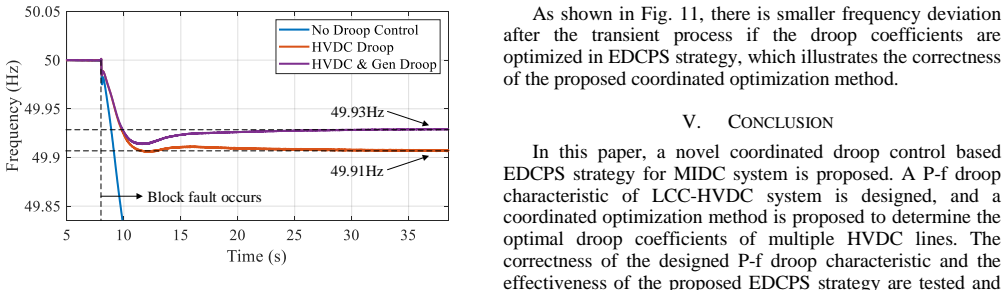
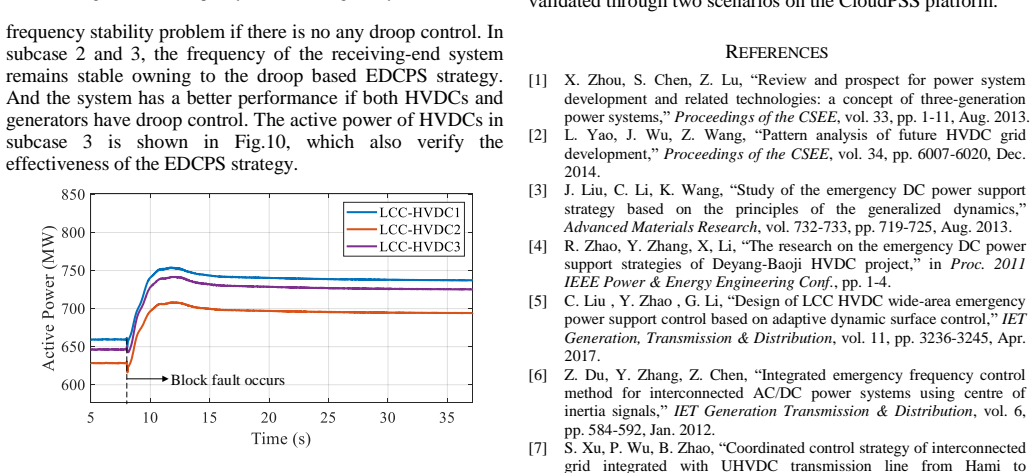
The emergency DC power support strategy rests on a droop characteristic between LCC-HVDC active power and receiving-end frequency, paired with a coordinated optimization procedure that selects the droop coefficients for all lines in the multi-infeed system; electromagnetic transient model tests confirm that this combination improves frequency stability of the receiving-end AC system.
What carries the argument
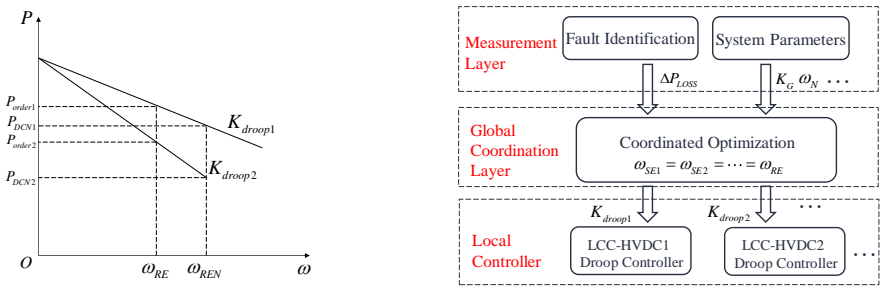
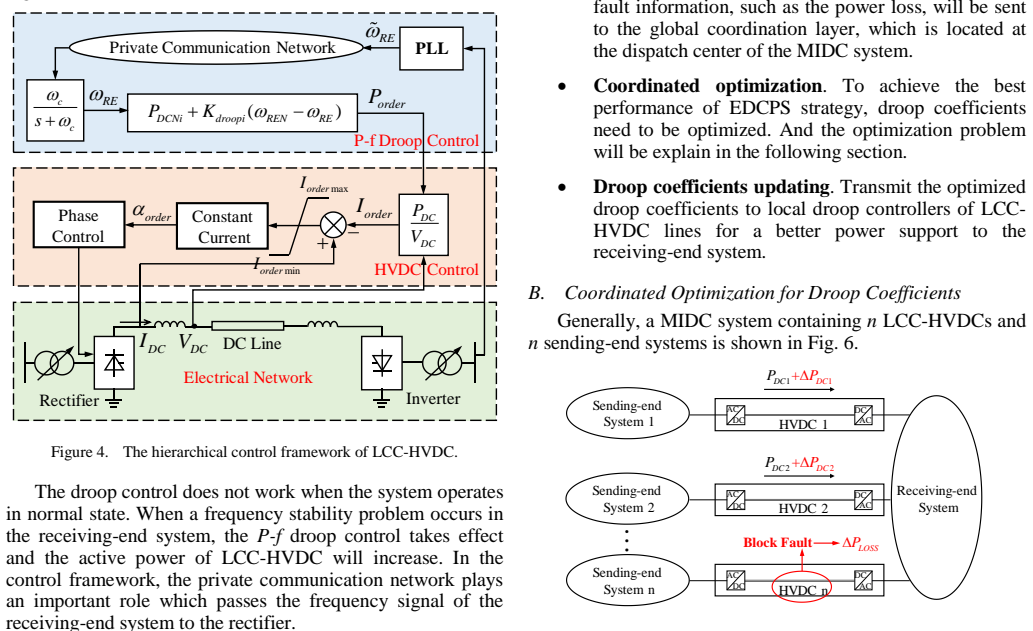
The droop characteristic relating HVDC active power to system frequency, together with the coordinated optimization routine that sets the coefficients for multiple HVDC lines
If this is right
- Frequency nadir and steady-state deviation decrease during DC block faults.
- Support burden is shared across multiple HVDC lines according to the optimized coefficients.
- The strategy operates through existing HVDC controls and requires no additional hardware.
- Effectiveness is demonstrated in EMT simulations on the tested multi-infeed configuration.
Where Pith is reading between the lines
- If the optimization remains effective under varied fault types, operators could reduce reliance on local synchronous generation for post-fault frequency recovery.
- The same droop framework could be examined for compatibility with AC-side frequency response services from renewables.
- Extension to systems containing both LCC and VSC HVDC would test whether the coefficient optimization generalizes beyond the LCC-only case studied.
Load-bearing premise
The optimized droop coefficients will supply frequency support without triggering new instabilities or harmful interactions among the HVDC lines.
What would settle it
An electromagnetic transient simulation of the same multi-infeed system in which the proposed EDCPS strategy produces larger frequency deviations or sustained oscillations than the baseline case without support.
Figures

read the original abstract
With the complex hybrid AC-DC power system in China coming into being, the HVDC faults, such as DC block faults, have an enormous effect on the frequency stability of the AC side. In multi-infeed HVDC (MIDC) system, to improve the frequency stability of the receiving-end system, this paper proposes an emergency DC power support (EDCPS) strategy, which is based on a designed droop characteristic between the active power of LCC-HVDC lines and the receiving-end system frequency. Then, a coordinated optimization method is proposed to determine the droop coefficients of the MIDC lines. To test the proposed EDCPS method, the electromagnetic transient (EMT) model of a MIDC system is built on the CloudPSS platform, and the test results verify the effectiveness of the proposed EDCPS strategy.
Editorial analysis
A structured set of objections, weighed in public.
Referee Report
Summary. The manuscript proposes an emergency DC power support (EDCPS) strategy for multi-infeed HVDC (MIDC) systems. The strategy defines a droop characteristic relating LCC-HVDC active power to receiving-end frequency and uses a coordinated optimization procedure to select the droop coefficients. Effectiveness is demonstrated solely through electromagnetic transient (EMT) simulations of a MIDC system on the CloudPSS platform, with the claim that the approach improves frequency stability under HVDC faults such as DC block.
Significance. If the optimization procedure and simulation results hold under scrutiny, the work supplies a concrete, droop-based control design that could be applied to frequency support in large hybrid AC-DC grids. The EMT verification on CloudPSS is a standard and appropriate tool for this class of control proposals; explicit reporting of the optimization objective, constraints, and quantitative frequency metrics would strengthen the contribution.
major comments (3)
- [Abstract, §3] Abstract and §3 (coordinated optimization): the optimization method for selecting droop coefficients is described only at a high level; no objective function, constraints, or decision variables are stated, so it is impossible to determine whether the procedure guarantees stability margins or merely fits the simulated cases.
- [Simulation results] Simulation results section: the EMT tests on CloudPSS are reported only qualitatively; no numerical values are given for frequency nadir, rate of change of frequency, or settling time with versus without the EDCPS strategy, leaving the central claim of improvement without measurable support.
- [§4] §4 (EMT model): system parameters, fault scenarios, and the exact droop-coefficient values obtained from the optimization are not listed, preventing independent reproduction or assessment of whether the reported benefit is robust to parameter variation.
minor comments (2)
- [Method] Notation for the droop characteristic (e.g., the slope relating power to frequency) should be introduced with an equation number in the method section for clarity.
- [Abstract] The abstract states that the strategy 'improves the frequency stability' but does not specify the baseline (conventional droop or no support); a single sentence clarifying the comparison would aid readability.
Simulated Author's Rebuttal
We thank the referee for the thorough review and valuable comments on our manuscript. The suggestions highlight areas where additional detail will improve clarity and reproducibility. We agree with the major comments and will incorporate revisions to address them.
read point-by-point responses
-
Referee: [Abstract, §3] Abstract and §3 (coordinated optimization): the optimization method for selecting droop coefficients is described only at a high level; no objective function, constraints, or decision variables are stated, so it is impossible to determine whether the procedure guarantees stability margins or merely fits the simulated cases.
Authors: We acknowledge that §3 presents the coordinated optimization at a high level. In the revised manuscript we will explicitly define the objective function (minimization of a weighted sum of frequency deviation and control effort), the decision variables (the droop coefficients for each HVDC line), and the constraints (DC power limits, stability margins derived from small-signal analysis, and coordination among lines). This will demonstrate that the procedure is formulated to guarantee adequate stability margins rather than merely fitting the simulated cases. revision: yes
-
Referee: [Simulation results] Simulation results section: the EMT tests on CloudPSS are reported only qualitatively; no numerical values are given for frequency nadir, rate of change of frequency, or settling time with versus without the EDCPS strategy, leaving the central claim of improvement without measurable support.
Authors: The original presentation emphasized qualitative waveform comparisons. In the revision we will add a table (or set of tables) reporting quantitative metrics—frequency nadir, maximum RoCoF, and settling time—for the base case and the EDCPS case under each fault scenario. These numbers will be extracted directly from the CloudPSS EMT simulations already performed. revision: yes
-
Referee: [§4] §4 (EMT model): system parameters, fault scenarios, and the exact droop-coefficient values obtained from the optimization are not listed, preventing independent reproduction or assessment of whether the reported benefit is robust to parameter variation.
Authors: We agree that the absence of these data limits reproducibility. The revised §4 will include: (i) a table of key system parameters (AC line impedances, HVDC ratings, generator inertias, etc.), (ii) a detailed description of the fault scenarios (location, duration, and type of DC block), and (iii) the numerical droop coefficients obtained from the optimization. These additions will allow readers to assess robustness. revision: yes
Circularity Check
No significant circularity in derivation chain
full rationale
The paper proposes an EDCPS strategy via a designed droop characteristic between LCC-HVDC active power and receiving-end frequency, followed by a coordinated optimization method to set droop coefficients, with effectiveness verified by independent EMT simulation on CloudPSS. No load-bearing step reduces by construction to its own inputs: the optimization produces settings as an output of the method rather than redefining the target stability metric, and the simulation constitutes external verification rather than a self-referential fit. The derivation remains self-contained against the stated simulation benchmark with no self-citation load-bearing on the central claim.
Axiom & Free-Parameter Ledger
free parameters (1)
- droop coefficients
Reference graph
Works this paper leans on
-
[1]
X. Zhou, S. Chen, Z. Lu, “Review and prospect for power system development and related technologies: a concept of thr ee-generation power systems,” Proceedings of the CSEE, vol. 33, pp. 1-11, Aug. 2013
work page 2013
-
[2]
Pattern analysis of future HVDC grid development,
L. Yao, J. Wu, Z. Wang, “Pattern analysis of future HVDC grid development,” Proceedings of the CSEE , vol. 34, pp. 6007 -6020, Dec. 2014
work page 2014
-
[3]
J. Liu, C. Li, K. Wang, “Study of t he emergency DC power support strategy based on the principles of the generalized dynamics,” Advanced Materials Research, vol. 732-733, pp. 719-725, Aug. 2013
work page 2013
-
[4]
The research on the emergency DC power support strategies of Deyang -Baoji HVDC project,
R. Zhao, Y. Zhang, X, Li, “The research on the emergency DC power support strategies of Deyang -Baoji HVDC project,” in Proc. 2011 IEEE Power & Energy Engineering Conf., pp. 1-4
work page 2011
-
[5]
C. Liu , Y. Zhao , G. Li, “Design of LCC HVDC wide-area emergency power support control based on adaptive dynamic surface control,” IET Generation, Transmission & Distribution, vol. 11, pp. 3236-3245, Apr. 2017
work page 2017
-
[6]
Z. Du, Y. Zhang, Z. Chen, “Integrated emergency frequency control method for interconnected AC/DC power systems using centre of inertia signals,” IET Generation Transmission & Distribution , vol. 6, pp. 584-592, Jan. 2012
work page 2012
-
[7]
S. Xu, P. Wu, B. Zhao, “Coordinated control strategy of interconnected grid integrated with UHVDC transmission line from Hami to Zhengzhou,” Power System Technology , vol. 39, pp. 1773-1778, Jul. 2015
work page 2015
-
[8]
Study on frequency control strategy for ORMOC-NAGA HVDC project in Philippines ,
W. Zhao, Y. Wang, B. Chang, “Study on frequency control strategy for ORMOC-NAGA HVDC project in Philippines ,” in Proc. 201 6 IEEE PES Transmission & Distribution Conference and Exposition, pp. 1-6
-
[9]
E. Prieto-Araujo, F. D. Bianchi, A. Junyent-Ferré, “Methodology for droop control dynamic analysis of multiter minal VSC-HVDC grids for offshore wind farms,” IEEE Trans. Power Delivery, vol. 26, pp. 2476- 2485, Oct. 2011
work page 2011
-
[10]
Impact of DC line voltage drops on power flow of MTDC using droop control,
T. M. Haileselassie, K. Uhlen, “Impact of DC line voltage drops on power flow of MTDC using droop control, ” IEEE Trans . Power Systems, vol. 27, pp. 1441-1449, Aug. 2012
work page 2012
-
[11]
Feasible range and optimal value of the virtual impedance for droop-based control of microgrids,
X. Wu , C. Shen, R. Iravani, “Feasible range and optimal value of the virtual impedance for droop-based control of microgrids,” IEEE Trans. Smart Grid, vol. 8, pp. 1242–1251, May. 2017
work page 2017
-
[12]
Critical contingency management based on characteristic fault pattern for AC-HVDC-systems,
F. Sass, A. Rothstein, V. Staudt, “Critical contingency management based on characteristic fault pattern for AC-HVDC-systems,” in Proc. 2017 IET International Conference on AC and DC Power Transmission, pp. 1-6
work page 2017
-
[13]
Y. Liu, Y. Song, Z. Yu, “Modeling and simulation of hybrid AC -DC system on a cloud computi ng based simulation platf orm - CloudPSS,” in Proc. 2018 2nd IEEE Conference on Energy Internet and Energ y System Integration, pp. 1-6
work page 2018
discussion (0)
Sign in with ORCID, Apple, or X to comment. Anyone can read and Pith papers without signing in.