Edge-bipancyclicity of bubble-sort star graphs
Pith reviewed 2026-05-24 21:36 UTC · model grok-4.3
The pith
The bubble-sort star graph BS_n is edge-bipancyclic for n ≥ 3.
A machine-rendered reading of the paper's core claim, the machinery that carries it, and where it could break.
Core claim
The n-dimensional bubble-sort star graph BS_n is edge-bipancyclic for n≥3 and for each even length l with 4≤l≤n!, every edge of BS_n lies on at least four different cycles of length l.
What carries the argument
Edge-bipancyclicity applied to the bipartite (2n-3)-regular graph BS_n of order n!.
Load-bearing premise
The bubble-sort star graph BS_n is bipartite and (2n-3)-regular of order n! for n≥3.
What would settle it
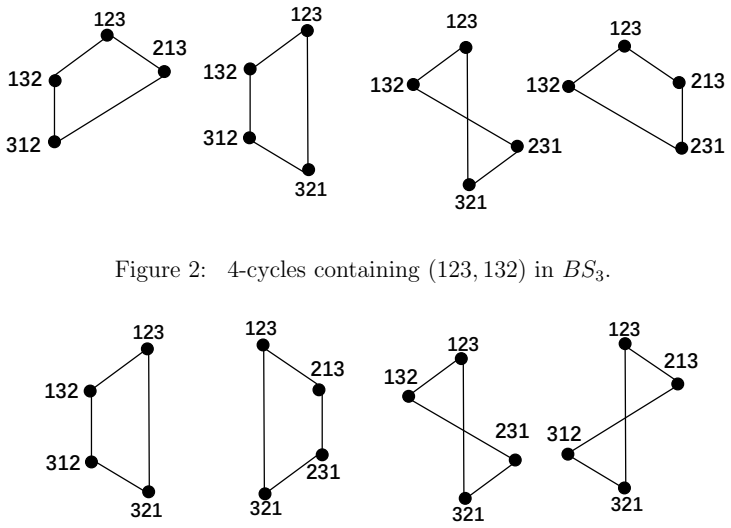
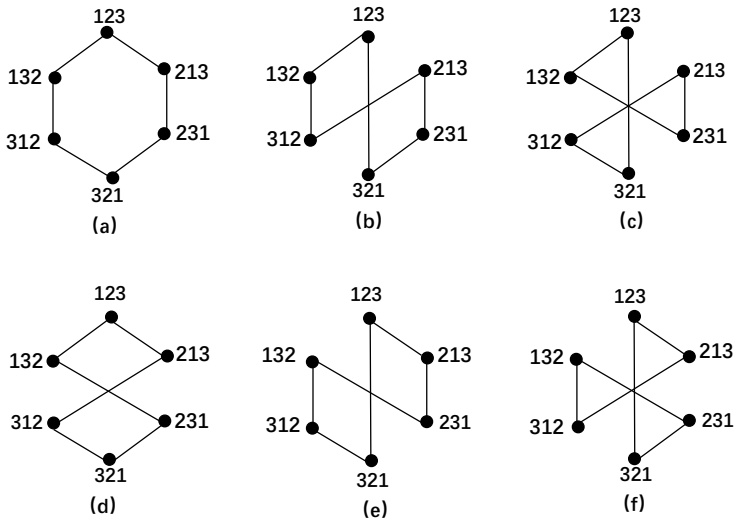
An explicit check in BS_3 showing that some edge misses a 4-cycle or a 6-cycle would disprove the claim for the smallest case.
Figures
read the original abstract
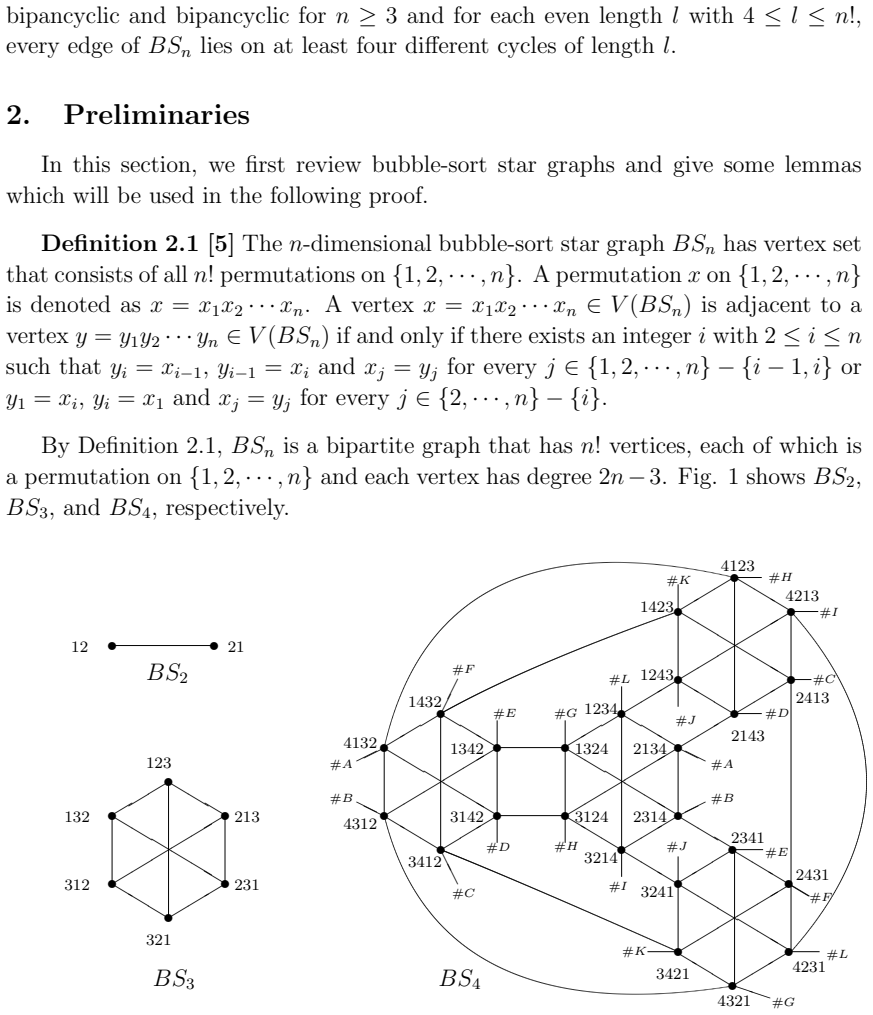
The interconnection network considered in this paper is the bubble-sort star graph. The $n$-dimensional bubble-sort star graph $BS_n$ is a bipartite and $(2n-3)$-regular graph of order $n!$. A bipartite graph $G$ is edge-bipancyclic if each edge of $G$ lies on a cycle of all even length $l$ with $4\leq l\leq |V(G)|$. In this paper, we show that the $n$-dimensional bubble-sort star graph $BS_n$ is edge-bipancyclic for $n\ge 3$ and for each even length $l$ with $4\leq l\leq n!$, every edge of $BS_n$ lies on at least four different cycles of length $l$.
Editorial analysis
A structured set of objections, weighed in public.
Referee Report
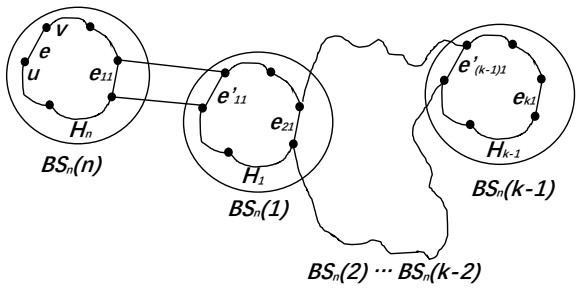
Summary. The manuscript proves that the n-dimensional bubble-sort star graph BS_n (bipartite, (2n-3)-regular, order n!) is edge-bipancyclic for all n≥3: for every edge e and every even l with 4≤l≤n!, there exist at least four distinct l-cycles containing e. The argument proceeds by induction on n; base cases n=3 and n=4 are settled by exhaustive enumeration, while the inductive step fixes an arbitrary edge, decomposes BS_n into n copies of BS_{n-1} joined by a perfect matching of a prescribed type, and constructs the required cycles by combining paths inside the subcubes with distinct pairs of crossing edges, handling all parity and size cases for l.
Significance. The result supplies an explicit, multiplicity-four strengthening of the cycle-embedding properties of a standard family of interconnection networks. The inductive construction is fully detailed, the base cases are verified directly, and the argument accounts for the precise lower bound of four cycles without additional assumptions on connectivity or diameter.
minor comments (2)
- [§2] §2, definition of the crossing matching: a single sentence clarifying that the matching edges correspond to the star transpositions involving the largest symbol would remove any ambiguity for readers unfamiliar with the recursive construction.
- [Theorem 3.1] The statement of the main theorem (Theorem 3.1) repeats the abstract almost verbatim; a compact restatement emphasizing the multiplicity-four claim would improve readability.
Simulated Author's Rebuttal
We thank the referee for the thorough review and the positive recommendation to accept the manuscript.
Circularity Check
No significant circularity; inductive proof is self-contained
full rationale
The paper presents a direct inductive proof that BS_n is edge-bipancyclic. The definition of BS_n (bipartite, (2n-3)-regular, order n!) is given independently of the claimed cycle property. The argument proceeds by induction on n, with explicit base cases n=3,4 verified by enumeration and an inductive step that constructs cycles by combining paths in subcubes with crossing edges. No fitted parameters, self-definitional equations, load-bearing self-citations, or renamed known results appear. The central existence claim does not reduce to its inputs by construction.
Axiom & Free-Parameter Ledger
axioms (1)
- domain assumption The bubble-sort star graph BS_n is bipartite and (2n-3)-regular of order n! for n≥3.
Reference graph
Works this paper leans on
-
[1]
A. Auletta, A. Rescigno, V. Scarano, Embedding graphs onto the supercube, IEEE Transactions on Computers 44(4)(1995) 593-597
work page 1995
-
[2]
J. A. Bondy and U. S. R. Murty, Graph Theory with Applications, Macmillan, London and Elsevier, New York, 1976
work page 1976
-
[3]
H. Cai, H. Liu, M. Lu, Fault-tolerant maximal local-connectivity on Bubble-sort star graphs, Discrete Applied Mathematics 181(2015) 33-40
work page 2015
-
[4]
X. B. Chen, Paired 2-disjoint path covers of multidimensional torus networks with faulty edges, Information Processing Letters 116(2)(2016) 107-110
work page 2016
-
[5]
Z. T. Chou, C. C. Hsu, J. P. Sheu, Bubblesort star graphs: a new interconnection network, International Conference on Parallel and Distributed Systems (1996) 41-48
work page 1996
-
[6]
W. B. Fan, J. X Fan., C. K. Lin, Y. Wang, Y. J. Han, R. C Wang, Opti- mally Embedding 3-Ary n-Cubes into Grids, Journal of Computer Science and Technology 34(2)(2019), 372-387
work page 2019
-
[7]
J. F. Fang, J. Y. Hsiao, C. Y. Tang, Embedding cycles and meshes onto incom- plete hypercubes, International Journal of Computer Mathematics 75(1)(2000) 1-19
work page 2000
-
[8]
M. M. Gu, R. X. Hao, Y. Q. Feng, The pessimistic diagnosability of bubble-sort star graphs and augmented k-ary n-cubes, International Journal of Computer Mathematics: Computer Systems Theory 1(3-4)(2016) 98-112
work page 2016
-
[9]
J. Guo, M. Lu, Conditional diagnosability of bubble-sort star graphs, Discrete Applied Mathematics 201(2016) 141-149
work page 2016
-
[10]
Y. Kikuchi, T. Araki, Edge-bipancyclicity and edge-fault-tolerant bipancyclicity of bubble-sort graphs, Information Processing Letters 100 (2006) 52-59
work page 2006
-
[11]
C. N. Kuo, I. A. Stewart, Edge-pancyclicity and edge-bipancyclicity of faulty folded hypercubes, Theoretical Computer Science 627(2016) 102-106
work page 2016
- [12]
-
[13]
P. Li, M. Xu, Edge-fault-tolerant edge-bipancyclicity of balanced hypercubes, Applied Mathematics and Computation 307(2017) 180-192
work page 2017
-
[14]
J. Li, S. Wang, D. Liu, S. Lin, Edge-bipancyclicity of the k-ary n-cubes with faulty nodes and edges, Information Sciences, 181(11)(2011) 2260-2267
work page 2011
-
[15]
T. K. Li, C. H. Tsai, J. J. M. Tan, L. H. Hsu, Bipanconnectivity and edge-fault- tolerant bipancyclicity of hypercubes, Information Processing Letters 87(2003) 107-110
work page 2003
-
[16]
Y. C. Lin, On balancing sorting on a linear array, IEEE Transactions on Parallel and Distributed Systems 4(5)(1993) 566-571
work page 1993
-
[17]
M. Liu, H. Liu, Vertex-fault-tolerant cycles embedding on enhanced hypercube networks, Acta Mathematicae Applicatae Sinica, English Series 32(1)(2016) 187- 198
work page 2016
-
[18]
D.R. O ´Hallaron, Uniform approach for solving some classical problems on a linear array, IEEE Transactions on Parallel and Distributed Systems 2(2)(1991) 236-241
work page 1991
-
[19]
A. Sengupta, On ring embedding in hypercubes with faulty nodes and links, Information Processing Letters 68(1998) 207-214
work page 1998
-
[20]
I. A. Stewart, Y. Xiang, Bipanconnectivity and bipancyclicity in k-ary n-cubes, IEEE Transactions on Parallel and Distributed Systems 20(1)(2009) 25-33
work page 2009
-
[21]
S. Wang, Z. Wang, M. Wang, The 2-extra connectivity and 2-extra diagnos- ability of bubble-sort star graph networks, The Computer Journal 59(12)(2016) 1839-1856
work page 2016
-
[22]
S. Wang, Z. Wang, M. Wang, The 2-good-neighbor connectivity and 2-good- neighbor diagnosability of bubble-sort star graph networks, Discrete Applied Mathematics 217(2017) 691-706. 13
work page 2017
discussion (0)
Sign in with ORCID, Apple, or X to comment. Anyone can read and Pith papers without signing in.