Coherency and Online Signal Selection Based Wide Area Control of Wind Integrated Power Grid
Pith reviewed 2026-05-24 21:10 UTC · model grok-4.3
The pith
A wide-area control architecture uses real-time coherency grouping and residue-based signal selection to damp interarea oscillations more effectively in wind-integrated grids.
A machine-rendered reading of the paper's core claim, the machinery that carries it, and where it could break.
Core claim
The architecture provides online coherency grouping that properly characterizes real-time changes in the power grid and online wide-area signal selection based on residue method for proper selection of the WAC signals, allowing more effective damping than conventional local signal based power system stabilizers or offline based WAC designs.
What carries the argument
Discrete linear quadratic regulator with Kalman filtering state-estimation, extended by real-time coherency grouping and residue-based wide-area signal selection.
If this is right
- The controller monitors and adapts to real-time grid changes caused by wind integration.
- Appropriate wide-area signals are selected dynamically for improved interarea oscillation damping.
- Performance exceeds both local stabilizers and offline wide-area designs on the tested two-area and 39-bus systems.
- The method reduces reliance on fixed tuning that becomes outdated as operating conditions shift.
Where Pith is reading between the lines
- The online grouping and selection steps could extend to other variable renewable sources such as solar.
- Embedding the method in existing phasor measurement unit networks would strengthen its real-time capability.
- Similar residue-based selection might improve other wide-area applications like voltage control.
Load-bearing premise
Power grid dynamics can be represented by linear models suitable for discrete LQR and Kalman filtering, with real-time coherency grouping and residue selection remaining effective under varying wind conditions without instability or delays.
What would settle it
A simulation on the IEEE 39-bus system under fluctuating wind output where the proposed controller produces less damping or induces instability compared with local power system stabilizers.
Figures
read the original abstract
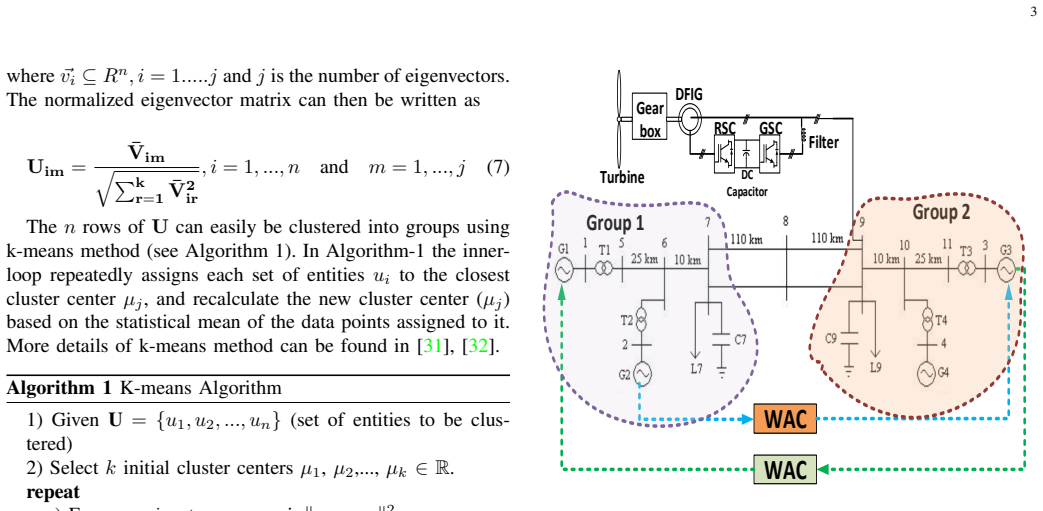
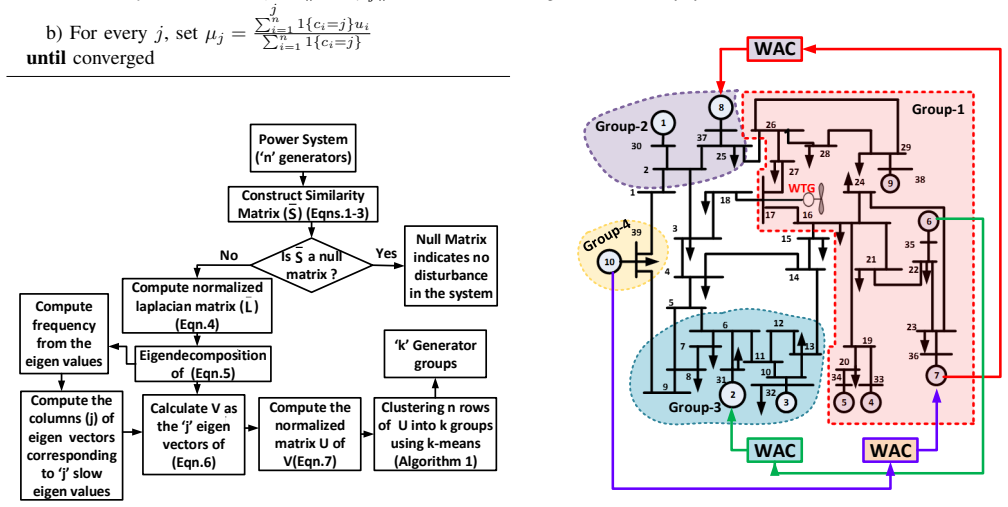
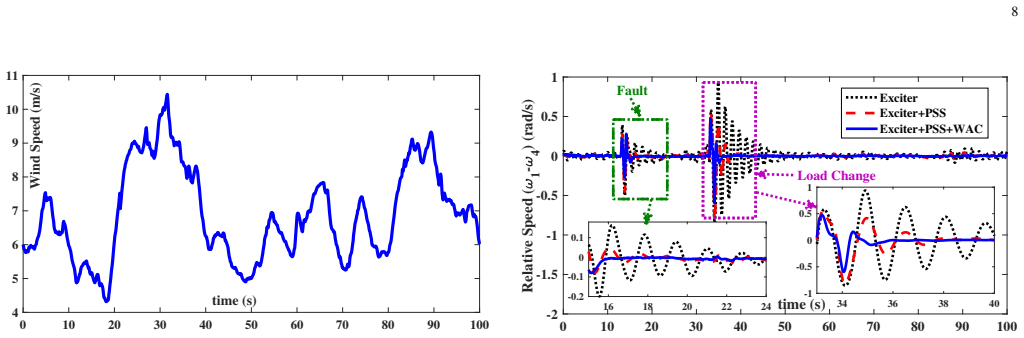
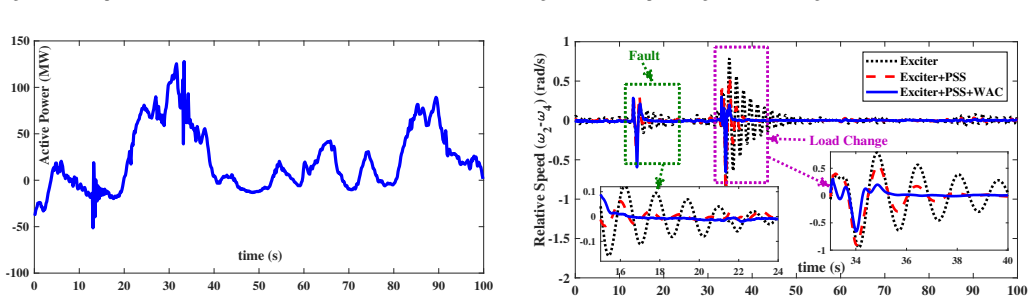
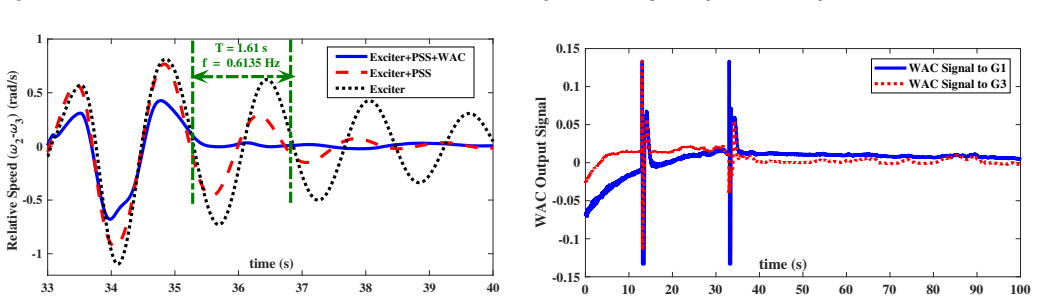
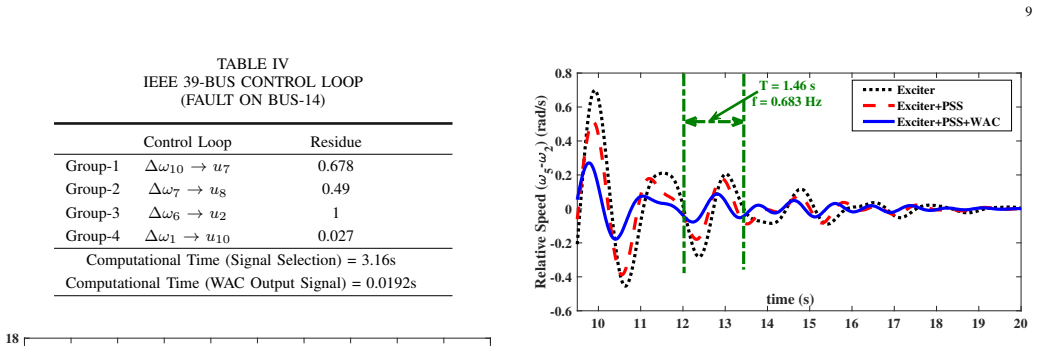
This paper introduces a novel method of designing wide area control (WAC) based on a discrete linear quadratic regulator and Kalman filtering based state-estimation that can be applied for real-time damping of interarea oscillations of wind integrated power grid. The main advantages of the proposed method are that the architecture provides online coherency grouping that properly characterizes real-time changes in the power grid and online wide-area signal selection based on residue method for proper selection of the WAC signals. The proposed architecture can, thus, accurately monitors changes in the power grid and select the appropriate control signal for more effectively damping the interarea oscillation when compared to the conventional local signal based power system stabilizers or offline based WAC designs. The architecture is tested on a wind integrated two-area system and the IEEE 39 bus system in order to show the capability of the proposed method.
Editorial analysis
A structured set of objections, weighed in public.
Referee Report
Summary. The paper proposes a wide-area control (WAC) architecture for real-time damping of inter-area oscillations in wind-integrated power grids. It combines discrete LQR control with Kalman filtering for state estimation, adding online coherency grouping to track real-time grid changes and residue-based online selection of WAC signals. The central claim is that this yields more effective damping than conventional local-signal PSS or offline WAC designs; the architecture is tested on a wind-integrated two-area system and the IEEE 39-bus system.
Significance. If the online coherency and signal-selection features can be shown to deliver measurable improvements in damping under realistic wind variation, the work would provide a practical, incrementally novel extension of standard LQR/Kalman tools to adaptive wide-area control. The explicit motivation for the online components is independent of the core LQR/Kalman machinery and addresses a recognized limitation of offline designs.
major comments (2)
- [Abstract] Abstract: the abstract states that the architecture was tested on the wind-integrated two-area system and IEEE 39-bus system yet supplies no quantitative results, error metrics, comparison data, or robustness checks. Without these data the central performance claims cannot be evaluated.
- [Abstract] Abstract (method description): the design rests on the assumption that the wind-integrated system can be represented by linear time-invariant models suitable for discrete LQR and Kalman filtering. No analysis or simulation is supplied to show that online coherency grouping and residue selection remain stable and effective when wind-speed fluctuations move the operating point or introduce nonlinearities.
Simulated Author's Rebuttal
We thank the referee for the constructive feedback on our manuscript. We address each major comment below and will revise the paper accordingly to strengthen the presentation of results and clarify methodological assumptions.
read point-by-point responses
-
Referee: [Abstract] Abstract: the abstract states that the architecture was tested on the wind-integrated two-area system and IEEE 39-bus system yet supplies no quantitative results, error metrics, comparison data, or robustness checks. Without these data the central performance claims cannot be evaluated.
Authors: We agree that the abstract would benefit from inclusion of key quantitative metrics. The full manuscript contains simulation results with damping ratios, settling times, and comparisons against local PSS and offline WAC designs on both test systems, including cases with wind variation. In the revised version we will condense the most salient numerical results (e.g., percentage improvement in damping ratio and inter-area mode settling time) into the abstract. revision: yes
-
Referee: [Abstract] Abstract (method description): the design rests on the assumption that the wind-integrated system can be represented by linear time-invariant models suitable for discrete LQR and Kalman filtering. No analysis or simulation is supplied to show that online coherency grouping and residue selection remain stable and effective when wind-speed fluctuations move the operating point or introduce nonlinearities.
Authors: The method is formulated within the standard small-signal linear framework used for inter-area oscillation damping; the online coherency and residue-based selection modules are explicitly intended to retune the controller when the operating point shifts due to wind changes. The reported simulations already include wind-speed variations on both test systems and demonstrate continued effective damping. To directly address the concern we will add a dedicated paragraph discussing the range of validity of the LTI assumption, the adaptation mechanism, and any observed limitations under larger disturbances. revision: partial
Circularity Check
No significant circularity detected in derivation chain
full rationale
The paper describes an architecture using standard discrete LQR and Kalman filtering for wide-area control, augmented with online coherency grouping and residue-based signal selection. No load-bearing steps in the abstract or described method reduce by construction to fitted inputs, self-definitions, or self-citation chains; the online features are presented as extensions of established LQR/Kalman tools with independent motivation from real-time grid monitoring needs. The two-area and IEEE 39-bus tests are cited as validation rather than as the source of the claimed performance. This matches the default expectation that most papers are not circular, yielding a self-contained derivation against external benchmarks.
Axiom & Free-Parameter Ledger
axioms (2)
- domain assumption Power system dynamics can be sufficiently approximated by linear time-invariant models for discrete LQR and Kalman filter application
- domain assumption Residue method and coherency grouping remain reliable indicators for signal selection under real-time wind variability
Reference graph
Works this paper leans on
-
[1]
A fundamental study of inter-area oscillations in power systems,
M. Klein, G. J. Rogers, and P. Kundur, “A fundamental study of inter-area oscillations in power systems,” IEEE Transactions on Power Systems, vol. 6, no. 3, pp. 914–921, Aug 1991
work page 1991
-
[2]
Chow, Power System Coherency and Model Reduction , ser
J. Chow, Power System Coherency and Model Reduction , ser. Power Electronics and Power Systems. Springer New York, 2014. [Online]. Available: https://books.google.com/books?id=HGnABAAAQBAJ
work page 2014
- [3]
-
[4]
Rogers, Power System Oscillations , ser
G. Rogers, Power System Oscillations , ser. Power Electronics and Power Systems. Springer US, 2012. [Online]. Available: https: //books.google.com/books?id=xOTTBwAAQBAJ
work page 2012
-
[5]
S. P. Azad, R. Iravani, and J. E. Tate, “Damping inter-area oscillations based on a model predictive control (mpc) hvdc supplementary con- troller,” IEEE Transactions on Power Systems, vol. 28, no. 3, pp. 3174– 3183, Aug 2013
work page 2013
-
[6]
W. Yao, L. Jiang, J. Wen, Q. H. Wu, and S. Cheng, “Wide-area damping controller of facts devices for inter-area oscillations considering communication time delays,” IEEE Transactions on Power Systems , vol. 29, no. 1, pp. 318–329, Jan 2014
work page 2014
-
[7]
S. F. P. Jiang and X. Wu, “Robust design method for power oscillation damping controller of statcom based on residue and tls-esprit,” Interna- tional Transactions on Electrical Energy Systems , vol. 24, no. 10, pp. 1385–1400, Jul 2013
work page 2013
-
[8]
Robust power system sta- bilizer design using h infin; loop shaping approach,
C. Zhu, M. Khammash, V . Vittal, and W. Qiu, “Robust power system sta- bilizer design using h infin; loop shaping approach,” IEEE Transactions on Power Systems, vol. 18, no. 2, pp. 810–818, May 2003
work page 2003
-
[9]
Adaptive delay compensator for the robust wide-area damping controller design,
M. Beiraghi and A. M. Ranjbar, “Adaptive delay compensator for the robust wide-area damping controller design,” IEEE Transactions on Power Systems, vol. 31, no. 6, pp. 4966–4976, Nov 2016
work page 2016
-
[10]
Wide area measurements based robust power system controller design,
M. Watanabe, M. Yamashita, and Y . Mitani, “Wide area measurements based robust power system controller design,” in 2014 Power Systems Computation Conference, Aug 2014, pp. 1–7
work page 2014
-
[11]
Wide-area measurement system development at the distribution level: An fnet/grideye example,
Y . Liu, “Wide-area measurement system development at the distribution level: An fnet/grideye example,” in2016 IEEE Power and Energy Society General Meeting (PESGM) , July 2016, pp. 1–1
work page 2016
-
[12]
Distributed data analytics platform for wide-area synchrophasor measurement systems,
D. Zhou, J. Guo, Y . Zhang, J. Chai, H. Liu, Y . Liu, C. Huang, X. Gui, and Y . Liu, “Distributed data analytics platform for wide-area synchrophasor measurement systems,” IEEE Transactions on Smart Grid , vol. 7, no. 5, pp. 2397–2405, Sept 2016
work page 2016
-
[13]
Probing signal design for power system identifica- tion,
J. W. Pierre, N. Zhou, F. K. Tuffner, J. F. Hauer, D. J. Trudnowski, and W. A. Mittelstadt, “Probing signal design for power system identifica- tion,” IEEE Transactions on Power Systems, vol. 25, no. 2, pp. 835–843, May 2010
work page 2010
-
[14]
H. Liu, L. Zhu, Z. Pan, F. Bai, Y . Liu, Y . Liu, M. Patel, E. Farantatos, and N. Bhatt, “Armax-based transfer function model identification using wide-area measurement for adaptive and coordinated damping control,” IEEE Transactions on Smart Grid , vol. 8, no. 3, pp. 1105–1115, May 2017
work page 2017
-
[15]
A dynamic coherency identification method based on frequency deviation signals,
A. M. Khalil and R. Iravani, “A dynamic coherency identification method based on frequency deviation signals,” IEEE Transactions on Power Systems, vol. 31, no. 3, pp. 1779–1787, May 2016
work page 2016
-
[16]
A new method suitable for real- time generator coherency determination,
M. B. M. Jonsson and J. Daalder, “A new method suitable for real- time generator coherency determination,” IEEE Transactions on Power Systems, vol. 19, no. 3, pp. 1473–1482, Aug 2004
work page 2004
-
[17]
Generator coherency using the hilberthuang transform,
N. Senroy, “Generator coherency using the hilberthuang transform,” IEEE Transactions on Power Systems , vol. 23, no. 4, pp. 1701–1708, Nov 2008
work page 2008
-
[18]
Identification of coherent generators using energy function,
M. H. Haque and A. H. M. A. Rahim, “Identification of coherent generators using energy function,” in IEE Proceedings C - Generation, Transmission and Distribution, July 1990, pp. 255–260
work page 1990
-
[19]
Multi-machine power system dynamic equivalents using artificial intelligence,
I. D. H. M. Abd-EI-Rehim and M. A. H. Omar, “Multi-machine power system dynamic equivalents using artificial intelligence,” in Power Sys- tems Conference, 2006. MEPCON 2006. Eleventh International Middle East, Dec 2006, pp. 255–260
work page 2006
-
[20]
A coherency-based approach for signal selection for wide area stabilizing control in power systems,
S. C. S. B. B. Padhy and N. K. Verma, “A coherency-based approach for signal selection for wide area stabilizing control in power systems,” IEEE Systems Journal , vol. 7, no. 4, pp. 807–816, April 2013
work page 2013
-
[21]
Identification of coherent groups and pmu placement for inter-area monitoring based on graph theory,
M. A. Rios and O. Gomez, “Identification of coherent groups and pmu placement for inter-area monitoring based on graph theory,” in 2011 IEEE PES Conference on Innovative Smart Grid Technologies (ISGT Latin America), Nov 2011, pp. 255–260
work page 2011
-
[22]
Coherency identification in power systems through principal component analysis,
N. F. T. K. K. Anaparthi, B. Chaudhuri and B. C. Pal, “Coherency identification in power systems through principal component analysis,” IEEE Transactions on Power Systems , vol. 20, no. 3, pp. 1658–1660, Aug 2005
work page 2005
-
[23]
Coherency approach by hybrid pso, k-means clustering method in power system,
E. R. M. Davodi, H. R. Modares and A. Sarikhani, “Coherency approach by hybrid pso, k-means clustering method in power system,” in IEEE 2nd International Power and Energy Conference, 2008 , Jan 2008, pp. 255–260
work page 2008
-
[24]
I. Kamwa, R. Grondin, and Y . Hebert, “Wide-area measurement based stabilizing control of large power systems-a decentralized/hierarchical approach,” IEEE Transactions on Power Systems , vol. 16, no. 1, pp. 136–153, Feb 2001
work page 2001
-
[25]
Selection of input/output signals for wide area control loops,
H. Nguyen-Duc, L. A. Dessaint, A. F. Okou, and I. Kamwa, “Selection of input/output signals for wide area control loops,” in IEEE PES General Meeting, July 2010, pp. 1–7
work page 2010
-
[26]
Electromechan- ical mode on-line estimation using regularized robust rls methods,
N. Zhou, D. Trudnowski, J. Pierre, and W. Mittelstadt, “Electromechan- ical mode on-line estimation using regularized robust rls methods,” in IEEE PES General Meeting , July 2010, pp. 1–1
work page 2010
-
[27]
N. Zhou, Z. Huang, L. Dosiek, D. Trudnowski, and J. W. Pierre, “Electromechanical mode shape estimation based on transfer function 11 identification using pmu measurements,” in 2009 IEEE Power Energy Society General Meeting , July 2009, pp. 1–7
work page 2009
-
[28]
Electromechanical mode estimation using recursive adaptive stochastic subspace identification,
S. A. N. Sarmadi and V . Venkatasubramanian, “Electromechanical mode estimation using recursive adaptive stochastic subspace identification,” in 2014 IEEE PES T D Conference and Exposition , April 2014, pp. 1–1
work page 2014
-
[29]
Initial results in power system identification from injected probing signals using a subspace method,
N. Zhou, J. W. Pierre, and J. F. Hauer, “Initial results in power system identification from injected probing signals using a subspace method,” IEEE Transactions on Power Systems , vol. 21, no. 3, pp. 1296–1302, Aug 2006
work page 2006
-
[30]
Coherency based online wide area control of wind integrated power grid,
A. Thakallapelli, S. J. Hossain, and S. Kamalasadan, “Coherency based online wide area control of wind integrated power grid,” in 2016 IEEE International Conference on Power Electronics, Drives and Energy Systems (PEDES), Dec 2016, pp. 1–6
work page 2016
-
[31]
A. Ng. (2017, Dec.) The k-means clustering algorithm. [Online]. Available: http://cs229.stanford.edu/notes/cs229-notes7a.pdf
work page 2017
-
[32]
Parallel spectral clustering in distributed systems,
W. Y . Chen, Y . Song, H. Bai, C. J. Lin, and E. Y . Chang, “Parallel spectral clustering in distributed systems,” IEEE Transactions on Pattern Analysis and Machine Intelligence , vol. 33, no. 3, pp. 568–586, March 2011
work page 2011
-
[33]
Real-time frequency based reduced order modeling of large power grid,
A. Thakallapelli, S. Ghosh, and S. Kamalasadan, “Real-time frequency based reduced order modeling of large power grid,” in 2016 IEEE Power and Energy Society General Meeting (PESGM) , July 2016, pp. 1–5
work page 2016
-
[34]
A pid controller for real-time dc motor speed control using the c505c microcontroller,
S. Kamalasadan and A. Hande, “A pid controller for real-time dc motor speed control using the c505c microcontroller,” in CAINE, 2004, pp. 1–8
work page 2004
-
[35]
Real-time reduced order model based adaptive pitch controller for grid connected wind turbines,
A. Thakallapelli, S. Ghosh, and S. Kamalasadan, “Real-time reduced order model based adaptive pitch controller for grid connected wind turbines,” in 2016 IEEE Industry Applications Society Annual Meeting , Oct 2016, pp. 1–8
work page 2016
-
[36]
K. ˚Astr¨om and B. Wittenmark, Adaptive Control: Second Edition , ser. Dover Books on Electrical Engineering. Dover Publications, 2013. [On- line]. Available: https://books.google.com/books?id=4CLCAgAAQBAJ
work page 2013
-
[37]
Alternating direction method of multipliers (admm) based distributed approach for wide-area control,
A. Thakallapelli and S. Kamalasadan, “Alternating direction method of multipliers (admm) based distributed approach for wide-area control,” in 2017 IEEE Industry Applications Society Annual Meeting , Oct 2017, pp. 1–7
work page 2017
-
[38]
S. Nabavi, J. Zhang, and A. Chakrabortty, “Distributed optimization algorithms for wide-area oscillation monitoring in power systems using interregional pmu-pdc architectures,” IEEE Transactions on Smart Grid, vol. 6, no. 5, pp. 2529–2538, Sep 2015
work page 2015
-
[39]
On the value functions of the discrete- time switched lqr problem,
W. Zhang, J. Hu, and A. Abate, “On the value functions of the discrete- time switched lqr problem,” IEEE Transactions on Automatic Control , vol. 54, no. 11, pp. 2669–2674, Nov 2009
work page 2009
-
[40]
A two-stage kalman filter approach for robust and real-time power system state estimation,
J. Zhang, G. Welch, G. Bishop, and Z. Huang, “A two-stage kalman filter approach for robust and real-time power system state estimation,” IEEE Transactions on Sustainable Energy , vol. 5, no. 2, pp. 629–636, April 2014
work page 2014
-
[41]
R. Pena, J. C. Clare, and G. M. Asher, “Doubly fed induction generator using back-to-back pwm converters and its application to variable-speed wind-energy generation,” IEE Proceedings - Electric Power Applica- tions, vol. 143, no. 3, pp. 231–241, May 1996. A. Thakallapelli (S’14) received his B.Tech degree in Electrical Engineering from Acharya Nagarjuna ...
work page 1996
-
[42]
He is currently a PhD candidate at University of North Carolina at Charlotte
He worked as a software engineer in Samsung Research and Development institute Bangladesh from 2013 to 2015. He is currently a PhD candidate at University of North Carolina at Charlotte. His research interests are distributed energy systems in- tegration, modeling and control, and wide area mon- itoring, optimization and control of power system. S. Kamala...
work page 2013
discussion (0)
Sign in with ORCID, Apple, or X to comment. Anyone can read and Pith papers without signing in.