Performance Assessment of Kron Reduction in the Numerical Analysis of Polyphase Power Systems
Pith reviewed 2026-05-24 21:00 UTC · model grok-4.3
The pith
Kron reduction alters the performance of Newton-Raphson power-flow, weighted-least-squares state estimation, and homotopy voltage-stability methods in unbalanced polyphase networks.
A machine-rendered reading of the paper's core claim, the machinery that carries it, and where it could break.
Core claim
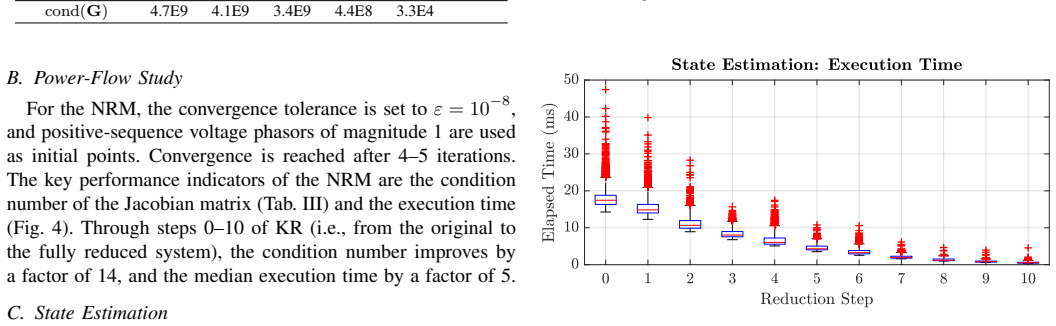
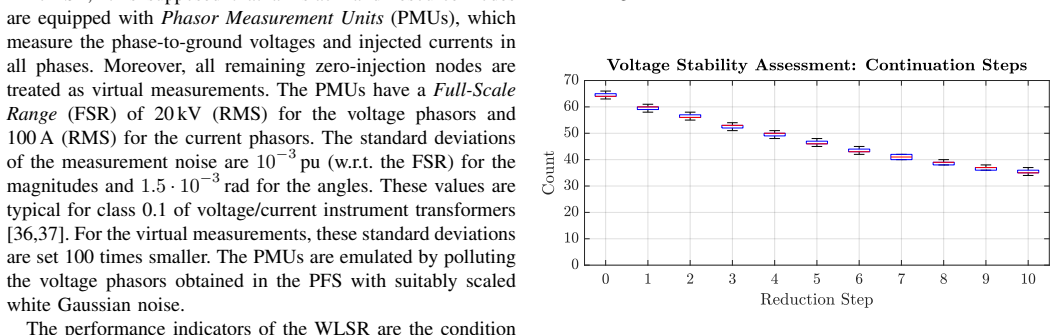
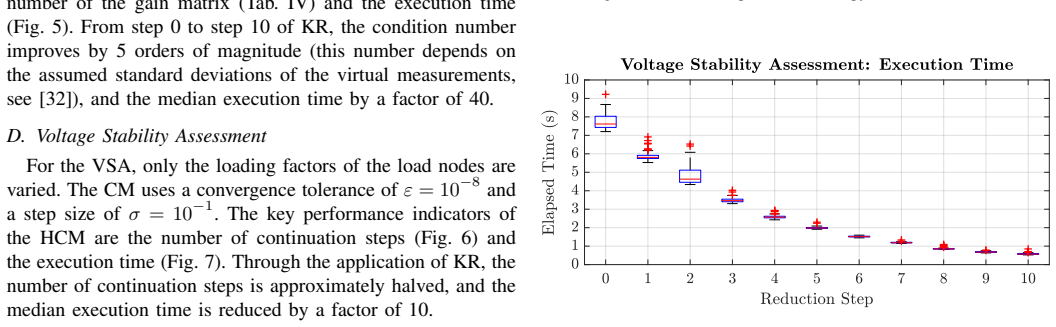
The paper claims that successively eliminating zero-injection nodes through Kron reduction produces measurable changes in the performance of the Newton-Raphson method applied to power-flow studies, the linear weighted-least-squares method applied to state estimation, and the homotopy continuation method applied to voltage stability assessment when these techniques are run on unbalanced polyphase test systems.
What carries the argument
Kron reduction: algebraic elimination of zero-injection nodes from the network admittance matrix to obtain a smaller equivalent model.
If this is right
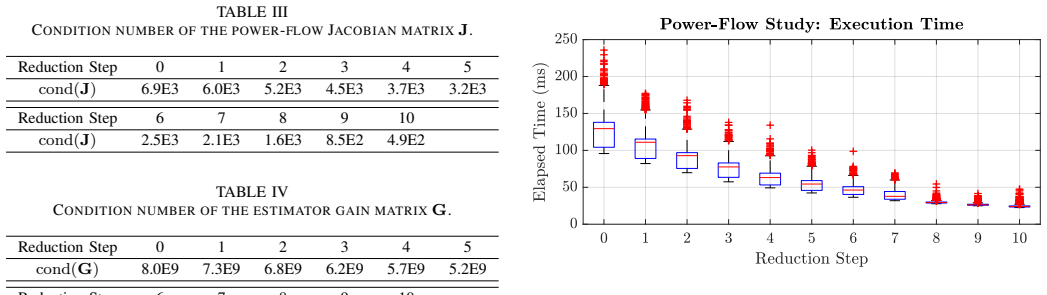
- The iteration count and computational time of the Newton-Raphson power-flow solver change as zero-injection nodes are removed.
- The accuracy and speed of linear weighted-least-squares state estimation vary with the degree of Kron reduction applied.
- The convergence path of the homotopy continuation method for voltage stability assessment is affected by progressive node elimination.
- Model size reduction therefore becomes an explicit design choice that influences numerical efficiency for all three applications.
Where Pith is reading between the lines
- Practitioners could run the same reduction sequence on their own networks to decide the optimal retained-node count for each solver they use.
- The assessment method could be applied to other reduction techniques such as Ward equivalents to compare their numerical side-effects.
- If the observed performance shifts scale with system size, the results would directly inform model-preprocessing steps in real-time control centers.
Load-bearing premise
Performance changes observed when nodes are eliminated from one test system represent the effect of Kron reduction across polyphase power systems in general.
What would settle it
Repeating the same sequence of reductions on several independent test systems with different topologies and unbalanced load patterns and finding inconsistent trends in iteration counts or run times would show the single-system results are not representative.
Figures
read the original abstract
This paper investigates the impact of Kron reduction on the performance of numerical methods applied to the analysis of unbalanced polyphase power systems. Specifically, this paper focuses on power-flow study, state estimation, and voltage stability assessment. For these applications, the standard Newton-Raphson method, linear weighted-least-squares regression, and homotopy continuation method are used, respectively. The performance of the said numerical methods is assessed in a series of simulations, in which the zero-injection nodes of a test system are successively eliminated through Kron reduction.
Editorial analysis
A structured set of objections, weighed in public.
Referee Report
Summary. This manuscript investigates the impact of Kron reduction on the performance of numerical methods for analyzing unbalanced polyphase power systems. It focuses on power-flow studies using the Newton-Raphson method, state estimation using linear weighted-least-squares regression, and voltage stability assessment using the homotopy continuation method. Performance is evaluated through a series of simulations on a single test system in which zero-injection nodes are successively eliminated via Kron reduction.
Significance. If the observed trends in iteration counts, accuracy, and stability margins prove robust, the work could offer practical insights into when Kron reduction is beneficial for computational efficiency versus accuracy in polyphase network analysis. The emphasis on unbalanced systems fills a gap relative to balanced-case literature. However, the single-test-system design limits the transferability of any performance conclusions to general polyphase systems.
major comments (2)
- [Numerical experiments / simulation setup] The entire numerical assessment is performed on a single test system with successive Kron reduction of its zero-injection nodes. This design leaves open whether changes in solver iterations, estimation errors, or stability margins are representative of polyphase systems or are artifacts of that system's specific topology, loading, and imbalance profile. The central claim of assessing impact 'in the numerical analysis of polyphase power systems' therefore rests on an unverified assumption of generalizability.
- [Numerical experiments / simulation setup] No additional independent networks, network-size sweeps, or analytic bounds on the Kron-reduction operator are described that would establish transferability of the reported performance changes. Without such controls, the empirical trends cannot reliably support statements about the three numerical methods across real polyphase systems.
minor comments (1)
- [Abstract] The abstract describes the experimental plan and methods but reports no quantitative results, error metrics, or validation statistics from the simulations.
Simulated Author's Rebuttal
We thank the referee for the detailed review and constructive criticism. The concerns about the single-test-system design are valid and point to a genuine limitation in the transferability of the reported trends. We address each major comment below and will revise the manuscript accordingly to better scope our claims and discuss limitations.
read point-by-point responses
-
Referee: The entire numerical assessment is performed on a single test system with successive Kron reduction of its zero-injection nodes. This design leaves open whether changes in solver iterations, estimation errors, or stability margins are representative of polyphase systems or are artifacts of that system's specific topology, loading, and imbalance profile. The central claim of assessing impact 'in the numerical analysis of polyphase power systems' therefore rests on an unverified assumption of generalizability.
Authors: We agree that the use of a single test system (the IEEE 13-bus unbalanced feeder) limits the generalizability of the observed performance changes. The successive elimination of zero-injection nodes was chosen to isolate the effect of Kron reduction in a controlled setting, but this does not substitute for testing across diverse topologies. In revision we will (i) explicitly state that results are specific to this benchmark system, (ii) add a limitations subsection discussing potential topology/loading dependence, and (iii) moderate language in the abstract and conclusions to avoid implying broad applicability across all polyphase systems. revision: yes
-
Referee: No additional independent networks, network-size sweeps, or analytic bounds on the Kron-reduction operator are described that would establish transferability of the reported performance changes. Without such controls, the empirical trends cannot reliably support statements about the three numerical methods across real polyphase systems.
Authors: We acknowledge the absence of additional networks, size sweeps, or analytic bounds. The manuscript's scope is an empirical performance assessment on one representative unbalanced system rather than a comprehensive generalization study; providing analytic bounds on the Kron operator would require a separate theoretical contribution. In the revision we will add text clarifying this scope, include a brief discussion of why the chosen system is a standard benchmark, and note that future work should examine multiple networks to confirm robustness of the trends. revision: yes
Circularity Check
No circularity; purely empirical simulation study on single test system.
full rationale
The paper conducts a series of simulations eliminating zero-injection nodes via Kron reduction on one test system and measures performance of three numerical methods (Newton-Raphson, WLS, homotopy continuation). No derivation chain, fitted parameters renamed as predictions, self-definitional equations, or load-bearing self-citations are present. The central claim is an empirical observation whose validity rests on the representativeness of the chosen network rather than any reduction of outputs to inputs by construction. This matches the default expectation of no circularity for simulation-based assessment papers.
Axiom & Free-Parameter Ledger
Reference graph
Works this paper leans on
-
[1]
Kron, Tensors for Circuits, 2nd ed
G. Kron, Tensors for Circuits, 2nd ed. New York City, NY , USA: Dover, 1959
work page 1959
-
[2]
Kron reduction of graphs with applications to electrical networks,
F. D ¨orfler and F. Bullo, “Kron reduction of graphs with applications to electrical networks,” IEEE Trans. Circuits Syst. I: Reg. Papers , vol. 60, no. 1, pp. 150–163, Jan. 2013
work page 2013
-
[3]
On the properties of the power systems nodal admittance matrix,
A. M. Kettner and M. Paolone, “On the properties of the power systems nodal admittance matrix,” IEEE Trans. Power Syst. , vol. 33, no. 1, pp. 1130–1131, Jan. 2018
work page 2018
-
[4]
On the properties of the compound nodal admittance matrix of polyphase power systems,
——, “On the properties of the compound nodal admittance matrix of polyphase power systems,” IEEE Trans. Power Syst. , Accepted for publication. DOI: 10.1109/TPWRS.2018.2863671
-
[5]
Method of symmetrical coordinates applied to the solution of polyphase networks,
C. L. Fortescue, “Method of symmetrical coordinates applied to the solution of polyphase networks,” Trans. AIEE, vol. 37, no. 2, pp. 1027– 1140, Jun. 1918
work page 1918
-
[6]
Review of load-flow calculation methods,
B. Stott, “Review of load-flow calculation methods,” Proc. IEEE, vol. 62, no. 7, pp. 916–929, Jul. 1974
work page 1974
-
[7]
Application of fixed-point techniques to load-flow studies,
J. Meisel and R. D. Barnard, “Application of fixed-point techniques to load-flow studies,” IEEE Trans. Power App. Syst. , vol. 89, no. 1, pp. 136–140, Jan. 1970
work page 1970
-
[8]
Gradient methods for load-flow problems,
Y . Wallach, “Gradient methods for load-flow problems,” IEEE Trans. Power App. Syst. , no. 5, pp. 1314–1318, May 1968
work page 1968
-
[9]
M. A. Laughton, “Analysis of unbalanced polyphase networks by the method of phase coordinates. Part 1: System representation in phase frame of reference,” Proc. IEE, vol. 115, no. 8, pp. 1163–1172, Aug. 1968
work page 1968
-
[10]
Explicit con- ditions on existence and uniqueness of load-flow solutions in distribution networks,
C. Wang, A. Bernstein, J.-Y . LeBoudec, and M. Paolone, “Explicit con- ditions on existence and uniqueness of load-flow solutions in distribution networks,” IEEE Trans. Smart Grid , vol. 9, no. 2, pp. 953–962, Mar. 2018
work page 2018
-
[11]
S. N. Tiwari and L. P. Singh, “Six-phase (multiphase) power transmission systems: A generalized investigation of the load-flow problem,” Elect. Power Syst. Res. , vol. 5, no. 4, pp. 285–297, 1982
work page 1982
-
[12]
Newton-Raphson algorithm for 3-phase load flow,
R. G. Wasley and M. A. Shlash, “Newton-Raphson algorithm for 3-phase load flow,” Proc. IEE, vol. 121, no. 7, pp. 630–638, Jul. 1974
work page 1974
-
[13]
Multiphase load-flow solution for large-scale distribution systems using MANA,
I. Kocar, J. Mahseredjian, U. Karaagac, G. Soykan, and O. Saad, “Multiphase load-flow solution for large-scale distribution systems using MANA,” IEEE Trans. Power Del., vol. 29, no. 2, pp. 908–915, Apr. 2014
work page 2014
-
[14]
Electric power system state estimation,
A. J. Monticelli, “Electric power system state estimation,” Proc. IEEE , vol. 88, no. 2, pp. 262–282, Feb. 2000
work page 2000
-
[15]
State estimation in power systems. Part I: Theory and feasibility,
R. E. Larson, W. F. Tinney, and J. Peschon, “State estimation in power systems. Part I: Theory and feasibility,” IEEE Trans. Power App. Syst. , no. 3, pp. 345–352, Mar. 1970
work page 1970
-
[16]
Power system static-state estimation. Part I: Exact model,
F. C. Schweppe and J. Wildes, “Power system static-state estimation. Part I: Exact model,” IEEE Trans. Power App. Syst. , no. 1, pp. 120–125, Jan. 1970
work page 1970
-
[17]
Power system static-state estimation. Part II: Approximate model,
F. C. Schweppe and D. B. Rom, “Power system static-state estimation. Part II: Approximate model,” IEEE Trans. Power App. Syst. , no. 1, pp. 125–130, Jan. 1970
work page 1970
-
[18]
A dynamic estimator for tracking the state of a power system,
A. S. Debs and R. E. Larson, “A dynamic estimator for tracking the state of a power system,” IEEE Trans. Power App. Syst. , no. 7, pp. 1670–1678, Sep./Oct. 1970
work page 1970
-
[19]
Static and recursive PMU-based state estimation processes for transmission and distribution grids,
M. Paolone, J.-Y . LeBoudec, S. Sarri, and L. Zanni, “Static and recursive PMU-based state estimation processes for transmission and distribution grids,” in Advanced Techniques for Power System Modelling, Control and Stability Analysis , F. Milano, Ed. Stevenage, HRT, UK: IET, 2016
work page 2016
-
[20]
A. M. Kettner and M. Paolone, “Sequential discrete Kalman filter for real-time state estimation in power distribution systems: Theory and implementation,” IEEE Trans. Instrum. Meas. , vol. 66, no. 9, pp. 2358– 2370, Sep. 2017
work page 2017
-
[21]
Definition and classification of power system stability,
P. S. Kundur et al. , “Definition and classification of power system stability,” IEEE Trans. Power Syst. , vol. 19, no. 3, pp. 1387–1401, May 2004
work page 2004
-
[22]
The continuation power flow: A tool for steady-state voltage stability analysis,
V . Ajjarapu and C. Christy, “The continuation power flow: A tool for steady-state voltage stability analysis,” IEEE Trans. Power Syst. , vol. 7, no. 1, pp. 416–423, Feb. 1992
work page 1992
-
[23]
Point-of-collapse and continuation methods for large ac/dc systems,
C. A. Ca ˜nizares and F. L. Alvarado, “Point-of-collapse and continuation methods for large ac/dc systems,” IEEE Trans. Power Syst. , vol. 8, no. 1, pp. 1–8, Feb. 1993
work page 1993
-
[24]
H.-D. Chiang, A. J. Flueck, K. S. Shah, and N. J. Balu, “CPFLOW: A practical tool for tracing power system steady-state stationary behavior due to load and generation variations,” IEEE Trans. Power Syst. , vol. 10, no. 2, pp. 623–634, May 1995
work page 1995
-
[25]
Maximum loadability of power systems using interior-point nonlinear optimization method,
G. D. Irisarri, X. Wang, J. Tong, and S. Mokhtari, “Maximum loadability of power systems using interior-point nonlinear optimization method,” IEEE Trans. Power Syst. , vol. 12, no. 1, pp. 162–172, Feb. 1997
work page 1997
-
[26]
V oltage-stability indices for stressed power systems,
P.-A. L ¨of, G. Andersson, and D. J. Hill, “V oltage-stability indices for stressed power systems,” IEEE Trans. Power Syst. , vol. 8, no. 1, pp. 326–335, Feb. 1993
work page 1993
-
[27]
V oltage-stability evaluation using modal analysis,
B. Gao, G. K. Morrison, and P. S. Kundur, “V oltage-stability evaluation using modal analysis,” IEEE Trans. Power Syst. , vol. 7, no. 4, pp. 1529– 1542, Nov. 1992
work page 1992
-
[28]
R. Prada and L. Souza, “V oltage stability and thermal limit: Constraints on the maximum loading of electrical energy distribution feeders,” IEE Proc.–Gener . Transm. Distrib., vol. 145, no. 5, pp. 573–577, 1998
work page 1998
-
[29]
CDFLOW: A practical tool for tracing stationary behaviors of general distribution networks,
H. Sheng and H.-D. Chiang, “CDFLOW: A practical tool for tracing stationary behaviors of general distribution networks,” IEEE Trans. Power Syst., vol. 29, no. 3, pp. 1365–1371, May 2014
work page 2014
-
[30]
A. M. Kettner and M. Paolone, “A generalized index for static voltage stability of unbalanced polyphase power systems including Th ´evenin equivalents and polynomial models,” IEEE Trans. Power Syst. , under review, available on https://arxiv.org/abs/1809.09922
work page internal anchor Pith review Pith/arXiv arXiv
-
[31]
X.-P. Zhang, P. Ju, and E. Handschin, “Continuation three-phase power flow: A tool for voltage stability analysis of unbalanced three-phase power systems,” IEEE Trans. Power Syst. , vol. 20, no. 3, pp. 1320–1329, Aug. 2005
work page 2005
-
[32]
L. Zanni, “Power-system state estimation based on PMUs: Static and dynamic approaches, from theory to real implementation,” Ph.D. disser- tation, ´Ecole Polytechnique F ´ed´erale de Lausanne, VD, CH, 2017
work page 2017
-
[33]
M. L. Baughman et al. , “IEEE 34-node test feeder,” IEEE PES, Tech. Rep., 2004
work page 2004
-
[34]
Load modeling for power-flow and transient-stability computer studies,
W. W. Price et al., “Load modeling for power-flow and transient-stability computer studies,” IEEE Trans. Power Syst. , vol. 3, no. 1, pp. 180–187, Feb. 1988
work page 1988
-
[35]
Real-time state estimation of the EPFL-campus medium-voltage grid by using PMUs,
M. Pignati et al. , “Real-time state estimation of the EPFL-campus medium-voltage grid by using PMUs,” in Proc. IEEE PES Innovative Smart Grid Techn. Conf. (ISGT), Washington, DC, USA , 2015, pp. 1–5
work page 2015
-
[36]
Instrument transformers, part 2: Additional require- ments for current transformers,
IEC 61869-2:2012, “Instrument transformers, part 2: Additional require- ments for current transformers,” International Electrotechnical Commis- sion, Geneva, GE, CH, Standard, 2012
work page 2012
-
[37]
Instrument transformers, part 3: Additional require- ments for inductive voltage transformers,
IEC 61869-3:2011, “Instrument transformers, part 3: Additional require- ments for inductive voltage transformers,” International Electrotechnical Commission, Geneva, GE, CH, Standard, 2011
work page 2011
discussion (0)
Sign in with ORCID, Apple, or X to comment. Anyone can read and Pith papers without signing in.