Heteroclinic solutions for a generalized Frenkel-Kontorova model by minimization methods of Rabinowitz and Stredulinsky
Pith reviewed 2026-05-24 19:19 UTC · model grok-4.3
The pith
If the rotation vector is rational and an adjacent pair of periodic configurations exists, then heteroclinic solutions in one or more directions can be constructed by minimization for the generalized Frenkel-Kontorova model.
A machine-rendered reading of the paper's core claim, the machinery that carries it, and where it could break.
Core claim
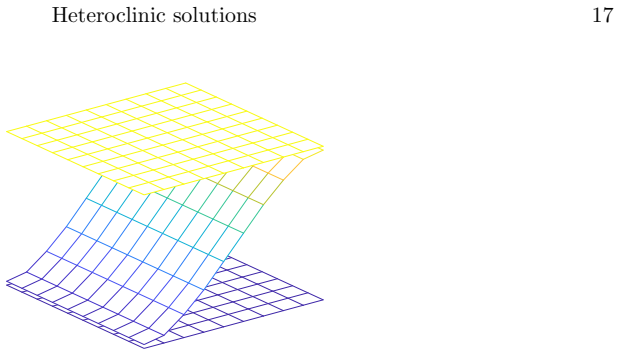
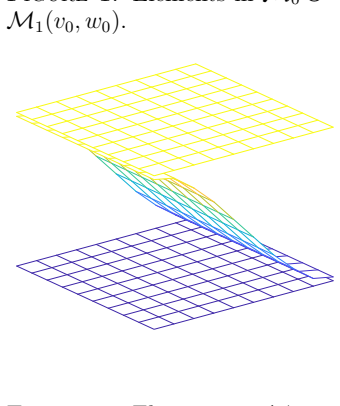
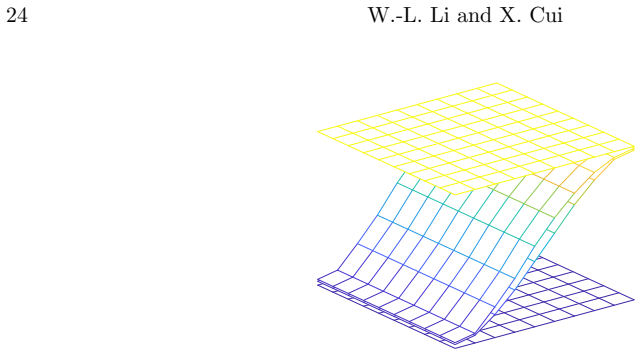
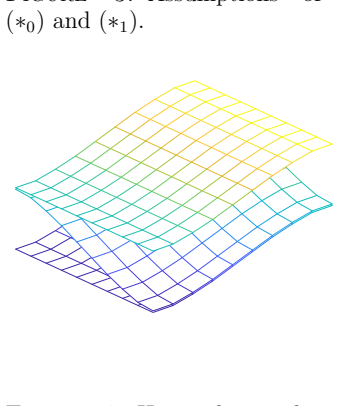
If the rotation vector of the configuration is rational and if there is an adjacent pair of periodic configurations, then there is a solution that is heteroclinic in one fixed direction and periodic in other directions. Furthermore, if the above heteroclinic solutions have an adjacent pair, then there is a solution that is heteroclinic in two directions and periodic in other directions. The procedure can be repeated to produce more complex solutions, giving a variational construction for these minimal and Birkhoff solutions.
What carries the argument
Minimization of the action functional over spaces of configurations with fixed rational rotation vector and asymptotic conditions to adjacent periodic states, following the approach of Rabinowitz and Stredulinsky.
Load-bearing premise
An adjacent pair of periodic configurations must exist for the given rational rotation vector.
What would settle it
For some rational rotation vector and adjacent periodic pair, show that the infimum of the action is not attained by any configuration connecting them.
Figures
read the original abstract
We study heteroclinic solutions of a generalized Frenkel-Kontorova model. Using the methods of Rabinowitz and Stredulinsky, we prove that if the rotation vector of the configuration is rational and if there is an adjacent pair of periodic configurations, then there is a solution that is heteroclinic in one fixed direction and periodic in other directions. Furthermore, if the above heteroclinic solutions have an adjacent pair, then there is a solution that is heteroclinic in two directions and periodic in other directions. The procedure can be repeated to produce more complex solutions. Thus we obtain a variational construction for these minimal and Birkhoff solutions.
Editorial analysis
A structured set of objections, weighed in public.
Referee Report
Summary. The manuscript proves existence of heteroclinic solutions to a generalized Frenkel-Kontorova model via the minimization methods of Rabinowitz and Stredulinsky. Under the hypotheses that the rotation vector is rational and an adjacent pair of periodic configurations exists, it constructs a solution that is heteroclinic in one fixed direction and periodic in the remaining directions. The construction is iterated when the resulting heteroclinics themselves form adjacent pairs, yielding solutions heteroclinic in two directions (and periodically in the others); the procedure extends to produce solutions with more complex heteroclinic structure. The resulting objects are minimal and Birkhoff.
Significance. If the cited minimization techniques apply directly to the generalized model under the stated adjacency hypotheses, the work supplies an explicit variational route to minimal/Birkhoff configurations whose heteroclinic complexity can be increased by iteration. This is a concrete contribution to the variational theory of lattice systems with rational rotation vectors.
minor comments (3)
- [§1] The precise statement of the generalized Frenkel-Kontorova Hamiltonian (including the form of the interaction potential and the adjacency condition) should be recalled in §1 or §2 before the main theorem is stated, so that the hypotheses are self-contained.
- [§3] The paper invokes the Rabinowitz-Stredulinsky theorem without an explicit verification that the Palais-Smale condition or the required coercivity holds for the generalized potential; a short paragraph confirming the hypotheses of the cited result would strengthen the argument.
- [Introduction] Notation for the rotation vector and the directions of heteroclinicity is introduced only in the abstract and should be fixed once in the introduction with a clear reference to the lattice indices.
Simulated Author's Rebuttal
We thank the referee for the positive summary and recommendation of minor revision. No specific major comments were provided in the report.
Circularity Check
No significant circularity
full rationale
The paper's central result is a conditional existence theorem: given a rational rotation vector and an adjacent pair of periodic configurations (taken as hypothesis), the Rabinowitz-Stredulinsky minimization method produces a heteroclinic solution in one direction (periodic in others), with iteration when new adjacent pairs arise. This relies on external variational techniques rather than any internal reduction of the claimed solutions to quantities defined by the paper's own equations or self-citations. No self-definitional steps, fitted inputs renamed as predictions, or load-bearing self-citation chains appear; the adjacent-pair assumption is explicitly external to the derivation.
Axiom & Free-Parameter Ledger
axioms (1)
- domain assumption Existence of an adjacent pair of periodic configurations for a given rational rotation vector
Reference graph
Works this paper leans on
-
[1]
S. Aubry, The twist map, the extended Frenkel-Kontorova model and the devil’s staircase, Physica D: Nonlinear Phenomena 7.1-3 (1983): 240-258
work page 1983
-
[2]
S. Aubry and P. Y. Le Daeron, The discrete Frenkel-Kontorova model and its ex- tensions: I. Exact results for the ground-states , Physica D: Nonlinear Phenomena 8.3 (1983): 381-422
work page 1983
-
[3]
Bangert, The existence of gaps in minimal foliations , Aequationes Mathematicae 34.2 (1987): 153-166
V. Bangert, The existence of gaps in minimal foliations , Aequationes Mathematicae 34.2 (1987): 153-166
work page 1987
-
[4]
V. Bangert, A uniqueness theorem for Zn-periodic variational problems, Commen- tarii Mathematici Helvetici 62.1 (1987): 511-531
work page 1987
-
[5]
Bangert, Mather sets for twist maps and geodesics on tori , Lectures in Mathe- matics
V. Bangert, Mather sets for twist maps and geodesics on tori , Lectures in Mathe- matics. Vieweg Teubner Verlag, Wiesbaden, 1988
work page 1988
-
[6]
Bangert, On minimal laminations of the torus , Ann
V. Bangert, On minimal laminations of the torus , Ann. Inst. H. Poincar´ e Anal. Non Lin´ eaire. 6 (1989): 95-138
work page 1989
-
[7]
Oleg M. Braun and Yuri S. Kivshar, Nonlinear dynamics of the FrenkelõKontorova model, Physics Reports 306.1-2 (1998): 1-108
work page 1998
-
[8]
Oleg M. Braun and Yuri S. Kivshar, The Frenkel-Kontorova model: concepts, meth- ods, and applications. Springer Science and Business Media, 2013
work page 2013
-
[9]
Rafael de la Llave and Enrico Valdinoci, Ground states and critical points for gen- eralized Frenkel-Kontorova models inZd, Nonlinearity. 20.10 (2007): 2409-2424
work page 2007
-
[10]
Rafael de la Llave and Enrico Valdinoci, Critical points inside the gaps of ground state laminations for some models in statistical mechanics , Journal of Statistical Physics 129.1 (2007): 81-119
work page 2007
-
[11]
Rafael de la Llave and Enrico Valdinoci, Ground states and critical points for AubryõMather theory in statistical mechanics , Journal of nonlinear science 20.2 (2010): 153-218
work page 2010
-
[12]
J. Frenkel and T. Kontorova, On the theory of plastic deformation and twinning , Acad. Sci. U.S.S.R. J. Phys. 1 (1939): 137-149. 40 W.-L. Li and X. Cui
work page 1939
-
[13]
J. Mather, Existence of quasi-periodic orbits for twist homeomorphisms of the an- nulus, Topology 21.4 (1982): 457-467
work page 1982
-
[14]
X.-Q. Miao, W.-X. Qin and Y.-N. Wang, Secondary invariants of Birkhoff mini- mizers and heteroclinic orbits, Journal of Differential Equations 260.2 (2016): 1522- 1557
work page 2016
-
[15]
Moser, Minimal solutions of variations problems on a torus , Ann
J. Moser, Minimal solutions of variations problems on a torus , Ann. Inst. H. Poincar´ e Anal. Non Lin´ eaire 3 (1986): 229-272
work page 1986
-
[16]
B. Mramor and B. Rink, Ghost circles in lattice Aubry-Mather theory, J. Differential Equations 252.4 (2012): 3163-3208
work page 2012
-
[17]
Paul H. Rabinowitz and Edward W. Stredulinsky, Mixed states for an Allen-Cahn type equation , Communications on Pure and Applied Mathematics 56.8 (2003): 1078-1134
work page 2003
-
[18]
Paul H. Rabinowitz and Edward W. Stredulinsky, Mixed states for an Allen-Cahn type equation, II , Calculus of Variations and Partial Differential Equations 21.2 (2004): 157-207
work page 2004
-
[19]
Paul H. Rabinowitz and Edward W. Stredulinsky, On some results of Moser and of Bangert, Annales de l’Institut Henri Poincar´ e (C) Non Linear Analysis. 21.5 (2004): 673-688
work page 2004
-
[20]
Paul H. Rabinowitz and Edward W. Stredulinsky, On some results of Moser and of Bangert, II, Advanced Nonlinear Studies 4.4 (2004): 377-396
work page 2004
-
[21]
Paul H. Rabinowitz and Edward W. Stredulinsky, Infinite transition solutions for a class of Allen-Cahn model equations , Journal of Fixed Point Theory and Applica- tions 4.2 (2008): 247-262
work page 2008
-
[22]
Paul H. Rabinowitz and Edward W. Stredulinsky, Extensions of Moser-Bangert Theory: Locally Minimal Solutions , Progress in Nonlinear Differential Equations and Their Applications 81, Birkh¨auser Basel, 2011
work page 2011
-
[23]
W. M. Senn, Phase-locking in the multidimensional Frenkel-Kontorova model, Math- ematische Zeitschrift 227.4 (1998): 623-643
work page 1998
-
[24]
Wen-Long Li, School of Mathematics, Sun Yat-Sen University, Guangzhou, 510275, P
Xifeng Su and Rafael de la Llave, Percival Lagrangian approach to the AubryõMather theory, Expositiones Mathematicae 30.2 (2012): 182-208. Wen-Long Li, School of Mathematics, Sun Yat-Sen University, Guangzhou, 510275, P. R. China E-mail address : liwenlongchn@gmail.com Xiaojun Cui, Department of Mathematics, Nanjing University, Nanjing, 210093, P. R. Chin...
work page 2012
discussion (0)
Sign in with ORCID, Apple, or X to comment. Anyone can read and Pith papers without signing in.