Modeling the non-thermal emission of the gamma Cygni Supernova Remnant up to the highest energies
Pith reviewed 2026-05-24 19:07 UTC · model grok-4.3
The pith
HAWC observations extend the gamma-ray spectrum of gamma Cygni SNR to higher energies and tighten the bound on maximum particle acceleration energy.
A machine-rendered reading of the paper's core claim, the machinery that carries it, and where it could break.
Core claim
HAWC's sensitivity at TeV energies and above enables extension of the spectral measurements of gamma Cygni SNR and better constrains the maximum acceleration energy of the non-thermal particle population responsible for the observed multi-wavelength emission.
What carries the argument
HAWC gamma-ray observatory spectral measurements above 1 TeV that extend the observed cutoff and allow modeling of the parent particle distribution via multi-wavelength fitting.
If this is right
- The maximum energy of accelerated particles is bounded more tightly than with prior instruments.
- Hadronic versus leptonic emission scenarios can be distinguished with greater precision.
- Acceleration efficiency in middle-aged, Sedov-phase SNRs receives a direct observational test.
- The derived particle spectrum provides a template for interpreting emission from similar remnants.
Where Pith is reading between the lines
- Comparison of the constrained cutoff across multiple SNRs of different ages could test whether maximum energy scales with remnant size or magnetic field strength.
- If the model holds, the same fitting approach could be applied to HAWC data on other gamma-ray bright SNRs to search for systematic trends in acceleration limits.
Load-bearing premise
The observed gamma-ray emission comes from one non-thermal particle population whose spectrum is shaped only by standard diffusive shock acceleration.
What would settle it
Detection of a spectral break, hardening, or continued power-law extension significantly above the energy range where the single-population model predicts a cutoff would falsify the central modeling result.
Figures
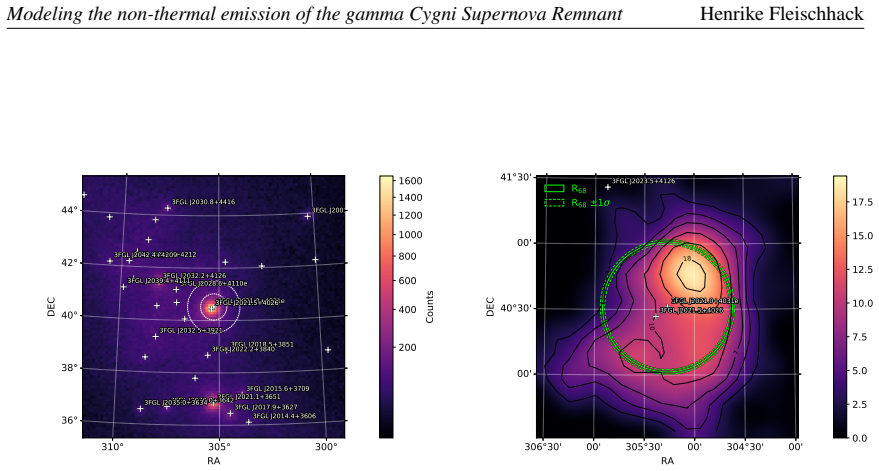


read the original abstract
The gamma Cygni supernova remnant (SNR) is a middle-aged, Sedov-phase SNR in the Cygnus region. It is a known source of non-thermal emission at radio, X-ray, and gamma-ray energies. Very-high energy (VHE, >100 GeV) gamma-ray emission from gamma Cygni was first detected by the VERITAS observatory and it has since been observed by other experiments. Observations so far indicate that there must be a population of non-thermal particles present in the remnant which produces the observed emission. However, it is not clear what kind of particles (protons/ions or electrons) are accelerated in the remnant, how efficient the acceleration is, and up to which energy particles can be accelerated. Accurate measurements of the VHE gamma-ray spectrum are crucial to investigate particle acceleration above TeV energies. This presentation will focus on multi-wavelength observations of the gamma Cygni SNR and their interpretation. We will present improved measurements of the VHE gamma-ray emission spectrum of gamma Cygni by the High-Altitude Water Cherenkov (HAWC) gamma-ray observatory, and use these results as well as measurements from other instruments to model the underlying particle populations producing this emission. HAWC's excellent sensitivity at TeV energies and above enables us to extend spectral measurements to higher energies and better constrain the maximum acceleration energy.
Editorial analysis
A structured set of objections, weighed in public.
Referee Report
Summary. The manuscript reports new HAWC observations of VHE gamma-ray emission from the middle-aged gamma Cygni SNR in the Cygnus region. Combined with radio, X-ray, and lower-energy gamma-ray data, the authors model the non-thermal particle populations under a diffusive shock acceleration framework to extend the spectrum to higher energies and place improved constraints on the maximum acceleration energy.
Significance. If the modeling assumptions hold, the HAWC data's sensitivity above 1 TeV provides a meaningful extension of the spectrum that can tighten limits on the high-energy cutoff in a Sedov-phase SNR. The multi-wavelength approach is a positive feature for cross-checking the particle population responsible for the emission.
major comments (1)
- [Modeling and results sections (around the spectral fitting and Emax discussion)] The headline result that HAWC data better constrains the maximum acceleration energy rests on the assumption that the observed VHE flux arises from a single non-thermal particle population whose spectrum is shaped solely by standard DSA (no dominant multi-component emission or unresolved background). The Cygnus field is crowded; without a quantitative limit on allowed contamination fraction or a likelihood-ratio test against alternative models (e.g., hadronic emission from nearby clouds or a sub-dominant leptonic IC component), the robustness of the Emax constraint cannot be assessed. This is load-bearing for the central claim.
minor comments (2)
- Notation for the particle spectra (e.g., power-law index, cutoff energy) should be defined explicitly in the text rather than only in figure captions.
- The abstract states that HAWC 'enables us to extend spectral measurements to higher energies,' but the manuscript should include a direct comparison plot or table showing the new HAWC points versus prior VERITAS data to quantify the extension.
Simulated Author's Rebuttal
We thank the referee for highlighting the importance of assessing potential contamination and model assumptions in the crowded Cygnus region. We address this concern directly below and have revised the manuscript accordingly.
read point-by-point responses
-
Referee: [Modeling and results sections (around the spectral fitting and Emax discussion)] The headline result that HAWC data better constrains the maximum acceleration energy rests on the assumption that the observed VHE flux arises from a single non-thermal particle population whose spectrum is shaped solely by standard DSA (no dominant multi-component emission or unresolved background). The Cygnus field is crowded; without a quantitative limit on allowed contamination fraction or a likelihood-ratio test against alternative models (e.g., hadronic emission from nearby clouds or a sub-dominant leptonic IC component), the robustness of the Emax constraint cannot be assessed. This is load-bearing for the central claim.
Authors: We agree that the Cygnus region is complex and that unresolved emission or nearby clouds could in principle contaminate the measured VHE flux, which would affect the robustness of the Emax constraint. Our analysis selects a region of interest matched to the HAWC point-spread function and demonstrates consistency with the VERITAS spectrum below 1 TeV and with the multi-wavelength radio-to-X-ray data under a single DSA population. To address the referee's point, the revised manuscript will include a quantitative upper bound on possible contamination (derived from known source catalogs and the instrument response) and will explicitly discuss how this bound propagates into the Emax uncertainty. A full likelihood-ratio comparison against multi-component models lies outside the scope of the present work; we will note this as a limitation and a direction for future study. revision: partial
Circularity Check
No circularity detected; derivation chain not detailed enough to exhibit reduction
full rationale
The provided text consists solely of the abstract, which describes HAWC observations extending the VHE spectrum of gamma Cygni SNR and using multi-wavelength data to model particle populations and constrain maximum acceleration energy. No equations, fitting procedures, parameter definitions, self-citations, or derivation steps are supplied. Consequently, none of the enumerated circularity patterns (self-definitional, fitted-input-called-prediction, etc.) can be exhibited by quoting paper text and showing reduction to inputs. The central claim remains a high-level modeling statement without internal structure that collapses by construction.
Axiom & Free-Parameter Ledger
Lean theorems connected to this paper
-
IndisputableMonolith/Cost/FunctionalEquation.leanwashburn_uniqueness_aczel unclear?
unclearRelation between the paper passage and the cited Recognition theorem.
we attempted to extract the parameters of the underlying proton spectrum... a powerlaw spectrum with an exponential cutoff... reproduces the GeV to TeV data well
-
IndisputableMonolith/Foundation/RealityFromDistinction.leanreality_from_one_distinction unclear?
unclearRelation between the paper passage and the cited Recognition theorem.
HAWC detects VHE gamma-ray emission... well-fit by a pion decay model
What do these tags mean?
- matches
- The paper's claim is directly supported by a theorem in the formal canon.
- supports
- The theorem supports part of the paper's argument, but the paper may add assumptions or extra steps.
- extends
- The paper goes beyond the formal theorem; the theorem is a base layer rather than the whole result.
- uses
- The paper appears to rely on the theorem as machinery.
- contradicts
- The paper's claim conflicts with a theorem or certificate in the canon.
- unclear
- Pith found a possible connection, but the passage is too broad, indirect, or ambiguous to say the theorem truly supports the claim.
Reference graph
Works this paper leans on
-
[1]
The Supernova Remnant G78.2+2.1: New Optical and X-ray Observations
T. A. Lozinskaya, V . V . Pravdikova & A. V . Finoguenov. “The Supernova Remnant G78.2+2.1: New Optical and X-ray Observations”. In: Astronomy Letters 26 (Feb. 2000), pp. 77–87
work page 2000
-
[2]
X-ray and radio observations of the θ s Cygni su- pernova remnant G78.2+2.1
D. A. Leahy, K. Green & S. Ranasinghe. “X-ray and radio observations of the θ s Cygni su- pernova remnant G78.2+2.1”. In: Monthly Notices of the Royal Astronomical Society 436.2 (Oct. 2013), pp. 968–977
work page 2013
-
[3]
THE FIRST FERMILAT SUPERNOV A REMNANT CATALOG
F. Acero et al. “THE FIRST FERMILAT SUPERNOV A REMNANT CATALOG”. In: The Astrophysical Journal Supplement Series 224.1 (2016), p. 8
work page 2016
-
[4]
FERMI LARGE AREA TELESCOPE THIRD SOURCE CATALOG
F. Acero et al. “FERMI LARGE AREA TELESCOPE THIRD SOURCE CATALOG”. In: The Astrophysical Journal Supplement Series 218.2 (2015), p. 23
work page 2015
-
[5]
M. Ackermann et al. “Search for Extended Sources in the Galactic Plane Using Six Years of Fermi-Large Area Telescope Pass 8 Data above 10 GeV”. In: Astrophys. J. 843.2 (2017), p. 139
work page 2017
-
[6]
N. Fraija & M. Araya. “The GeV counterpart of VER J2019+407 in the northern shell of the supernova remnant G78.2+2.1 (γ Cygni)”. In: Astrophys. J. 826.1 (2016), p. 31
work page 2016
-
[7]
Discovery of TeV Gamma-ray Emission Toward Supernova Remnant SNR G78.2+2.1
E. Aliu et al. “Discovery of TeV Gamma-ray Emission Toward Supernova Remnant SNR G78.2+2.1”. In: Astrophys. J. 770 (2013), p. 93
work page 2013
-
[8]
Gamma-Cygni: the GeV to TeV morphology of an unique Sedov-phase SNR with MAGIC andF ermi-LAT
M. Strzys. “Gamma-Cygni: the GeV to TeV morphology of an unique Sedov-phase SNR with MAGIC andF ermi-LAT”. In: PoS ICRC2017 (2017)
work page 2017
-
[9]
Testing the Limits of Particle Acceleration in Cygnus OB2 with HAWC
B. Hona et al. “Testing the Limits of Particle Acceleration in Cygnus OB2 with HAWC”. PoS(ICRC2019)699. In: These proceedings. 2019
work page 2019
-
[10]
A Cocoon of Freshly Accelerated Cosmic Rays Detected by Fermi in the Cygnus Superbubble
M. Ackermann et al. “A Cocoon of Freshly Accelerated Cosmic Rays Detected by Fermi in the Cygnus Superbubble”. In: Science 334.6059 (2011), pp. 1103–1107
work page 2011
-
[11]
A Very High Energy γ-Ray Survey toward the Cygnus Region of the Galaxy
A. U. Abeysekara et al. “A Very High Energy γ-Ray Survey toward the Cygnus Region of the Galaxy”. In: The Astrophysical Journal 861.2 (2018), p. 134
work page 2018
-
[12]
The 2HWC HAWC Observatory Gamma-Ray Catalog
A. U. Abeysekara et al. “The 2HWC HAWC Observatory Gamma-Ray Catalog”. In: The Astrophysical Journal 843.1 (2017), p. 40
work page 2017
-
[13]
Observation of the Crab Nebula with the HAWC Gamma-Ray Observatory
A. U. Abeysekara et al. “Observation of the Crab Nebula with the HAWC Gamma-Ray Observatory”. In: Astrophys. J. 843.1 (2017), p. 39
work page 2017
-
[14]
Measurement of the Crab Nebula at the Highest Energies with HAWC
A. U. Abeysekara et al. “Measurement of the Crab Nebula at the Highest Energies with HAWC”. In: Accepted for publication by ApJ (2019)
work page 2019
-
[15]
A high-level analysis framework for HAWC
P. W. Younk et al. “A high-level analysis framework for HAWC”. In: Proceedings of the 34th International Cosmic Ray Conference (PoS) . 2015, arXiv:1508.07479
-
[16]
The Multi-Mission Maximum Likelihood framework (3ML)
G. Vianello et al. “The Multi-Mission Maximum Likelihood framework (3ML)”. In: Pro- ceedings of the 34th International Cosmic Ray Conference (PoS) . 2015
work page 2015
-
[17]
The Large Area Telescope on the Fermi Gamma-Ray Space Telescope Mission
W. B. Atwood et al. “The Large Area Telescope on the Fermi Gamma-Ray Space Telescope Mission”. In: ApJ 697.2 (2009), pp. 1071–1102. 6 Modeling the non-thermal emission of the gamma Cygni Supernova Remnant Henrike Fleischhack
work page 2009
-
[18]
Fermi-LAT improved Pass~8 event selection
P. Bruel et al. “Fermi-LAT improved Pass ~8 event selection”. In: arXiv e-prints, arXiv:1810.11394 (2018), arXiv:1810.11394
work page internal anchor Pith review Pith/arXiv arXiv 2018
-
[19]
2013, arXiv e-prints, arXiv:1303.3514
W. Atwood et al. “Pass 8: Toward the Full Realization of the Fermi-LAT Scientific Poten- tial”. In: arXiv e-prints, arXiv:1303.3514 (2013), arXiv:1303.3514
-
[20]
Fermipy: An open-source Python package for analysis of Fermi-LAT Data
M. Wood et al. “Fermipy: An open-source Python package for analysis of Fermi-LAT Data”. In: International Cosmic Ray Conference 35, 824 (Jan. 2017), p. 824
work page 2017
-
[21]
V . Zabalza. “naima: a Python package for inference of relativistic particle energy distribu- tions from observed nonthermal spectra”. In: Proc. of International Cosmic Ray Conference 2015 (2015), p. 922
work page 2015
-
[22]
2019, arXiv e-prints, arXiv:1902.10045
The Fermi-LAT collaboration. “Fermi Large Area Telescope Fourth Source Catalog”. In: arXiv e-prints, arXiv:1902.10045 (2019), arXiv:1902.10045. 7
discussion (0)
Sign in with ORCID, Apple, or X to comment. Anyone can read and Pith papers without signing in.