A Gap Theorem for Half-Conformally Flat Manifolds
Pith reviewed 2026-05-24 18:17 UTC · model grok-4.3
The pith
Any compact half-conformally flat manifold of negative type with bounded L2 energy, sufficiently small scalar curvature, and a non-collapsing assumption has all Betti numbers bounded.
A machine-rendered reading of the paper's core claim, the machinery that carries it, and where it could break.
Core claim
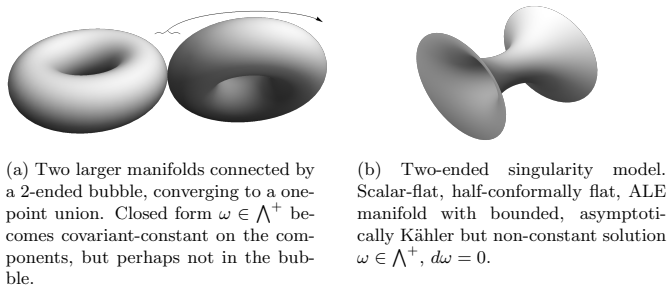
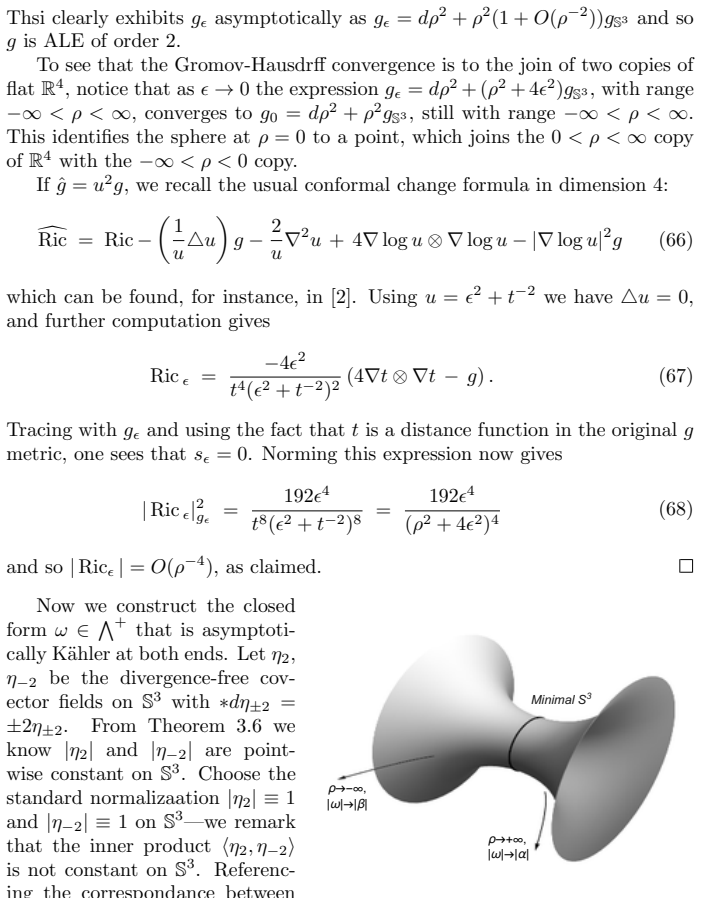
Any compact half-conformally flat manifold of negative type, with bounded L2 energy, sufficiently small scalar curvature, and a non-collapsing assumption, has all Betti numbers bounded. This result is optimal from an analytic perspective by demonstrating singularity models that are 2-ended and asymptotically Kähler on both ends. Bounded self-dual solutions of dω=0 on ALE manifold ends are either asymptotically Kähler or they have a decay rate of O(r^{-4}) or better.
What carries the argument
The gap theorem that combines bounded L2 energy, a small scalar curvature threshold, and non-collapsing to force a uniform bound on all Betti numbers.
If this is right
- The Betti number bound follows from the stated analytic conditions on energy, curvature, and non-collapsing.
- The 2-ended asymptotically Kähler singularity models demonstrate that the small-curvature and non-collapsing hypotheses are sharp.
- Bounded self-dual solutions of dω=0 on ALE ends must be asymptotically Kähler or decay at rate O(r^{-4}) or better.
Where Pith is reading between the lines
- Dropping non-collapsing could permit sequences with topology concentrating at points while curvature remains controlled.
- The end classification may support gluing constructions that produce complete non-compact examples.
- The bound may restrict possible diffeomorphism types among 4-manifolds admitting such curvature conditions.
Load-bearing premise
The non-collapsing assumption together with the sufficiently small scalar curvature threshold.
What would settle it
A compact half-conformally flat manifold of negative type with bounded L2 energy, non-collapsing, sufficiently small scalar curvature, yet unbounded Betti numbers would falsify the claim.
Figures
read the original abstract
We show that any compact half-conformally flat manifold of negative type, with bounded $L^2$ energy, sufficiently small scalar curvature, and a non-collapsing assumption, has all betti numbers bounded. We show that this result is optimal from an analytic perspective by demonstrating singularity models that are 2-ended, and are asymptotically K\"ahler on both ends. We show that bounded self-dual solutions of $d\omega=0$ on ALE manifold ends are either asymptotically K\"ahler, or they have a decay rate of $O(r^{-4})$ or better.
Editorial analysis
A structured set of objections, weighed in public.
Referee Report
Summary. The paper proves a gap theorem asserting that any compact half-conformally flat manifold of negative type with bounded L² energy, sufficiently small scalar curvature, and satisfying a non-collapsing assumption has all Betti numbers bounded. Optimality is shown by constructing 2-ended ALE singularity models that are asymptotically Kähler on both ends, together with a decay dichotomy stating that bounded self-dual solutions of dω=0 on ALE ends are either asymptotically Kähler or decay at rate O(r^{-4}) or better.
Significance. If the proofs hold, the result supplies a topological bound for a class of 4-manifolds under integral curvature and non-collapsing hypotheses, which is of interest in conformal geometry. The explicit construction of optimal 2-ended models and the decay dichotomy for harmonic 2-forms constitute concrete analytic contributions that strengthen the sharpness claim.
major comments (2)
- [Main theorem (likely Theorem 1.1)] The non-collapsing assumption and the smallness threshold on scalar curvature are load-bearing for the Betti-number conclusion; the main theorem statement should record the explicit dependence of the bound on these quantities (or the constants appearing in their definitions) so that the result can be checked against the constructed models.
- [Singularity models / optimality section] The optimality claim rests on the 2-ended ALE models being half-conformally flat of negative type while violating the conclusion when the small-curvature or non-collapsing hypotheses fail; the verification that these models satisfy the curvature hypotheses of the theorem (or explicitly fail them) must be supplied in the construction section.
minor comments (3)
- [Introduction] The notions of 'half-conformally flat' and 'negative type' should be recalled with their standard definitions (or precise references) in the introduction before the statement of the main result.
- [Introduction / notation] Clarify the precise integrand whose L² norm is assumed bounded (e.g., |W|^2, |Rm|^2, or a combination) and its relation to the scalar curvature term appearing in the smallness hypothesis.
- [Decay dichotomy section] The decay statement for self-dual harmonic 2-forms should include a brief comparison with the expected decay rates on ALE spaces of order 4 or higher.
Simulated Author's Rebuttal
We thank the referee for the careful reading and the constructive suggestions. We address the two major comments point by point below.
read point-by-point responses
-
Referee: [Main theorem (likely Theorem 1.1)] The non-collapsing assumption and the smallness threshold on scalar curvature are load-bearing for the Betti-number conclusion; the main theorem statement should record the explicit dependence of the bound on these quantities (or the constants appearing in their definitions) so that the result can be checked against the constructed models.
Authors: We agree that the dependence should be recorded explicitly. In the revised manuscript we will restate Theorem 1.1 so that the bound on the Betti numbers is expressed in terms of the constants appearing in the non-collapsing hypothesis and the smallness threshold on the scalar curvature. revision: yes
-
Referee: [Singularity models / optimality section] The optimality claim rests on the 2-ended ALE models being half-conformally flat of negative type while violating the conclusion when the small-curvature or non-collapsing hypotheses fail; the verification that these models satisfy the curvature hypotheses of the theorem (or explicitly fail them) must be supplied in the construction section.
Authors: We will expand the construction section to include explicit verification that the 2-ended ALE models are half-conformally flat of negative type. We will also add a short paragraph clarifying that these models violate either the small-curvature threshold or the non-collapsing assumption, thereby showing that the bounded-Betti conclusion fails when those hypotheses are dropped. revision: yes
Circularity Check
No significant circularity detected
full rationale
The derivation presents a gap theorem under explicit hypotheses (half-conformally flat of negative type, bounded L2 energy, small scalar curvature, non-collapsing) implying bounded Betti numbers, with optimality shown via independent construction of 2-ended ALE singularity models that are asymptotically Kähler. No step reduces by definition to its inputs, no fitted parameter is relabeled as a prediction, and no load-bearing premise rests on a self-citation chain that itself lacks external verification. The analytic decay dichotomy for self-dual forms is stated as a supporting result rather than a circular reduction. The argument is therefore self-contained against the listed assumptions and external benchmarks.
Axiom & Free-Parameter Ledger
Lean theorems connected to this paper
-
IndisputableMonolith/Foundation/AlexanderDuality.leanalexander_duality_circle_linking echoes?
echoesECHOES: this paper passage has the same mathematical shape or conceptual pattern as the Recognition theorem, but is not a direct formal dependency.
Theorem 3.7: ... either asymptotically Kähler or |ω| = O(r^{-4}). ... spec(*d) = ℤ∖{-1,0,1}
-
IndisputableMonolith/Cost/FunctionalEquation.leanwashburn_uniqueness_aczel unclear?
unclearRelation between the paper passage and the cited Recognition theorem.
Lemma 2.1 (Improved elliptic inequality) ... △|ω|^{1/2} ≥ s/6 |ω|^{1/2}
What do these tags mean?
- matches
- The paper's claim is directly supported by a theorem in the formal canon.
- supports
- The theorem supports part of the paper's argument, but the paper may add assumptions or extra steps.
- extends
- The paper goes beyond the formal theorem; the theorem is a base layer rather than the whole result.
- uses
- The paper appears to rely on the theorem as machinery.
- contradicts
- The paper's claim conflicts with a theorem or certificate in the canon.
- unclear
- Pith found a possible connection, but the passage is too broad, indirect, or ambiguous to say the theorem truly supports the claim.
Reference graph
Works this paper leans on
- [1]
-
[2]
A. Besse. “Einstein manifolds” Springer Science & Business Media, 2007
work page 2007
-
[3]
Branson, Kato constants in Riemannian geometry Mathematical Re- search Letters 7, no
T. Branson, Kato constants in Riemannian geometry Mathematical Re- search Letters 7, no. 3 (2000): 245-261
work page 2000
-
[4]
Brill, Euclidean Maxwell-Einstein theory
D. Brill, Euclidean Maxwell-Einstein theory. Topics on Quantum Gravity and Beyond: Essay in Honor of Louis Witten on His Retirement. F. Mansouri and JJ Scanio, eds.(World Scientific: Singapore) (1993)
work page 1993
-
[5]
R. Bryant, ”Nine lectures on exterior differential systems.” Informal notes for a series of lectures delivered (1999): 12-23
work page 1999
-
[6]
D. Calderbank, P. Gauduchon, and M. Herzlich, Refined Kato inequalities and conformal weights in Riemannian geometry. Journal of Functional Anal- ysis 173, no. 1 (2000): 214-255
work page 2000
-
[7]
Folland, Harmonic analysis of the de Rham complex on the sphere , J
G. Folland, Harmonic analysis of the de Rham complex on the sphere , J. reine angew. Math 398 (1989): 130-143
work page 1989
-
[8]
Gao, Convergence of Riemannian manifolds; Ricci and Ln/2-curvature pinching
Z. Gao, Convergence of Riemannian manifolds; Ricci and Ln/2-curvature pinching. Journal of Differential Geometry 32, no. 2 (1990): 349-381
work page 1990
-
[9]
Z. Gao, Ln/2-curvature pinching. Journal of Differential Geometry 32, no. 3 (1990): 713-774
work page 1990
-
[10]
D. Gilbarg and N. Trudinger, Elliptic partial differential equations of second order. springer, 2015
work page 2015
-
[11]
Gromov, Curvature, diameter and Betti numbers
M. Gromov, Curvature, diameter and Betti numbers . Commentarii Math- ematici Helvetici 56, no. 1 (1981): 179-195
work page 1981
-
[12]
Heras, Electromagnetism in Euclidean four space: A discussion between God and the Devil
J. Heras, Electromagnetism in Euclidean four space: A discussion between God and the Devil. American Journal of Physics 62, no. 10 (1994): 914-916
work page 1994
-
[13]
J. Heras The kirchhoff gauge . Annals of Physics 321, no. 5 (2006): 1265- 1273. 23
work page 2006
-
[14]
C. LeBrun, On the topology of self-dual 4-manifolds , Proceedings of the American Mathematical Society, 98 (1986) no. 4 637–640
work page 1986
-
[15]
Lebrun, Counterexamples to the generalized positive action conjecture
C. Lebrun, Counterexamples to the generalized positive action conjecture. Communications in Mathematical Physics 118 (1988): 591–596
work page 1988
-
[16]
Lebrun, Curvature functionals, optimal metrics, and the differen- tial topology of 4-manifolds
C. Lebrun, Curvature functionals, optimal metrics, and the differen- tial topology of 4-manifolds . In Different faces of geometry (pp. 199- 256). Springer, Boston, MA. Communications in Mathematical Physics 118 (1988): 591–596
work page 1988
-
[17]
L. Lindblom, N. Taylor, and F. Zhang, Scalar, vector and tensor harmonics on the three-sphere. General Relativity and Gravitation 49, no. 11 (2017): 139
work page 2017
-
[18]
H. Minkowski, Die Grundgleichungen f¨ ur die elektromagnetischen Vorg¨ ange in bewegten K¨ orpern.Nachrichten von der Gesellschaft der Wissenschaften zu Gttingen, Mathematisch-Physikalische Klasse 1908 (1908): 53-111
work page 1908
-
[19]
P. Peterson, S. Shteingold, and G. Wei, Comparison geometry with integral curvature bounds. Geometric & Functional Analysis GAFA 7, no. 6 (1997): 1011-1030
work page 1997
-
[20]
Sandberg, Tensor sherical harmonics on S2 and S3 as eigenvalue prob- lems
V. Sandberg, Tensor sherical harmonics on S2 and S3 as eigenvalue prob- lems. Journal of Mathematical Physics Vol 12, no. 12 (1978): 2441–2446
work page 1978
-
[21]
Seaman, Harmonic two-forms in four dimensions
W. Seaman, Harmonic two-forms in four dimensions . Proceedings of the American Mathematical Society (1991): 545-548
work page 1991
-
[22]
Schwinger Euclidean quantum electrodynamics
J. Schwinger Euclidean quantum electrodynamics. Physical Review 115, no. 3 (1959): 721
work page 1959
-
[23]
C. Taubes, The extistence of anti-self dual conformal structures , Journal of Differential Geometry 36 (1992) 163–253
work page 1992
-
[24]
G. Tian and J. Viaclovsky, Bach-flat symptotically locally Euclidean met- rics, Invetiones Mathematicae 160 (2005) No. 2 357–415
work page 2005
-
[25]
G. Tian and J. Viaclovsky, Moduli spaces of critical Riemannian metrics in dimensiona four , Advances in Mathematics 196 (2005) 346–372
work page 2005
-
[26]
Volume growth, curvature decay, and critical metrics
G. Tian and J. Viaclovsky, Volume growth, curvature decay, and critical metrics, arXiv preprint math/0612491 (2006)
work page internal anchor Pith review Pith/arXiv arXiv 2006
-
[27]
Weber, Two classical flows and the topology of 4-manifolds , To appear
B. Weber, Two classical flows and the topology of 4-manifolds , To appear. (2017)
work page 2017
-
[28]
Yang, Convergence of Riemannian manifolds with integral bounds on curvature
D. Yang, Convergence of Riemannian manifolds with integral bounds on curvature. I.” In Annales scientifiques de l’Ecole normale suprieure, vol. 25, no. 1, pp. 77-105. 1992. 24
work page 1992
-
[29]
E. Zampino, A brief study on the transformation of Maxwell equations in Euclidean fourspace, Journal of mathematical physics 27, no. 5 (1986): 1315- 1318
work page 1986
-
[30]
Zampino ”Can A” Hyperspace” Really Exist?.” NASA 19990023249 (1999)
E. Zampino ”Can A” Hyperspace” Really Exist?.” NASA 19990023249 (1999). 25
work page 1999
discussion (0)
Sign in with ORCID, Apple, or X to comment. Anyone can read and Pith papers without signing in.