Dual Univariate Interpolatory Subdivision of Every Arity: Algebraic Characterization and Construction
Pith reviewed 2026-05-24 18:11 UTC · model grok-4.3
The pith
Dual univariate interpolatory subdivision schemes of every arity receive a complete algebraic characterization through trigonometric polynomial identities.
A machine-rendered reading of the paper's core claim, the machinery that carries it, and where it could break.
Core claim
A complete algebraic characterization, which covers every arity, is given in terms of identities of trigonometric polynomials associated to the schemes. This characterization is based on a necessary condition for refinable functions to have prescribed values at the nodes of a uniform lattice, as a consequence of the Poisson summation formula. A strategy for the construction is then showed, alongside meaningful examples for applications that have comparable or even superior properties, in terms of regularity, length of the support and/or polynomial reproduction, with respect to the primal counterparts.
What carries the argument
Identities of trigonometric polynomials associated to the schemes, which encode the algebraic characterization for dual interpolatory schemes of any arity.
If this is right
- The characterization applies uniformly to schemes of arbitrary arity.
- Dual schemes can be constructed with even-length masks that avoid step-wise interpolation.
- The construction yields schemes whose regularity, support length, and polynomial reproduction equal or surpass those of corresponding primal schemes.
- Specific examples illustrate the approach for concrete applications.
Where Pith is reading between the lines
- The same condition-based approach could be examined for its ability to generate schemes with prescribed reproduction degrees beyond the examples given.
- Connections between the trigonometric identities and the support size of the resulting masks may allow systematic control over scheme properties not explicitly derived in the paper.
- The algebraic framework might be checked against existing dual schemes from the literature to confirm coverage.
- Testable extensions include applying the construction to generate schemes for specific reproduction orders and measuring their actual regularity numerically.
Load-bearing premise
The necessary condition from the Poisson summation formula on refinable functions taking prescribed values at uniform lattice nodes is sufficient to produce the trigonometric polynomial identities for dual schemes.
What would settle it
A dual interpolatory scheme of some arity that meets the Poisson summation condition yet fails to satisfy the claimed trigonometric polynomial identities, or one that satisfies the identities without meeting the condition.
Figures
read the original abstract
A new class of univariate stationary interpolatory subdivision schemes of dual type is presented. As opposed to classical primal interpolatory schemes, these new schemes have masks with an even number of elements and are not step-wise interpolants. A complete algebraic characterization, which covers every arity, is given in terms of identities of trigonometric polynomials associated to the schemes. This characterization is based on a necessary condition for refinable functions to have prescribed values at the nodes of a uniform lattice, as a consequence of the Poisson summation formula. A strategy for the construction is then showed, alongside meaningful examples for applications that have comparable or even superior properties, in terms of regularity, length of the support and/or polynomial reproduction, with respect to the primal counterparts.
Editorial analysis
A structured set of objections, weighed in public.
Referee Report
Summary. The manuscript introduces a new class of univariate stationary interpolatory subdivision schemes of dual type, featuring masks with an even number of elements that are not step-wise interpolants. It claims a complete algebraic characterization covering every arity, expressed as identities on associated trigonometric polynomials. This characterization is derived from a necessary condition for refinable functions to attain prescribed values on a uniform lattice, obtained via the Poisson summation formula. A construction strategy is presented, along with examples asserted to match or exceed primal schemes in regularity, support length, and polynomial reproduction.
Significance. If the claimed sufficiency of the Poisson-derived condition holds and the algebraic identities are fully verified, the work would supply a general framework for constructing dual interpolatory schemes of arbitrary arity. This could expand options in subdivision theory for applications requiring flexible mask designs with controlled reproduction properties.
major comments (2)
- [Abstract] Abstract: the assertion that the necessary condition obtained from the Poisson summation formula is also sufficient to produce the complete algebraic characterization for every arity is stated without explicit identities, derivations, or verification that no further constraints on mask support or factorization arise when moving from necessity to the claimed identities.
- The construction strategy and examples section: the claim that the generated schemes have comparable or superior properties is made, but the absence of explicit trigonometric polynomial identities or quantitative checks for the sufficiency step across arities leaves the completeness of the characterization unverified.
Simulated Author's Rebuttal
We thank the referee for the careful reading of the manuscript and the constructive comments. We address each major comment below, providing clarifications on where the explicit derivations appear in the paper and indicating revisions to improve presentation.
read point-by-point responses
-
Referee: [Abstract] Abstract: the assertion that the necessary condition obtained from the Poisson summation formula is also sufficient to produce the complete algebraic characterization for every arity is stated without explicit identities, derivations, or verification that no further constraints on mask support or factorization arise when moving from necessity to the claimed identities.
Authors: The necessary condition is obtained in Section 2 via the Poisson summation formula applied to the refinable function. Sufficiency is established in Section 3 by deriving the explicit trigonometric polynomial identities (Equations (3.4)–(3.7)) that must hold for the symbol to generate a dual interpolatory scheme of any given arity. These identities are both necessary and sufficient by direct substitution back into the refinement equation and verification that the resulting mask produces the required interpolation property on the lattice. Mask support is fixed by the degree of the trigonometric polynomials, and the proofs show that no additional factorization constraints arise beyond the stated parity and symmetry conditions. We will revise the abstract to reference these identities explicitly. revision: partial
-
Referee: The construction strategy and examples section: the claim that the generated schemes have comparable or superior properties is made, but the absence of explicit trigonometric polynomial identities or quantitative checks for the sufficiency step across arities leaves the completeness of the characterization unverified.
Authors: Section 4 details the construction by solving the algebraic system of trigonometric identities for each arity, yielding explicit masks. Sufficiency follows immediately from the characterization in Section 3: any solution to the identities satisfies the dual interpolatory condition. Examples for arities 2, 3, and 4 are given with the corresponding identities and masks; regularity is computed via the joint spectral radius, support length is reported directly, and polynomial reproduction is verified by checking the reproduction of monomials up to the claimed degree. These provide quantitative comparisons to primal schemes. We will add an appendix listing the explicit identities solved for each example to make the verification across arities fully transparent. revision: partial
Circularity Check
Derivation chain is self-contained via standard Poisson summation without self-referential reduction
full rationale
The paper derives its algebraic characterization of dual interpolatory schemes from the Poisson summation formula applied to refinable functions, yielding a necessary condition on lattice values that is then used to construct the trigonometric polynomial identities. No equations or steps reduce by construction to fitted parameters, self-citations, or renamed inputs; the sufficiency claim for generating the identities across arities follows from the stated necessary condition without invoking load-bearing prior work by the authors. The derivation remains independent of the target result itself.
Axiom & Free-Parameter Ledger
axioms (1)
- standard math Poisson summation formula yields a necessary condition for refinable functions to attain prescribed values at uniform lattice nodes
Reference graph
Works this paper leans on
-
[1]
L. Auslander and Y. Meyer , A generalized Poisson summation formula , Appl. Comput. Harmon. Anal., 3 (1996), pp. 372–376
work page 1996
-
[2]
A. S. Cavaretta, W. Dahmen, and C. A. Micchelli , Stationary subdivision , Mem. Amer. Math. Soc., 93 (1991)
work page 1991
-
[3]
M. Charina and T. Mejstrik , Multiple multivariate subdivision schemes: matrix and ope rator approaches, J. Comput. Appl. Math., 349 (2019), pp. 279–291
work page 2019
-
[4]
S. W. Choi, B.-G. Lee, Y. J. Lee, and J. Yoon , Stationary subdivision schemes reproducing polynomials , Computer Aided Geometric Design, 23 (2006), pp. 351 – 360
work page 2006
-
[5]
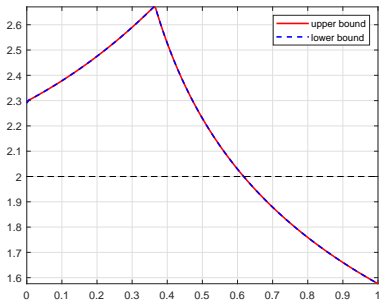
C. K. Chui, W. He, J. St ¨ockler, and Q. Sun , Compactly supported tight affine frames with integer dilatio ns and maximum vanishing moments , Adv. Comput. Math., 18 (2003), pp. 159–187. 19 0 0.1 0.2 0.3 0.4 0.5 0.6 0.7 0.8 0.9 1 1.6 1.7 1.8 1.9 2 2.1 2.2 2.3 2.4 2.5 2.6 upper bound lower bound Figure 7: Regularity analysis via joint spectral radius of t he...
work page 2003
- [6]
-
[7]
C. Conti and K. Hormann , Polynomial reproduction for univariate subdivision schem es of any arity , J. Approx. Theory, 163 (2011), pp. 413–437
work page 2011
-
[8]
C. Conti and L. Romani , Algebraic conditions on non-stationary subdivision symbo ls for exponential polynomial repro- duction, J. Comput. Appl. Math., 236 (2011), pp. 543–556
work page 2011
-
[9]
, Dual univariate m-ary subdivision schemes of de Rham-type , J. Math. Anal. Appl., 407 (2013), pp. 443–456
work page 2013
-
[10]
I. Daubechies, B. Han, A. Ron, and Z. Shen , Framelets: MRA-based constructions of wavelet frames , Appl. Comput. Harmon. Anal., 14 (2003), pp. 1–46
work page 2003
-
[11]
J. M. de Villiers, C. A. Micchelli, and T. Sauer , Building refinable functions from their values at integers , Calcolo, 37 (2000), pp. 139–158
work page 2000
-
[12]
C. Deng, H. Xu, W. Ma, and Y. Li , Repeated local operations and associated interpolation pr operties of dual 2n-point subdivision schemes , Journal of Computational and Applied Mathematics, 349 (20 19), pp. 344 – 353
-
[13]
C. Deng and X. Yang , A simple method for interpolating meshes of arbitrary topol ogy by Catmull-Clark surfaces , Visual Computer, 26 (2010), pp. 137–146. cited By 10
work page 2010
-
[14]
G. Deslauriers and S. Dubuc , Symmetric iterative interpolation processes , Constr. Approx., 5 (1989), pp. 49–68
work page 1989
-
[15]
Publ., River Edge, NJ, 1991, pp
, Continuous iterative interpolation processes , in European Conference on Iteration Theory (Batschuns, 19 89), W orld Sci. Publ., River Edge, NJ, 1991, pp. 71–78
work page 1991
-
[16]
O. Dovgoshey, O. Martio, V. Ryazanov, and M. Vuorinen , The Cantor function , Expo. Math., 24 (2006), pp. 1–37
work page 2006
-
[17]
N. Dyn , Subdivision schemes in computer-aided geometric design , in Advances in numerical analysis, Vol. II (Lancaster, 1990), Oxford Sci. Publ., Oxford Univ. Press, New York, 1992 , pp. 36–104
work page 1990
-
[18]
N. Dyn, K. Hormann, M. A. Sabin, and Z. Shen , Polynomial reproduction by symmetric subdivision schemes , J. Approx. Theory, 155 (2008), pp. 28–42
work page 2008
- [19]
-
[20]
N. Guglielmi and V. Protasov , Exact computation of joint spectral characteristics of lin ear operators, Found. Comput. Math., 13 (2013), pp. 37–97
work page 2013
-
[21]
M. F. Hassan, I. P. Ivrissimitzis, N. A. Dodgson, and M. A. Sabin , An interpolating 4-point C2 ternary stationary subdivision scheme , Comput. Aided Geom. Design, 19 (2002), pp. 1–18
work page 2002
-
[22]
Mejstrik , Improved invariant polytope algorithm and applications , arXiv:1812.03080v2, (2018)
T. Mejstrik , Improved invariant polytope algorithm and applications , arXiv:1812.03080v2, (2018)
-
[23]
C. A. Micchelli , Interpolatory subdivision schemes and wavelets , J. Approx. Theory, 86 (1996), pp. 41–71
work page 1996
-
[24]
G. Muntingh , Symbols and exact regularity of symmetric pseudo-splines o f any arity , BIT, 57 (2017), pp. 867–900
work page 2017
-
[25]
J. Peters and U. Reif , Subdivision surfaces, vol. 3 of Geometry and Computing, Springer-Verlag, Berlin , 2008
work page 2008
-
[26]
L. Romani , Interpolating m-refinable functions with compact support: the second gener ation class , Applied Mathematics and Computation, under second review, (2019)
work page 2019
-
[27]
Romani , Local cardinal interpolation by C2 cubic B2-splines with a tunable shape parameter , Appl
L. Romani , Local cardinal interpolation by C2 cubic B2-splines with a tunable shape parameter , Appl. Math. Lett., 94 (2019), pp. 13–20
work page 2019
-
[28]
J. W arren and H. Weimer , Subdivision Methods for Geometric Design: A Constructive A pproach, Morgan Kaufmann Publishers Inc., San Francisco, CA, USA, 1st ed., 2001
work page 2001
-
[29]
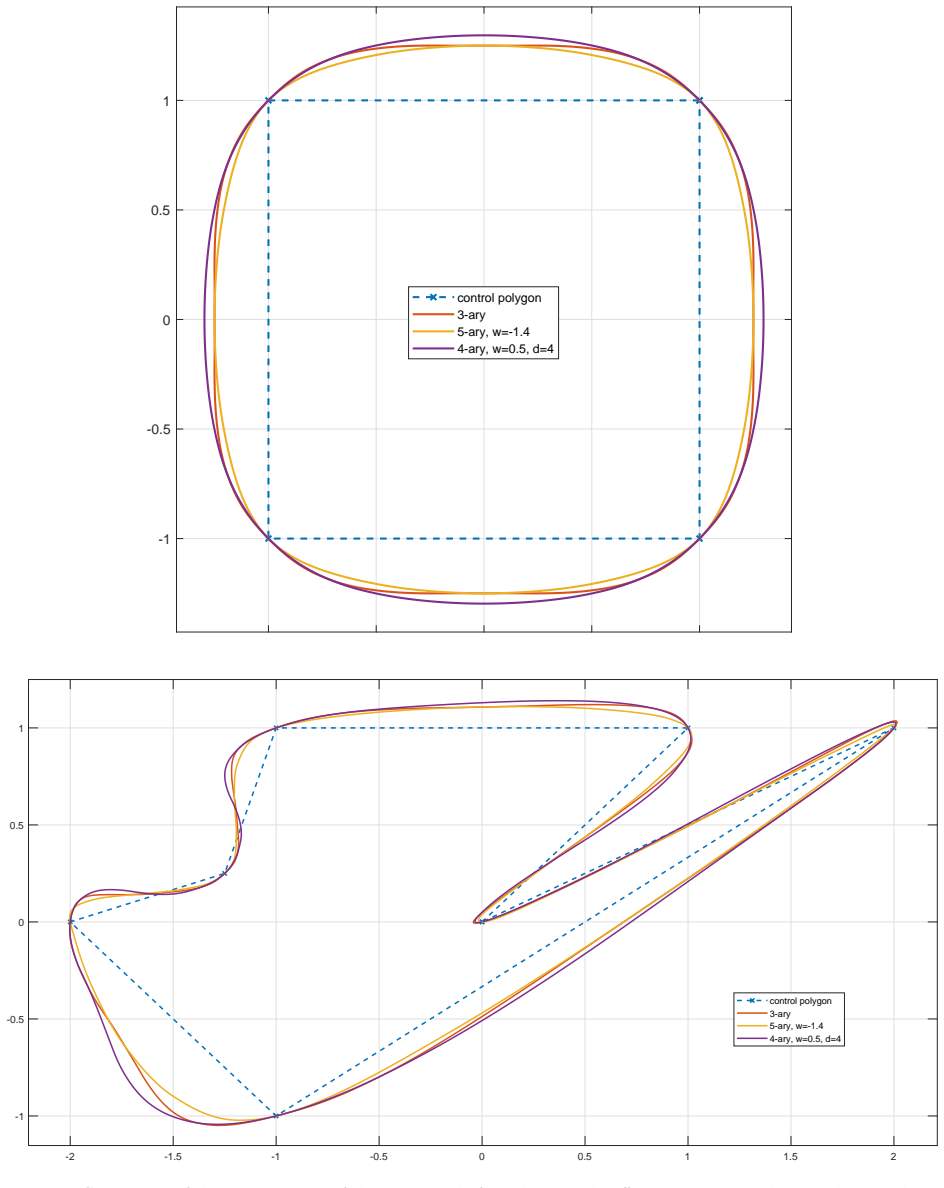
J. Zheng and Y. Cai , Interpolation over arbitrary topology meshes using a two-p hase subdivision scheme , IEEE Trans- actions on Visualization and Computer Graphics, 12 (2006), pp. 301–310. cited By 29. 20 -1 -0.5 0 0.5 1 -1 -0.5 0 0.5 1 control polygon 3-ary 5-ary, w=-1.4 4-ary, w=0.5, d=4 -2 -1.5 -1 -0.5 0 0.5 1 1.5 2 -1 -0.5 0 0.5 1 control polygon 3-...
work page 2006
discussion (0)
Sign in with ORCID, Apple, or X to comment. Anyone can read and Pith papers without signing in.