A Stochastic Model for Uncontrolled Charging of Electric Vehicles Using Cluster Analysis
Pith reviewed 2026-05-24 20:11 UTC · model grok-4.3
The pith
Clustering travel survey data reduces vehicle use to one parameter in a stochastic model for home EV charging loads.
A machine-rendered reading of the paper's core claim, the machinery that carries it, and where it could break.
Core claim
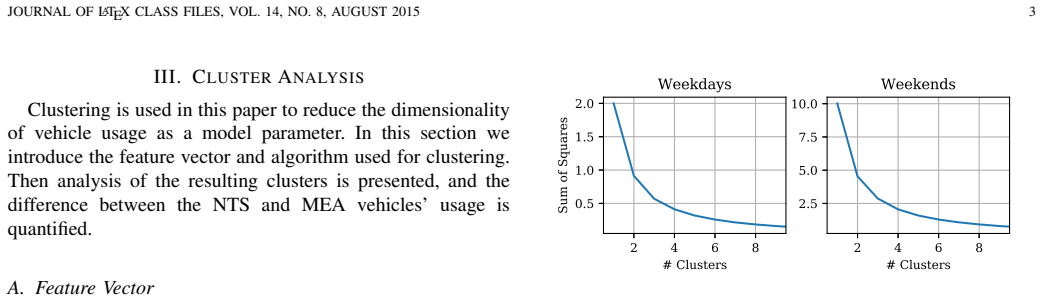
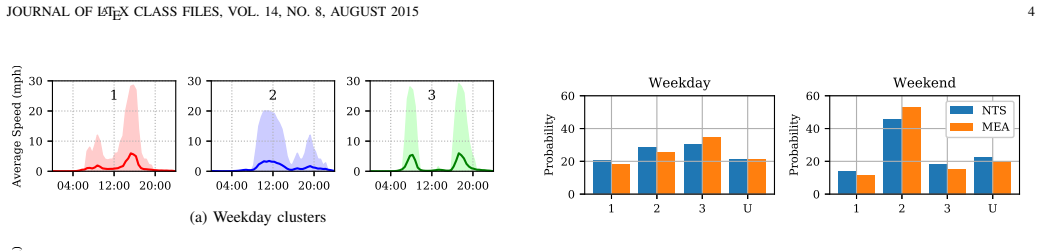
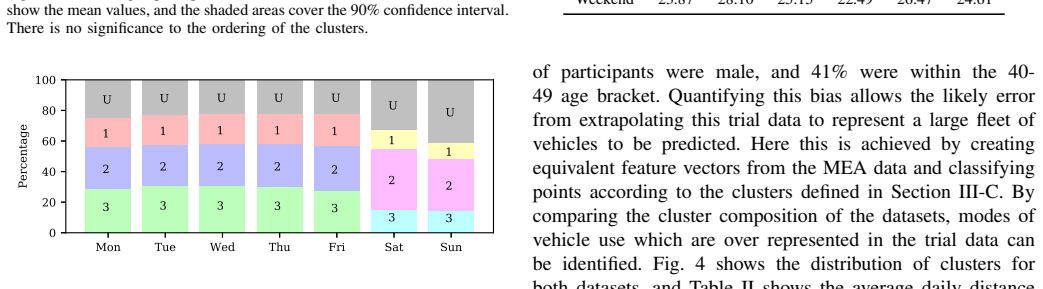
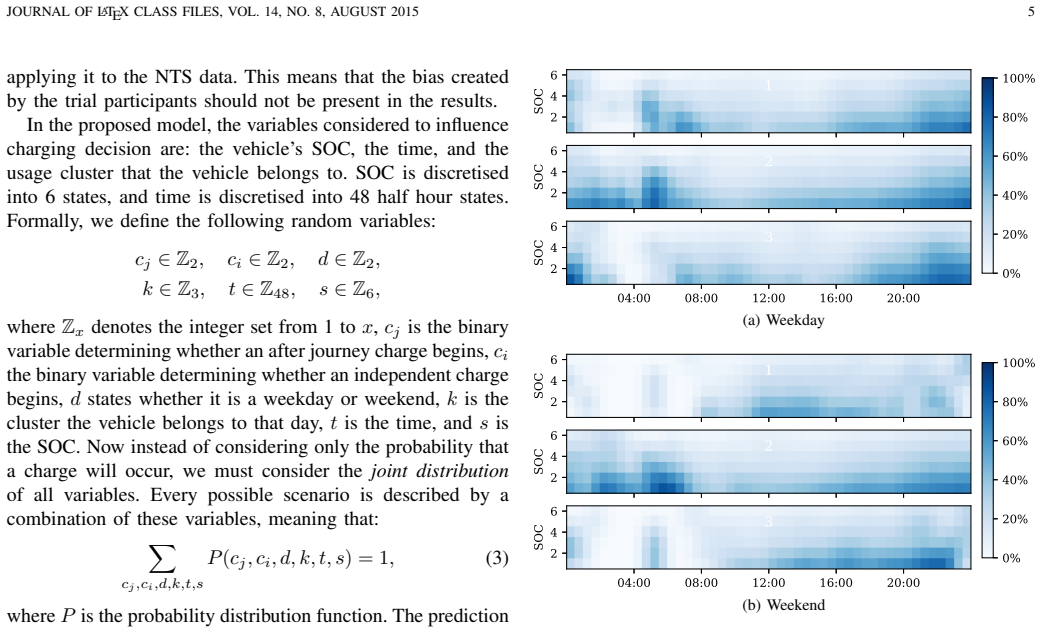
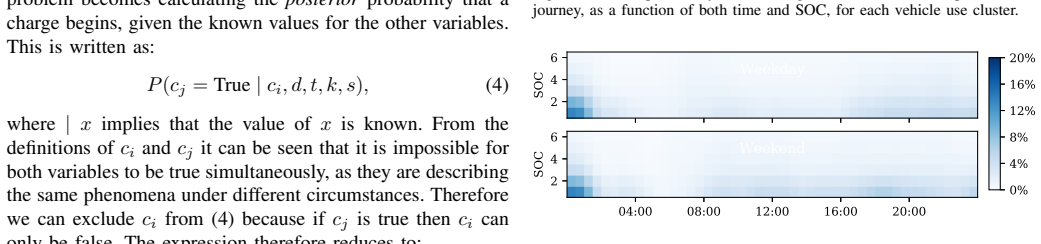
The central claim is that cluster analysis applied to conventional-vehicle travel surveys identifies distinct modes of daily use, allowing vehicle behavior to be captured by a single parameter that is then fed into a stochastic model of uncontrolled EV charging whose remaining parameters come from EV trial data.
What carries the argument
Cluster analysis on travel survey data that collapses vehicle use patterns into a single sampled parameter for the probabilistic charging model.
If this is right
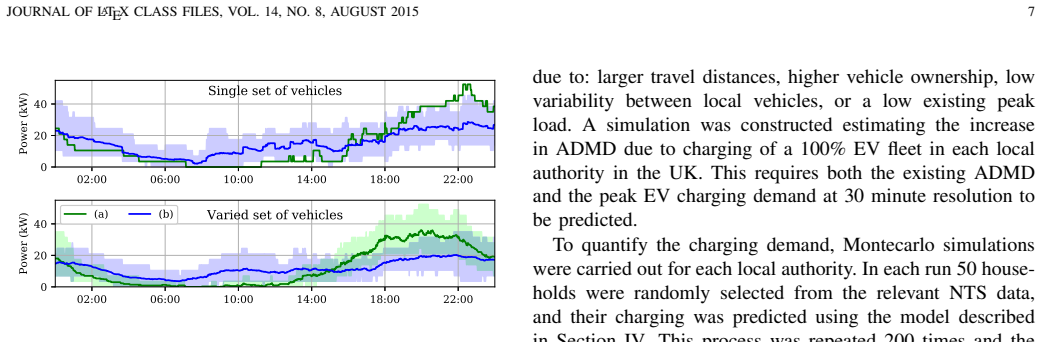
- Aggregated charging profiles can be generated for fleets of 50 vehicles without prohibitive computation.
- Regional increases in after-diversity maximum demand can be quantified for UK distribution networks.
- Large survey samples can be used as model inputs while trial data supplies accurate charging physics.
- Grid planners gain a lightweight way to estimate reinforcements needed in residential feeders.
Where Pith is reading between the lines
- The single-parameter reduction could be reused inside larger power-system simulators that already sample many households.
- If future EV-specific travel data becomes available the same clustering pipeline could be rerun to update the modes.
- The approach separates usage statistics from charging physics, making it straightforward to test time-of-use tariffs by shifting the sampled start times.
- National-scale application would directly inform distribution-network investment plans under high EV uptake.
Load-bearing premise
Travel survey records for conventional vehicles will match the daily timing and distance patterns of electric vehicles once they replace them in the same households.
What would settle it
A large residential EV charging dataset whose measured aggregate load profiles fall outside the probability bands produced by the model would falsify the claim that survey-based clusters transfer directly.
Figures
read the original abstract
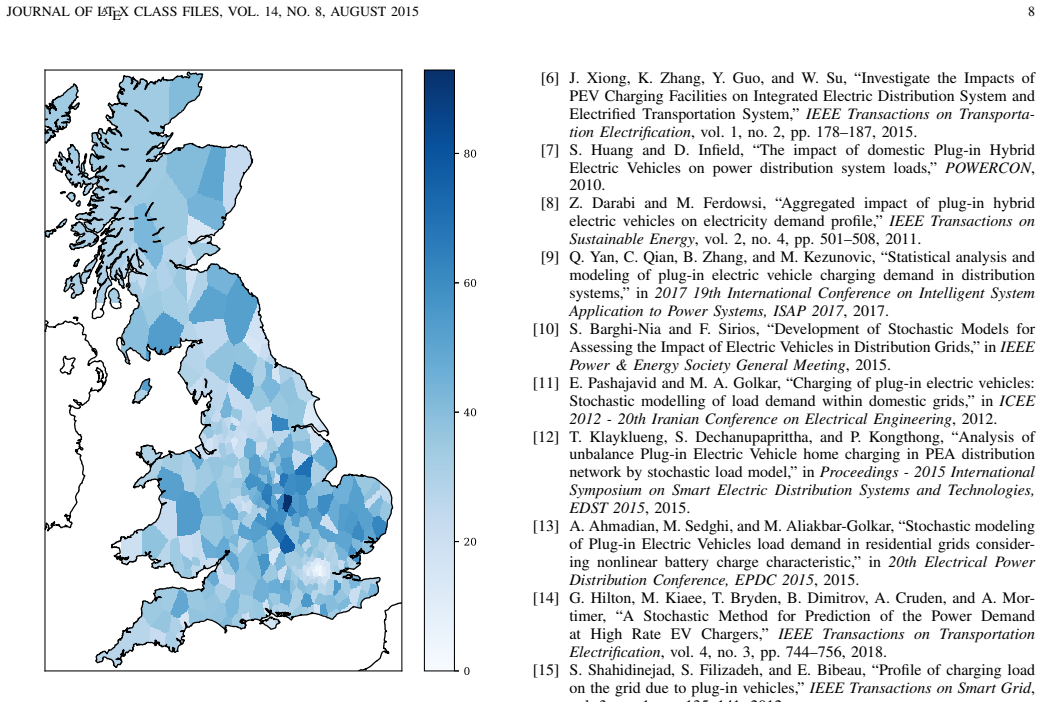
This paper proposes a probabilistic model for uncontrolled charging of electric vehicles (EVs). EV charging will add significant load to power systems in the coming years and, due to the convenience of charging at home, this is likely to occur in residential distribution systems. Estimating the size and shape of the load will allow necessary reinforcements to be identified. Models predicting EV charging are usually based on data from travel surveys, or from small trials. Travel surveys are recorded by hand and typically describe conventional vehicles, but represent a much larger and more diverse sample of the population. The model here utilizes both sources: trial data to parameterize the model, and survey data as the model input. Clustering is used to identify modes of vehicle use, thus reducing vehicle use to a single parameter -- which can be incorporated into the model without adding significant computational burden. Two case studies are included: one investigating the aggregated charging of 50 vehicles, and one predicting the increase in after diversity maximum demand for different regions of the UK.
Editorial analysis
A structured set of objections, weighed in public.
Referee Report
Summary. The paper proposes a probabilistic stochastic model for uncontrolled EV charging. It uses cluster analysis on conventional-vehicle travel survey data to reduce usage patterns (mileage, timing, dwell) to a single categorical parameter, parameterizes charging duration/power from small EV trials, and demonstrates the model via two case studies: aggregated load for 50 vehicles and UK regional after-diversity maximum demand (ADMD) forecasts.
Significance. If the survey-to-EV extrapolation holds, the clustering reduction supplies a computationally lightweight way to embed population diversity into residential EV load models, which could support distribution-network reinforcement planning without requiring exhaustive EV-specific datasets.
major comments (2)
- [Data Sources and Model Input] Data Sources and Model Input section: The load-bearing assumption that joint distributions of daily mileage, departure/arrival times, and dwell durations from conventional-vehicle surveys will match those realized by future EV owners is not accompanied by any sensitivity analysis or comparison against EV-specific usage statistics. Systematic differences (range anxiety, home-charging preference, public-charging substitution) would directly scale the simulated residential load shape in both case studies.
- [Case Studies] Case Studies (50-vehicle aggregation and UK ADMD): Cluster probabilities extracted from survey data are treated as exogenous; the manuscript supplies no internal consistency check or validation run against measured EV charging data that would bound the extrapolation error for the reported load predictions.
minor comments (2)
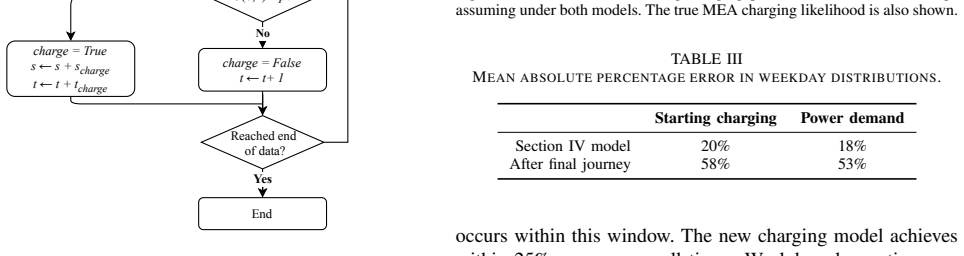
- [Abstract] Abstract: No quantitative validation metrics, error bars, or direct comparison to measured EV data are supplied, limiting the ability to gauge model performance from the summary.
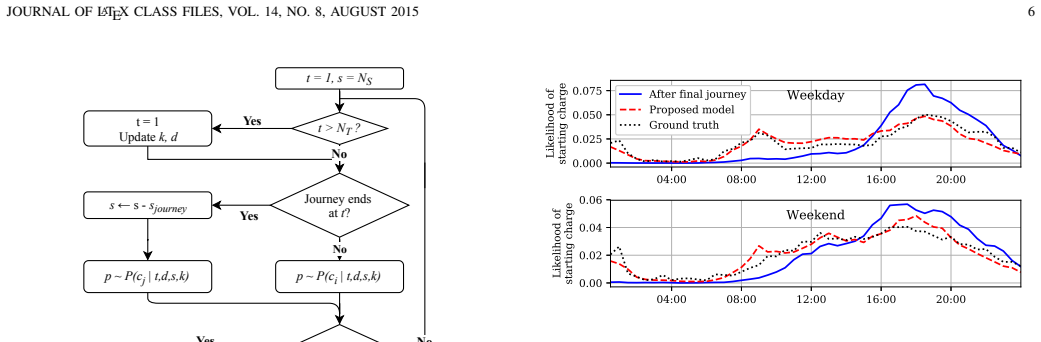
- [Methodology] Notation and Clustering description: The precise mapping from cluster labels to the single input parameter and its insertion into the stochastic charging process should be stated explicitly with an equation or pseudocode.
Simulated Author's Rebuttal
We thank the referee for their thoughtful review and constructive comments on our manuscript. We address each major comment below and propose revisions where appropriate to strengthen the paper.
read point-by-point responses
-
Referee: Data Sources and Model Input section: The load-bearing assumption that joint distributions of daily mileage, departure/arrival times, and dwell durations from conventional-vehicle surveys will match those realized by future EV owners is not accompanied by any sensitivity analysis or comparison against EV-specific usage statistics. Systematic differences (range anxiety, home-charging preference, public-charging substitution) would directly scale the simulated residential load shape in both case studies.
Authors: We agree that the assumption regarding the transferability of usage patterns from conventional vehicles to EVs is central to the model and that a sensitivity analysis would be beneficial. The choice of survey data is motivated by its scale and representativeness of the population, which is not yet available for EVs. EV trial data is used solely for charging parameters (duration and power). In the revised manuscript, we will include a new subsection discussing potential systematic differences and perform a sensitivity analysis on key parameters such as daily mileage and arrival times to assess their impact on the aggregated load profiles. revision: yes
-
Referee: Case Studies (50-vehicle aggregation and UK ADMD): Cluster probabilities extracted from survey data are treated as exogenous; the manuscript supplies no internal consistency check or validation run against measured EV charging data that would bound the extrapolation error for the reported load predictions.
Authors: The case studies serve to demonstrate the application of the model to aggregated load and regional demand forecasting, rather than to validate against empirical EV data. We note that large-scale measured EV charging datasets suitable for such validation are limited and often not publicly available. The model is parameterized consistently with available trial data, and the clustering provides a transparent reduction of the input space. In revision, we will add text clarifying the role of the case studies and explicitly state the limitations regarding extrapolation, including a discussion of how future EV data could be used to update the cluster probabilities. revision: partial
Circularity Check
No circularity; model inputs are external data sources with independent parameterization.
full rationale
The paper's derivation chain takes travel-survey records as exogenous inputs, applies clustering to reduce them to a categorical mode variable, and uses separate EV trial data solely to set charging-duration and power parameters. No equation equates a model output to a fitted constant by construction, no self-citation supplies a load-bearing uniqueness theorem, and the aggregated-load predictions remain falsifiable against external benchmarks. The central stochastic process is therefore not algebraically forced by its own fitted values.
Axiom & Free-Parameter Ledger
Reference graph
Works this paper leans on
- [1]
- [2]
-
[3]
Electric energy and power consumption by light-duty plug-in electric vehicles,
D. Wu, D. C. Aliprantis, and K. Gkritza, “Electric energy and power consumption by light-duty plug-in electric vehicles,” IEEE Transactions on Power Systems, vol. 26, no. 2, pp. 738–746, 2011
work page 2011
-
[4]
Stochastic analyses of electric vehicle charging impacts on distribution network,
R. C. Leou, C. L. Su, and C. N. Lu, “Stochastic analyses of electric vehicle charging impacts on distribution network,” IEEE Transactions on Power Systems, vol. 29, no. 3, pp. 1055–1063, 2014
work page 2014
-
[5]
Electric Vehicle Charging on Residential Distribution Systems: Impacts and Mitigations,
A. Dubey and S. Santoso, “Electric Vehicle Charging on Residential Distribution Systems: Impacts and Mitigations,” 2015
work page 2015
-
[6]
J. Xiong, K. Zhang, Y . Guo, and W. Su, “Investigate the Impacts of PEV Charging Facilities on Integrated Electric Distribution System and Electrified Transportation System,” IEEE Transactions on Transporta- tion Electrification, vol. 1, no. 2, pp. 178–187, 2015
work page 2015
-
[7]
The impact of domestic Plug-in Hybrid Electric Vehicles on power distribution system loads,
S. Huang and D. Infield, “The impact of domestic Plug-in Hybrid Electric Vehicles on power distribution system loads,” POWERCON, 2010
work page 2010
-
[8]
Aggregated impact of plug-in hybrid electric vehicles on electricity demand profile,
Z. Darabi and M. Ferdowsi, “Aggregated impact of plug-in hybrid electric vehicles on electricity demand profile,” IEEE Transactions on Sustainable Energy, vol. 2, no. 4, pp. 501–508, 2011
work page 2011
-
[9]
Q. Yan, C. Qian, B. Zhang, and M. Kezunovic, “Statistical analysis and modeling of plug-in electric vehicle charging demand in distribution systems,” in 2017 19th International Conference on Intelligent System Application to Power Systems, ISAP 2017 , 2017
work page 2017
-
[10]
S. Barghi-Nia and F. Sirios, “Development of Stochastic Models for Assessing the Impact of Electric Vehicles in Distribution Grids,” inIEEE Power & Energy Society General Meeting , 2015
work page 2015
-
[11]
Charging of plug-in electric vehicles: Stochastic modelling of load demand within domestic grids,
E. Pashajavid and M. A. Golkar, “Charging of plug-in electric vehicles: Stochastic modelling of load demand within domestic grids,” in ICEE 2012 - 20th Iranian Conference on Electrical Engineering , 2012
work page 2012
-
[12]
T. Klayklueng, S. Dechanupaprittha, and P. Kongthong, “Analysis of unbalance Plug-in Electric Vehicle home charging in PEA distribution network by stochastic load model,” in Proceedings - 2015 International Symposium on Smart Electric Distribution Systems and Technologies, EDST 2015, 2015
work page 2015
-
[13]
A. Ahmadian, M. Sedghi, and M. Aliakbar-Golkar, “Stochastic modeling of Plug-in Electric Vehicles load demand in residential grids consider- ing nonlinear battery charge characteristic,” in 20th Electrical Power Distribution Conference, EPDC 2015 , 2015
work page 2015
-
[14]
A Stochastic Method for Prediction of the Power Demand at High Rate EV Chargers,
G. Hilton, M. Kiaee, T. Bryden, B. Dimitrov, A. Cruden, and A. Mor- timer, “A Stochastic Method for Prediction of the Power Demand at High Rate EV Chargers,” IEEE Transactions on Transportation Electrification, vol. 4, no. 3, pp. 744–756, 2018
work page 2018
-
[15]
Profile of charging load on the grid due to plug-in vehicles,
S. Shahidinejad, S. Filizadeh, and E. Bibeau, “Profile of charging load on the grid due to plug-in vehicles,” IEEE Transactions on Smart Grid , vol. 3, no. 1, pp. 135–141, 2012
work page 2012
-
[16]
Location-based forecasting of vehicular charging load on the distribution system,
N. G. Omran and S. Filizadeh, “Location-based forecasting of vehicular charging load on the distribution system,” IEEE Transactions on Smart Grid, vol. 5, no. 2, pp. 632–641, 2014
work page 2014
-
[17]
M. Godde, T. Findeisen, T. Sowa, and P. H. Nguyen, “Modelling the charging probability of electric vehicles as a Gaussian mixture model for a convolution based power flow analysis,” in 2015 IEEE Eindhoven PowerTech, PowerTech 2015, 2015
work page 2015
-
[18]
Statistical Representation of EV Charging: Real Data Analysis and Applications,
J. Quir ´os-Tort´os, A. Navarro-Espinosa, L. F. Ochoa, and T. Butler, “Statistical Representation of EV Charging: Real Data Analysis and Applications,” in 20th Power Systems Computation Conference , 2018, pp. 1–7
work page 2018
-
[19]
Large- Scale Modeling of Grid-Connected Electric Vehicles,
J. Rolink and C. Rehtanz, “Large- Scale Modeling of Grid-Connected Electric Vehicles,” IEEE Trans. Power Deliv. , vol. 28, no. 2, pp. 894– 902, 2013
work page 2013
-
[20]
A scalable stochastic model for the electricity demand of electric and plug-in hybrid vehicles,
M. Alizadeh, A. Scaglione, J. Davies, and K. S. Kurani, “A scalable stochastic model for the electricity demand of electric and plug-in hybrid vehicles,” IEEE Transactions on Smart Grid , vol. 5, no. 2, 2014
work page 2014
-
[21]
Plug-in electric vehicle charging demand estimation based on queueing network analy- sis,
H. Liang, I. Sharma, W. Zhuang, and K. Bhattacharya, “Plug-in electric vehicle charging demand estimation based on queueing network analy- sis,” in IEEE Power and Energy Society General Meeting , 2014
work page 2014
-
[22]
S. Haustein and A. F. Jensen, “Factors of electric vehicle adoption: A comparison of conventional and electric car users based on an extended theory of planned behavior,” International Journal of Sustainable Trans- portation, pp. 1–13, 2018
work page 2018
-
[23]
Clustering of Usage Profiles for Electric Vehicle Behaviour Analysis,
C. Crozier, D. Apostolopoulou, and M. McCulloch, “Clustering of Usage Profiles for Electric Vehicle Behaviour Analysis,” in 2018 IEEE PES Innovative Smart Grid Technologies Conference Europe (ISGT-Europe), 2018, pp. 1–6
work page 2018
-
[24]
Clustering of vehicle trajectories,
S. Atev, G. Miller, and N. P. Papanikolopoulos, “Clustering of vehicle trajectories,” IEEE Transactions on Intelligent Transportation Systems , vol. 11, no. 3, pp. 647–657, 2010
work page 2010
-
[25]
National travel survey: 2015 report,
K. Lepanjuuri, P. Cornick, C. Byron, I. Templeton, and J. Hurn, “National travel survey: 2015 report,” Department for Transport, Tech. Rep., 2016
work page 2015
- [26]
-
[27]
J. Quir ´os-Tort´os, L. Ochoa, and T. Butler, “How Electric Vehicles and the Grid Work Together: Lessons Learned from One of the Largest Electric Vehicle Trials in the World,” IEEE Access, pp. 64–76, 2018
work page 2018
-
[28]
A comparison of weekend and weekday travel behavior characteristics in urban areas,
A. Agarwal, “A comparison of weekend and weekday travel behavior characteristics in urban areas,” Ph.D. dissertation, University of South Florida, Scholar Commons, 7 2004. JOURNAL OF LATEX CLASS FILES, VOL. 14, NO. 8, AUGUST 2015 9
work page 2004
-
[29]
k-shape: Efficient and accurate clustering of time series,
J. Paparrizos and L. Gravano, “k-shape: Efficient and accurate clustering of time series,” Special Interest Group on Management of Data Rec. , no. 1, pp. 69–76, 06 2016
work page 2016
-
[30]
Ebk-means: A clustering technique based on elbow method and k-means in wsn,
P. Bholowalia and A. Kumar, “Ebk-means: A clustering technique based on elbow method and k-means in wsn,” International Journal of Computer Applications , 2014
work page 2014
-
[31]
Design and planning: Framework for underground net- works in uk power networks,
D. Croucher, “Design and planning: Framework for underground net- works in uk power networks,” UK Power Networks, Tech. Rep., 2011
work page 2011
-
[32]
Lsoa domestic electricity 2016,
UK Govt. Department for Business, Energy & Industrial Strategy, “Lsoa domestic electricity 2016,” https://www.gov.uk/government/statistics/ lower-and-middle-super-output-areas-electricity-consumption
work page 2016
-
[33]
Elexon, “Profile classes,” https://www.elexon.co.uk/ operations-settlement/profiling/
discussion (0)
Sign in with ORCID, Apple, or X to comment. Anyone can read and Pith papers without signing in.