pith. sign in

arxiv: 1907.09555 · v1 · pith:CAJVFVOLnew · submitted 2019-07-22 · 🧮 math.HO

An analysis of IQ LINK^(TM)

Pith reviewed 2026-05-24 17:27 UTC · model grok-4.3

classification 🧮 math.HO
keywords IQ-Linkpuzzle game analysisstrategy explorationcomputational enumerationreplayabilityvisual appeal versus depthsingle-player gameposition space mapping
0
0 comments X

The pith

Theoretical and computational strategy exploration of IQ-Link shows what kind of game it actually is.

A machine-rendered reading of the paper's core claim, the machinery that carries it, and where it could break.

The paper performs a theoretical and computational exploration of strategies in the IQ-Link game. It starts from the observation that visual appeal alone does not make a game worth sustained attention from a puzzlist. The analysis is intended to supply concrete information about the game's underlying structure and replay value so that a potential player can judge whether it merits time investment. By mapping out possible moves and positions the work aims to classify the type of challenge the game presents.

Core claim

A combined theoretical and computational examination of IQ-Link maps its move sequences and position spaces, thereby classifying the game as one whose strategic content can be assessed independently of its visual presentation and whose replayability follows from the density and variety of those positions.

What carries the argument

Theoretical and computational strategy exploration that enumerates and classifies reachable positions and move sequences to assess overall strategic value.

If this is right

  • Players receive an evidence-based basis for deciding whether to pursue the game beyond initial visual appeal.
  • The same style of exploration can be applied to other visually attractive single-player puzzles to separate presentation from substance.
  • Game designers obtain a concrete method for quantifying the strategic depth they have built into a title.
  • Puzzlists gain a way to compare IQ-Link against other abstract strategy games on shared quantitative terms.

Where Pith is reading between the lines

These are editorial extensions of the paper, not claims the author makes directly.

  • If the exploration method generalizes, it could be used to rank-order a collection of commercial puzzles by estimated replay hours before purchase.
  • The approach might reveal whether certain visual motifs systematically correlate with shallow or deep underlying graphs.
  • Extending the computation to larger boards or variants could test how scaling changes the density of interesting positions.

Load-bearing premise

The chosen theoretical and computational probes capture a representative sample of the game's full strategic possibilities rather than a narrow or atypical subset.

What would settle it

A systematic play log or exhaustive enumeration that shows either far higher or far lower variety of distinct winning strategies than the paper's exploration predicts.

Figures

Figures reproduced from arXiv: 1907.09555 by Donna A. Dietz.

Figure 1
Figure 1. Figure 1: This is the game board, box, and pieces [PITH_FULL_IMAGE:figures/full_fig_p003_1.png] view at source ↗
Figure 2
Figure 2. Figure 2: This is Puzzle 92 and its solution. 4. Toy mechanics The game (whose manufacturer is found online [12]) is shown in [PITH_FULL_IMAGE:figures/full_fig_p003_2.png] view at source ↗
Figure 3
Figure 3. Figure 3: A challenge [PITH_FULL_IMAGE:figures/full_fig_p004_3.png] view at source ↗
Figure 4
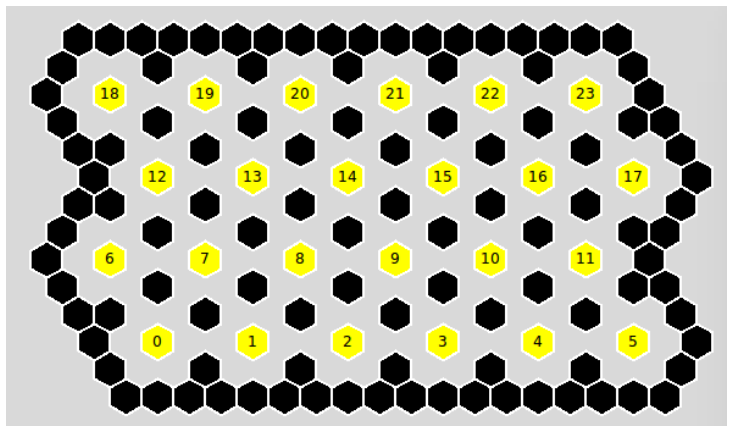
Figure 4. Figure 4: The solution. The pieces can be grouped into families by how many ways they may be legally placed on the board. In the hexagonal diagram of the game board ( [PITH_FULL_IMAGE:figures/full_fig_p004_4.png] view at source ↗
Figure 5
Figure 5. Figure 5: The game board with anchor spots [PITH_FULL_IMAGE:figures/full_fig_p006_5.png] view at source ↗
Figure 6
Figure 6. Figure 6: A fitted placement which is not a solution. collisions with the boundary to be sure the piece fits on the virtual board in the same way it would on the physical board. In my diagrams, this boundary piece is black. Illegal placements are simply stopped in the algorithm by collision mechanisms just like other collisions between pieces. The hexagonal diagram in [PITH_FULL_IMAGE:figures/full_fig_p006_6.png] view at source ↗
Figure 7
Figure 7. Figure 7: The only piece with mirror symmetry [PITH_FULL_IMAGE:figures/full_fig_p007_7.png] view at source ↗
Figure 8
Figure 8. Figure 8: A useless move [PITH_FULL_IMAGE:figures/full_fig_p007_8.png] view at source ↗
Figure 9
Figure 9. Figure 9: A useful move. 8. Orthographic coordinates To address a position in a hexagonal grid, orthographic coordinates are often used. In a hexagonal grid, there are three families of parallel lines, thus we get “tri-ordinates” rather than “coordinates”. However, since the hex grid is in a plane, there is redundancy, and the third coordinate can be dropped computationally, although its use can lead to insights. Si… view at source ↗
Figure 10
Figure 10. Figure 10: Game board with orthographic coordinates. using just the two parallel line families P (for positive slope) and H (horizontal movements). The third set of parallel lines is indicated by N (for negative slope). Note again that since P+H=N, any two families may be used without loss of information. Using (0,0) as the anchor point, the cell currently at (1,3) could end up at (4,-1,3), (3, -4, -1), (-1,-3,-4), … view at source ↗
Figure 11
Figure 11. Figure 11: How to flip and rotate in orthographic coordinates. cannot be used with any of the placements for the second piece, clearly that placement cannot be used. By this logic, quite a few placements are eliminated. This strategy alone solves all but one of the first 25 puzzles and a total of 29 puzzles overall. As an example, let’s take a puzzle which has six remaining legal placements, two for each of three pi… view at source ↗
Figure 12
Figure 12. Figure 12: Basic pairwise cleanup [PITH_FULL_IMAGE:figures/full_fig_p010_12.png] view at source ↗
Figure 13
Figure 13. Figure 13: Size of search space before and after basic cleanup (logscale) [PITH_FULL_IMAGE:figures/full_fig_p010_13.png] view at source ↗
Figure 14
Figure 14. Figure 14: Reduction of search space by percent. a percent rather than raw values, it’s clear that there is quite a bit of value in doing even this little bit of cleanup. For the easiest problems, it seems to help quite a bit, but less so for puzzles after about number 60 [PITH_FULL_IMAGE:figures/full_fig_p010_14.png] view at source ↗
Figure 15
Figure 15. Figure 15: The edges are not as easily occupied as the center of the board [PITH_FULL_IMAGE:figures/full_fig_p011_15.png] view at source ↗
Figure 16
Figure 16. Figure 16: Puzzle 25, its solution, and its heatmap. 12. Heatsort Since a naive way to brute force a solution is to simply try all possible permutations of legal placements for each piece, it would make sense to try to prioritize the list somehow. One way this can be done is to superimpose all the possible legal placements onto a single grid and see which locations on the base grid are harder to reach. Although it’s… view at source ↗
Figure 17
Figure 17. Figure 17: Puzzle 29, its solution, and its heatmap [PITH_FULL_IMAGE:figures/full_fig_p012_17.png] view at source ↗
Figure 18
Figure 18. Figure 18: Puzzle 40, its solution, and its heatmap. In Puzzle 40, the heatmap is still giving very clear directives for us to place a couple of pieces with priority. For example, the light purple piece must be placed at the top of the puzzle. However, for Puzzle 85, you see more color variations, and the heatmap looks more like the overall heatmap for the entire puzzle. Thus, the [PITH_FULL_IMAGE:figures/full_fig_… view at source ↗
Figure 19
Figure 19. Figure 19: Puzzle 85, its solution, and its heatmap. algorithm will first try something such as placing the correct light purple, light pink, and aqua pieces down and then continue to look for the solution to the remaining puzzle with 6 missing pieces. The benefits of adding heatmap sorting to our basic introductory phase of the sorting can be shown in [PITH_FULL_IMAGE:figures/full_fig_p013_19.png] view at source ↗
Figure 20
Figure 20. Figure 20: Fraction of search space explored, reduced by basic techniques, then by heatsort [PITH_FULL_IMAGE:figures/full_fig_p014_20.png] view at source ↗
Figure 21
Figure 21. Figure 21: Pieces to place, graphed by puzzle number. To reduce this horrific computational explosion, a wiser strategy (and more compatible with what a human puzzlist would do) would be to restrict each successive piece placement to a piece which would actually link to one of the existing pieces already in the puzzle. This makes sense because a puzzle can be completed by only selecting from the available, currently… view at source ↗
Figure 22
Figure 22. Figure 22: Relationship between all legal placements, correct placements, and currently linkable pieces [PITH_FULL_IMAGE:figures/full_fig_p015_22.png] view at source ↗
Figure 23
Figure 23. Figure 23: Two grayed out solution pieces for Puzzle 92, one of which is currently linkable. however, if you are already on the right track, you are promised at least one fruitful placement is available to you to make. This makes an apples-to-oranges comparison difficult, but it has to be done nonetheless [PITH_FULL_IMAGE:figures/full_fig_p015_23.png] view at source ↗
Figure 24
Figure 24. Figure 24: Total number of legal and linkable moves at the start of each challenge [PITH_FULL_IMAGE:figures/full_fig_p016_24.png] view at source ↗
Figure 25
Figure 25. Figure 25: Computation time per challenge, in seconds [PITH_FULL_IMAGE:figures/full_fig_p017_25.png] view at source ↗
Figure 26
Figure 26. Figure 26: Computation time per challenge, with logscale. The two graphs in Figures 25 and 26 give computation time in seconds, and the log-seconds for transi￾tioning to exhaustive search at either 3 or 4 remaining pieces in a puzzle. All puzzles were ultimately solved. (There can only be a solution or a hung computer. We are guaranteed to eventually find the solution.) The longest puzzle took about 5 1/2 to 7 days … view at source ↗
read the original abstract

This is a theoretical and computational strategy exploration of the visually attractive game IQ-Link. Not all games which are visually appealing are worthy of your time as a puzzlist. This analysis gives a would-be addict some idea of what type of game they are falling for.

Editorial analysis

A structured set of objections, weighed in public.

Desk editor's note, referee report, simulated authors' rebuttal, and a circularity audit. Tearing a paper down is the easy half of reading it; the pith above is the substance, this is the friction.

Referee Report

0 major / 2 minor

Summary. The manuscript presents a theoretical and computational strategy exploration of the IQ-Link puzzle game. Its central claim is modest and advisory: the exploration provides would-be players with an idea of the type of game they might be engaging with, noting that visual appeal alone does not guarantee a game worthy of a puzzlist's time.

Significance. If the exploration holds, the paper offers an illustrative example of applying strategy analysis to a commercial puzzle game within the recreational mathematics tradition. This aligns with the journal's history-and-overview scope by documenting one instance of game assessment, though the advisory framing limits its scope to guidance rather than new formal results or exhaustive enumeration.

minor comments (2)
  1. The abstract states the intent of the analysis but provides no outline of the theoretical framework, computational methods, or specific observations used. Adding a sentence summarizing the scope or key observations would improve accessibility without altering the modest claim.
  2. No equations, tables, or numbered sections are referenced in the provided abstract; if the full manuscript contains such elements, ensure they are clearly labeled so readers can trace how any strategy observations support the advisory conclusion.

Simulated Author's Rebuttal

0 responses · 0 unresolved

We thank the referee for their thoughtful summary and positive assessment of the manuscript's scope within the recreational mathematics tradition. The recommendation for minor revision is noted, but the report contains no specific major comments requiring point-by-point response.

Circularity Check

0 steps flagged

No significant circularity identified

full rationale

The paper is a non-formal theoretical and computational exploration of the IQ-Link game whose central claim is modest and advisory: it simply aims to give a would-be player 'some idea' of the game's nature. No equations, derivations, fitted parameters, uniqueness theorems, or self-citation chains appear in the provided text. The analysis therefore contains no load-bearing steps that reduce by construction to their own inputs, satisfying the default expectation that most papers exhibit no circularity.

Axiom & Free-Parameter Ledger

0 free parameters · 0 axioms · 0 invented entities

No free parameters, axioms, or invented entities are identifiable from the abstract alone.

pith-pipeline@v0.9.0 · 5545 in / 878 out tokens · 28838 ms · 2026-05-24T17:27:36.448829+00:00 · methodology

discussion (0)

Sign in with ORCID, Apple, or X to comment. Anyone can read and Pith papers without signing in.

Reference graph

Works this paper leans on

12 extracted references · 12 canonical work pages

  1. [1]

    AK Peters, 2001

    Elwyn R Berlenkamp, John Conway, and Richard Guy, Winning ways for your mathematical plays: Volume 1 . AK Peters, 2001

  2. [2]

    Dagstahl Reports, Artifical and computational intelligence in games: integration. Vol. 5, Issue 1, pp 207-242. Editors: Simon Lucas, Michael Mateas, Mike Preuss, Pieter Spronck, and Julian Togelius, January 2015

  3. [3]

    pp 475-535 in MSRI publications Volume 42, 2002

    Aviezre Fraenkel, Bibliography of Combinatorial Games: Updated . pp 475-535 in MSRI publications Volume 42, 2002. More games of no chance , editor Richard Nowakowski

  4. [4]

    Hearn, Games, puzzles, and computation

    Robert A. Hearn, Games, puzzles, and computation . PhD Thesis, Massachusetts Institute of Technology, 1987

  5. [5]

    Retrieved June 11, 2018 from http://web.archive.org/web/20180611025539/https://github.com/scala/scala-async EsperTech Inc

    Internet Archive. https://web.archive.org/web/2018061023045/http://www.smartgames.eu/en/smartgames/iq-link errata notice published between 2014 and 2018

  6. [6]

    IEEE Conference on Computational Intelligence and Games, August 2017

    Aaron Isaksen, Drew Wallace, Adam Finkelstein, and Andy Nealen, Simulating strategy and dexterity for puzzle games . IEEE Conference on Computational Intelligence and Games, August 2017

  7. [7]

    https://www.cse.iitk.ac.in/users/hk/cs785/2016172/details/gametheory.pdf, 24 February 2019

    Harish Karnick, Basics of game theory 1 . https://www.cse.iitk.ac.in/users/hk/cs785/2016172/details/gametheory.pdf, 24 February 2019

  8. [8]

    In 2015 IEEE Conference on Computational Intelligence and Games

    Marc van Kreveld, Maarten L¨ offler and Paul Muster,Automated Puzzle Difficulty Estimation . In 2015 IEEE Conference on Computational Intelligence and Games

  9. [9]

    http://www.staff.science.uu.nl/˜loffl001/puzzles/html/puzzlecomplexity.html

    Mark van Kreveld, Maarten L¨ offler, Nicky Vendrig, and Paul Muster, Puzzle Complexity . http://www.staff.science.uu.nl/˜loffl001/puzzles/html/puzzlecomplexity.html

  10. [10]

    PhD Thesis, City University of New York, 2014

    Valia Mitsou, The computational complexity of some games and puzzles with theoretical applications . PhD Thesis, City University of New York, 2014

  11. [11]

    http://norvig.com/sudoku.html, June 2006

    Peter Norvig, Solving every Sudoku puzzle . http://norvig.com/sudoku.html, June 2006

  12. [12]

    E-mail address: dietz@american.edu

    Website of IQ-Link manufacturer smartgamesandpuzzles.com, 2019. E-mail address: dietz@american.edu