Non-separating Planar Graphs
Pith reviewed 2026-05-24 17:38 UTC · model grok-4.3
The pith
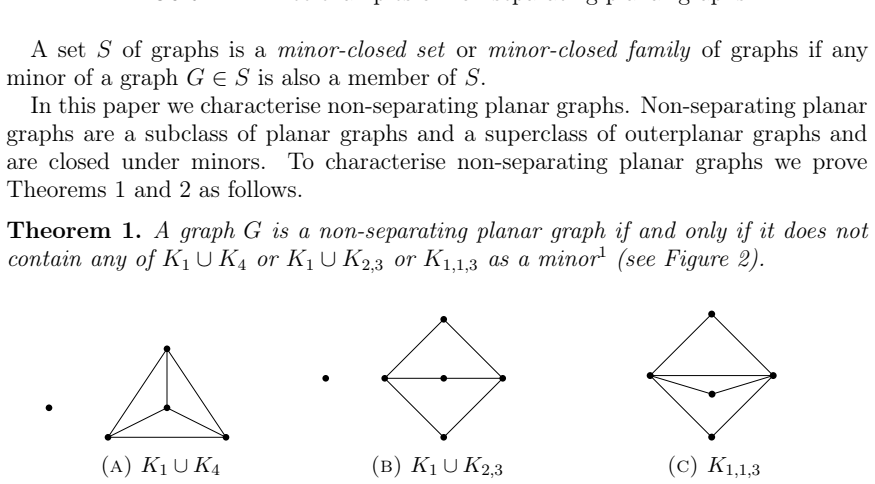
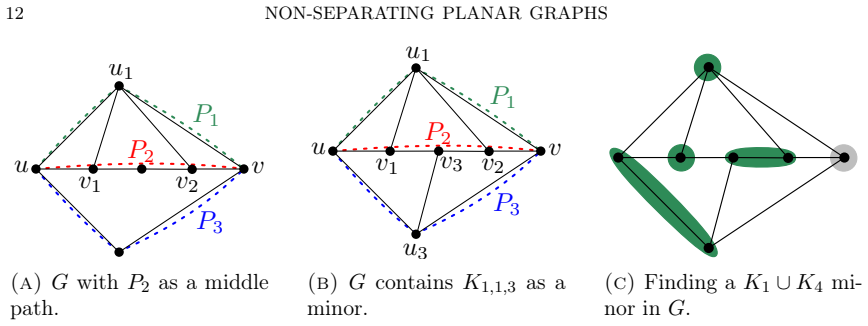
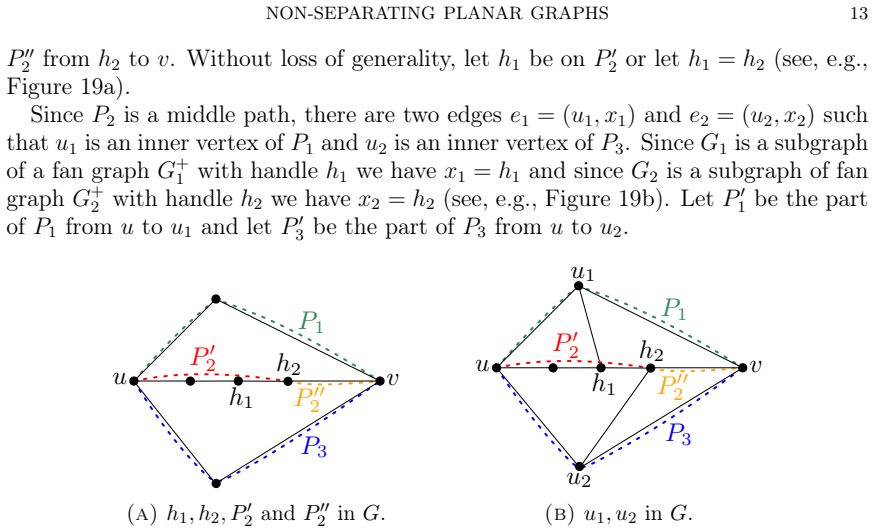
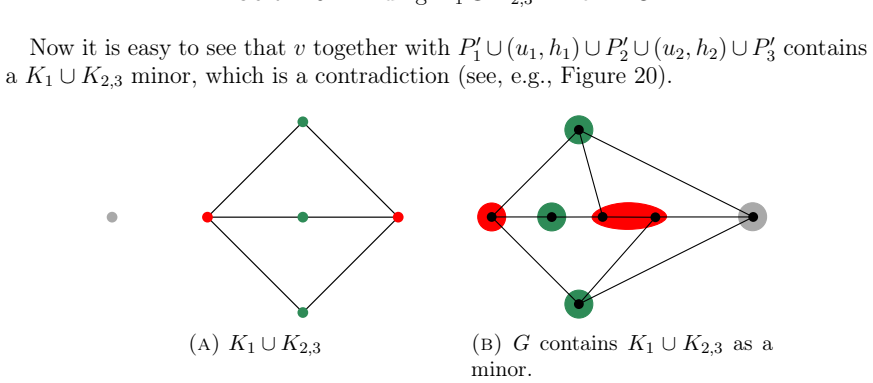
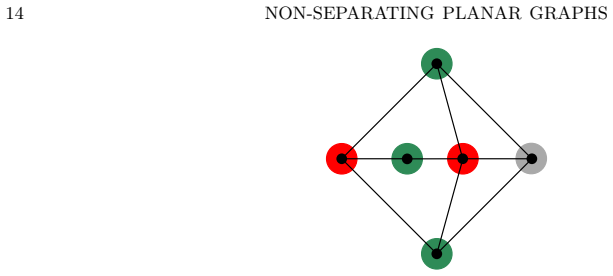
A graph is non-separating planar exactly when it avoids K1 ∪ K4, K1 ∪ K2,3 and K1,1,3 as minors.
A machine-rendered reading of the paper's core claim, the machinery that carries it, and where it could break.
Core claim
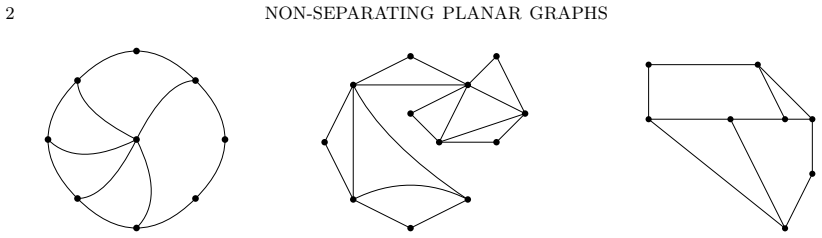
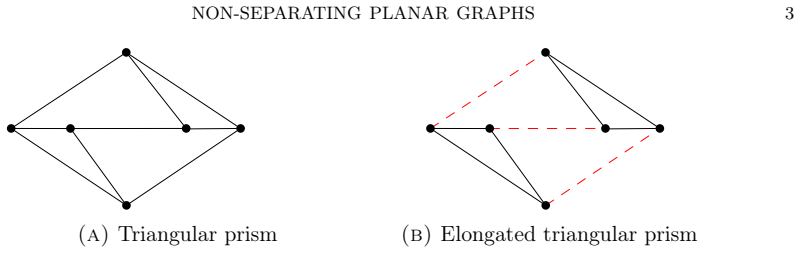
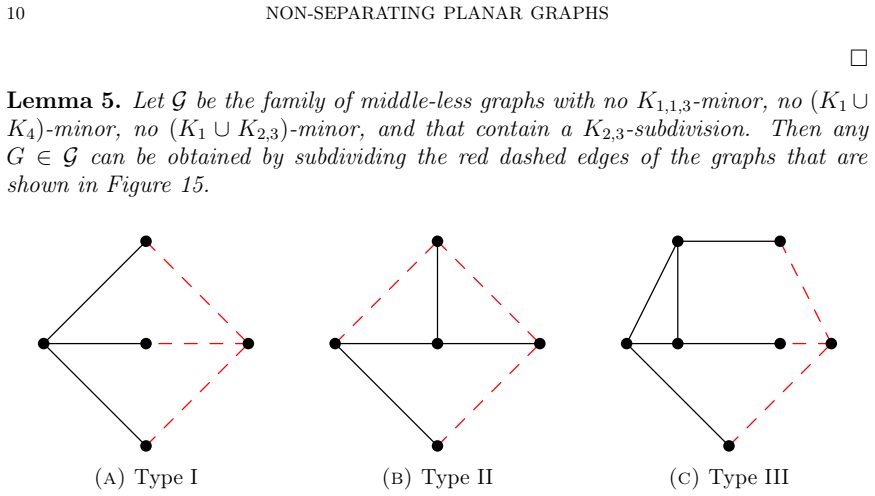
A graph G is a non-separating planar graph if and only if it does not contain K1 ∪ K4 or K1 ∪ K2,3 or K1,1,3 as a minor. Any maximal non-separating planar graph is either an outerplanar graph, a subgraph of a wheel, or obtained by subdividing some side-edges of the 1-skeleton of a triangular prism.
What carries the argument
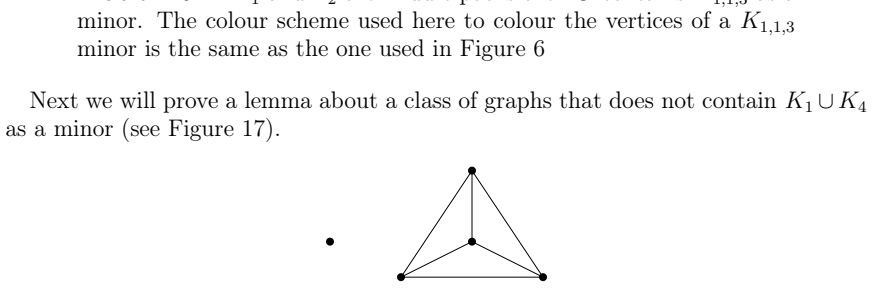
The three forbidden minors K1 ∪ K4, K1 ∪ K2,3 and K1,1,3 that together characterize the minor-closed class of non-separating planar graphs.
If this is right
- Non-separating planar graphs are closed under minors and therefore have a finite forbidden-minor list.
- The class properly contains all outerplanar graphs and is properly contained in the planar graphs.
- Maximal members of the class have one of three explicit structural descriptions.
- The class supplies maximal linkless graphs on exactly 3n-3 edges.
Where Pith is reading between the lines
- The explicit minor list supplies a direct certificate for non-membership that can be checked by standard minor-testing routines.
- The structural forms for maximal members allow exhaustive construction of all members up to any given order.
- The linkless-graph application indicates that the same minor obstructions may bound edge counts or other parameters in related spatial embedding problems.
Load-bearing premise
The class of non-separating planar graphs is closed under taking minors.
What would settle it
A single graph that contains none of the three listed minors yet admits no non-separating planar drawing, or a graph that contains one of the minors yet still admits such a drawing.
Figures

read the original abstract
A graph $G$ is a non-separating planar graph if there is a drawing $D$ of $G$ on the plane such that (1) no two edges cross each other in $D$ and (2) for any cycle $C$ in $D$, any two vertices not in $C$ are on the same side of $C$ in $D$. Non-separating planar graphs are closed under taking minors and are a subclass of planar graphs and a superclass of outerplanar graphs. In this paper, we show that a graph is a non-separating planar graph if and only if it does not contain $K_1 \cup K_4$ or $K_1 \cup K_{2,3}$ or $K_{1,1,3}$ as a minor. Furthermore, we provide a structural characterisation of this class of graphs. More specifically, we show that any maximal non-separating planar graph is either an outerplanar graph or a subgraph of a wheel or it can be obtained by subdividing some of the side-edges of the 1-skeleton of a triangular prism (two disjoint triangles linked by a perfect matching). Lastly, to demonstrate an application of non-separating planar graphs, we use the characterisation of non-separating planar graphs to prove that there are maximal linkless graphs with $3n-3$ edges which provides an answer to a question asked by Horst Sachs about the number of edges of linkless graphs in 1983.
Editorial analysis
A structured set of objections, weighed in public.
Referee Report
Summary. The paper defines a graph G to be non-separating planar if it admits a plane drawing in which every cycle has all remaining vertices on one side. It states that the class is minor-closed, lies strictly between outerplanar graphs and planar graphs, and proves that membership is equivalent to the absence of K1 ∪ K4, K1 ∪ K2,3 and K1,1,3 as minors. It further supplies a structural description of the maximal members of the class (outerplanar, subgraphs of wheels, or subdivisions of the 1-skeleton of the triangular prism) and applies the characterization to exhibit maximal linkless graphs on 3n−3 edges.
Significance. If the central claims hold, the work supplies a clean forbidden-minor theorem for a natural minor-closed subclass of planar graphs together with an explicit structural description of its maximal elements and a concrete application resolving a 1983 question of Sachs on linkless graphs. The combination of a minor characterization, a structural theorem, and an extremal application is a standard and useful contribution in structural graph theory.
major comments (2)
- [Abstract and §1] Abstract and §1 (preliminary facts): the statement that non-separating planar graphs are closed under minors is asserted prior to the main theorem. Because the right-hand side of the claimed equivalence is minor-closed by construction, this closure property is load-bearing. A self-contained argument is required showing that if G admits a qualifying drawing then so do all minors of G; in particular, the effect of contraction on the side-of-cycle condition must be verified explicitly.
- [Theorem 1] Theorem 1 (forbidden-minor characterization): the proof must establish both directions. The “only if” direction follows once closure under minors is shown and the three listed graphs are verified to violate the drawing condition; the “if” direction requires an argument that every graph avoiding the three minors admits a qualifying drawing. The manuscript should indicate where each direction is proved and whether the structural characterization in the subsequent section is used as an intermediate step.
minor comments (2)
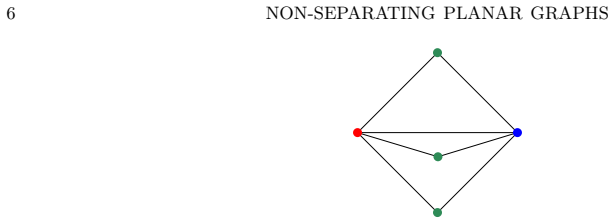
- Notation: the symbol K1,1,3 is non-standard; a brief definition or reference to the precise graph (a star K1,3 with one additional pendant edge on a leaf) would aid readability.
- The application section on linkless graphs should state explicitly which property of non-separating planar graphs is used to construct the 3n−3 edge examples.
Simulated Author's Rebuttal
We thank the referee for the thoughtful report and for identifying points where the logical structure and self-contained nature of the arguments can be improved. We will revise the manuscript to provide the requested explicit arguments and clarifications while preserving the original results.
read point-by-point responses
-
Referee: [Abstract and §1] Abstract and §1 (preliminary facts): the statement that non-separating planar graphs are closed under minors is asserted prior to the main theorem. Because the right-hand side of the claimed equivalence is minor-closed by construction, this closure property is load-bearing. A self-contained argument is required showing that if G admits a qualifying drawing then so do all minors of G; in particular, the effect of contraction on the side-of-cycle condition must be verified explicitly.
Authors: We agree that the closure under minors requires an explicit, self-contained proof before the main theorem, as the referee notes. In the revision we will insert a new lemma (placed in §1 immediately after the definition) that proves preservation under deletion of vertices/edges and under contraction. The contraction case will explicitly track how a cycle C and the vertices on one side map to the contracted graph, verifying that the single-side condition is inherited. revision: yes
-
Referee: [Theorem 1] Theorem 1 (forbidden-minor characterization): the proof must establish both directions. The “only if” direction follows once closure under minors is shown and the three listed graphs are verified to violate the drawing condition; the “if” direction requires an argument that every graph avoiding the three minors admits a qualifying drawing. The manuscript should indicate where each direction is proved and whether the structural characterization in the subsequent section is used as an intermediate step.
Authors: We will revise the statement and proof of Theorem 1 to label the two directions explicitly. The 'only if' direction will be proved right after the new closure lemma by checking that each of the three graphs fails the drawing condition. The 'if' direction will be shown to proceed via the structural characterization of maximal members (proved in the following section): any graph avoiding the three minors is contained in a maximal member, which by the structural result admits a qualifying drawing; we will add an outline paragraph at the start of the proof of Theorem 1 making this dependence clear. revision: yes
Circularity Check
No circularity: characterization derived directly from drawing definition
full rationale
The paper defines non-separating planar graphs explicitly via existence of a crossing-free drawing in which every cycle has all external vertices on one side. The preliminary statement that the class is minor-closed follows from direct (if non-trivial) construction of suitable drawings on minors and does not rely on the later forbidden-minor theorem. The central iff result is obtained by proving both inclusions separately: graphs satisfying the drawing definition avoid the three listed minors, while graphs avoiding those minors admit such a drawing (via the additional structural characterization into outerplanar graphs, wheel subgraphs, or prism subdivisions). No step reduces a claimed prediction or uniqueness result to a fitted parameter, self-citation, or definitional renaming; the derivation chain remains self-contained against the given drawing property.
Axiom & Free-Parameter Ledger
axioms (1)
- standard math Standard definitions and closure properties of planar graphs, minors, cycles, and embeddings in the plane.
Lean theorems connected to this paper
-
IndisputableMonolith/Foundation/AlexanderDuality.leanalexander_duality_circle_linking unclear?
unclearRelation between the paper passage and the cited Recognition theorem.
A graph G is a non-separating planar graph if there is a drawing D of G on the plane such that (1) no two edges cross each other in D and (2) for any cycle C in D, any two vertices not in C are on the same side of C in D.
-
IndisputableMonolith/Foundation/RealityFromDistinction.leanreality_from_one_distinction unclear?
unclearRelation between the paper passage and the cited Recognition theorem.
Non-separating planar graphs are closed under taking minors
What do these tags mean?
- matches
- The paper's claim is directly supported by a theorem in the formal canon.
- supports
- The theorem supports part of the paper's argument, but the paper may add assumptions or extra steps.
- extends
- The paper goes beyond the formal theorem; the theorem is a base layer rather than the whole result.
- uses
- The paper appears to rely on the theorem as machinery.
- contradicts
- The paper's claim conflicts with a theorem or certificate in the canon.
- unclear
- Pith found a possible connection, but the passage is too broad, indirect, or ambiguous to say the theorem truly supports the claim.
Reference graph
Works this paper leans on
-
[1]
D. Archdeacon. A Kuratowski theorem for the projective plane. Journal of Graph Theory , 5(3):243–246, 1981
work page 1981
-
[2]
D. Archdeacon, C. P. Bonnington, N. Dean, N. Hartsfield, and K. Scott. Obstruction sets for outer-cylindrical graphs. Journal of Graph Theory , 38(1):42–64, 2001
work page 2001
-
[3]
D. Archdeacon, N. Hartsfield, C. Little, and B. Mohar. Obstruction sets for outer-projective- planar graphs. Ars Combinatoria, 49:113–128, 1998
work page 1998
-
[4]
G. Chartrand and F. Harary. Planar permutation graphs.Annales de l’Institut Henri Poincaré. Probabilités et Statistiques, 3(4):433–438, 1967
work page 1967
-
[5]
J. H. Conway and C. McA. Gordon. Knots and links in spatial graphs.Journal of Graph Theory, 7(4):445–453, 1983
work page 1983
-
[6]
H. R. Dehkordi and G. Farr. A stronger version of the Hanani-Tutte Theorem
-
[7]
K. Kawarabayashi, S. Kreutzer, and B. Mohar. Linkless and flat embeddings in 3-space and the unknot problem. InProceedings of the Twenty-Sixth Annual Symposium on Computational Geometry, pages 97–106. ACM, 2010
work page 2010
-
[8]
C. Kuratowski. Sur le problème des courbes gauches en topologie.Fundamenta Mathematicae, 15(1):271–283, 1930
work page 1930
-
[9]
W. Mader. Homomorphiesätze für graphen.Mathematische Annalen, 178(2):154–168, 1968
work page 1968
-
[10]
W. Myrvold and J. Woodcock. A large set of torus obstructions and how they were discovered. The Electronic Journal of Combinatorics , 25(1):1–16, 2018
work page 2018
-
[11]
N. Robertson, P. Seymour, and R. Thomas. Sachs’ linkless embedding conjecture.Journal of Combinatorial Theory, Series B , 64(2):185–227, 1995
work page 1995
-
[12]
N. Robertson and P. D. Seymour. Graph minors. XX. Wagner’s conjecture.Journal of Combi- natorial Theory, Series B , 92(2):325–357, 2004
work page 2004
-
[13]
N. Robertson, P. D. Seymour, and R. Thomas. A survey of linkless embeddings. In N. Robertson and P. D. Seymour, editors,Graph Structure Theory, pages 125–136. American Mathematical Society, 1991
work page 1991
-
[14]
H. Sachs. On a spatial analogue of Kuratowski’s theorem on planar graphs — an open problem. In M. Borowiecki, J. W. Kennedy, and M. M. Sysło, editors,Graph Theory, pages 230–241. Springer, 1983
work page 1983
-
[15]
K. Wagner. Bemerkungen zum Vierfarbenproblem.Jahresbericht der Deutschen Mathematiker- Vereinigung, 46:26–32, 1936
work page 1936
discussion (0)
Sign in with ORCID, Apple, or X to comment. Anyone can read and Pith papers without signing in.