A system for efficient 3D printed stop-motion face animation
Pith reviewed 2026-05-24 16:44 UTC · model grok-4.3
The pith
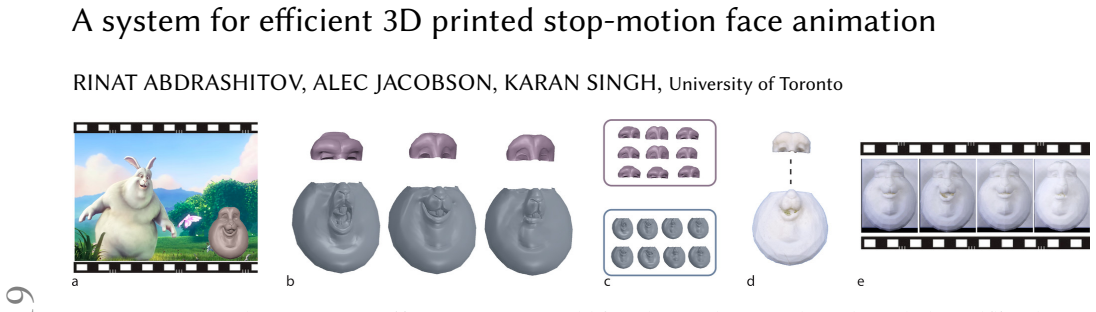
A pipeline converts deforming face mesh animations into compact libraries of interchangeable 3D printed parts assigned per frame to approximate the input motion with minimal printing and assembly.
A machine-rendered reading of the paper's core claim, the machinery that carries it, and where it could break.
Core claim
Given an input animation sequence of topology invariant deforming meshes, the method outputs a library of replacement parts and per-animation-frame assignment of the parts such that the animation is maximally approximated while the amount of 3D printing and assembly is minimized. User-specified preferred segmentation regions guide the search for minimal-deformation curves; boundary deformations are then zeroed so that parts from each replacement set can be interchanged without seams; each part is optimized separately by graph-cut to produce a user-chosen or budget-constrained number of replacements whose boundaries are shaped for easy printing and assembly.
What carries the argument
User-guided minimal-deformation curve segmentation followed by boundary deformation zeroing and independent graph-cut optimization of replacement sets per segment, which produces interchangeable 3D printable components.
If this is right
- The number of replacements per part can be set by the user or computed automatically to respect a printing budget or allowed deviation from the original animation.
- Part boundaries are shaped to simplify both 3D printing and physical assembly instrumentation.
- The same pipeline produces usable results on both purely digital sequences and sequences that are actually printed and assembled.
- The approach yields higher fidelity at lower cost than naive full-frame printing or simpler segmentation strategies.
Where Pith is reading between the lines
- The same replacement libraries might be reusable across different animations that share a common base mesh and similar deformation patterns.
- Extending the segmentation step to run without manual region hints would test whether the rest of the pipeline still succeeds on new mesh sequences.
- The method could be applied to other topology-preserving deforming objects, such as cloth or articulated props, if the minimal-deformation curves remain well-defined.
- Physical production trials could measure whether the added step of swapping parts during filming is offset by the large reduction in total printing time.
Load-bearing premise
Manually indicated preferred segmentation regions plus minimal-deformation curves, followed by boundary deformation zeroing, will produce interchangeable parts whose independent optimization still yields a faithful overall animation without visible artifacts at assembly seams.
What would settle it
If physical assemblies of the optimized parts show visible seams or distortions at the cut boundaries during playback, or if the total printed volume fails to fall substantially below the volume required to print every frame, the central claim would be falsified.
Figures


read the original abstract
Computer animation in conjunction with 3D printing has the potential to positively impact traditional stop-motion animation. As 3D printing every frame of a computer animation is prohibitively slow and expensive, 3D printed stop-motion can only be viable if animations can be faithfully reproduced using a compact library of 3D printed and efficiently assemblable parts. We thus present the first system for processing computer animation sequences (typically faces) to produce an optimal set of replacement parts for use in 3D printed stop-motion animation. Given an input animation sequence of topology invariant deforming meshes, our problem is to output a library of replacement parts and per-animation-frame assignment of the parts, such that we maximally approximate the input animation, while minimizing the amount of 3D printing and assembly. Inspired by current stop-motion workflows, a user manually indicates which parts of the model are preferred for segmentation; then, we find curves with minimal deformation along which to segment the mesh. We then present a novel algorithm to zero out deformations along the segment boundaries, so that replacement sets for each part can be interchangeably and seamlessly assembled together. The part boundaries are designed to ease 3D printing and instrumentation for assembly. Each part is then independently optimized using a graph-cut technique to find a set of replacements, whose size can be user defined, or automatically computed to adhere to a printing budget or allowed deviation from the original animation. Our evaluation is threefold: we show results on a variety of facial animations, both digital and 3D printed, critiqued by a professional animator; we show the impact of various algorithmic parameters; and compare our results to naive solutions. Our approach can reduce the printing time and cost significantly for stop-motion animated films.
Editorial analysis
A structured set of objections, weighed in public.
Referee Report
Summary. The paper presents a pipeline for converting topology-invariant deforming mesh animation sequences (primarily faces) into a compact library of 3D-printable replacement parts together with per-frame part assignments. The objective is to maximize fidelity to the input animation while minimizing total printed material and assembly operations. The method begins with user-specified preferred segmentation regions, computes minimal-deformation cut curves, applies a boundary-deformation zeroing step to enable interchangeability, and then performs independent graph-cut optimization on each part to select a user- or budget-constrained replacement set. Results are demonstrated on several facial animations, with qualitative feedback from a professional animator and comparisons against naive baselines.
Significance. If the seam-free interchangeability claim holds, the work provides a concrete, user-controllable bridge between computer animation and traditional stop-motion that could materially lower the cost and time barriers to 3D-printed facial animation. The pipeline incorporates practical printing and assembly considerations and includes both parameter studies and professional critique, which are positive attributes for an applied graphics paper.
major comments (2)
- [Boundary deformation zeroing and independent part optimization] The boundary-deformation zeroing step (described after the minimal-deformation curve computation) fixes boundary geometry on the input sequence only; the subsequent independent per-part graph-cut optimization contains no explicit cross-part or post-zeroing constraint that would guarantee chosen replacements continue to match at the fixed boundaries. Consequently, replacements that alter geometry adjacent to the boundary can produce visible discontinuities even when each part individually satisfies its error budget.
- [Evaluation] The evaluation section reports results on digital and 3D-printed animations together with professional animator critique and comparisons to naive solutions, yet provides no quantitative per-seam error metric, no controlled measurement of assembled seam deviation, and no formal invariance argument establishing that arbitrary recombination of the independently optimized libraries remains seam-free.
minor comments (2)
- [Method overview] The abstract states that the part boundaries are 'designed to ease 3D printing and instrumentation for assembly,' but the manuscript does not detail the concrete geometric or topological criteria used for this design.
- [Graph-cut optimization] Notation for the user-specified number of replacements versus the automatically computed budget-constrained size could be clarified to avoid ambiguity when both options are discussed.
Simulated Author's Rebuttal
We thank the referee for the constructive review and positive assessment of the work's potential. We respond point-by-point to the major comments below.
read point-by-point responses
-
Referee: [Boundary deformation zeroing and independent part optimization] The boundary-deformation zeroing step (described after the minimal-deformation curve computation) fixes boundary geometry on the input sequence only; the subsequent independent per-part graph-cut optimization contains no explicit cross-part or post-zeroing constraint that would guarantee chosen replacements continue to match at the fixed boundaries. Consequently, replacements that alter geometry adjacent to the boundary can produce visible discontinuities even when each part individually satisfies its error budget.
Authors: The boundary-deformation zeroing is performed on the complete input sequence prior to segmentation or optimization. This step enforces identical boundary vertex positions across all frames for each user-specified region. Consequently every candidate replacement part in a library inherits exactly the same boundary geometry. Graph-cut selection then operates exclusively over these pre-zeroed candidates; arbitrary recombination therefore preserves boundary alignment by construction. We will add an explicit invariance paragraph and short proof sketch to the method section. revision: partial
-
Referee: [Evaluation] The evaluation section reports results on digital and 3D-printed animations together with professional animator critique and comparisons to naive solutions, yet provides no quantitative per-seam error metric, no controlled measurement of assembled seam deviation, and no formal invariance argument establishing that arbitrary recombination of the independently optimized libraries remains seam-free.
Authors: We agree that quantitative seam metrics would strengthen the evaluation. In revision we will add (i) average boundary-vertex deviation measured over all possible part recombinations and (ii) a controlled seam-deviation measurement on the assembled 3D-printed models. The formal invariance argument follows directly from the pre-optimization zeroing step described above; we will state it explicitly alongside the new metrics. revision: yes
Circularity Check
No circularity: algorithmic pipeline is externally evaluated and self-contained
full rationale
The paper presents a multi-stage algorithmic pipeline (user-specified regions, minimal-deformation curve segmentation, boundary zeroing, then independent per-part graph-cut optimization) whose outputs are not definitionally equivalent to its inputs. No equations, fitted parameters, or predictions reduce to the input data by construction; the method is compared to naive baselines and assessed via external animator critique rather than internal self-reference. No self-citations serve as load-bearing uniqueness theorems, and no ansatz or renaming patterns appear. The derivation chain therefore remains independent of the target result.
Axiom & Free-Parameter Ledger
free parameters (1)
- number of replacements per part
axioms (2)
- domain assumption Input animation consists of topology-invariant deforming meshes
- domain assumption User can manually indicate preferred parts for segmentation
Reference graph
Works this paper leans on
-
[1]
Representing Animations by Principal Compo- nents. Comput. Graph. Forum (2000). Jed Alger, Travis Knight, and Chris Butler
work page 2000
- [2]
- [3]
-
[4]
ACM Transactions on Graphics (TOG) 31, 4 (2012),
Physical face cloning. ACM Transactions on Graphics (TOG) 31, 4 (2012),
work page 2012
-
[5]
Tangible and Embedded Interaction (2009)
Stop-motion prototyping for tangible interfaces. Tangible and Embedded Interaction (2009). Yuri Boykov and Vladimir Kolmogorov
work page 2009
-
[6]
IEEE transactions on pattern analysis and machine intelligence 26, 9 (2004), 1124–1137
An experimental comparison of min- cut/max-flow algorithms for energy minimization in vision. IEEE transactions on pattern analysis and machine intelligence 26, 9 (2004), 1124–1137. Gabriel J. Brostow and Irfan Essa
work page 2004
-
[7]
Perceptually-motivated Real-time Temporal Upsampling of 3D Content for High-refresh-rate Displays. Comput. Graph. Forum (2010). Marek Dvorožnák, Wilmot Li, Vladimir G Kim, and Daniel S`ykora
work page 2010
-
[8]
ACM Transactions on Graphics (TOG) 37, 4 (2018),
Toonsynth: example-based synthesis of hand-colored cartoon animations. ACM Transactions on Graphics (TOG) 37, 4 (2018),
work page 2018
- [9]
-
[10]
IEEE Transactions on Image processing 15, 12 (2006), 3736–3745
Image denoising via sparse and redundant representations over learned dictionaries. IEEE Transactions on Image processing 15, 12 (2006), 3736–3745. Jakub Fišer, Ondřej Jamriška, David Simons, Eli Shechtman, Jingwan Lu, Paul Asente, Michal Lukáč, and Daniel S`ykora
work page 2006
-
[11]
ACM Transactions on Graphics (TOG) 36, 4 (2017),
Example-based synthesis of stylized facial animations. ACM Transactions on Graphics (TOG) 36, 4 (2017),
work page 2017
-
[12]
From Deformations to Parts - Motion-based Segmentation of 3D Objects. NIPS (2012). Qin Gu, Jingliang Peng, and Zhigang Deng
work page 2012
-
[13]
Computer Graphics Forum (2009)
Compression of Human Motion Capture Data Using Motion Pattern Indexing. Computer Graphics Forum (2009). Gaël Guennebaud, Benoît Jacob, et al
work page 2009
-
[14]
Eigen v3. (2010). http://eigen.tuxfamily.org. Xiaoguang Han, Hongbo Fu, Hanlin Zheng, Ligang Liu, and Jue Wang
work page 2010
-
[15]
A Video- Based System for Hand-Driven Stop-Motion Animation. IEEE CG&A (2014). Philipp Herholz, Wojciech Matusik, and Marc Alexa
work page 2014
-
[16]
Approximating Free-form Geometry with Height Fields for Manufacturing. Comput. Graph. Forum 34, 2 (May 2015), 239–251. https://doi.org/10.1111/cgf.12556 Ruizhen Hu, Honghua Li, Hao Zhang, and Daniel Cohen-Or
-
[17]
Approximate Pyramidal Shape Decomposition. ACM Trans. Graph. 33, 6, Article 213 (Nov. 2014), 12 pages. https://doi.org/10.1145/2661229.2661244 Alec Jacobson, Daniele Panozzo, et al
-
[18]
libigl: A simple C++ geometry processing library. (2017). http://libigl.github.io/libigl/. Alec Jacobson, Elif Tosun, Olga Sorkine, and Denis Zorin
work page 2017
- [19]
-
[20]
Multiscale saliency detection for 3D meshes using random walk. APSIPA (2014). Brian Knep, Craig Hayes, Rick Sayre, and Tom Williams
work page 2014
-
[21]
Vladimir Kolmogorov and Ramin Zabin
Objet Geometries’ 3-D Printers Play Starring Role in New Animated Film Coraline.http://www.prnewswire.co.uk/news-releases/objet-geometries- 3-d-printers-play-starring-role-in-new-animated-film-coraline-155479455.html (2009). Vladimir Kolmogorov and Ramin Zabin
work page 2009
-
[22]
Jan Eric Kyprianidis, John Collomosse, Tinghuai Wang, and Tobias Isenberg
What energy functions can be minimized via graph cuts? IEEE TPAMI (2004). Jan Eric Kyprianidis, John Collomosse, Tinghuai Wang, and Tobias Isenberg
work page 2004
-
[23]
IEEE Transactions on Visualization and Computer Graphics 19, 5 (May 2013), 866–885
State of the "Art”: A Taxonomy of Artistic Stylization Techniques for Images and Video. IEEE Transactions on Visualization and Computer Graphics 19, 5 (May 2013), 866–885. https://doi.org/10.1109/TVCG.2012.160 Binh Huy Le and Zhigang Deng
-
[24]
ACM Transactions on Graphics (2013)
Two-layer sparse compression of dense-weight blend skinning. ACM Transactions on Graphics (2013). Binh Huy Le and Zhigang Deng
work page 2013
- [25]
-
[26]
The Visual Computer 22, 9-11 (2006), 729–739
Segmenting a deforming mesh into near-rigid components. The Visual Computer 22, 9-11 (2006), 729–739. John P Lewis, Ken Anjyo, Taehyun Rhee, Mengjie Zhang, Frédéric H Pighin, and Zhigang Deng
work page 2006
-
[27]
Practice and Theory of Blendshape Facial Models. Eurographics (2014). Stuart P. Lloyd
work page 2014
-
[28]
IEEE Transactions on Informa- tion Theory 28 (1982), 129–137
Least squares quantization in pcm. IEEE Transactions on Informa- tion Theory 28 (1982), 129–137. Linjie Luo, Ilya Baran, Szymon Rusinkiewicz, and Wojciech Matusik
work page 1982
- [29]
-
[30]
https://www.nytimes.com/interactive/2015/12/18/movies/anomalisa-behind-the- scenes.html (2015)
Showing the Seams in ‘Anomalisa’. https://www.nytimes.com/interactive/2015/12/18/movies/anomalisa-behind-the- scenes.html (2015). Thomas Neumann, Kiran Varanasi, Stephan Wenger, Markus Wacker, Marcus A Magnor, and Christian Theobalt
work page 2015
-
[31]
Sparse localized deformation components.ACM Trans. Graph. (2013). Seung-Tak Noh and Takeo Igarashi
work page 2013
-
[32]
Facial Retargeting with Automatic Range of Motion Alignment.ACM Trans. Graph. (2017). 2019-07-25 00:40 page 10 (pp. 1-11) A system for efficient 3D printed stop-motion face animation • 39:11 0 20 40 λ = 1 100 200 300 400 500 600 700 0 20 40 λ = 5 Naive uniform sampling 0 50 100 150 200 Velocity Energy Position Energy Number of Frames 0 20 40 λ = 0 Our opt...
work page 2017
- [33]
-
[34]
A survey on Mesh Segmentation Techniques. Comput. Graph. Forum (2008). Karan Singh and Eugene Fiume
work page 2008
-
[35]
ACM Transactions on Graphics (TOG) 31, 6 (2012),
Recursive interlocking puzzles. ACM Transactions on Graphics (TOG) 31, 6 (2012),
work page 2012
-
[36]
Computer Graphics Forum 33, 2 (2014), 145–154
Compressing dynamic meshes with geometric laplacians. Computer Graphics Forum 33, 2 (2014), 145–154. Jue Wang, Yingqing Xu, Heung-Yeung Shum, and Michael F. Cohen
work page 2014
-
[37]
Improved Surface Quality in 3D Printing by Optimizing the Printing Direction. InProceedings of the 37th Annual Conference of the European Association for Computer Graphics (EG ’16) . Eurographics Association, Goslar Germany, Germany, 59–70. https://doi.org/10.1111/cgf.12811 Brian Whited, Gioacchino Noris, Maryann Simmons, Robert W Sumner, Markus H Gross, ...
-
[38]
BetweenIT - An Interactive Tool for Tight Inbe- tweening. Comput. Graph. Forum (2010). Andrew P Witkin and Michael Kass
work page 2010
-
[39]
Spacetime constraints. Siggraph (1988). John Wright, Yi Ma, Julien Mairal, Guillermo Sapiro, Thomas S Huang, and Shuicheng Yan
work page 1988
-
[40]
Sparse representation for computer vision and pattern recognition. Proc. IEEE 98, 6 (2010), 1031–1044. Y Y. Boykov, O Veksler R., and R Zabih
work page 2010
-
[41]
Efficient Approximate Energy Minimiza- tion via Graph Cuts. 20 (01 2001). Xiaoting Zhang, Xinyi Le, Athina Panotopoulou, Emily Whiting, and Charlie C. L. Wang
work page 2001
- [42]
discussion (0)
Sign in with ORCID, Apple, or X to comment. Anyone can read and Pith papers without signing in.