REVIEW 38 references
The Temperature-dependent Damping of Propagating Slow Magnetoacoustic Waves
T0 review · reviewed 2026-08-14 · deepseek-v4-flash
Pith's one-line read First measurement of the temperature dependence of slow magnetoacoustic wave damping lengths in coronal fan loops finds no apparent decrease with temperature, conflicting with thermal conduction expectations.
The pith
A machine-rendered reading of the paper's core claim, the machinery that carries it, and where it could break.
The reading
Extended reading notes
Core claim
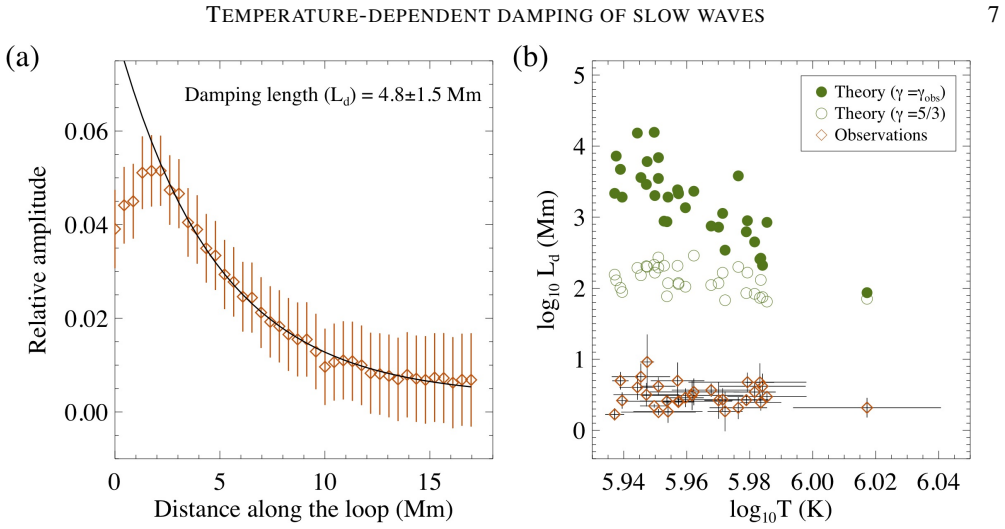
The paper's central claim is that the measured damping length of propagating slow magnetoacoustic waves in coronal fan loops does not decrease with loop temperature, contrary to the expectation from thermal conduction damping; the authors infer that thermal conduction is suppressed in hotter loops or is not the dominant damping mechanism. Abstract: 'The results do not indicate any apparent decrease in damping length with temperature, which is in contrast to the existing viewpoint.'
Load-bearing premise
The comparison across loops assumes that the DEM peak temperature from a double-Gaussian fit to the regularized inversion is a faithful single temperature for each loop and is the correct input for the thermal conduction damping calculation. The authors note in Section 4 that 'it can be argued whether the peak emission in a DEM sufficiently represents the plasma within the loop.' If temperature biases vary systematically with loop properties, the observed absence of a damping-length trend could be an artifact.
Signed reviews
Editorial analysis
A structured set of objections, weighed in public.
Assumptions & free parameters
assumptions (5)
- domain assumption The observed compressive oscillations in fan loops are propagating slow magnetoacoustic waves.
- domain assumption The weak thermal conduction limit (dω << 1) applies to the analyzed loops.
- domain assumption Spitzer thermal conductivity with κ0 = 7.8e-7 is the correct conductivity.
- domain assumption The temperature, density, polytropic index, and period values from Krishna Prasad et al. (2018) are accurate for these loops.
- domain assumption The 1D linear wave theory with thermal conduction as the damping mechanism is applicable.
Cite this review
Pith. "Pith review of The Temperature-dependent Damping of Propagating Slow Magnetoacoustic Waves." pith.science (2026). https://pith.science/paper/JD6G4JWW
@misc{pith2026190800384,
  author       = {Pith},
  title        = {Pith review of: The Temperature-dependent Damping of Propagating Slow Magnetoacoustic Waves},
  year         = {2026},
  howpublished = {\url{https://pith.science/paper/JD6G4JWW}},
  note         = {Machine review of arXiv:1908.00384}
}
read the original abstract
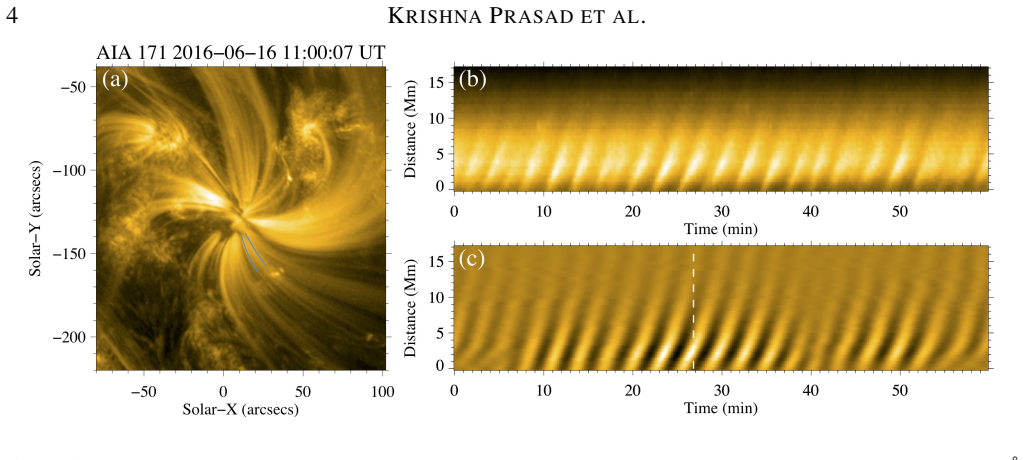
The rapid damping of slow magnetoacoustic waves in the solar corona has been extensively studied in previous years. Most studies suggest that thermal conduction is a dominant contributor to this damping, albeit with a few exceptions. Employing extreme-ultraviolet (EUV) imaging data from SDO/AIA, we measure the damping lengths of propagating slow magnetoacoustic waves observed in several fan-like loop structures using two independent methods. The dependence of the damping length on temperature has been studied for the first time. The results do not indicate any apparent decrease in damping length with temperature, which is in contrast to the existing viewpoint. Comparing with the corresponding theoretical values calculated from damping due to thermal conduction, it is inferred that thermal conduction is suppressed in hotter loops. An alternative interpretation that suggests thermal conduction is not the dominant damping mechanism, even for short period waves in warm active region loops, is also presented.
Figures

Reference graph
Works this paper leans on
-
[1]
!1A Qa
thebibliography [1] 20pt to REFERENCES 6pt =0pt 10pt plus 3pt =0pt =0pt =1pt plus 1pt =0pt =0pt -12pt =13pt plus 1pt =20pt =13pt plus 1pt \@M =10000 =-1.0em =0pt =0pt 0pt =0pt =1.0em @enumiv\@empty 10000 10000 `\.\@m \@noitemerr \@latex@warning Empty `thebibliography' environment \@ifnextchar \@reference \@latexerr Missing key on reference command Each re...
1998
-
[2]
Banerjee , D. and Krishna Prasad , S. (2016). MHD Waves in Coronal Holes . Washington DC American Geophysical Union Geophysical Monograph Series 216, 419--430. doi:10.1002/9781119055006.ch24 2016GMS...216..419B
-
[3]
Berghmans , D. and Clette , F. (1999). Active region EUV transient brightenings - First Results by EIT of SOHO JOP80 . 186, 207--229 bc1999SoPh186
work page 1999
-
[4]
Cally , P. S., Bogdan , T. J., and Zweibel , E. G. (1994). Umbral oscillations in sunspots: Absorption of p-modes and active region heating by mode conversion . 437, 505--521. doi:10.1086/175014 1994ApJ...437..505C
doi:10.1086/175014 1994
-
[5]
Culhane , J. L., Harra , L. K., James , A. M., Al-Janabi , K., Bradley , L. J., Chaudry , R. A., et al. (2007). The EUV Imaging Spectrometer for Hinode . 243, 19--61. doi:10.1007/s01007-007-0293-1 2007SoPh..243...19C
-
[6]
De Moortel , I. (2009). Longitudinal Waves in Coronal Loops . 149, 65--81. doi:10.1007/s11214-009-9526-5 2009SSRv..149...65D
-
[7]
De Moortel , I. and Hood , A. W. (2003). The damping of slow MHD waves in solar coronal magnetic fields . 408, 755--765. doi:10.1051/0004-6361:20030984 2003A&A...408..755D
-
[8]
De Moortel , I. and Hood , A. W. (2004). The damping of slow MHD waves in solar coronal magnetic fields. II. The effect of gravitational stratification and field line divergence . 415, 705--715. doi:10.1051/0004-6361:20034233 2004A&A...415..705D
Show all 38 references
-
[9]
De Moortel , I., Ireland , J., and Walsh , R. W. (2000). Observation of oscillations in coronal loops . 355, L23--L26 2000A&A...355L..23D
2000
-
[10]
De Pontieu , B., Erd \'e lyi , R., and De Moortel , I. (2005). How to Channel Photospheric Oscillations into the Corona . 624, L61--L64. doi:10.1086/430345 2005ApJ...624L..61D
2005 doi
-
[11]
Deforest , C. E. and Gurman , J. B. (1998). Observation of Quasi-periodic Compressive Waves in Solar Polar Plumes . 501, L217. doi:10.1086/311460 1998ApJ...501L.217D
1998 doi
-
[12]
Erd \'e lyi , R. (2006). Magnetic seismology of the lower solar atmosphere . In Proceedings of SOHO 18/GONG 2006/HELAS I, Beyond the spherical Sun. vol. 624 of ESA Special Publication, 15.1 2006ESASP.624E..15E
2006
-
[13]
Hannah , I. G. and Kontar , E. P. (2012). Differential emission measures from the regularized inversion of Hinode and SDO data . 539, A146. doi:10.1051/0004-6361/201117576 2012A&A...539A.146H
2012 doi
-
[14]
B., De Moortel , I., Mathioudakis , M., Christian , D
Jess , D. B., De Moortel , I., Mathioudakis , M., Christian , D. J., Reardon , K. P., Keys , P. H., et al. (2012). The Source of 3 Minute Magnetoacoustic Oscillations in Coronal Fans . 757, 160. doi:10.1088/0004-637X/757/2/160 2012ApJ...757..160J
2012 doi
-
[15]
B., Dillon , C
Jess , D. B., Dillon , C. J., Kirk , M. S., Reale , F., Mathioudakis , M., Grant , S. D. T., et al. (2019). Statistical Signatures of Nanoflare Activity. I. Monte Carlo Simulations and Parameter-space Exploration . 871, 133. doi:10.3847/1538-4357/aaf8ae 2019ApJ...871..133J
2019 doi
-
[16]
Khomenko , E., Centeno , R., Collados , M., and Trujillo Bueno , J. (2008). Channeling 5 Minute Photospheric Oscillations into the Solar Outer Atmosphere through Small-Scale Vertical Magnetic Flux Tubes . 676, L85. doi:10.1086/587057 2008ApJ...676L..85K
2008 doi
-
[17]
W., and Whittaker , I
Kiddie , G., De Moortel , I., Del Zanna , G., McIntosh , S. W., and Whittaker , I. (2012). Propagating Disturbances in Coronal Loops: A Detailed Analysis of Propagation Speeds . 279, 427--452. doi:10.1007/s11207-012-0042-5 2012SoPh..279..427K
2012 doi
-
[18]
A., Tanner , S
Klimchuk , J. A., Tanner , S. E. M., and De Moortel , I. (2004). Coronal Seismology and the Propagation of Acoustic Waves along Coronal Loops . 616, 1232--1241. doi:10.1086/425122 2004ApJ...616.1232K
2004 doi
-
[19]
(2012 a )
Krishna Prasad , S., Banerjee , D., and Singh , J. (2012 a ). Oscillations in Active Region Fan Loops: Observations from EIS/ Hinode and AIA/SDO . 281, 67--85. doi:10.1007/s11207-012-0098-2 2012SoPh..281...67K
2012 doi
-
[20]
Krishna Prasad , S., Banerjee , D., and Van Doorsselaere , T. (2014). Frequency-dependent Damping in Propagating Slow Magneto-acoustic Waves . 789, 118. doi:10.1088/0004-637X/789/2/118 2014ApJ...789..118K
2014 doi
-
[21]
(2012 b )
Krishna Prasad , S., Banerjee , D., Van Doorsselaere , T., and Singh , J. (2012 b ). Omnipresent long-period intensity oscillations in open coronal structures . 546, A50. doi:10.1051/0004-6361/201219885 2012A&A...546A..50K
2012 doi
-
[22]
B., and Khomenko , E
Krishna Prasad , S., Jess , D. B., and Khomenko , E. (2015). On the Source of Propagating Slow Magnetoacoustic Waves in Sunspots . 812, L15. doi:10.1088/2041-8205/812/1/L15 2015ApJ...812L..15K
2015 doi
-
[23]
B., Van Doorsselaere , T., Verth , G., Morton , R
Krishna Prasad , S., Jess , D. B., Van Doorsselaere , T., Verth , G., Morton , R. J., Fedun , V., et al. (2017). The Frequency-dependent Damping of Slow Magnetoacoustic Waves in a Sunspot Umbral Atmosphere . 847, 5. doi:10.3847/1538-4357/aa86b5 2017ApJ...847....5K
2017 doi
-
[24]
O., Van Doorsselaere , T., Magyar , N., and Jess , D
Krishna Prasad , S., Raes , J. O., Van Doorsselaere , T., Magyar , N., and Jess , D. B. (2018). The Polytropic Index of Solar Coronal Plasma in Sunspot Fan Loops and Its Temperature Dependence . 868, 149. doi:10.3847/1538-4357/aae9f5 2018ApJ...868..149K
2018 doi
-
[25]
R., Title , A
Lemen , J. R., Title , A. M., Akin , D. J., Boerner , P. F., Chou , C., Drake , J. F., et al. (2012). The Atmospheric Imaging Assembly (AIA) on the Solar Dynamics Observatory (SDO) . 275, 17--40. doi:10.1007/s11207-011-9776-8 2012SoPh..275...17L
2012 doi
-
[26]
Mandal , S., Magyar , N., Yuan , D., Van Doorsselaere , T., and Banerjee , D. (2016). Forward Modeling of Propagating Slow Waves in Coronal Loops and Their Frequency-dependent Damping . 820, 13. doi:10.3847/0004-637X/820/1/13 2016ApJ...820...13M
2016 doi
-
[27]
Markwardt , C. B. (2009). Non-linear Least-squares Fitting in IDL with MPFIT . In Astronomical Data Analysis Software and Systems XVIII, eds. D. A. Bohlender , D. Durand , and P. Dowler . vol. 411 of Astronomical Society of the Pacific Conference Series, 251 2009ASPC..411..251M
2009
-
[28]
S., De Moortel , I., and Walsh , R
Marsh , M. S., De Moortel , I., and Walsh , R. W. (2011). Observed Damping of the Slow Magnetoacoustic Mode . 734, 81. doi:10.1088/0004-637X/734/2/81 2011ApJ...734...81M
2011 doi
-
[29]
Ofman , L., Romoli , M., Poletto , G., Noci , G., and Kohl , J. L. (1997). Ultraviolet Coronagraph Spectrometer Observations of Density Fluctuations in the Solar Wind . 491, L111. doi:10.1086/311067 1997ApJ...491L.111O
1997 doi
-
[30]
D., Thompson , B
Pesnell , W. D., Thompson , B. J., and Chamberlin , P. C. (2012). The Solar Dynamics Observatory (SDO) . 275, 3--15. doi:10.1007/s11207-011-9841-3 2012SoPh..275....3P
2012 doi
-
[31]
Spruit , H. C. (1991). Absorption of p-Mode Waves by Magnetic Fields . In Challenges to Theories of the Structure of Moderate-Mass Stars, eds. D. Gough and J. Toomre . vol. 388 of Lecture Notes in Physics, Berlin Springer Verlag, 121--134. doi:10.1007/3-540-54420-8\_58 1991LNP...
1991 doi
-
[32]
Van Doorsselaere , T., Wardle , N., Del Zanna , G., Jansari , K., Verwichte , E., and Nakariakov , V. M. (2011). The First Measurement of the Adiabatic Index in the Solar Corona Using Time-dependent Spectroscopy of Hinode/EIS Observations . 727, L32. doi:10.1088/2041-8205/727/...
2011 doi
-
[33]
Wang , T. (2011). Standing Slow-Mode Waves in Hot Coronal Loops: Observations, Modeling, and Coronal Seismology . 158, 397--419. doi:10.1007/s11214-010-9716-1 2011SSRv..158..397W
2011 doi
-
[34]
Wang , T., Ofman , L., Sun , X., Provornikova , E., and Davila , J. M. (2015). Evidence of Thermal Conduction Suppression in a Solar Flaring Loop by Coronal Seismology of Slow-mode Waves . 811, L13. doi:10.1088/2041-8205/811/1/L13 2015ApJ...811L..13W
2015 doi
-
[35]
K., and Davila , J
Wang , T., Ofman , L., Sun , X., Solanki , S. K., and Davila , J. M. (2018). Effect of Transport Coefficients on Excitation of Flare-induced Standing Slow-mode Waves in Coronal Loops . 860, 107. doi:10.3847/1538-4357/aac38a 2018ApJ...860..107W
2018 doi
-
[36]
R., Tarbell , T
Wuelser , J.-P., Lemen , J. R., Tarbell , T. D., Wolfson , C. J., Cannon , J. C., Carpenter , B. A., et al. (2004). EUVI: the STEREO-SECCHI extreme ultraviolet imager . In Telescopes and Instrumentation for Solar Astrophysics, eds. S. Fineschi and M. A. Gummin . vol. 5171 of ,...
2004 doi
-
[37]
and Nakariakov , V
Yuan , D. and Nakariakov , V. M. (2012). Measuring the apparent phase speed of propagating EUV disturbances . 543, A9. doi:10.1051/0004-6361/201218848 2012A&A...543A...9Y
2012 doi
-
[38]
I., Kolotkov , D
Zavershinskii , D. I., Kolotkov , D. Y., Nakariakov , V. M., Molevich , N. E., and Ryaschikov , D. S. (2019). Quasi-periodicity of magnetoacoustic waves in a plasma with heating/cooling misbalance . PPCF Under review Priv_Comm_Kolotkov
2019
Reviewed August 14, 2026 · model on record in the stance chip above.
Discussion (0). Continue with ORCID to comment.