REVIEW 3 major objections 4 minor 73 references
Five Gas-rich Ultra-faint Dwarf Galaxy Candidates Discovered in WIYN Imaging of ALFALFA Sources
T0 review · 3 major / 4 minor · reviewed 2026-08-14 · deepseek-v4-flash
Pith's one-line read Five of 23 ultra-compact high-velocity clouds show likely stellar counterparts, making them gas-rich ultra-faint dwarf galaxy candidates at 0.35 to 1.6 Mpc.
desk verdict A careful candidate catalog, not a finished discovery: three new gas-rich UFD candidates from a transparent pipeline, but the 'likely counterparts' language overstates what a uniform-random null can establish. read the letter →
The pith
A machine-rendered reading of the paper's core claim, the machinery that carries it, and where it could break.
The reading
They found five clumps that are close to the hydrogen gas and are unlikely to be random superpositions. The estimated distances range from 350,000 to 1.6 million light-years. The objects are extremely faint, with absolute magnitudes between -1.4 and -7.1, and contain only a few hundred to a few hundred thousand times the Sun's mass in stars, while holding much more gas. None of them show young blue stars. Two of the five were reported earlier by the same group; three are new, and one earlier detection moved to a different distance after the data were reprocessed.
The authors are careful to call these objects 'candidates.' Confirming them as real galaxies will require deeper images or spectra of individual stars, which the paper says is the next step.
Extended reading notes
Core claim
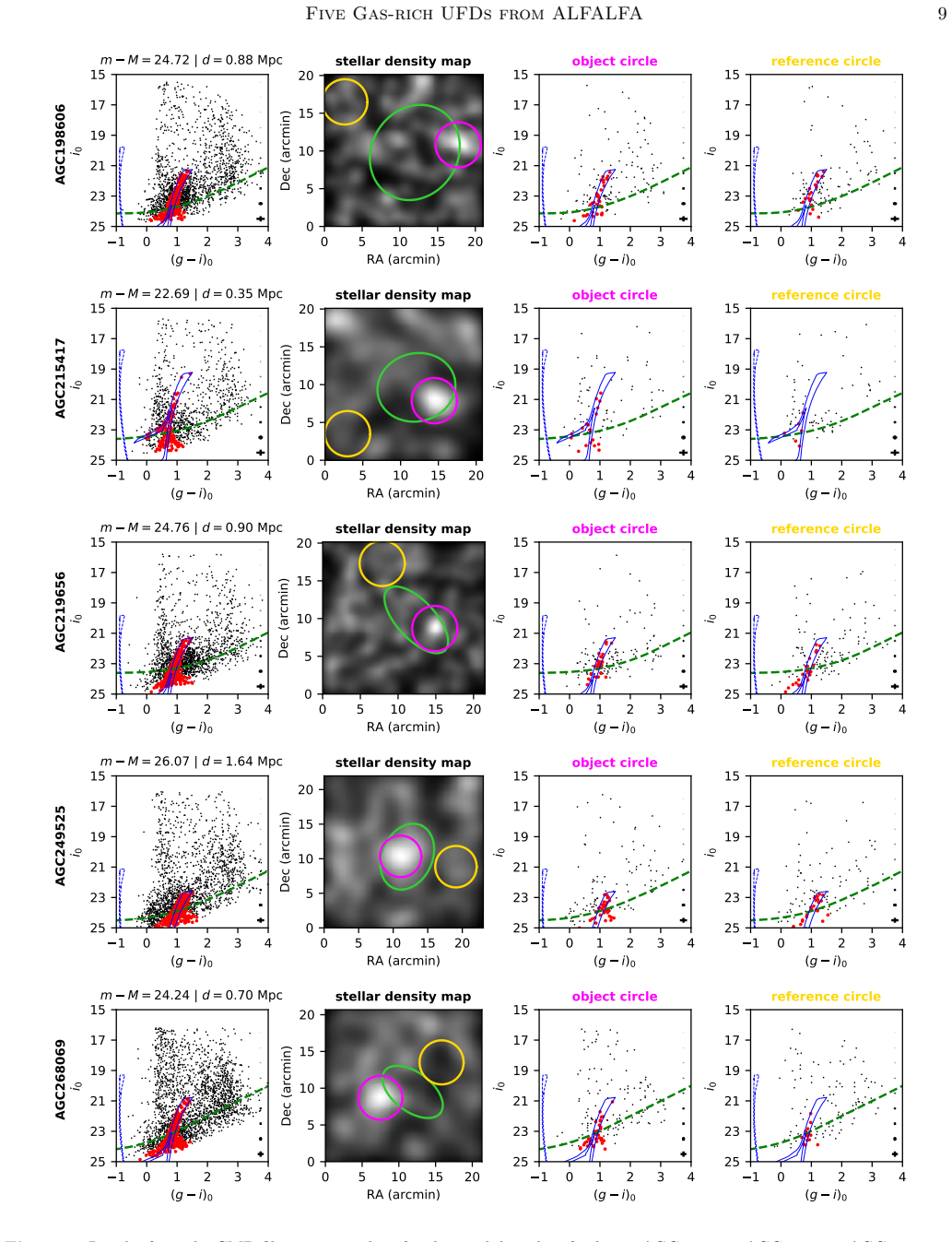
In the abstract: 'We identify five objects that are likely stellar counterparts to the UCHVCs, at distances of ~350 kpc to ~1.6 Mpc... Their properties would make the UCHVCs some of the most extreme objects in and around the Local Group, comparable to ultra faint dwarf galaxies in their stellar populations, but with significant gas content.' Concretely, Table 2 lists five detections with xi between 97.9% and 99.9% within 8 arcmin of the HI centroid, with M_V from -1.4 to -7.1 and HI-to-stellar mass ratios from 0.8 to 205.
Load-bearing premise
The detection pipeline relies on a CMD filter built from old (8-14 Gyr), metal-poor (Z = 0.0001-0.0004) isochrones (Section 3). The search therefore only finds stellar populations that match these assumptions; a younger or more metal-rich counterpart would be missed, and the distance modulus at which the maximum significance occurs would be biased. The paper itself acknowledges this in the CMD panels by showing a 10 Myr filter that is not used, and by finding no young stars. If the true populations are not old and metal-poor, the distances, luminosities, and hence masses in Table 2 would be systematically wrong.
Signed reviews
Editorial analysis
A structured set of objections, weighed in public.
Referee Report
Summary. The paper presents the full analysis of WIYN pODI imaging of 23 ALFALFA ultra-compact high-velocity clouds (UCHVCs), using a color-magnitude diagram (CMD) filter built from old, metal-poor isochrones to search for resolved stellar overdensities. Overdensities are detected by smoothing the spatial distribution of CMD-selected stars, and their statistical significance is assessed with a 25,000-realization Monte Carlo test against uniformly distributed random fields. The authors report five robust detections (ξ = 97.9–99.9%) within 8 arcmin of the HI centroid, with distances 350 kpc–1.6 Mpc, M_V from −1.4 to −7.1, stellar masses from 4×10^2 to 4×10^5 M_sun, and HI-to-stellar mass ratios from 0.8 to 205. Four additional marginal close detections and fourteen high-significance corner/edge overdensities are also cataloged but are not claimed as counterparts. The reanalysis of AGC 198606 moves the previously reported detection from ~380 kpc to 880 kpc and shifts the peak position by ~9 arcmin. The paper argues that the five candidates are extremely gas-rich, quiescent ultra-faint dwarf galaxies and that such systems are more common than predicted by some galaxy formation simulations.
Significance. If the five detections are genuine stellar counterparts to the HI clouds, the objects would occupy a poorly explored regime at the low-luminosity, gas-rich end of the galaxy mass function, with important implications for baryonic feedback and star formation in low-mass halos. The paper's strengths are its homogeneous sample, explicit detection criteria, artificial-star completeness tests, and the public presentation of CMDs and density maps for every field, including the null results. The reanalysis of AGC 198606 with a revised extended-source cut is a useful demonstration of pipeline sensitivity. The central claim, however, currently rests on a significance test whose null hypothesis ignores real large-scale stellar clustering; the paper's own corner/edge detections show that high ξ does not imply association with the HI. The scientific goal is worthwhile, and the requested control analysis is feasible, so the work is suitable for revision rather than rejection.
major comments (3)
- [Section 3 and Section 4.3] The claim that the five Table 2 overdensities are 'likely stellar counterparts' rests on the Monte Carlo significance ξ computed against 25,000 uniformly random spatial distributions. However, Section 4.3 reports that 14 of the 23 fields contain overdensities with ξ = 96.3–99.9% that are not associated with the UCHVCs and are attributed to clustered background galaxies. This is direct evidence that a high ξ does not by itself discriminate a physical association with the HI from a chance alignment of a real clustered overdensity with the HI centroid. The false-positive rate for peaks occurring within 8 arcmin of an arbitrary center is not calibrated with a clustering-aware null, such as scrambling the observed star positions or measuring the occurrence of similar overdensities around many random field centers. I request such a control test before the five detections are described as likely counterparts; absent that, the abstract and conclusions should present them as candidates requiring confirmation.
- [Section 3 and Table 2] The CMD filter is constructed from Girardi et al. (2004) isochrones at ages 8–14 Gyr and metallicities Z = 0.0001–0.0004, so the search is only sensitive to old, metal-poor stellar populations. A younger or more metal-rich counterpart would not be selected, and the distance modulus at which the maximum significance occurs, which sets the distances and hence M_V, M_* and M_HI/M_* in Table 2, is chosen entirely within this assumed parameter space. The quoted distance uncertainties are only the range over which ξ > 90% occurs at the same sky position; they do not include the systematic error from the isochrone assumptions. The paper should state this limitation explicitly and, where possible, quantify how the derived distances and magnitudes change when the filter parameters are varied over plausible ranges.
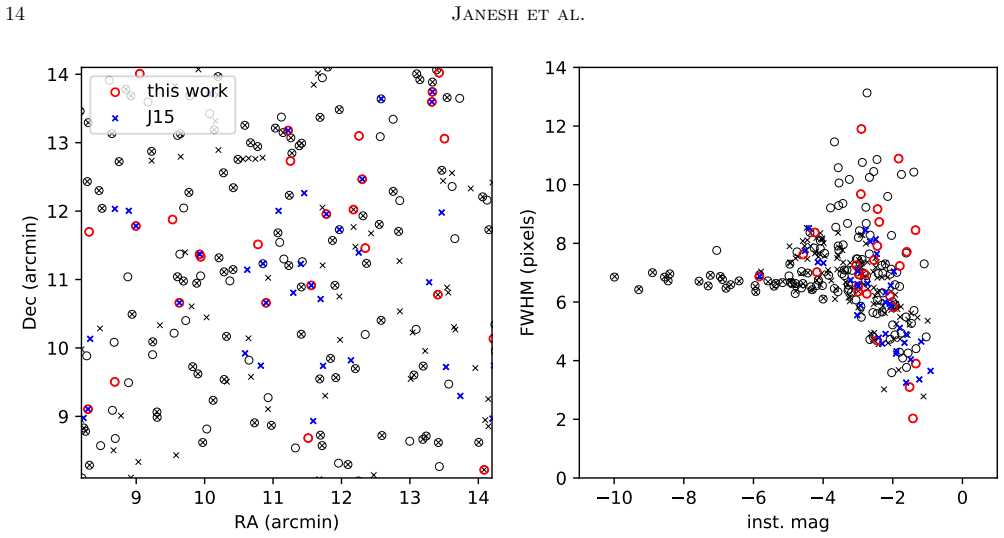
- [Section 4.1 and Figure 6] The reanalysis of AGC 198606 changes the previously reported detection at ~380 kpc (J15) into a different overdensity at 880 kpc, located 9 arcmin away, with essentially all stars in the original overdensity removed by the revised extended-source cut. This demonstrates that at least one reported detection and its derived distance depend sensitively on the source-classification procedure. Because AGC 198606 is one of the five robust detections in Table 2, the paper should demonstrate the stability of the other four detections to the same extended-source-cut choice, or explicitly discuss the implications of this sensitivity for the reliability of the sample. The current presentation makes it difficult to assess how much of the final list is robust against modest analysis choices.
minor comments (4)
- [Table 2] The column headers for the optical properties are difficult to parse: 'MV a (faint)a (bright)' and 'log M* a (faint)a (bright)' mix subscripts, superscripts, and the faint/bright estimate labels in a way that is not self-explanatory. Please use separate clear subheadings for the summed-star and aperture magnitude estimates and state the units.
- [Section 5.1] The inequality '−1.4 > M_V > −7.1' is confusing and appears to invert the usual magnitude ordering; I recommend writing the range as 'M_V between −7.1 and −1.4' or '−7.1 < M_V < −1.4'.
- [Figure 6] The right panel labels 'inst. mag' and 'FWHM (pixels)' are not defined in the caption; please spell out 'instrumental magnitude' and describe the FWHM measurement (e.g., the average PSF FWHM in the image).
- [Section 5.2] The incidence rate is quoted as '5 out of 23' overall, but the 23 observed fields are a prioritized subsample of the 59-object optical follow-up sample. Please clarify that this is not an unbiased, volume-limited rate and discuss how the selection criteria might affect the comparison with the Sawala et al. (2016) prediction.
Assumptions & free parameters
free parameters (5)
- Isochrone age range =
8-14 Gyr
- Isochrone metallicity range =
Z = 0.0001-0.0004
- Smoothing kernel FWHM =
2-3 arcmin
- Significance threshold for robust detection =
xi > 97%
- Extended-source cut sigma =
3 standard deviations
assumptions (4)
- domain assumption The stellar population of UCHVC counterparts is old (8-14 Gyr) and metal-poor (Z = 0.0001-0.0004).
- domain assumption A uniform random spatial distribution is an appropriate null hypothesis for the significance test.
- domain assumption The distance modulus at which the overdensity significance peaks is the true distance.
- standard math The Girardi et al. (2004) isochrones accurately represent the CMD of old metal-poor populations.
Cite this review
Pith. "Pith review of Five Gas-rich Ultra-faint Dwarf Galaxy Candidates Discovered in WIYN Imaging of ALFALFA Sources." pith.science (2026). https://pith.science/paper/X5JTDHJB
@misc{pith2026190800438,
  author       = {Pith},
  title        = {Pith review of: Five Gas-rich Ultra-faint Dwarf Galaxy Candidates Discovered in WIYN Imaging of ALFALFA Sources},
  year         = {2026},
  howpublished = {\url{https://pith.science/paper/X5JTDHJB}},
  note         = {Machine review of arXiv:1908.00438}
}
abstract
We present results from the analysis of WIYN pODI imaging of 23 ultra-compact high-velocity clouds (UCHVCs), which were identified in the ALFALFA HI survey as possible dwarf galaxies in or near the Local Group. To search for a resolved stellar population associated with the HI gas in these objects, we carried out a series of steps designed to identify stellar overdensities in our optical images. We identify five objects that are likely stellar counterparts to the UCHVCs, at distances of $\sim 350$ kpc to $\sim 1.6$ Mpc. Two of the counterparts were already described in Janesh et al. (2015) and Janesh et al. (2017); the estimated distance and detection significance for one of them changed in the final analysis of the full pODI data set. At their estimated distances, the detected objects have HI masses from $2 \times 10^4$ to $3 \times 10^6$ Msun, $M_V$ from -1.4 to -7.1, and stellar masses from $4 \times 10^2$ to $4 \times 10^5$ Msun. None of the objects shows evidence of a young stellar population. Their properties would make the UCHVCs some of the most extreme objects in and around the Local Group, comparable to ultra faint dwarf galaxies in their stellar populations, but with significant gas content. Such objects probe the extreme end of the galaxy mass function, and provide a testbed for theories regarding the baryonic feedback processes that impact star formation and galaxy evolution in this low-mass regime.
Figures


Figures from the paper (4 more)



Reference graph
Works this paper leans on
-
[1]
&;R!xS,W.(< <_ :ۙ,Y 2fB OFfΩxsP x6۞g ) 2Q P< <|Kn* 2 1ypO ߫ E gmv 6 Gf jfu-nCBرsc- 6َ@ :љ>Ec 4hQ6MbHLJ ,!\'e >@ p j#hz7'6F>g
thebibliography [1] 20pt to REFERENCES 6pt =0pt 10pt plus 3pt =0pt =0pt =1pt plus 1pt =0pt =0pt -12pt =13pt plus 1pt =20pt =13pt plus 1pt \@M =10000 =-1.0em =0pt =0pt 0pt =0pt =1.0em @enumiv\@empty 10000 10000 `\.\@m \@noitemerr \@latex@warning Empty `thebibliography' environment \@ifnextchar \@reference \@latexerr Missing key on reference command Each re...
2015
-
[2]
Adams, E. A. K., Giovanelli, R., & Haynes, M. P.\ 2013, , 768, 77
work page 2013
-
[3]
Adams, E. A. K.\ 2014, Ph.D. Thesis, Cornell University
work page 2014
-
[4]
Adams, E. A. K., Faerman, Y., Janesh, W. F., et al.\ 2015, , 573, LL3
work page 2015
-
[5]
Adams, E. A. K., Cannon, J. M., Rhode, K. L., et al.\ 2015, , 580, A134
work page 2015
-
[6]
Adams, E. A. K., Oosterloo, T. A., Cannon, J. M., Giovanelli, R., & Haynes, M. P.\ 2016, , 596, A117
work page 2016
-
[7]
Adams, E. A. K., & Oosterloo, T. A.\ 2017, arXiv:1712.06636
arXiv 2017
-
[8]
Beccari, G., Bellazzini, M., Battaglia, G., et al.\ 2016, , 591, A56
work page 2016
Show all 73 references
-
[9]
Beccari, G., Bellazzini, M., Magrini, L., et al.\ 2017, , 465, 2189
2017
-
[10]
Bechtol, K., Drlica-Wagner, A., Balbinot, E., et al.\ 2015, , 807, 50
2015
-
[11]
N.\ 2003, , 409, 879
Begum, A., & Chengalur, J. N.\ 2003, , 409, 879
2003
-
[12]
F., McIntosh, D
Bell, E. F., McIntosh, D. H., Katz, N., & Weinberg, M. D.\ 2003, , 149, 289
2003
-
[13]
Bellazzini, M., Beccari, G., Battaglia, G., et al.\ 2015, , 575, A126
2015
-
[14]
Bellazzini, M., Magrini, L., Mucciarelli, A., et al.\ 2015, , 800, L15
2015
-
[15]
B., Evans, N
Belokurov, V., Zucker, D. B., Evans, N. W., et al.\ 2007, , 654, 897
2007
-
[16]
F., Frenk, C
Ben \' tez-Llambay, A., Navarro, J. F., Frenk, C. S., et al.\ 2017, , 465, 3913
2017
-
[17]
Z., Cannon, J
Bernstein-Cooper, E. Z., Cannon, J. M., Elson, E. C., et al.\ 2014, , 148, 35
2014
-
[18]
N., Teuben, P
Blitz, L., Spergel, D. N., Teuben, P. J., Hartmann, D., & Burton, W. B.\ 1999, , 514, 818
1999
-
[19]
S., & Ricotti, M.\ 2011, , 741, 18
Bovill, M. S., & Ricotti, M.\ 2011, , 741, 18
2011
-
[20]
B.\ 1999, , 341, 437
Braun, R., & Burton, W. B.\ 1999, , 341, 437
1999
-
[21]
M., Giovanelli, R., Haynes, M
Cannon, J. M., Giovanelli, R., Haynes, M. P., et al.\ 2011, , 739, L22
2011
-
[22]
J., & Stilp, A
Dalcanton, J. J., & Stilp, A. M.\ 2010, , 721, 547
2010
-
[23]
de Jong, J. T. A., Harris, J., Coleman, M. G., et al.\ 2008, , 680, 1112-1119
2008
- [24]
-
[25]
J., Weinberg, D
Eisenstein, D. J., Weinberg, D. H., Agol, E., et al.\ 2011, , 142, 72
2011
-
[26]
G., Zhang, H.-X., & Hunter, D
Elmegreen, B. G., Zhang, H.-X., & Hunter, D. A.\ 2012, , 747, 105
2012
-
[27]
P., Kent, B
Giovanelli, R., Haynes, M. P., Kent, B. R., et al.\ 2005, , 130, 2598
2005
-
[28]
P., Kent, B
Giovanelli, R., Haynes, M. P., Kent, B. R., & Adams, E. A. K.\ 2010, , 708, L22
2010
-
[29]
P., Adams, E
Giovanelli, R., Haynes, M. P., Adams, E. A. K., et al.\ 2013, , 146, 15
2013
-
[30]
K., Odenkirchen, M., & Chiosi, C.\ 2004, , 422, 205
Girardi, L., Grebel, E. K., Odenkirchen, M., & Chiosi, C.\ 2004, , 422, 205
2004
-
[31]
P., Giovanelli, R., Martin, A
Haynes, M. P., Giovanelli, R., Martin, A. M., et al.\ 2011, , 142, 170
2011
-
[32]
P., Giovanelli, R., Kent, B
Haynes, M. P., Giovanelli, R., Kent, B. R., et al.\ 2018, , 861, 49
2018
-
[33]
S., Salzer, J
Hirschauer, A. S., Salzer, J. J., Skillman, E. D., et al.\ 2016, , 822, 108
2016
-
[34]
J., Belokurov, V., Evans, N
Irwin, M. J., Belokurov, V., Evans, N. W., et al.\ 2007, , 656, L13
2007
-
[35]
L., Salzer, J
Janesh, W., Rhode, K. L., Salzer, J. J., et al.\ 2015, , 811, 35
2015
-
[36]
L., Salzer, J
Janesh, W., Rhode, K. L., Salzer, J. J., et al.\ 2017, , 837, L16
2017
-
[37]
Janowiecki, S., Leisman, L., J \'o zsa, G., et al.\ 2015, , 801, 96
2015
-
[38]
G., Papastergis, E., Haynes, M
Jones, M. G., Papastergis, E., Haynes, M. P., & Giovanelli, R.\ 2016, , 457, 4393
2016
-
[39]
Kauffmann, G., White, S. D. M., & Guiderdoni, B.\ 1993, , 264, 201
1993
-
[40]
V., Valenzuela, O., & Prada, F.\ 1999, , 522, 82
Klypin, A., Kravtsov, A. V., Valenzuela, O., & Prada, F.\ 1999, , 522, 82
1999
-
[41]
E., Belokurov, V., Torrealba, G., & Evans, N
Koposov, S. E., Belokurov, V., Torrealba, G., & Evans, N. W.\ 2015, , 805, 130
2015
-
[42]
Kotulla, R.\ 2014, Astronomical Society of the Pacific Conference Series, 485, 375
2014
-
[43]
F., Ibata, R
Martin, N. F., Ibata, R. A., Chapman, S. C., Irwin, M., & Lewis, G. F.\ 2007, , 380, 281
2007
-
[44]
W.\ 2012, , 144, 4
McConnachie, A. W.\ 2012, , 144, 4
2012
-
[45]
S.\ 2012, , 143, 40
McGaugh, S. S.\ 2012, , 143, 40
2012
-
[46]
T., Teich, Y
McNichols, A. T., Teich, Y. G., Nims, E., et al.\ 2016, , 832, 89
2016
-
[47]
McQuinn, K. B. W., Skillman, E. D., Dolphin, A., et al.\ 2015, , 812, 158
2015
-
[48]
Moore, B., Ghigna, S., Governato, F., et al.\ 1999, , 524, L19
1999
-
[49]
S., et al.\ 2015, arXiv:1502.02036
O \ n orbe, J., Boylan-Kolchin, M., Bullock, J. S., et al.\ 2015, arXiv:1502.02036
2015 arXiv
-
[50]
Peek, J. E. G., Heiles, C., Douglas, K. A., et al.\ 2011, , 194, 20
2011
-
[51]
Revaz, Y., & Jablonka, P.\ 2018, arXiv:1801.06222
2018 arXiv
-
[52]
L., Salzer, J
Rhode, K. L., Salzer, J. J., Haurberg, N. C., et al.\ 2013, , 145, 149
2013
-
[53]
V., Begum, A., Oosterloo, T., et al.\ 2008, , 384, 535
Ryan-Weber, E. V., Begum, A., Oosterloo, T., et al.\ 2008, , 384, 535
2008
-
[54]
J., Crnojevi \'c , D., Bennet, P., et al.\ 2015, , 806, 95
Sand, D. J., Crnojevi \'c , D., Bennet, P., et al.\ 2015, , 806, 95
2015
-
[55]
J., Seth, A
Sand, D. J., Seth, A. C., Crnojevi \'c , D., et al.\ 2017, , 843, 134
2017
-
[56]
S., Fattahi, A., et al.\ 2016, , 456, 85
Sawala, T., Frenk, C. S., Fattahi, A., et al.\ 2016, , 456, 85
2016
-
[57]
J., Finkbeiner, D
Schlegel, D. J., Finkbeiner, D. P., & Davis, M.\ 1998, , 500, 525
1998
-
[58]
& Finkbeiner, D.P
Schlafly, E.F. & Finkbeiner, D.P. 2011, , 737, 103
2011
-
[59]
D., Allende Prieto, C., et al.\ 2016, arXiv:1608.02013
SDSS Collaboration, Albareti, F. D., Allende Prieto, C., et al.\ 2016, arXiv:1608.02013
2016 arXiv
-
[60]
D., Salzer, J
Skillman, E. D., Salzer, J. J., Berg, D. A., et al.\ 2013, , 146, 3
2013
-
[61]
S., Willman, B., & Aguirre, J
Spekkens, K., Urbancic, N., Mason, B. S., Willman, B., & Aguirre, J. E.\ 2014, , 795, L5
2014
-
[62]
F., & Wolfire, M
Sternberg, A., McKee, C. F., & Wolfire, M. G.\ 2002, , 143, 419
2002
-
[63]
J., Geha, M
Tollerud, E. J., Geha, M. C., Grcevich, J., Putman, M. E., & Stern, D.\ 2015, , 798, L21
2015
-
[64]
J., Geha, M
Tollerud, E. J., Geha, M. C., Grcevich, J., et al.\ 2016, , 827, 89
2016
-
[65]
B., Courtois, H
Tully, R. B., Courtois, H. M., Dolphin, A. E., et al.\ 2013, , 146, 86
2013
-
[66]
B., & Fisher, J
Tully, R. B., & Fisher, J. R.\ 1977, , 54, 661
1977
-
[67]
P., Salzer, J
van Zee, L., Haynes, M. P., Salzer, J. J., & Broeils, A. H.\ 1997, , 113, 1618
1997
-
[68]
Vandenbroucke, B., Verbeke, R., & De Rijcke, S.\ 2016, , 458, 912
2016
-
[69]
Verbeke, R., Vandenbroucke, B., & De Rijcke, S.\ 2015, , 815, 85
2015
-
[70]
M., Willman, B., & Jerjen, H.\ 2009, , 137, 450
Walsh, S. M., Willman, B., & Jerjen, H.\ 2009, , 137, 450
2009
-
[71]
Willman, B., et al.\ 2005, , 129, 2692
2005
-
[72]
W., et al.\ 2006, arXiv:astro-ph/0603486
Willman, B., Masjedi, M., Hogg, D. W., et al.\ 2006, arXiv:astro-ph/0603486
2006 arXiv
-
[73]
M., Skillman, E
Young, L. M., Skillman, E. D., Weisz, D. R., et al.\ 2007, , 659, 331
2007
Reviewed August 14, 2026 · model on record in the stance chip above.
Discussion (0). Continue with ORCID to comment.