REVIEW 24 references
On the existence of paradoxical motions of generically rigid graphs on the sphere
T0 review · reviewed 2026-08-14 · deepseek-v4-flash
Pith's one-line read A graph has a flexible assignment of spherical edge lengths if and only if it admits a NAP-coloring, and K3,3 has exactly three proper spherical motions: two Dixon-type motions and one new constant diagonal angle motion.
The pith
A machine-rendered reading of the paper's core claim, the machinery that carries it, and where it could break.
The reading
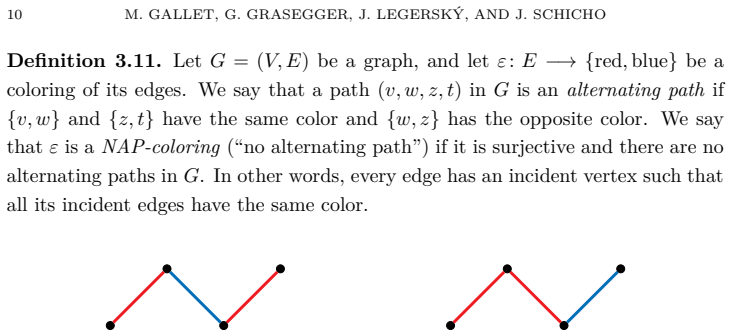
The proof has two halves. One half is constructive: if a NAP-coloring exists, the vertices that touch both colors are placed at the two poles of the sphere, and the blue subgraph is rotated around the polar axis while the red subgraph stays still. The other half uses algebraic geometry: realizations on the sphere are translated into points of a moduli space of curves, and a flexible framework must degenerate at the boundary of this moduli space, producing a colored cut called a bond that is exactly a NAP-coloring.
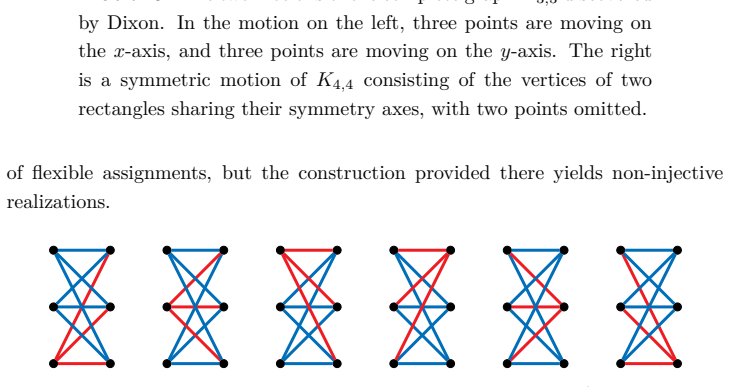
The second part of the paper is a case study of the smallest generically rigid graph that admits paradoxical motion on the sphere, the complete bipartite graph K3,3. Using a careful classification of how its 4-vertex subgraphs move, the authors show there are only three possible motions with no coincident or antipodal vertices: two spherical versions of Dixon's classical planar motions, and a third, new motion in which the angle between two diagonals of a 4-cycle stays constant. This new motion is described by an explicit parametrization.
Extended reading notes
Core claim
Theorem 3.14: "Let G be a connected graph without multiedges, or self-loops. Then G admits a flexible assignment of edge lengths on the sphere if and only if it admits a NAP-coloring." If the paper is correct, the combinatorial NAP-coloring condition completely determines which graphs can be flexed on the sphere for some choice of edge lengths, including generically rigid Laman graphs.
Load-bearing premise
The only-if direction of Theorem 3.14 and all of Section 4 depend on the moduli-space reduction imported from the same-author paper [GGS19]: realizations of an n-vertex graph on the sphere up to SO(3) correspond to points in the compactified moduli space M̄_{0,2n}, and the spherical distance is read off as a cross-ratio of four lift points on a conic (Section 2, Definition 2.5 and surrounding text). That reduction is cited rather than reproved or machine-checked, so the bond and NAP-coloring conclusions inherit any error in it. Separately, the K3,3 classification assumes the completeness of the spherical quadrilateral classification of [GS88a, GS88b] and the correctness of the 26-case degree-table search (Lemma 4.18, Proposition 4.21).
Signed reviews
Editorial analysis
A structured set of objections, weighed in public.
Assumptions & free parameters
assumptions (5)
- domain assumption The GGS19 reduction: realizations on the sphere up to SO(3) correspond to points in M̄_{0,2n}; spherical distance is the cross-ratio of lifts; the map η: M̄_{0,2n} -> CM_n is surjective.
- standard math Keel's intersection theory of M̄_{0,n}, including quadratic relations in the Chow ring, is used to compute divisor intersection numbers in Section 4.1 (for example, Z·Dou = 0).
- domain assumption The classification of movable spherical quadrilaterals (general, odd/even deltoid, rhomboid, lozenge) from [GS88a, GS88b] is complete for real proper motions.
- ad hoc to paper A finite case analysis shows that only four type tables are allowed after inspecting the 26 degree-table orbits.
- domain assumption Generic rigidity on the sphere coincides with Laman graphs, as proved in [EJN+19].
Cite this review
Pith. "Pith review of On the existence of paradoxical motions of generically rigid graphs on the sphere." pith.science (2026). https://pith.science/paper/HKO66VYJ
@misc{pith2026190800467,
  author       = {Pith},
  title        = {Pith review of: On the existence of paradoxical motions of generically rigid graphs on the sphere},
  year         = {2026},
  howpublished = {\url{https://pith.science/paper/HKO66VYJ}},
  note         = {Machine review of arXiv:1908.00467}
}
abstract
We interpret realizations of a graph on the sphere up to rotations as elements of a moduli space of curves of genus zero. We focus on those graphs that admit an assignment of edge lengths on the sphere resulting in a flexible object. Our interpretation of realizations allows us to provide a combinatorial characterization of these graphs in terms of the existence of particular colorings of the edges. Moreover, we determine necessary relations for flexibility between the spherical lengths of the edges. We conclude by classifying all possible motions on the sphere of the complete bipartite graph with $3+3$ vertices where no two vertices coincide or are antipodal.
Figures


Figures from the paper (9 more)




Reference graph
Works this paper leans on
-
[1]
Oene Bottema, Die Bahnkurven eines merkw\"urdigen Zw\"olfstabgetriebes , \"Osterreichisches Ingenieur-Archiv 14 (1960), no. 3, 218--222
work page 1960
-
[2]
David Corinaldi, Massimo Callegari, and Jorge Angeles, Singularity-free path-planning of dexterous pointing tasks for a class of spherical parallel mechanisms, Mechanism and Machine Theory 128 (2018), 47--57
work page 2018
-
[3]
Dixon, On certain deformable frameworks , Messenger 29 (1899), no
Alfred C. Dixon, On certain deformable frameworks , Messenger 29 (1899), no. 2, 1--21
-
[4]
Yaser Eftekhari, Bill Jackson, Anthony Nixon, Bernd Schulze, Shin-ichi Tanigawa, and Walter Whiteley, Point-hyperplane frameworks, slider joints, and rigidity preserving transformations, Journal of Combinatorial Theory, Series B 135 (2019), 48--74
work page 2019
-
[5]
Terence Essomba and Linh Nguyen Vu, Kinematic analysis of a new five-bar spherical decoupled mechanism with two-degrees of freedom remote center of motion, Mechanism and Machine Theory 119 (2018), 184--197
work page 2018
-
[6]
Matteo Gallet, Georg Grasegger, and Josef Schicho, Counting realizations of Laman graphs on the sphere , Available at https://arxiv.org/abs/1903.01145 https://arxiv.org/abs/1903.01145
work page Pith review arXiv 1903
-
[7]
Georg Grasegger, Jan Legersk \'y , and Josef Schicho, Graphs with Flexible Labelings , Discrete & Computational Geometry (2018)
work page 2018
-
[8]
, Graphs with flexible labelings allowing injective realizations, Available at https://arxiv.org/abs/1811.06709 https://arxiv.org/abs/1811.06709
Show all 24 references
-
[9]
Gibson and Jon M
Christopher G. Gibson and Jon M. Selig, Movable hinged spherical quadrilaterals---I, Mechanism and Machine Theory 23 (1988), no. 1, 13--18
1988
-
[10]
1, 19--24
, Movable hinged spherical quadrilaterals---II singularities and reductions, Mechanism and Machine Theory 23 (1988), no. 1, 19--24
1988
-
[11]
us , Zijia Li , Josef Schicho , and Hans-Peter Schr\
G\'abor Heged\"us , Zijia Li , Josef Schicho , and Hans-Peter Schr\"ocker , The theory of bonds II: Closed 6R linkages with maximal genus , Journal of Symbolic Computation 68 (2015), 167--180
2015
-
[12]
us , Josef Schicho , and Hans-Peter Schr\
G\'abor Heged\"us , Josef Schicho , and Hans-Peter Schr\"ocker , The theory of bonds: A new method for the analysis of linkages , Mechanism and Machine Theory 70 (2013), 407--424
2013
-
[13]
2, 545--574
Sean Keel, Intersection theory of moduli space of stable n -pointed curves of genus zero , Transactions of the American Mathematical Society 330 (1992), no. 2, 545--574
1992
-
[14]
Knudsen, The projectivity of the moduli space of stable curves
Finn F. Knudsen, The projectivity of the moduli space of stable curves. II . T he stacks M_ g,n , Mathematica Scandinavica 52 (1983), no. 2, 161--199
1983
-
[15]
Gerard Laman, On graphs and rigidity of plane skeletal structures, Journal of Engineering Mathematics 4 (1970), 331--340
1970
-
[16]
1, 279--295
Zijia Li, Josef Schicho, and Hans-Peter Schr \"o cker, A survey on the theory of bonds, IMA Journal of Mathematical Control and Information 35 (2018), no. 1, 279--295
2018
-
[17]
5, 725--742
Georg Nawratil, Reducible compositions of spherical four-bar linkages with a spherical coupler component, Mechanism and Machine Theory 46 (2011), no. 5, 725--742
2011
-
[18]
, Reducible compositions of spherical four-bar linkages without a spherical coupler component, Mechanism and Machine Theory 49 (2012), 87--103
2012
-
[19]
Georg Nawratil and Helmut Stachel, Composition of spherical four-bar-mechanisms, New Trends in Mechanism Science (Dordrecht) (Doina Pisla, Marco Ceccarelli, Manfred Husty, and Burkhard Corves, eds.), Springer Netherlands, 2010, pp. 99--106
2010
-
[20]
Uber die Gliederung ebener Fachwerke , Zeitschrift f\
Hilda Pollaczek-Geiringer , \"Uber die Gliederung ebener Fachwerke , Zeitschrift f\"ur Angewandte Mathematik und Mechanik (ZAMM) 7 (1927), 58--72
1927
-
[21]
Jianwei Sun, Wenrui Liu, and Jinkui Chu, Synthesis of spherical four-bar linkage for open path generation using wavelet feature parameters, Mechanism and Machine Theory 128 (2018), 33--46
2018
-
[22]
Helmuth Stachel, On the flexibility and symmetry of overconstrained mechanisms, Philosophical Transactions of the Royal Society of London A: Mathematical, Physical and Engineering Sciences 372 (2013)
2013
-
[23]
Husty, On a nine-bar linkage, its possible configurations and conditions for paradoxical mobility, 12th World Congress on Mechanism and Machine Science, IFToMM 2007, 2007
Dominic Walter and Manfred L. Husty, On a nine-bar linkage, its possible configurations and conditions for paradoxical mobility, 12th World Congress on Mechanism and Machine Science, IFToMM 2007, 2007
2007
-
[24]
3, 257--262
Walter Wunderlich, On deformable nine-bar linkages with six triple joints , Indagationes Mathematicae (Proceedings) 79 (1976), no. 3, 257--262
1976
Reviewed August 14, 2026 · model on record in the stance chip above.
Discussion (0). Continue with ORCID to comment.