REVIEW 3 major objections 5 minor 93 references
A review of feature extraction and performance evaluation in epileptic seizure detection using EEG
T0 review · 3 major / 5 minor · reviewed 2026-08-14 · deepseek-v4-flash
Pith's one-line read Amplitude and variance EEG features, not frequency features, separated seizures from normal signals in the authors' Bayes-error experiment on the CHB-MIT database.
desk verdict Useful review, thin experimental claim: the feature catalog and complexity analysis are worth citing, but the 'significant features' result needs uncertainty quantification and a pre-specified threshold. read the letter →
The pith
A machine-rendered reading of the paper's core claim, the machinery that carries it, and where it could break.
The reading
What carries the argument
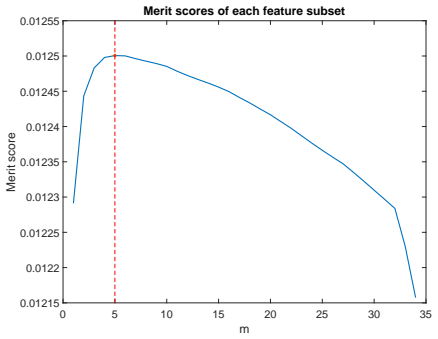
The carrying mechanism is the improvement rate over a prior-probability baseline: $\mathrm{err}_0 = P(C_2)$, and $\mathrm{rate} = (\mathrm{err}_0 - \mathrm{err}_b)/\mathrm{err}_0 \times 100\%$. The Bayes error $\mathrm{err}_b = \int \min_i P(C_i|x) p(x) dx$ is computed with Gaussian kernel density estimates $p(x|C_i)$ using bandwidth $h \approx 1.06 \hat{\sigma} N_i^{-1/5}$. Features whose improvement rate exceeds 4.5% are called significant, and then the CFS merit score $\mathrm{Merit}_F = k \bar{r}_{fc}/\sqrt{k + k(k-1)\bar{r}_{ff}}$ selects non-redundant subsets. This machinery lets the paper judge single features without training classifiers and compare them on the same footing.
What would settle it
Resample the 4,677 seizure epochs and 263,424 normal epochs to build bootstrap intervals for each feature's improvement rate; if the intervals for the eight claimed features overlap zero, or if changing the kernel bandwidth $h$ or the threshold around 4.5% changes which features qualify, the reported ranking fails. A reader could run this on the same CHB-MIT records and the reported procedure.
Extended reading notes
Core claim
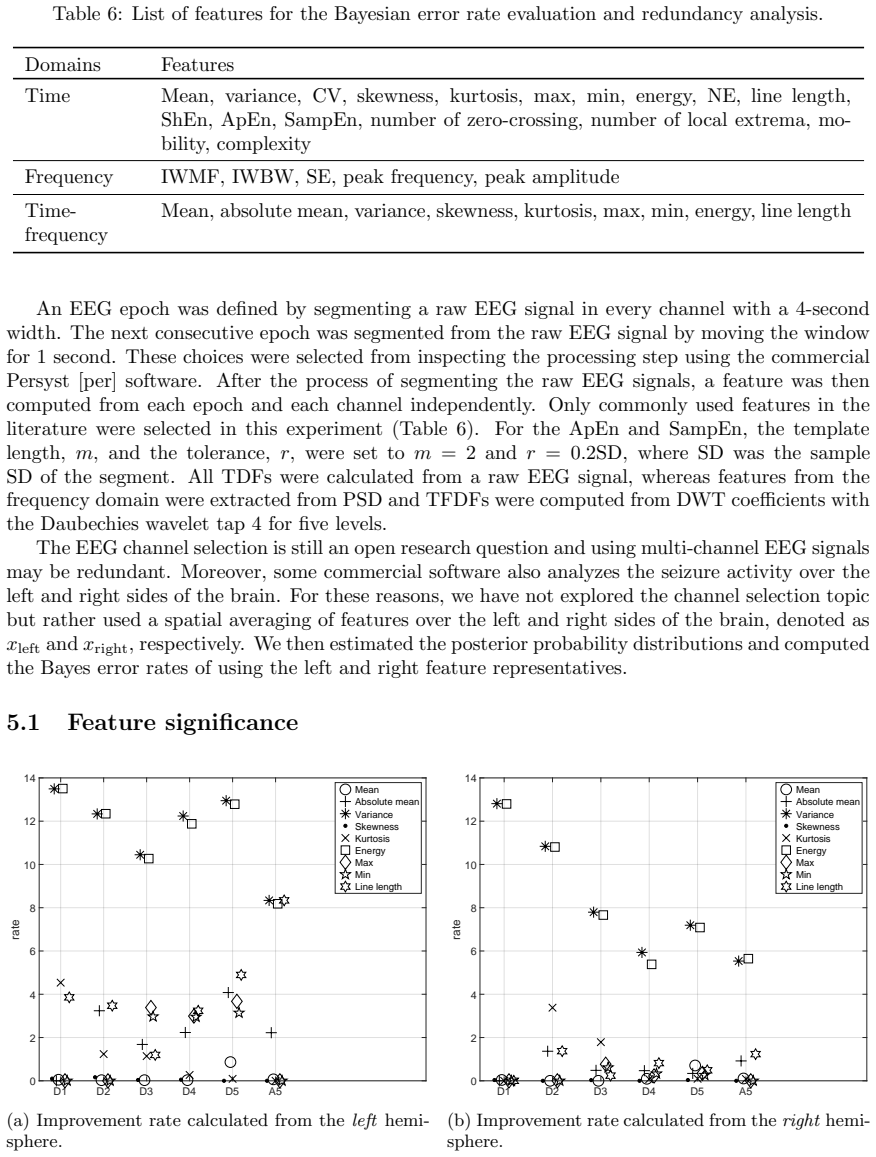
On the paper's own terms, the central discovery is a ranking of single-feature discriminative power for EEG seizure detection: the Bayes error rate drops by 4.77–13.51% relative to the prior-only baseline for the eight named features, while most statistical, entropy, and frequency-domain features do not move the error at all. In particular, energy computed on the D1 wavelet coefficients of the left hemisphere achieved the largest improvement (13.51%). The redundancy analysis further shows that five wavelet-domain variance/energy features—energy on D1 of the right side, variance on D5 and D1 of the left, energy on D5 of the left, and variance on D1 of the right—form an optimal subset under the CFS merit score, and summing their computations costs $O(N)$.
Load-bearing premise
The paper's ranking rests on treating a 4.5% improvement rate as the significance threshold and on trusting the kernel-density Bayes error estimates without error bars or statistical tests; if that threshold is arbitrary or the density estimates are unstable on the 4,677 available seizure epochs, the list of significant features is not supported.
Editorial extensions
If this is right
- Automatic seizure detectors can be built around variance, energy, nonlinear energy, and Shannon entropy from the raw signal, or variance, energy, kurtosis, and line length from wavelet coefficients, with a Bayes-error advantage of 4.77–13.51% over the baseline.
- The five non-redundant features selected by CFS all cost $O(N)$ per epoch, so real-time screening is plausible on modest hardware.
- Accuracy as a headline metric is misleading for imbalanced seizure data; epoch-based sensitivity/specificity and event-based good detection rate and false positives per hour should be reported together.
- Frequency-domain features such as spectral entropy, peak frequency, intensity-weighted mean frequency, and intensity-weighted bandwidth showed no improvement over baseline on this dataset, so they should not be relied on alone for scalp EEG seizure detection.
Reading between the lines
- The 4.5% threshold is presented without a statistical justification; the ranking should be read as descriptive of this dataset until bootstrap or permutation intervals are supplied.
- Because the paper attributes the weak frequency-domain results to artifacts, a cleaner recording setting or explicit artifact-removal preprocessing might change the ranking and deserves a direct test.
- The five-feature subset could be tested as a fixed, low-dimensional input for lightweight classifiers on held-out patients from the same database, which the review itself does not do.
- Applying the same single-feature Bayes-error protocol to other public EEG databases would show whether the amplitude/variance dominance generalizes beyond the CHB-MIT recordings.
Signed reviews
Editorial analysis
A structured set of objections, weighed in public.
Referee Report
Summary. This manuscript is a review of feature extraction and performance evaluation for automated epileptic seizure detection from EEG signals, supplemented by an original evaluation experiment. The review portions provide mathematical definitions of time-, frequency-, and time-frequency-domain features, discuss their computational complexity, summarize published detection results on the CHB-MIT and Bonn databases, and review epoch-based and event-based metrics. In the experimental portion, the authors use the CHB-MIT database to compute the Bayes error rate of each feature individually, with a class-prior baseline (err0 = 0.0174), and define an improvement rate as (err0 - errb)/err0. Features with improvement rates above 4.5% are declared significant; these include variance, energy, nonlinear energy, and Shannon entropy on raw EEG, and variance, energy, kurtosis, and line length on DWT coefficients. A correlation-based feature selection (CFS) then yields an optimal subset of five features, all computable in O(N) time. The paper concludes that these features 'significantly capture the seizures' with an improvement of 4.77-13.51% in Bayesian error from the baseline.
Significance. If the experimental claims were properly supported, this would be a useful contribution: the feature review with explicit mathematical formulas and complexity analysis is valuable as a reference, and the idea of benchmarking individual features against the class-prior Bayes error is a more principled comparison than raw classification accuracy on imbalanced data. The literature tables organized by database are also a convenient resource. However, the central quantitative claim of 'significant' features is not yet established because the significance criterion is post hoc and the reported improvements are not accompanied by any uncertainty quantification. The strengths of the review alone justify publication if the experimental conclusion is either repaired or softened to a descriptive finding.
major comments (3)
- [Section 5.1, sentence after Table 7] The statement 'The features with an improvement rate higher than 4.5% were considered as significant' is a post hoc threshold with no null distribution, no correction for multiple testing, and no justification. The word 'significantly' in the abstract and conclusions is therefore unsupported. A permutation test or a bootstrap null distribution over the class labels (or over records) is needed to determine whether the observed improvement rates exceed what would be expected by chance. This is load-bearing because the entire list of eight significant features and the subsequent redundancy analysis in Section 5.2 depend on this threshold.
- [Section 5.1, Eq. (26) and Table 7] The reported improvements are tiny absolute differences in Bayes error with no error bars or confidence intervals. For example, Table 7a lists variance with errb = 0.0160 versus err0 = 0.0174, a difference of 0.0014, and energy with a similar difference. The kernel density estimate uses a fixed bandwidth h ≈ 1.06 σ N^(-1/5) and a single random record selection. Moreover, the 4-second epochs slide by 1 second, so adjacent epochs overlap by 75%; the effective sample size is therefore far smaller than the reported 4,677 seizure epochs. Without record-level bootstrap or cluster-robust resampling, a difference of about 0.001 in error cannot be distinguished from estimation noise. The feature ranking and the CFS subset in Section 5.2 are not established as statistically significant.
- [Section 5, Table 5 and text 'We randomly chose two records from each case'] The experiment uses a single random selection of records with no reported seed or repetition. The choice of records can strongly affect the estimated densities and Bayes errors, especially for the minority seizure class. The authors should repeat the record selection (e.g., 100 random splits) and report the distribution of improvement rates, or use a record-wise bootstrap. Without this, the results may reflect the idiosyncrasies of the chosen 48 records rather than a general property of the features.
minor comments (5)
- [Section 2.4] The word 'exmaple' should be 'example'.
- [Section 3.2.2 heading] The heading 'F requency-domain features' contains an extra space and should be 'Frequency-domain features'.
- [Figure 1] The y-axis label 'rate' should specify that the values are percentages, consistent with the definition of rate in Eq. (26).
- [Reference [per]] The citation to the Persyst website lacks an access date and a full bibliographic entry; it is listed only as 'Accessed: 2019-4-25' in a footnote, which is fine, but the reference list does not include a formal entry.
- [Section 2.1, item 13] The definition of SVD entropy uses a matrix A without specifying how it is constructed from the epoch X; the subsequent sentence describes the delay method and channel rows, but the notation for the temporal construction (e.g., embedding dimension and lag) is not stated explicitly.
Circularity Check
No significant circularity: the experimental feature evaluation is an empirical measurement on a public database, not a derivation that reduces to its inputs.
full rationale
The central claim is that variance, energy, nonlinear energy, and Shannon entropy on raw EEG, plus variance, energy, kurtosis, and line length on wavelet coefficients, achieve a 4.77–13.51% improvement in Bayesian error over the baseline. This is produced by a direct empirical pipeline: features are computed on CHB-MIT epochs, class-conditional densities are estimated with a Gaussian kernel using a standard bandwidth rule, the Bayes error is obtained by numerical integration, and the improvement rate is defined as (err0 − errb)/err0 where err0 is the seizure-class prior (4,677/268,101 = 0.0174). No parameter is fitted to the output and then renamed as a prediction; the improvement rate is arithmetic from independently estimated densities. The correlation-based feature selection in Section 5.2 is a separate redundancy analysis and is not used to define the significance of individual features, so it does not make the feature ranking circular. The only self-citation found is the authors’ own prior work [SLUC15] appearing in the literature review tables, and the experimental conclusion does not rely on that citation. The 4.5% significance threshold and the lack of uncertainty estimates are statistical robustness concerns, not circularity, because the threshold is an evaluation criterion rather than an input that forces the reported numbers. Accordingly, no circular step can be quoted or exhibited, and the correct finding is no significant circularity.
Assumptions & free parameters
free parameters (5)
- Significance threshold for improvement rate =
4.5%
- Kernel bandwidth for density estimation =
1.06 sigma_hat N_i^(-1/5)
- Entropy parameters m and r =
m = 2, r = 0.2 SD
- Epoch and stride lengths =
4 s epoch, 1 s stride
- DWT decomposition level and wavelet =
5 levels, Daubechies 4
assumptions (5)
- domain assumption CHB-MIT annotations are correct and seizure versus normal labels reflect the true brain states.
- domain assumption Gaussian kernel density estimates with Silverman bandwidth give reliable univariate likelihoods.
- domain assumption A feature's univariate Bayes error is a valid proxy for its contribution in a multivariate classifier.
- ad hoc to paper The 4.5% improvement threshold is a meaningful significance criterion.
- domain assumption The randomly chosen two records per patient are representative of the database.
Cite this review
Pith. "Pith review of A review of feature extraction and performance evaluation in epileptic seizure detection using EEG." pith.science (2026). https://pith.science/paper/Q225TDFS
@misc{pith2026190800492,
  author       = {Pith},
  title        = {Pith review of: A review of feature extraction and performance evaluation in epileptic seizure detection using EEG},
  year         = {2026},
  howpublished = {\url{https://pith.science/paper/Q225TDFS}},
  note         = {Machine review of arXiv:1908.00492}
}
read the original abstract
Since the manual detection of electrographic seizures in continuous electroencephalogram (EEG) monitoring is very time-consuming and requires a trained expert, attempts to develop automatic seizure detection are diverse and ongoing. Machine learning approaches are intensely being applied to this problem due to their ability to classify seizure conditions from a large amount of data, and provide pre-screened results for neurologists. Several features, data transformations, and classifiers have been explored to analyze and classify seizures via EEG signals. In the literature, some jointly-applied features used in the classification may have shared similar contributions, making them redundant in the learning process. Therefore, this paper aims to comprehensively summarize feature descriptions and their interpretations in characterizing epileptic seizures using EEG signals, as well as to review classification performance metrics. To provide meaningful information of feature selection, we conducted an experiment to examine the quality of each feature independently. The Bayesian error and non-parametric probability distribution estimation were employed to determine the significance of the individual features. Moreover, a redundancy analysis using a correlation-based feature selection was applied. The results showed that the following features --variance, energy, nonlinear energy, and Shannon entropy computed on a raw EEG signal, as well as variance, energy, kurtosis, and line length calculated on wavelet coefficients-- were able to significantly capture the seizures. An improvement of 4.77--13.51% in the Bayesian error from the baseline was obtained.
Figures

Reference graph
Works this paper leans on
-
[1]
Alotaiby, F.E.A
T. Alotaiby, F.E.A. El-Samie, S.A. Alshebeili, and I. Ahmad. A review of channel selection algorithms for EEG signal processing. EURASIP Journal on Advances in Signal Processing , 2015(1):66--86, 2015
2015
-
[2]
Acharya, H
U.R. Acharya, H. Fujita, V.K. Sudarshan, S. Bhat, and J.E.W. Koh. Application of entropies for automated diagnosis of epilepsy using EEG signals: A review. Knowledge-Based Systems , 88:85--96, 2015
2015
-
[3]
U. R. Acharya, Y. Hagiwara, S. N. Deshpande, S. Suren, J. E. W. Koh, S. L. Oh, N. Arunkumar, E. J. Ciaccio, and C. M. Lim. Characterization of focal EEG signals: A review. Future Generation Computer Systems , 91:290--299, 2018
2018
-
[4]
Anand, S
S. Anand, S. Jaiswal, and P.K. Ghosh. Automatic focal epileptic seizure detection in EEG signals. In Proceedings of the 2017 IEEE International WIE Conference on Electrical and Computer Engineering , pages 103--107. IEEE, 2017
2017
-
[5]
Alickovic, J
E. Alickovic, J. Kevric, and A. Subasi. Performance evaluation of empirical mode decomposition, discrete wavelet transform, and wavelet packed decomposition for automated epileptic seizure detection and prediction. Biomedical Signal Processing and Control , 39:94--102, 2018
2018
-
[6]
Andrzejak, K
R.G. Andrzejak, K. Lehnertz, F. Mormann, C. Rieke, P. David, and C.E. Elger. Indications of nonlinear deterministic and finite-dimensional structures in time series of brain electrical activity: Dependence on recording region and brain state. Physical Review. E , 64(6):061907, 2001
2001
-
[7]
Assi, D.K
E.B. Assi, D.K. Nguyen, S. Rihana, and M. Sawan. Towards accurate prediction of epileptic seizures: A review. Biomedical Signal Processing and Control , 34:144--157, 2017
2017
-
[8]
Acharya, S.L
U.R. Acharya, S.L. Oh, Y. Hagiwara, J.H. Tan, and H. Adeli. Deep convolutional neural network for the automated detection and diagnosis of seizure using EEG signals. Computers in Biology and Medicine , 100(1):270--278, 2018
2018
Show all 93 references
-
[9]
Ammar and M
S. Ammar and M. Senouci. Seizure detection with single-channel EEG using extreme learning machine. In Proceedings of the 17th International Conference on Sciences and Techniques of Automatic Control and Computer Engineering , pages 776--779. IEEE, 2016
2016
-
[10]
R. G. Andrzejak, K. Schindler, and C. Rummel. Nonrandomness, nonlinear dependence, and nonstationarity of electroencephalographic recordings from epilepsy patients. Physical Review E , 86(4):046206, 2012
2012
-
[11]
Acharya, S.V
U.R. Acharya, S.V. Sree, G. Swapna, R.J. Martis, and J.S. Suri. Automated EEG analysis of epilepsy: A review. Knowledge-Based Systems , 45:147--165, 2013
2013
-
[12]
Ahmad, M
M.Z. Ahmad, M. Saeed, S. Saleem, and A.M. Kamboh. Seizure detection using EEG : A survey of different techniques. In Proceedings of the 2016 International Conference on Emerging Technologies , pages 1--6. IEEE, 2016
2016
-
[13]
Altunay, Z
S. Altunay, Z. Telatar, and O. Erogul. Epileptic EEG detection using the linear prediction error energy. Expert Systems with Applications , 37(8):5661--5665, 2010
2010
-
[14]
Aarabi, F
A. Aarabi, F. Wallois, and R. Grebe. Automated neonatal seizure detection: a multistage classification system through feature selection based on relevance and redundancy analysis. Clinical Neurophysiology , 117(2):328--340, 2006
2006
-
[15]
Boashash and S
B. Boashash and S. Ouelha. Designing high-resolution time--frequency and time--scale distributions for the analysis and classification of non-stationary signals: a tutorial review with a comparison of features performance. Digital Signal Processing , 77:120--152, 2018
2018
-
[16]
Bandt and B
C. Bandt and B. Pompe. Permutation entropy: a natural complexity measure for time series. Physical Review Letters , 88(17):174102, 2002
2002
-
[17]
Bryce and K.B
R.M. Bryce and K.B. Sprague. Revisiting detrended fluctuation analysis. Scientific Reports , 2:315--320, 2012
2012
-
[18]
Bandarabadi, C.A
M. Bandarabadi, C.A. Teixeira, J. Rasekhi, and A. Dourado. Epileptic seizure prediction using relative spectral power features. Clinical Neurophysiology , 126(2):237--248, 2015
2015
-
[19]
Chakraborti, A
S. Chakraborti, A. Choudhary, A. Singh, R. Kumar, and A. Swetapadma. A machine learning based method to detect epilepsy. International Journal of Information Technology , pages 1--7, 2018
2018
-
[20]
G. Chen. Automatic EEG seizure detection using dual-tree complex wavelet- Fourier features. Expert Systems with Applications , 41(5):2391--2394, 2014
2014
-
[21]
T. H. Cormen, Charles E. Leiserson, R. L. Rivest, and C. Stein. Introduction to Algorithms . MIT press, 2009
2009
-
[22]
W. Chen, Z. Wang, H. Xie, and W. Yu. Characterization of surface EMG signal based on fuzzy entropy. IEEE Transactions on Neural Systems and Rehabilitation Engineering , 15(2):266--272, 2007
2007
-
[23]
Devroye, L
L. Devroye, L. Gy \"o rfi, and G. Lugosi. A Probabilistic Theory of Pattern Recognition , volume 31. Springer Science & Business Media, 2013
2013
-
[24]
Dingle, R.D
A.A. Dingle, R.D. Jones, G.J. Carroll, and W.R. Fright. A multistage system to detect epileptiform activity in the EEG . IEEE Transactions on Biomedical Engineering , 40(12):1260--1268, 1993
1993
-
[25]
Esteller, J
R. Esteller, J. Echauz, T. Tcheng, B. Litt, and B. Pless. Line length: an efficient feature for seizure onset detection. In Proceedings of the 23rd Annual International Conference of the IEEE Engineering in Medicine and Biology Society , volume 2, pages 1707--1710. IEEE, 2001
-
[26]
Fisher, C
R.S. Fisher, C. Acevedo, A. Arzimanoglou, A. Bogacz, J.H. Cross, C.E. Elger, J. Jr Engel, L. Forsgren, J.A. French, M. Glynn, et al. ILAE official report: a practical clinical definition of epilepsy. Epilepsia , 55(4):475--482, 2014
2014
-
[27]
Faust, U
O. Faust, U. R. Acharya, H. Adeli, and A. Adeli. Wavelet-based EEG processing for computer-aided seizure detection and epilepsy diagnosis. Seizure , 26:56--64, 2015
2015
-
[28]
Falconer
K. Falconer. Fractal Geometry: Mathematical Foundations and Applications . John Wiley & Sons, 2004
2004
-
[29]
Faust, U.R
O. Faust, U.R. Acharya, L.C. Min, and B.H.C. Sputh. Automatic identification of epileptic and background EEG signals using frequency domain parameters. International Journal of Neural Systems , 20(02):159--176, 2010
2010
-
[30]
Fadlallah, B
B. Fadlallah, B. Chen, A. Keil, and J. Pr \' ncipe. Weighted-permutation entropy: A complexity measure for time series incorporating amplitude information. Physical Review. E , 87(2):022911, 2013
2013
-
[31]
Fergus, A
P. Fergus, A. Hussain, D. Hignett, D. Al-Jumeily, K. Abdel-Aziz, and H. Hamdan. A machine learning system for automated whole-brain seizure detection. Applied Computing and Informatics , 12(1):70--89, 2016
2016
-
[32]
Faust, Y
O. Faust, Y. Hagiwara, T.J. Hong, O.S. Lih, and U.R. Acharya. Deep learning for healthcare applications based on physiological signals: A review. Computer Methods and Programs in Biomedicine , 161:1--13, 2018
2018
-
[33]
Fukunaga
K. Fukunaga. Introduction to Statistical Pattern Recognition . Academic Press, Inc., second edition, 1990
1990
-
[34]
Fele- Z or z
G. Fele- Z or z . A faster algorithm for calculating the sample entropy. In Proceedings of the Middle-European Conference on Applied Theoretical Computer Science, Slovenia , 2013
2013
-
[35]
Goldberger, L.A.N
A.L. Goldberger, L.A.N. Amaral, L. Glass, J.M. Hausdorff, P.C. Ivanov, R.G. Mark, J.E. Mietus, G.B. Moody, C. Peng, and H.E. Stanley. Physio B ank, P hysio T oolkit, and P hysio N et. Circulation , 101(23):e215--e220, 2000
2000
-
[36]
Greene, S
B.R. Greene, S. Faul, W.P. Marnane, G. Lightbody, I. Korotchikova, and G.B. Boylan. A comparison of quantitative EEG features for neonatal seizure detection. Clinical Neurophysiology , 119(6):1248--1261, 2008
2008
-
[37]
Gotman, D
J. Gotman, D. Flanagan, J. Zhang, and B. Rosenblatt. Automatic seizure detection in the newborn: methods and initial evaluation. Electroencephalography and Clinical Neurophysiology , 103(3):356--362, 1997
1997
-
[38]
Gotman and P
J. Gotman and P. Gloor. Automatic recognition and quantification of interictal epileptic activity in the human scalp EEG . Electroencephalography and Clinical Neurophysiology , 41(5):513--529, 1976
1976
-
[39]
J. Gotman. Automatic recognition of epileptic seizures in the EEG . Electroencephalography and Clinical Neurophysiology , 54(5):530--540, 1982
1982
-
[40]
L. Guo, D. Rivero, J. Dorado, J.R. Rabunal, and A. Pazos. Automatic epileptic seizure detection in EEGs based on line length feature and artificial neural networks. Journal of Neuroscience Methods , 191(1):101--109, 2010
2010
-
[41]
L. Guo, D. Rivero, and A. Pazos. Epileptic seizure detection using multiwavelet transform based approximate entropy and artificial neural networks. Journal of Neuroscience Methods , 193(1):156--163, 2010
2010
-
[42]
Gupta, P
A. Gupta, P. Singh, and M. Karlekar. A novel signal modeling approach for classification of seizure and seizure-free EEG signals. IEEE Transactions on Neural Systems and Rehabilitation Engineering , 26(5):925--935, 2018
2018
-
[43]
M.A. Hall. Correlation-based feature selection for machine learning . PhD thesis, University of Waikato Hamilton, New Zealand, 1999
1999
-
[44]
T. Higuchi. Approach to an irregular time series on the basis of the fractal theory. Physica D: Nonlinear Phenomena , 31(2):277--283, 1988
1988
-
[45]
B. Hjorth. EEG analysis based on time domain properties. Electroencephalography and Clinical Neurophysiology , 29(3):306--310, 1970
1970
-
[46]
Hall and L.A
M.A. Hall and L.A. Smith. Feature subset selection: a correlation based filter approach. In Proceedings of the 4th International Conference on Neural Information Processing and Intelligent Information Systems , pages 855--858. Springer, 1997
1997
-
[47]
N.E. Huang. Hilbert- Huang transform and its applications , volume 16. World Scientific, 2014
2014
-
[48]
H.E. Hurst. Long-term storage capacity of reservoirs. Transactions of the American Society of Civil Engineers , 116:770--799, 1951
1951
-
[49]
Hellstr \"o m-Westas, L.S
L. Hellstr \"o m-Westas, L.S. de Vries, and I. Ros \'e n. An atlas of amplitude-integrated EEGs in the newborn . CRC Press, 2008
2008
-
[50]
Huang, Q
G. Huang, Q. Zhu, and C. Siew. Extreme learning machine: theory and applications. Neurocomputing , 70(1-3):489--501, 2006
2006
-
[51]
Janjarasjitt
S. Janjarasjitt. Epileptic seizure classifications of single-channel scalp EEG data using wavelet-based features and svm. Medical & Biological Engineering & Computing , 55(10):1743--1761, 2017
2017
-
[52]
Janjarasjitt
S. Janjarasjitt. Performance of epileptic single-channel scalp EEG classifications using single wavelet-based features. Australasian Physical & Engineering Sciences in Medicine , 40(1):57--67, 2017
2017
-
[53]
Jaiswal and H
A.K. Jaiswal and H. Banka. Local pattern transformation based feature extraction techniques for classification of epileptic EEG signals. Biomedical Signal Processing and Control , 34:81--92, 2017
2017
-
[54]
J.F. Kaiser. On a simple algorithm to calculate the energy of a signal. In Proceedings of the International Conference on Acoustics, Speech, and Signal Processing , pages 381--384. IEEE, 1990
1990
-
[55]
Kumar, V
T.S. Kumar, V. Kanhangad, and R.B. Pachori. Classification of seizure and seizure-free EEG signals using local binary patterns. Biomedical Signal Processing and Control , 15:33--40, 2015
2015
-
[56]
Kononenko, E
I. Kononenko, E. S imec, and M. Robnik- S ikonja. Overcoming the myopia of inductive learning algorithms with RELIEFF . Applied Intelligence , 7(1):39--55, 1997
1997
-
[57]
M. Li, W. Chen, and T. Zhang. Automatic epileptic EEG detection using DT-CWT -based non-linear features. Biomedical Signal Processing and Control , 34:114--125, 2017
2017
-
[58]
M. Li, W. Chen, and T. Zhang. Classification of epilepsy EEG signals using DWT -based envelope analysis and neural network ensemble. Biomedical Signal Processing and Control , 31:357--365, 2017
2017
-
[59]
P. Li, C. Karmakar, J. Yearwood, S. Venkatesh, M. Palaniswami, and C. Liu. Detection of epileptic seizure based on entropy analysis of short-term EEG . PloS one , 13(3):e0193691, 2018
2018
-
[60]
P. Li, C. Liu, K. Li, D. Zheng, C. Liu, and Y. Hou. Assessing the complexity of short-term heartbeat interval series by distribution entropy. Medical & Biological Engineering & Computing , 53(1):77--87, Jan 2015
2015
-
[61]
J. Li, J. Yan, X. Liu, and G. Ouyang. Using permutation entropy to measure the changes in EEG signals during absence seizures. Entropy , 16(6):3049--3061, 2014
2014
-
[62]
G. Manis. Fast computation of approximate entropy. Computer Methods and Programs in Biomedicine , 91(1):48--54, 2008
2008
-
[63]
Manis, M
G. Manis, M. Aktaruzzaman, and R. Sassi. Low computational cost for sample entropy. Entropy , 20(1):61--75, 2018
2018
-
[64]
Maynard, P.F
D.E. Maynard, P.F. Prior, and D.F. Scott. Device for continuous monitoring of cerebral activity in resuscitated patients. British Medical Journal , 4(5682):545--546, 1969
1969
-
[65]
Mursalin, Y
M. Mursalin, Y. Zhang, Y. Chen, and N.V. Chawla. Automated epileptic seizure detection using improved correlation-based feature selection with random forest classifier. Neurocomputing , 241:204--214, 2017
2017
-
[66]
H. Ocak. Automatic detection of epileptic seizures in EEG using discrete wavelet transform and approximate entropy. Expert Systems with Applications , 36(2):2027--2036, 2009
2027
-
[67]
Orosco, E
L. Orosco, E. Laciar, A.G Correa, A. Torres, and J.P. Graffigna. An epileptic seizures detection algorithm based on the empirical mode decomposition of EEG . In Proceedings of the Annual International Conference of the IEEE Engineering in Medicine and Biology Society , pages 2...
2009
-
[68]
E. Parzen. On estimation of a probability density function and mode. The Annals of Mathematical Statistics , 33(3):1065--1076, 1962
1962
-
[69]
https://www.persyst.com/technology/seizure-detection/
Seizure D etection. https://www.persyst.com/technology/seizure-detection/. Accessed: 2019-4-25
2019
-
[70]
Polat and S
K. Polat and S. G \"u ne s . Classification of epileptiform EEG using a hybrid system based on decision tree classifier and fast Fourier transform. Applied Mathematics and Computation , 187(2):1017--1026, 2007
2007
-
[71]
S.M. Pincus. Approximate entropy as a measure of system complexity. Proceedings of the National Academy of Sciences , 88(6):2297--2301, 1991
1991
-
[72]
Pauri, F
F. Pauri, F. Pierelli, G. Chatrian, and W.W. Erdly. Long-term EEG -video-audio monitoring: computer detection of focal EEG seizure patterns. Electroencephalography and Clinical Neurophysiology , 82(1):1--9, 1992
1992
-
[73]
Richman and J.R
J.S. Richman and J.R. Moorman. Physiological time-series analysis using approximate entropy and sample entropy. American Journal of Physiology-Heart and Circulatory Physiology , 278(6):H2039--H2049, 2000
2000
-
[74]
Roberts, W
S.J. Roberts, W. Penny, and I. Rezek. Temporal and spatial complexity measures for electroencephalogram based brain-computer interfacing. Medical & Biological Engineering & Computing , 37(1):93--98, 1999
1999
-
[75]
Shoeb, H
A.H. Shoeb, H. Edwards, J. Connolly, B. Bourgeois, S.T. Treves, and J. Guttag. Patient-specific seizure onset detection. Epilepsy & Behavior , 5(4):483--498, 2004
2004
-
[76]
Shoeb and J
A.H. Shoeb and J. Guttag. Application of machine learning to epileptic seizure detection. In Proceedings of the 27th International Conference on Machine Learning , pages 975--982, 2010
2010
-
[77]
Subasi and M.I
A. Subasi and M.I. Gursoy. EEG signal classification using PCA , ICA , LDA and support vector machines. Expert Systems with Applications , 37(12):8659--8666, 2010
2010
-
[78]
C.E. Shannon. A mathematical theory of communication. Bell System Technical Journal , 27(3):379--423, 1948
1948
-
[79]
A.H. Shoeb. Application of machine learning to epileptic seizure onset detection and treatment . PhD thesis, Massachusetts Institute of Technology, 2009
2009
-
[80]
Samiee, P
K. Samiee, P. Kovacs, and M. Gabbouj. Epileptic seizure classification of EEG time-series using rational discrete short-time Fourier transform. IEEE Transactions on Biomedical Engineering , 62(2):541--552, 2015
2015
-
[81]
Satirasethawong, A
C. Satirasethawong, A. Lek-Uthai, and K. Chomtho. Amplitude-integrated EEG processing and its performance for automatic seizure detection. In Proceedings of the 2015 IEEE International Conference on Signal and Image Processing Applications , pages 551--556. IEEE, 2015
2015
-
[82]
Salem, A
O. Salem, A. Naseem, and A. Mehaoua. Epileptic seizure detection from EEG signal using discrete wavelet transform and ant colony classifier. In Proceedings of the 2014 IEEE International Conference on Communications , pages 3529--3534. IEEE, 2014
2014
-
[83]
Thurman, E
D.J. Thurman, E. Beghi, C.E. Begley, A.T. Berg, J.R. Buchhalter, D. Ding, D.C. Hesdorffer, W.A. Hauser, L. Kazis, R. Kobau, et al. Standards for epidemiologic studies and surveillance of epilepsy. Epilepsia , 52(7):2--26, 2011
2011
-
[84]
Tzallas, M.G
A.T. Tzallas, M.G. Tsipouras, and D.I. Fotiadis. Automatic seizure detection based on time-frequency analysis and artificial neural networks. Computational Intelligence and Neuroscience , 2007, 2007
2007
-
[85]
Tzallas, M.G
A.T. Tzallas, M.G. Tsipouras, and D.I. Fotiadis. Epileptic seizure detection in EEGs using time--frequency analysis. IEEE Transactions on Information Technology in Biomedicine , 13(5):703--710, 2009
2009
-
[86]
Temko, E
A. Temko, E. Thomas, W. Marnane, G. Lightbody, and G. Boylan. EEG -based neonatal seizure detection with support vector machines. Clinical Neurophysiology , 122(3):464--473, 2011
2011
-
[87]
Temko, E
A. Temko, E. Thomas, W. Marnane, G. Lightbody, and G.B. Boylan. Performance assessment for EEG -based neonatal seizure detectors. Clinical Neurophysiology , 122(3):474--482, 2011
2011
-
[88]
Tawfik, S.M
N.S. Tawfik, S.M. Youssef, and M. Kholief. A hybrid automated detection of epileptic seizures in EEG records. Computers & Electrical Engineering , 53:177--190, 2016
2016
-
[89]
Vidyaratne and K.M
L.S. Vidyaratne and K.M. Iftekharuddin. Real-time epileptic seizure detection using EEG . IEEE Transactions on Neural Systems and Rehabilitation Engineering , 25(11):2146--2156, 2017
2017
-
[90]
D. Wang, D. Miao, and C. Xie. Best basis-based wavelet packet entropy feature extraction and hierarchical EEG classification for epileptic detection. Expert Systems with Applications , 38(11):14314--14320, 2011
2011
-
[91]
Yu and H
L. Yu and H. Liu. Efficient feature selection via analysis of relevance and redundancy. Journal of Machine Learning Research , 5(Oct):1205--1224, 2004
2004
-
[92]
Y. Yuan, G. Xun, K. Jia, and A. Zhang. A multi-view deep learning method for epileptic seizure detection using short-time fourier transform. In Proceedings of the 8th ACM International Conference on Bioinformatics, Computational Biology, and Health Informatics , pages 213--222...
2017
-
[93]
Z. Zhao, F. Morstatter, S. Sharma, S. Alelyani, A. Anand, and H. Liu. Advancing feature selection research. ASU Feature Selection Repository , pages 1--28, 2010
2010
Reviewed August 14, 2026 · model on record in the stance chip above.
Discussion (0). Continue with ORCID to comment.