REVIEW 3 major objections 4 minor 27 references
Deep Generative Model Driven Protein Folding Simulation
T0 review · 3 major / 4 minor · reviewed 2026-08-14 · deepseek-v4-flash
Pith's one-line read A deep generative model can act as an adaptive steering mechanism for molecular dynamics simulations, folding Fs-peptide to 1.6 Å root-mean-squared deviation from its native state and FSD-EY to 4.4 Å.
desk verdict A plausible proof-of-concept coupling a CVAE to adaptive MD for folding a small peptide, but the headline RMSD result is partly selected for and the factor-of-20 speedup claim is not controlled — worth a careful referee, not a pass as is. read the letter →
The pith
A machine-rendered reading of the paper's core claim, the machinery that carries it, and where it could break.
The reading
What carries the argument
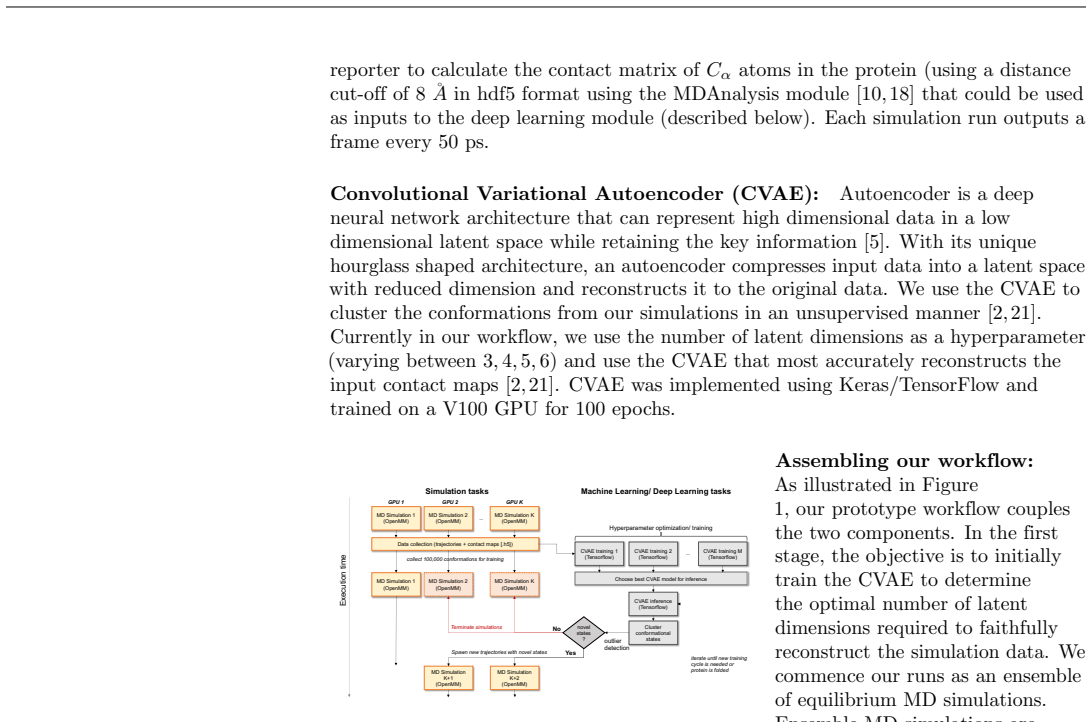
The central object is the convolutional variational autoencoder (CVAE), a neural network that compresses the Cα contact maps of conformations into a low-dimensional latent space and reconstructs them from that space. Trained unsupervised, it clusters the folding landscape into folded, partially folded, and unfolded states, giving a learned measure of novelty. The workflow couples the CVAE to all-atom MD by using DBSCAN outlier detection on the latent projections to select conformations that launch new simulations, which makes the generative model the decision-making component of an adaptive sampling loop.
What would settle it
A controlled run that replaces CVAE outlier selection with random frame selection, keeping every other step fixed, and compares the distribution of minimum RMSD reached; if random selection matches the adaptive workflow, the generative model is not the cause of the reported folding.
Extended reading notes
Core claim
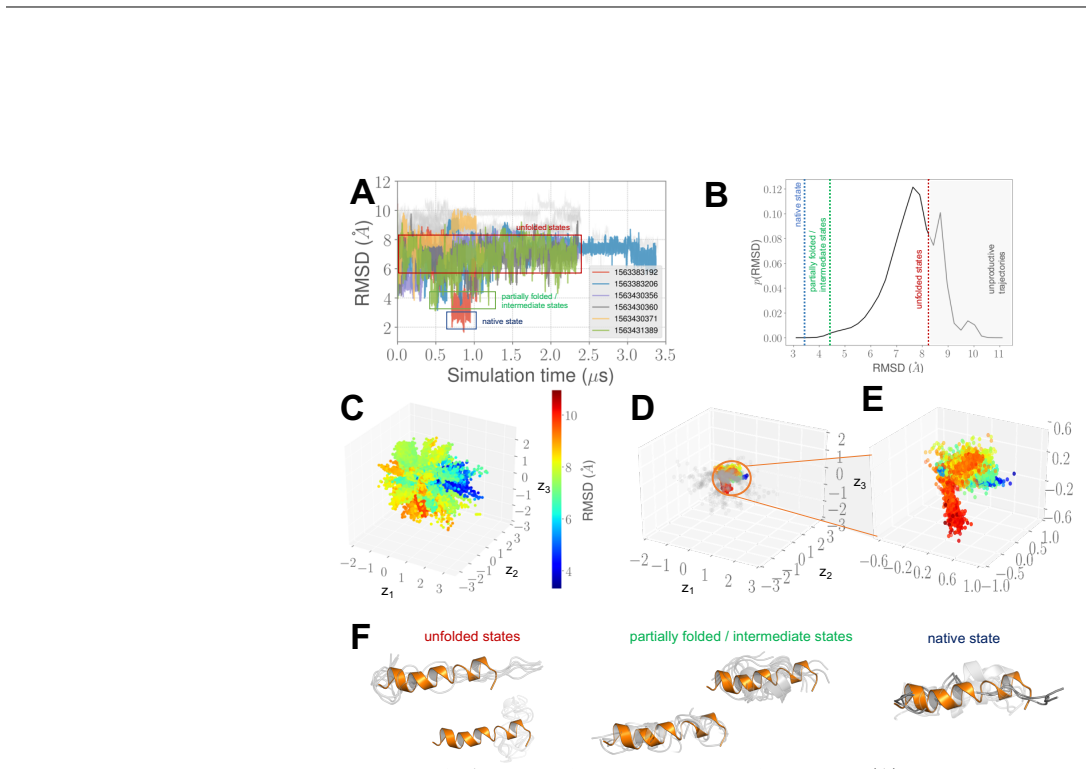
The authors' central claim is that the CVAE-learned latent space, built from Cα contact maps, organizes protein conformations by foldedness and can be used adaptively to drive MD simulations toward the native state. In the workflow, an initial ensemble of MD runs produces 100,000 conformations; the CVAE is trained on their contact maps; new frames are projected into latent space; DBSCAN flags outliers; and those outlier conformations seed the next round of simulations, repeating until a user-defined RMSD cutoff is reached. Using this protocol, the paper reports a minimum RMSD of 1.6 Å for Fs-peptide and 4.4 Å for FSD-EY, and it estimates at least a 20-fold effective-performance gain over vanilla MSM-based adaptive sampling when judged by convergence of the BBA system to within 4.5 Å. The authors further claim that folded, intermediate, and unfolded states separate into distinct clusters in the latent representation, so the learned dimensions function as reaction coordinates.
Load-bearing premise
The success metric and the selection criterion are both RMSD to the native state, so the reported folding could be driven by the workflow's explicit preference for low-RMSD seeds rather than by the generative model's novelty signal.
Editorial extensions
If this is right
- If the central claim is right, deep-learning-guided outlier selection can fold small helical proteins from extended starting structures within tens of microseconds of aggregate sampling.
- The same workflow can be pointed at harder folds such as ββα proteins and will approach, though may not fully reach, their native states without changing the physical model.
- CVAE-based adaptive sampling should outperform conventional Markov-state-model sampling by at least an order of magnitude on comparable targets, as estimated from the BBA comparison.
- Because training and inference costs are comparable to simulation cost per frame, adaptive decisions can be made online without stalling the simulation campaign.
Reading between the lines
- Editorial inference: the method's selection rule uses the same RMSD-to-native metric as its success criterion, so a control that seeds from random or density-minimum outliers would be needed to isolate the generative model's contribution.
- Editorial inference: if latent-space geometry carries the folding signal, the workflow may transfer to other rare-event problems, such as ligand binding or conformational transitions, where a target state can be scored by any low-dimensional metric.
- Editorial inference: the 20x effective-performance estimate comes from a single-system comparison, so a systematic benchmark across several proteins would reveal whether the factor is specific to BBA or general.
Signed reviews
Editorial analysis
A structured set of objections, weighed in public.
Referee Report
Summary. The paper describes an adaptive molecular-dynamics workflow in which a convolutional variational autoencoder (CVAE) is trained on contact maps from an ensemble of MD simulations and used to identify outlier or novel conformations from which new simulations are spawned. The workflow is applied to Fs-peptide and FSD-EY (BBA fold) using implicit-solvent all-atom MD on GPUs, and the authors report a minimum RMSD to the native state of 1.6 Å for Fs-peptide and 4.4 Å for FSD-EY. The Discussion also claims an effective-performance gain of at least a factor of 20 over a vanilla MSM-based adaptive sampling approach. The paper positions the work as a proof of concept that deep generative models can guide MD simulations toward folded states and highlights workflow-scheduling challenges on HPC systems.
Significance. If the central attribution is established, the paper would be a useful proof of concept for coupling deep generative models with adaptive MD sampling and for quantifying the infrastructure overhead of such workflows. The manuscript includes concrete workflow implementation details, aggregate simulation times of 54.2 µs and 18.6 µs for the two systems, a summary of DL training/inference costs in Table 2, and a commitment to release source code and data. These are genuine strengths. However, as described below, the experimental protocol does not currently separate the contribution of the CVAE from the direct selection pressure exerted by the RMSD-based restart criterion, so the main scientific claim is not yet established.
major comments (3)
- [Section 2.1] The restart-selection rule is circular with respect to the success metric. Section 2.1 states that a subset of conformations is selected for propagating MD runs 'based on their similarity to the native state (measured by the RMSD),' while the headline results in Table 1 and Figure 2 are minimum RMSDs to the native state. Repeatedly restarting from the lowest-RMSD frames available will reduce the observed minimum RMSD even if the CVAE contributes no useful representation. The manuscript reports no control experiments: no random-restart policy, no RMSD-greedy policy without the CVAE, and no identical-protocol MSM baseline. A concrete control comparing the reported workflow against a no-CVAE greedy RMSD selector is needed to support the claim that the deep generative model drives the folding.
- [Section 4] The factor-of-20 effective-performance claim is not supported by the data presented. The Discussion states that 'the effective performance of CVAE based sampling is at least a factor of 20 greater than vanilla MSM based sampling approaches,' citing Ref. [13], but no timing table, force-field comparison, solvent-model comparison, or wall-clock measurement is provided for either approach. The comparison is also between different implementations and, as far as the manuscript shows, different simulation protocols, and Ref. [13] shares authors with the present work. This claim should either be removed or substantiated with a controlled head-to-head comparison under matched conditions.
- [Section 3, Figure 2 and Table 1] The thresholds for folded, partially folded, and unfolded ensembles are chosen post hoc. The text says thresholds of 3.1 Å, 4.6 Å, and 8.3 Å are chosen 'based on the histograms' (Figure 2B), and Table 1 reports 'Min. RMSD' while the Abstract refers to an 'overall RMSD.' These are different quantities, and the adaptive loop uses a separate user-defined RMSD cutoff for termination. The paper should state explicitly whether the headline 1.6 Å is the global minimum over all trajectories, and should pre-specify or otherwise justify the thresholds and stopping criterion so that the reported success is not defined after seeing the results.
minor comments (4)
- [Section 3] There is a typo in the sentence 'When parameters such as the RMSD (to the native sztate)' — 'sztate' should be 'state.'
- [Figure 3 caption] The caption contains 'the trajecotries,' which should be 'the trajectories.'
- [Section 1] The Introduction contains 'worklfow' and 'high-peformance'; both should be corrected.
- [Section 2.2] The manuscript does not report the CVAE architecture (number and size of convolutional and dense layers, activation functions, optimizer, regularization) or the DBSCAN parameters (eps, min_samples) used for outlier detection; these details are needed for reproducibility.
Circularity Check
Restart selection in Section 2.1 uses the same RMSD-to-native metric that is later reported as the folding outcome, so the headline numbers are partly forced by the selection rule rather than by the CVAE alone.
-
self definitional
[Section 2.1 (Workflow description), 'Assembling our workflow', second stage; Results, Table 1]
"Based on their similarity to the native state (measured by the RMSD), a subset of these conformations are selected for propagating additional MD runs. The workflow is continued until the protein is folded (i.e., conformations reach a user-defined RMSD value to the native state)."
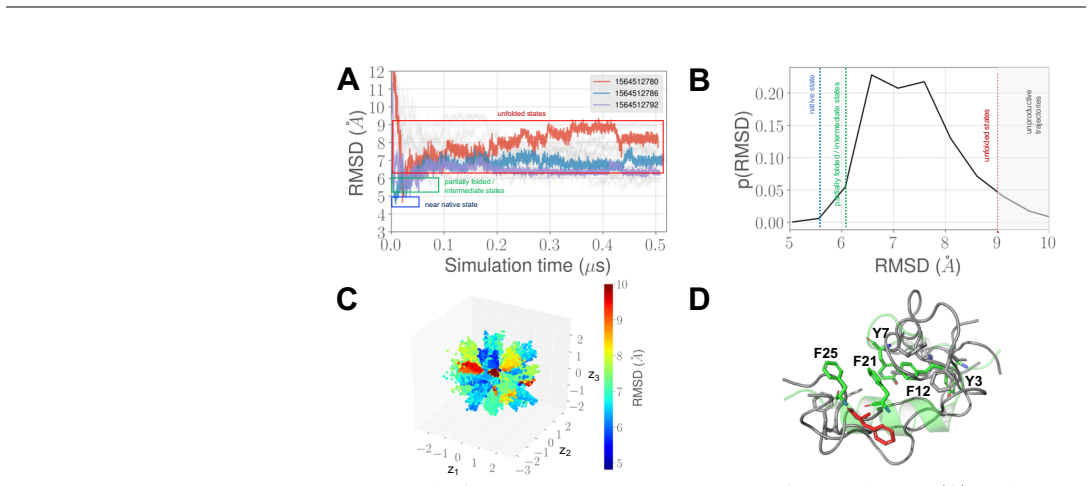
Table 1 reports the 'Min. RMSD' as the headline outcome (1.6 Å for Fs-peptide, 4.4 Å for FSD-EY), and Section 3 evaluates trajectories by an 'RMSD cut-off of 4.5 Å or less.' The restart-selection policy in Section 2.1 uses exactly the same quantity, RMSD to native, to choose which conformations to propagate. Thus the reported minimum RMSD is, by construction, the product of a greedy search on the evaluation metric: repeatedly restarting from low-RMSD frames will lower the observed minimum even if the CVAE contributes no useful representation. The paper reports no random-restart, RMSD-greedy-without-CVAE, or otherwise matched baseline, so the 1.6 Å / 4.4 Å numbers cannot establish that the deep generative model drives folding.
-
self citation load bearing
[Section 4 (Discussion), third paragraph]
"Using Ref. [13] as reference data, we find that the effective performance of CVAE based sampling is at least a factor of 20 greater than ”vanilla” MSM based sampling approaches. Our estimate is based upon the convergence of simulated BBA structures to its reference structures to within 4.5 ˚A."
The factor-of-20 efficiency claim is an informal, coarse-grained estimate (as the paper itself calls it) computed against Ref. [13], whose author list includes S. Jha, a co-author of the present paper. The comparison also invokes 'Effective Performance' from Ref. [9], another Jha-co-authored paper, and no controlled timing table or shared force-field/solvent protocol is provided in the current paper. The efficiency advantage therefore rests on the authors' own reference data rather than on an independent, same-protocol benchmark, and it cannot independently support the attribution of the folding result to CVAE-based sampling.
full rationale
The paper's CVAE training itself is not circular: the model consumes Cα contact maps, and the paper explicitly notes that RMSD to native is not part of the training data. The main circularity is in the adaptive loop. Section 2.1 states that the next starting conformations are selected 'based on their similarity to the native state (measured by the RMSD),' while Table 1 uses the minimum RMSD to native as the reported success metric (1.6 Å for Fs-peptide, 4.4 Å for FSD-EY). A policy that preferentially restarts from low-RMSD frames will mechanically reduce the observed minimum RMSD; without a random-restart or CVAE-free RMSD-greedy baseline, the deep generative model is not shown to be the cause of folding. This is a partial reduction of the outcome to the selection rule, so the score is 6 rather than 0. A secondary efficiency claim (factor-of-20 vs. vanilla MSM) is an informal estimate calibrated against Refs. [13] and [9], both with overlapping authorship, and lacks a controlled comparison; this is flagged as a self-citation load-bearing step, though it is not the central result.
Assumptions & free parameters
free parameters (4)
- latent_dimension =
3-6 (6 for BBA)
- RMSD_thresholds =
3.1/4.6/8.3 Å
- simulation_purge_thresholds =
20,000 frames (Fs), 10,000 frames (BBA), 5,000 frame stall
- DBSCAN_parameters =
not specified
assumptions (3)
- domain assumption CVAE latent space organizes conformations by biophysical properties such as RMSD to native state
- domain assumption Amber ff99SB-ildn force field with GBSA implicit solvent accurately models protein folding
- domain assumption DBSCAN outliers in the CVAE latent space correspond to novel and promising conformational states
Cite this review
Pith. "Pith review of Deep Generative Model Driven Protein Folding Simulation." pith.science (2026). https://pith.science/paper/CLKZFGOD
@misc{pith2026190800496,
  author       = {Pith},
  title        = {Pith review of: Deep Generative Model Driven Protein Folding Simulation},
  year         = {2026},
  howpublished = {\url{https://pith.science/paper/CLKZFGOD}},
  note         = {Machine review of arXiv:1908.00496}
}
abstract
Significant progress in computer hardware and software have enabled molecular dynamics (MD) simulations to model complex biological phenomena such as protein folding. However, enabling MD simulations to access biologically relevant timescales (e.g., beyond milliseconds) still remains challenging. These limitations include (1) quantifying which set of states have already been (sufficiently) sampled in an ensemble of MD runs, and (2) identifying novel states from which simulations can be initiated to sample rare events (e.g., sampling folding events). With the recent success of deep learning and artificial intelligence techniques in analyzing large datasets, we posit that these techniques can also be used to adaptively guide MD simulations to model such complex biological phenomena. Leveraging our recently developed unsupervised deep learning technique to cluster protein folding trajectories into partially folded intermediates, we build an iterative workflow that enables our generative model to be coupled with all-atom MD simulations to fold small protein systems on emerging high performance computing platforms. We demonstrate our approach in folding Fs-peptide and the $\beta\beta\alpha$ (BBA) fold, FSD-EY. Our adaptive workflow enables us to achieve an overall root-mean squared deviation (RMSD) to the native state of 1.6$~\AA$ and 4.4~$\AA$ respectively for Fs-peptide and FSD-EY. We also highlight some emerging challenges in the context of designing scalable workflows when data intensive deep learning techniques are coupled to compute intensive MD simulations.
Figures
Reference graph
Works this paper leans on
-
[2]
D. Bhowmik, S. Gao, M. T. Young, and A. Ramanathan. Deep clustering of protein folding simulations. BMC Bioinformatics , 19(18):484, 2018
work page 2018
-
[13]
Extensible and Scalable Adaptive Sampling on Supercomputers
E. Hruska, V. Balasubramanian, J. R. Ossyra, S. Jha, and C. Clementi. Extensible and scalable adaptive sampling on supercomputers. arXiv preprint arXiv:1907.06954, 2019
work page Pith review arXiv 1907
-
[1]
Adaptive Ensemble Biomolecular Simulations at Scale
V. Balasubramanian, T. Jensen, M. Turilli, P. M. Kasson, M. R. Shirts, and S. Jha. Implementing adaptive ensemble biomolecular applications at scale. CoRR, abs/1804.04736, 2018
work page Pith review arXiv 2018
-
[3]
G. R. Bowman, K. A. Beauchamp, G. Boxer, and V. S. Pande. Progress and challenges in the automated construction of markov state models for full protein systems. J Chem Phys , 131(12):124101, 2009
work page 2009
- [4]
-
[5]
C. Doersch. Tutorial on variational autoencoders. arXiv preprint arXiv:1606.05908, 2016
arXiv 2016
-
[6]
R. O. Dror, R. M. Dirks, J. Grossman, H. Xu, and D. E. Shaw. Biomolecular simulation: a computational microscope for molecular biology. Annu Rev Biophys , 41(1):429–452, 2012
work page 2012
-
[7]
P. Eastman, J. Swails, J. D. Chodera, R. T. McGibbon, Y. Zhao, K. A. Beauchamp, L.-P. Wang, A. C. Simmonett, M. P. Harrigan, C. D. Stern, R. P. Wiewiora, B. R. Brooks, and V. S. Pande. Openmm 7: Rapid development of high performance algorithms for molecular dynamics. PLOS Computational Biology, 13(7):1–17, 07 2017
work page 2017
Show all 27 references
-
[8]
Ester, H.-P
M. Ester, H.-P. Kriegel, J. Sander, and X. Xu. A density-based algorithm for discovering clusters in large spatial databases with noise. pages 226–231. AAAI Press, 1996
1996
-
[9]
G. Fox, J. A. Glazier, J. Kadupitiya, V. Jadhao, M. Kim, J. Qiu, J. P. Sluka, E. Somogyi, M. Marathe, A. Adiga, and S. Jha. Learning everywhere: Pervasive machine learning for effective high-performance computation. High-Performance Big Data Computing, IPDPS Workshop, Rio de J...
2019
-
[10]
R. J. Gowers, M. Linke, J. Barnoud, T. J. E. Reddy, M. N. Melo, S. L. Seyler, J. Domanski, D. L. Dotson, S. Buchoux, I. M. Kenney, and O. Beckstein. MDAnalysis: A python package for the rapid analysis of molecular dynamics 9/11 simulations. In Sebastian Benthall and Scott Rost...
2016
-
[11]
Gsponer and A
J. Gsponer and A. Caflisch. Molecular dynamics simulations of protein folding from the transition state. Proceedings of the National Academy of Sciences , 99(10):6719–6724, 2002
2002
-
[12]
N. S. Hinrichs and V. S. Pande. Calculation of the distribution of eigenvalues and eigenvectors in markovian state models for molecular dynamics. The Journal of Chemical Physics, 126(24):244101, 2007
2007
-
[14]
E. H. Lee, J. Hsin, M. Sotomayor, G. Comellas, and K. Schulten. Discovery through the computational microscope. Structure, 17(10):1295–1306
-
[15]
Lindorff-Larsen, P
K. Lindorff-Larsen, P. Maragakis, S. Piana, M. P. Eastwood, R. O. Dror, and D. E. Shaw. Systematic validation of protein force fields against experimental data. PLOS ONE , 7(2):e32131–, 02 2012
2012
-
[16]
Lindorff-Larsen, S
K. Lindorff-Larsen, S. Piana, R. O. Dror, and D. E. Shaw. How fast-folding proteins fold. Science, 334(6055):517–520, 2011
2011
-
[17]
R. T. McGibbon. Fs MD Trajectories. 5 2014
2014
-
[18]
Michaud-Agrawal, E
N. Michaud-Agrawal, E. J. Denning, T. B. Woolf, and O. Beckstein. Mdanalysis: A toolkit for the analysis of molecular dynamics simulations. J Comput Chem , 32(10), 2011
2011
-
[19]
Mittal and D
S. Mittal and D. Shukla. Recruiting machine learning methods for molecular simulations of proteins. Molecular Simulation, 44(11):891–904, 2018
2018
-
[20]
Onufriev, D
A. Onufriev, D. Bashford, and D. A. Case. Exploring protein native states and large-scale conformational changes with a modified generalized born model. Proteins: Structure, Function, and Bioinformatics , 55(2):383–394, 2004
2004
-
[21]
Romero, A
R. Romero, A. Ramanathan, T. Yuen, D. Bhowmik, M. Mathew, L. B. Munshi, S. Javaid, M. Bloch, D. Lizneva, A. Rahimova, A. Khan, C. Taneja, S.-M. Kim, L. Sun, M. I. New, S. Haider, and M. Zaidi. Mechanism of glucocerebrosidase activation and dysfunction in gaucher disease unrave...
2019
-
[22]
C. A. Sarisky and S. L. Mayo. The ββα fold: explorations in sequence space11edited by m. f. summers. Journal of Molecular Biology , 307(5):1411 – 1418, 2001
2001
-
[23]
A. J. Savol, V. M. Burger, P. K. Agarwal, A. Ramanathan, and C. S. Chennubhotla. QAARM: quasi-anharmonic autoregressive model reveals molecular recognition pathways in ubiquitin. Bioinformatics, 27(13):52–60, Jul 2011
2011
-
[24]
Shamsi, K
Z. Shamsi, K. J. Cheng, and D. Shukla. Reinforcement learning based adaptive sampling: Reaping rewards by exploring protein conformational landscapes. The Journal of Physical Chemistry B , 122(35):8386–8395, 09 2018. 10/11
2018
-
[25]
M. R. Shirts and V. S. Pande. Mathematical analysis of coupled parallel simulations. Phys Rev Lett , 86(22):4983–4987, May 2001
2001
-
[26]
Turilli, V
M. Turilli, V. Balasubramanian, A. Merzky, I. Paraskevakos, and S. Jha. Middleware building blocks for workflow systems. Computing in Science & Engineering (CiSE) special issue on Incorporating Scientific Workflows in Computing Research Processes, https://arxiv.org/abs/1903.10057
1903 arXiv
-
[27]
J. K. Weber and V. S. Pande. Characterization and rapid sampling of protein folding markov state model topologies. J Chem Theory Computat , 7(10):3405–3411, 2011. PMID: 22140370. 11/11
2011
Reviewed August 14, 2026 · model on record in the stance chip above.
Discussion (0). Continue with ORCID to comment.