REVIEW 5 major objections 5 minor 12 references
Radial Distribution of Blue Stragglers in NGC 5466 using AstroSat
T0 review · 5 major / 5 minor · reviewed 2026-08-14 · deepseek-v4-flash
Pith's one-line read Near-ultraviolet photometry combined with Gaia proper motions shows that blue stragglers in NGC 5466 are strongly concentrated toward the cluster center, and the previously reported rise in their numbers at large radius disappears once…
desk verdict Short IAU proceedings that uses UVIT + Gaia DR2 to clean the NGC 5466 BSS sample; central concentration is solid, but the 'no outer upturn' claim is not yet auditable. read the letter →
The pith
A machine-rendered reading of the paper's core claim, the machinery that carries it, and where it could break.
The reading
What carries the argument
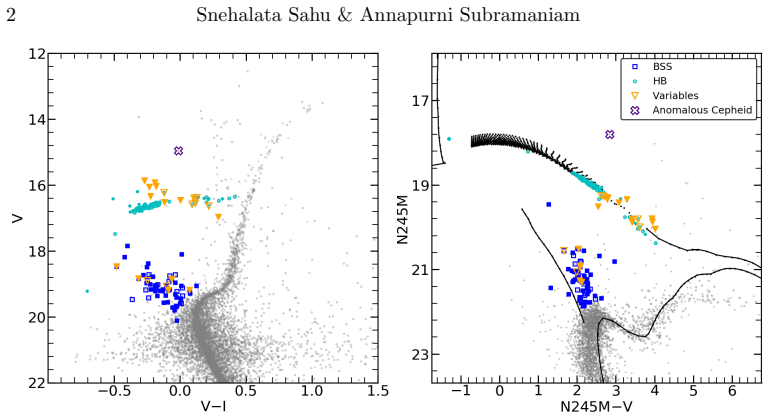
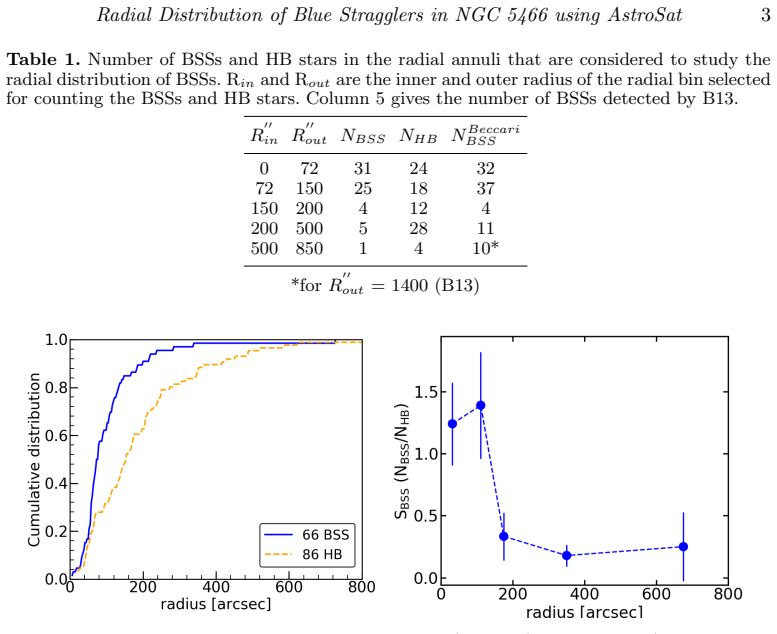
The central tool is the UV-optical color-magnitude diagram in $N245M$ versus $N245M-V$, constructed by cross-matching UVIT near-UV photometry with HST-ACS and ground-based data and then requiring Gaia DR2 proper-motion membership. This combination defines a clean blue-straggler sample. The paper then compares the cumulative radial distributions of blue stragglers and horizontal-branch stars using a Kolmogorov-Smirnov test, and computes the specific frequency $S_{\mathrm{BSS}}=N_{\mathrm{BSS}}/N_{\mathrm{HB}}$ in radial annuli matched to the earlier study, which is what exposes the first dip near $180''$ and the absence of an outer rise.
What would settle it
A reader could test this by obtaining spectroscopy or deeper UV photometry for the 15 rejected candidates: if any have radial velocities matching the cluster and UV-optical colors consistent with blue stragglers, the 'no upturn' result would be falsified. Alternatively, re-running the analysis with a stricter, explicitly quantified membership cut and checking whether the $500''$-$850''$ bin changes from one BSS to several would settle the issue.
Extended reading notes
Core claim
The central discovery is that in NGC 5466 the blue stragglers are more centrally concentrated than horizontal-branch stars, and the previously reported upturn in the blue-straggler specific frequency at large radius is not a real stellar-population signal. Combining the UVIT N245M near-UV filter with HST-ACS and ground-based optical data, and then filtering through Gaia DR2 proper motions, the authors reduce the earlier 94-candidate catalog to a clean sample of 66 cluster members. Fifteen candidates are rejected because they lack membership, are classified as quasars or galaxies, or fall outside the expected blue-straggler locus in the UV-optical color-magnitude diagram, mostly with $N245M-V>3.0$. The cumulative radial distributions of BSSs and horizontal-branch stars differ with KS probability about $5.7\times10^{-6}$, and the specific-frequency profile $S_{\mathrm{BSS}}=N_{\mathrm{BSS}}/N_{\mathrm{HB}}$ shows a minimum near $180''$ (about 1.5 half-mass radii) with no statistically significant rise beyond it.
Load-bearing premise
The conclusion that there is no outer upturn rests on rejecting 15 BSS candidates because their Gaia proper motions or UV-optical colors place them outside the adopted BSS locus; the paper gives no membership probability thresholds and uses a hand-set color boundary of $N245M-V>3.0$, so if even a few of these rejected stars are genuine cluster BSSs, the upturn could return (though the central concentration claim would survive).
Editorial extensions
If this is right
- The clean 66-member sample turns NGC 5466's blue-straggler radial distribution into a single declining one, removing the bimodal shape claimed from optical CMDs alone.
- The minimum near $180''$, close to 1.5 half-mass radii, places the dynamical-friction boundary and classifies NGC 5466 as a dynamically intermediate-age cluster, the second youngest in its family.
- Outer-region blue-straggler candidates in low-density clusters should not be trusted without proper-motion membership or UV colors.
- The same UV-plus-proper-motion procedure can serve as a template for cleaning blue-straggler samples in other globular clusters with claimed outer upturns.
- Tidal stripping, rather than a distinct outer stellar population, can explain the deficit of blue stragglers at large radii.
Reading between the lines
- If the conclusion is right, applying the same UV-plus-proper-motion cleaning with Gaia's improved later data releases could change reported bimodal blue-straggler distributions in other low-density globular clusters, many of which rely on optical selection alone.
- A fixed color cut such as $N245M-V>3.0$ could be replaced by a statistical outlier rejection in the UV CMD; doing so would show whether the 15 rejected candidates are rejected robustly or only because of the adopted boundary.
- If some genuine outer-region blue stragglers have hot companions, their UV-optical colors may be shifted redward out of the adopted locus; the color cut could then preferentially remove true cluster members and bias the radial profile toward the central concentration.
Signed reviews
Editorial analysis
A structured set of objections, weighed in public.
Referee Report
Summary. This IAU Symposium proceedings paper analyzes UVIT near-UV images of the globular cluster NGC 5466, cross-matched with optical photometry and Gaia DR2 astrometry, to study the radial distribution of blue straggler stars (BSSs). From an initial catalog of 94 BSS candidates, the authors retain 66 proper-motion members and report that these are more centrally concentrated than horizontal-branch (HB) stars, based on a Kolmogorov-Smirnov test with p ~ 5.7 x 10^-6. They further claim that the previously reported rising trend in the BSS radial distribution in the outer cluster regions disappears after removing non-members, quasars, and galaxies. The paper provides a table comparing BSS counts in radial bins with those of Beccari et al. (2013) and discusses implications for the cluster's dynamical state.
Significance. The paper demonstrates a promising combination of UVIT near-UV photometry and Gaia DR2 proper motions for cleaning BSS samples, an approach that is important for studies of low-density globular clusters. The KS-test comparison between BSSs and HB stars is a simple, transparent statistical test, and if the sample cleaning is reliable, the central-concentration result usefully confirms mass segregation in NGC 5466. However, the no-upturn claim in the outer regions is not firmly established: it hinges on the rejection of 15 candidates, the criteria for which are not fully specified or justified, and the outermost radial bin contains only one BSS. The paper's abstract states a stronger conclusion than the body text's caveats about poor statistics and incomplete coverage, so the manuscript needs revision before the conclusions can be relied upon.
major comments (5)
- [Section 2, Table 1] The sample accounting is incomplete and internally inconsistent. The text reports 8 proper-motion non-members (of which 3 are quasars) and 3 SDSS galaxies, and then states that 15 candidates were rejected because they do not qualify the CMD criteria, leaving 66 BSSs. Since 8+3+15=26 while 94-66=28, two candidates are unaccounted for, and it is unclear whether the 15 CMD rejections are disjoint from the previous 11. Because the no-upturn conclusion depends on which outer-region candidates are removed, the authors should provide a per-candidate disposition table listing all 94 Fekadu et al. candidates, including those without UVIT or Gaia matches.
- [Section 2, proper-motion membership] The membership selection is not defined quantitatively. The paper says only that Gaia DR2 data were used to select PM members, but it does not specify the proper-motion or parallax thresholds, the number of sigma, or the adopted cluster mean motion. Without this information, the claim that the 8 non-members are truly non-members cannot be verified, and the rejection procedure is not auditable. The authors should state their membership criterion explicitly, for example a proper-motion difference within 3 sigma of the cluster mean, and report the number of candidates rejected at each threshold.
- [Section 2, NUV color cut] The criterion N245M - V > 3.0 for rejecting candidates with redder NUV colors is introduced without justification or sensitivity analysis. Because the rejected candidates are stated to be mostly outside the half-light radius, the derived radial distribution and the no-upturn conclusion are sensitive to this hand-chosen boundary. The authors should show the radial distribution of BSSs when this cut is varied (e.g., 2.5, 3.5, or no cut) and should identify whether any of the 15 rejected candidates would remain in the BSS region under slightly relaxed criteria.
- [Section 2.1 and Abstract] The abstract claims 'We do not find a statistically significant rising trend in the radial distribution of BSSs for the outer regions,' but the text states that large errors and incomplete coverage 'prevents us from confirming whether the rise in the upturn as reported in the earlier study is significant or not.' These are logically different claims: one is a null result, the other an inconclusive measurement. With only one BSS in the 500-850 arcsec bin and no quoted uncertainty on S_BSS, the data cannot distinguish a rising trend from a flat distribution. The abstract should be made consistent with the text, or the authors should supply a quantitative significance test, such as a confidence interval or a likelihood comparison of flat versus rising models.
- [Section 2.1, KS test] The central-concentration result is based on the final cleaned sample, which has had outer-region candidates removed by the PM and NUV criteria. If those criteria preferentially remove BSSs (rather than HB stars) in the outer annuli, the KS test p-value could be biased in favor of central concentration. The authors should demonstrate the robustness of the KS result, for example by repeating the test on the full Fekadu et al. sample or on a sample that includes all candidates passing a relaxed membership criterion, and report these additional p-values.
minor comments (5)
- [Section 2] The phrase 'half-right radius' appears to be a typo for 'half-light radius'; please correct.
- [Table 1] The column header 'N Beccari BSS' could be more clearly labeled, for example 'N_BSS (B13)', to avoid confusion with the preceding sample column.
- [Section 2.1, Figure 2] The right panel shows S_BSS as a function of radius, but the uncertainties are not described; please state whether error bars are Poisson-based and how they are propagated from N_BSS and N_HB.
- [Section 2] The abbreviation 'SX Phes' should likely be 'SX Phe' as the plural of the variable-star class.
- [Section 1] The quantity 'log10 rho_c ~ 0.84 L_sun/pc^3' implies a logarithm of a dimensional quantity; consider writing log10(rho_c / (L_sun pc^-3)) ~ 0.84 for clarity.
Circularity Check
No significant circularity; the radial-distribution result is an empirical comparison of count samples, not a fitted or self-referential derivation.
full rationale
The paper's central claims—that BSSs are more centrally concentrated than HB stars and that no statistically significant outer upturn is found—are derived from counts of BSS and HB stars in radial annuli plus a Kolmogorov-Smirnov test. No equation in the paper defines the predicted quantity in terms of fitted parameters; the N245M-V > 3.0 cut is an explicit selection threshold, and the proper-motion rejection uses external Gaia DR2 astrometry rather than quantities derived from the same radial distribution being tested. The comparison with Beccari et al. (2013) uses similar annuli, but that is a re-analysis of the same cluster with different membership and UV-based cleaning, not a derivation from B13's conclusion. The only self-citations are Sahu et al. (2019), used for UVIT photometry details and a hot-companion detection; these are observational references and are not load-bearing for the radial-distribution conclusion. The manuscript's own caveat about poor statistics and incomplete coverage in the outermost bin is a correctness and robustness limitation, not a circularity. Thus no step reduces by construction to its input.
Assumptions & free parameters
free parameters (2)
- NUV color cut for BSS rejection =
N245M - V > 3.0 mag
- Outermost radial bin outer edge =
850 arcsec
assumptions (4)
- domain assumption Gaia DR2 proper motions accurately discriminate cluster members from field stars for BSS candidates in NGC 5466, including at large cluster radii.
- domain assumption Background-source classifications from Flesch (2015) and SDSS (quasars and galaxies) are correct, and these sources are not cluster BSSs.
- domain assumption The selected HB stars form an unbiased reference population for comparing radial distributions.
- domain assumption The Padova isochrone ([Fe/H] = -1.98, age 12.6 Gyr) adequately represents the cluster CMD and defines the expected BSS location.
Cite this review
Pith. "Pith review of Radial Distribution of Blue Stragglers in NGC 5466 using AstroSat." pith.science (2026). https://pith.science/paper/7IR4QN6Y
@misc{pith2026190800519,
  author       = {Pith},
  title        = {Pith review of: Radial Distribution of Blue Stragglers in NGC 5466 using AstroSat},
  year         = {2026},
  howpublished = {\url{https://pith.science/paper/7IR4QN6Y}},
  note         = {Machine review of arXiv:1908.00519}
}
abstract
We present the results obtained from Near-UV observations of the cluster NGC 5466 taken with UVIT onboard AstroSat to study the radial distribution of Blue Straggler Stars (BSSs), covering the cluster region up to a radius of 14$'$. Our study confirms that the BSSs are more centrally concentrated than Horizontal Branch (HB) stars in the cluster. We do not find a statistically significant rising trend in the radial distribution of BSSs for the outer regions, as most of the previously catalogued BSSs that are located in the cluster outskirts were found to be non-members, quasars or galaxies. This study highlights the importance of UV imaging combined with membership information to probe the radial distribution of BSSs.
Figures
Reference graph
Works this paper leans on
-
[1]
Carretta, E., Bragaglia, A., Gratton, R., et al. 2009, A&A, 508, 695
work page 2009
-
[2]
McLaughlin, D. E., & van der Marel, R. P. 2005, (ApJS), 161, 304
work page 2005
- [3]
- [4]
-
[5]
Beccari, G., Dalessandro, E., Lanzoni, B., et al. 2013, ApJ, 776, 60 (B13)
work page 2013
-
[6]
Mateo, M., Harris, H. C., Nemec, J., & Olszewski, E. W. 1990, AJ, 100, 469
work page 1990
-
[7]
Sahu, Snehalata., Subramaniam, Annapurni., Simunovic, Mirko., et al. 2019, ApJ, 876, 34
work page 2019
-
[8]
R., Chaboyer, B., et al
Sarajedini, A., Bedin, L. R., Chaboyer, B., et al. 2007, AJ, 133, 1658
2007
Show all 12 references
-
[9]
2018b, A&A, 616, A12
Gaia Collaboration, Helmi, A., van Leeuwen, F., et al. 2018b, A&A, 616, A12
-
[10]
E., & White, M
Conroy, C., Gunn, J. E., & White, M. 2009, ApJ, 699, 486
2009
-
[11]
Flesch, E. W. 2015, Publications of the Astronomical Society of Australia, 32, e010
2015
-
[12]
R., Lanzoni, B., Dalessandro, E., et al
Ferraro, F. R., Lanzoni, B., Dalessandro, E., et al. 2012, Nature, 492, 393
2012
Reviewed August 14, 2026 · model on record in the stance chip above.
Discussion (0). Continue with ORCID to comment.