REVIEW 2 major objections 5 minor 24 references
nsCouette -- A high-performance code for direct numerical simulations of turbulent Taylor-Couette flow
T0 review · 2 major / 5 minor · reviewed 2026-08-14 · deepseek-v4-flash
Pith's one-line read The paper presents nsCouette, a publicly released solver for turbulent Taylor-Couette flow between independently rotating and differentially heated cylinders, and claims it is verified, scales to tens of thousands of cores, and supports…
desk verdict A solid, honest software paper that releases a useful public DNS code for Taylor–Couette flow; the main gap is that the new heat-transfer and time-stepping paths are only validated in low-Ra and isothermal cases, not in the high-Ra turbulent regime they advertise. read the letter →
The pith
A machine-rendered reading of the paper's core claim, the machinery that carries it, and where it could break.
The reading
What carries the argument
The carrying mechanism is the hybrid MPI-OpenMP parallelization built around a one-dimensional slab decomposition of Fourier modes: linear terms are computed in OpenMP-parallel loops over modes, while nonlinear terms are handled through global MPI Alltoall transpositions and task-local transposes. This scheme relaxes the natural limit set by the number of radial points, letting the code reach $N_r = O(10^3)$ on $O(10^4)$ cores. Around it sit the pseudospectral Fourier-Galerkin discretization with high-order finite differences in the radial direction, a predictor-corrector time integrator with dynamic step-size control, a Boussinesq-like buoyancy term for temperature fields, and a C-CUDA GPU port of the same numerical scheme.
What would settle it
Run the distributed code on a Taylor-Couette case with well-measured high-$Re$ torque or Nusselt-number data — for example a rotating inner cylinder at $Re \sim 10^5$ with a matched radius ratio — and compare the simulated wall heat flux or torque with the laboratory value; a discrepancy beyond the stated resolution error would show that the code's intended turbulent regime is not covered by its current validation.
Extended reading notes
Core claim
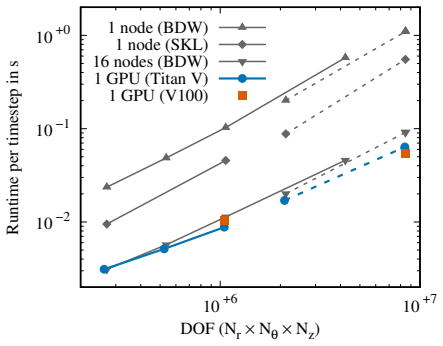
The central claim is that nsCouette is a working, high-performance tool for direct numerical simulation of Taylor-Couette flow with optional differential heating. The spatial discretization is pseudospectral in the azimuthal and axial directions and uses high-order finite differences in the radial direction; time integration uses a predictor-corrector scheme with dynamic step control. For buoyancy, the code implements a Boussinesq-like approximation in which a negative temperature gradient is imposed radially and gravity acts axially. Quality assurance rests on continuous-integration regression tests and on validation against an experimentally measured wave speed in wavy vortex flow, which must match to $10^{-4}$. The paper reports that the upgraded version retains the earlier scalability — highly resolved runs with $N_r = O(10^3)$ radial points on $O(10^4)$ cores — and that a single-GPU CUDA version of the same numerical scheme runs three to seventeen times faster than one CPU node for problems that fit on the card.
Load-bearing premise
The load-bearing premise is that the new time stepping and buoyancy physics, validated only against one experimental wave speed in wavy vortex flow, are correct across the fully turbulent high-$Re$ and high-$Ra$ regimes the code is meant to serve.
Editorial extensions
If this is right
- Users can reproduce and extend published DNS of Taylor-Couette flow without writing a new solver; the input-file interface and restart mechanism support changing resolution between runs.
- Predictor-corrector time stepping makes transient scenarios — imposed disturbances, sudden changes in rotation rates — tractable, since the step size is adjusted dynamically.
- The Boussinesq-like implementation allows direct computation of Nusselt-number evolution for differentially heated cylinders, as the illustrative runs at $Re_i = 50$ and increasing $Ra$ show.
- The nsPipe variant transfers the same parallel infrastructure to turbulent pipe flow, and polymer-additive and two-phase extensions are reported as tested and planned for release.
Reading between the lines
- The modular design suggests that changing the gravity direction or temperature-gradient sign is a small code change; if so, the same solver could be reconfigured for convection in curved geometries or stably stratified rotating flows. The paper does not make this claim.
- The reported 3-17x single-GPU speedup over one CPU node is for problems small enough to fit on the card; my inference is that multi-GPU scaling, listed as under development, will decide whether GPUs compete for the largest runs rather than only intermediate sizes.
- Because the only direct experimental validation is a wave-speed match in wavy vortex flow, I would treat the code's high-Re and high-Ra turbulent predictions as strong but not fully certified until additional benchmarks appear; this is an editorial caution, not a paper claim.
Signed reviews
Editorial analysis
A structured set of objections, weighed in public.
Referee Report
Summary. The paper presents nsCouette, a publicly available pseudospectral DNS code for incompressible Taylor–Couette flow between independently rotating, optionally differentially heated concentric cylinders. The code uses Fourier–Galerkin discretization in the azimuthal and axial directions, high-order finite differences in the radial direction, a predictor–corrector time stepper with dynamic step-size control, and a hybrid MPI–OpenMP parallelization. The manuscript claims high scalability (Nr = O(10^3) on O(10^4) cores, citing prior work), provides runtime benchmarks on several HPC architectures and a GPU implementation, and describes a quality-assurance pipeline based on continuous integration, regression tests, and one quantitative validation of the wave speed in wavy vortex flow against the experiments of King et al. An illustrative simulation shows the onset of natural convection at Ra = 2130–3550 and Re_i = 50. The paper also introduces nsPipe as a pipe-flow derivative of the code.
Significance. If the stated claims hold, nsCouette is a valuable community resource: it fills the Taylor–Couette slot among publicly available spectral DNS solvers alongside channelflow and openpipeflow, and its hybrid MPI–OpenMP design is a sensible compromise for modern HPC systems. The paper's concrete strengths are the open-source release with user guide and example Makefiles, the reproducible input-file and checkpoint/restart workflow, the HDF5/xdmf visualization interface, the CI-based regression testing, and the 10^-4 wave-speed match to experiment for wavy vortex flow. The performance data over multiple architectures are useful. The novelty relative to the authors' earlier method paper [5] is primarily in the software engineering and new physical modules, not in numerical methodology. For users, the code's value depends on the validity of the new heat-transfer and time-stepping modules, which is exactly where the presented evidence is thinnest; a targeted validation would materially strengthen the paper.
major comments (2)
- [§2.5 and Abstract] The verification and validation evidence presented for the upgraded code does not cover the two main new features advertised in §2.1. The only quantitative external comparison is the isothermal wavy-vortex wave-speed test against King et al. [12], described in §2.5; this case does not exercise the Boussinesq heat-transfer implementation and only indirectly tests the predictor–corrector time stepping. The illustrative example in §3 spans Ra = 2130–3550 at Re_i = 50, and its sole quantitative check is that the initial Nui ≈ 1 matches the analytic conductive solution; no grid-convergence study, no Nusselt-number comparison for turbulent heat transfer, and no accuracy test of the dynamic time-step control are reported. Because the Abstract states that the code is 'designed to compute turbulent flows at high Reynolds and Rayleigh numbers', and Section 4 advertises this as the main purpose, the missing validation is load-bearing. I request either (i) an additional quantitative validation of the heated path at higher Ra (e.g., comparison of Nui with published experimental or numerical data, or with a known linear-stability threshold, including a resolution study) and a test of the predictor–corrector step-size controller, or (ii) a careful re-scoping of the claims to indicate the parameter regimes and code paths for which validation currently exists, with the missing benchmarks described as planned work.
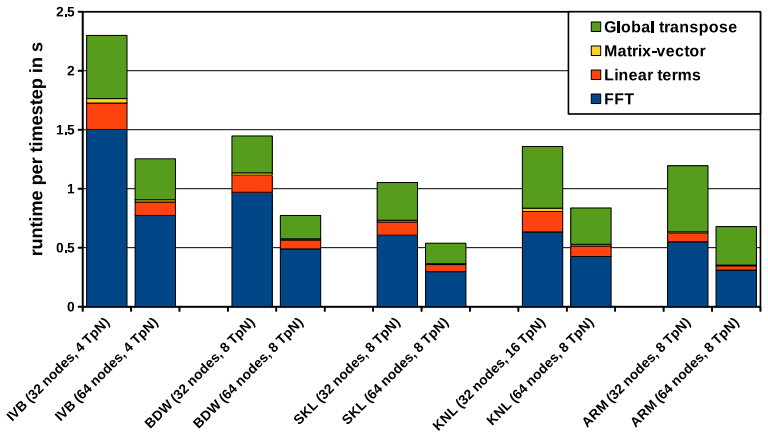
- [§2.3, Figure 1] The claim that nsCouette 'enables highly resolved DNS with Nr = O(10^3) using O(10^4) cores' is attributed to [5], which describes the version before the predictor–corrector and heat-transfer upgrades. In the present paper, all new performance data in Figure 1 use at most 2560 cores (64 nodes) at Nr = 512, and the sentence 'the upgraded version presented here exhibits the same scalability' is an assertion without supporting measurements. Since high performance is a central selling point of the paper, the authors should either include strong- or weak-scaling data for the upgraded version at O(10^4) cores (even at a moderate Nr) or explicitly state that the scalability of the present version inherits from the unchanged parallel architecture of [5] and has not been re-measured at the largest scale.
minor comments (5)
- [§2.5] Please specify whether the 'match up to 10^-4' tolerance in the wave-speed regression test is relative or absolute, and report the actual measured difference for the final validation run.
- [§3] The parameters Rei and Ra are not defined in the text; please define them (inner Reynolds number and Rayleigh number based on temperature difference and gap width) and define the symbols d and ν used in the time axis, or give the definitions explicitly in the user guide with a cross-reference.
- [§2.2] Please state explicitly whether the GPU implementation (C-CUDA) is included in the continuous-integration regression tests, and add a sentence on its numerical validation (e.g., comparison of representative flow statistics against the Fortran/CPU version) so users know it produces equivalent results, not only similar runtimes.
- [§2.5] The statement that CI configuration and V&V results are 'publicly accessible through the web interface of our development site' should be accompanied by a confirmation that the GitLab repository at gitlab.mpcdf.mpg.de can be viewed without registration, and a stable URL or CI status badge should be included.
- [§2.1] There is a typo in the first paragraph: 'Additionaly' should be 'Additionally'.
Circularity Check
No significant circularity: external experimental validation and analytic benchmarks anchor the claims; self-citations are supporting but not load-bearing.
full rationale
The paper contains no parameter fits and makes no physical predictions that could reduce to its inputs. The validation chain is anchored externally: Section 2.5 states that 'A final validation run compares the wave speed of a simulated wavy vortex flow with an experimentally determined value [12]', using the independent experiment of King et al. [12], and the illustrative example in Section 3 checks the computed Nusselt number against the analytic conductive basic state ('Figure 3a shows that initially Nui≈1, corresponding to purely conductive heat transfer' and the 'Analytical' reference line in Figure 3). The self-cited earlier papers [5] and [10] document the numerical method, prior V&V, and scaling of the same code family, but the present paper also supplies its own performance measurements (Figures 1 and 2), regression tests, and a wave-speed validation, so the central claim does not collapse into those citations. The skeptical concern that the upgraded predictor-corrector time stepping and the Boussinesq heat-transfer path are not separately validated at high-Re/high-Ra turbulent conditions is an evidence-gap or scoping criticism, not circularity: it identifies missing support, not a result that is equivalent to its input by construction. Under the hard rules, a paper that is self-contained against external benchmarks should receive a low score, and no exhibited reduction of any claimed result to a fitted parameter or to a self-citation chain was found.
Assumptions & free parameters
assumptions (4)
- domain assumption The incompressible Navier-Stokes equations with a Boussinesq-like buoyancy approximation correctly describe the target flows.
- domain assumption Axially periodic boundary conditions adequately represent Taylor-Couette flow with solid end plates.
- domain assumption The pseudospectral Fourier-Galerkin and high-order finite-difference discretization converges to the correct Navier-Stokes solution for the target turbulent and heated regimes.
- ad hoc to paper The QA procedures, one final experimental validation and a suite of regression tests, are sufficient to establish correctness of the code across its intended operating envelope.
Cite this review
Pith. "Pith review of nsCouette -- A high-performance code for direct numerical simulations of turbulent Taylor-Couette flow." pith.science (2026). https://pith.science/paper/4GDPYPFD
@misc{pith2026190800587,
  author       = {Pith},
  title        = {Pith review of: nsCouette -- A high-performance code for direct numerical simulations of turbulent Taylor-Couette flow},
  year         = {2026},
  howpublished = {\url{https://pith.science/paper/4GDPYPFD}},
  note         = {Machine review of arXiv:1908.00587}
}
read the original abstract
We present nsCouette, a highly scalable software tool to solve the Navier-Stokes equations for incompressible fluid flow between differentially heated and independently rotating, concentric cylinders. It is based on a pseudospectral spatial discretization and dynamic time-stepping. It is implemented in modern Fortran with a hybrid MPI-OpenMP parallelization scheme and thus designed to compute turbulent flows at high Reynolds and Rayleigh numbers. An additional GPU implementation (C-CUDA) for intermediate problem sizes and a basic version for turbulent pipe flow (nsPipe) are also provided.
Figures

Reference graph
Works this paper leans on
- [10]
-
[5]
L. Shi, M. Rampp, B. Hof, M. Avila, A hybrid MPI-OpenMP par- allel implementation for pseudospectral simulations with application to Taylor–Couette flow, Computers & Fluids 106 (2015) 1–11. doi: 10.1016/j.compfluid.2014.09.021
-
[12]
G. P. King, W. Lee, Y. Li, H. L. Swinney, P. S. Marcus, Wave speeds in wavy Taylor-vortex flow, Journal of Fluid Mechanics 141 (1984) 365–
work page 1984
-
[1]
Y. Bazilevs, I. Akkerman, Large eddy simulation of turbulent Taylor- Couette flow using isogeometric analysis and the residual-based vari- ational multiscale method, Journal of Computational Physics 229 (9) (2010) 3402–3414. doi:10.1016/j.jcp.2010.01.008
-
[2]
S. Grossmann, D. Lohse, C. Sun, High-Reynolds Number Taylor- Couette Turbulence, Annual Review of Fluid Mechanics 48 (1) (2016) 53–80. doi:10.1146/annurev-fluid-122414-034353
-
[3]
E. M. Edlund, H. Ji, Nonlinear stability of laboratory quasi-Keplerian flows, Physical Review E 89 (2) (2014) 021004.doi:10.1103/PhysRevE. 89.021004
doi:10.1103/physreve 2014
-
[4]
J. M. Lopez, M. Avila, Boundary-layer turbulence in experiments on quasi-Keplerian flows, Journal of Fluid Mechanics 817 (2017) 21–34. doi:10.1017/jfm.2017.109
-
[6]
A. Guseva, A. P. Willis, R. Hollerbach, M. Avila, Transition to mag- netorotational turbulence in Taylor–Couette flow with imposed az- imuthal magnetic field, New Journal of Physics 17 (9) (2015) 093018. doi:10.1088/1367-2630/17/9/093018
Show all 24 references
-
[7]
J. M. Lopez, F. Marques, M. Avila, The Boussinesq approximation in rapidly rotating flows, Journal of Fluid Mechanics 737 (2013) 56–77. doi:10.1017/jfm.2013.558
2013 doi
-
[8]
Gabriel, G
E. Gabriel, G. E. Fagg, G. Bosilca, T. Angskun, J. J. Dongarra, J. M. Squyres, V. Sahay, P. Kambadur, B. Barrett, A. Lumsdaine, R. H. Castain, D. J. Daniel, R. L. Graham, T. S. Woodall, Open MPI: Goals, Concept, and Design of a Next Generation MPI Imple- mentation, in: D. Kran...
2004
-
[9]
Frigo, S
M. Frigo, S. Johnson, The Design and Implementation of FFTW3, Pro- ceedings of the IEEE 93 (2) (2005) 216–231.doi:10.1109/JPROC.2004. 840301
2005 doi
-
[11]
A. P. Willis, The Openpipeflow Navier–Stokes solver, SoftwareX 6 (2017) 124–127. doi:10.1016/j.softx.2017.05.003
2017 doi
-
[13]
M. Ali, P. D. Weidman, On the stability of circular Couette flow with radial heating, Journal of Fluid Mechanics 220 (1990) 53–84. doi:10. 1017/S0022112090003184
1990
-
[14]
D. A. Howey, P. R. N. Childs, A. S. Holmes, Air-Gap Convection in Ro- tating Electrical Machines, IEEE Transactions on Industrial Electronics 59 (3) (2012) 1367–1375. doi:10.1109/TIE.2010.2100337
2012
-
[15]
J. M. Lopez, F. Marques, M. Avila, Conductive and convective heat transfer in fluid flows between differentially heated and rotating cylin- ders, International Journal of Heat and Mass Transfer 90 (2015) 959–
2015
-
[16]
J. F. Gibson, Channelflow: A spectral Navier-Stokes simulator in C++, Tech. rep., University of New Hampshire (2014). URL www.channelflow.org
2014
-
[17]
M. A. Fardin, C. Perge, N. Taberlet, ”The hydrogen atom of fluid dy- namics” – introduction to the Taylor–Couette flow for soft matter sci- entists, Soft Matter 10 (20) (2014) 3523. doi:10.1039/c3sm52828f
2014 doi
-
[18]
L. Shi, B. Hof, M. Rampp, M. Avila, Hydrodynamic turbulence in quasi- Keplerian rotating flows, Physics of Fluids 29 (4) (2017) 044107. doi: 10.1063/1.4981525
2017 doi
-
[19]
Leclercq, J
C. Leclercq, J. L. Partridge, P. Augier, C.-C. P. Caulfield, S. B. Dalziel, P. F. Linden, Nonlinear waves in stratified Taylor-Couette flow. Part 1. Layer formation. arXiv:1609.02885. 11
-
[20]
Leclercq, J
C. Leclercq, J. L. Partridge, C.-C. P. Caulfield, S. B. Dalziel, P. F. Lin- den, Nonlinear waves in stratified Taylor-Couette flow. Part 2. Buoyancy flux. arXiv:1609.02886
-
[21]
J. M. Lopez, G. H. Choueiri, B. Hof, Dynamics of viscoelastic pipe flow at low Reynolds numbers in the maximum drag reduction limit, Journal of Fluid Mechanics 874 (2019) 699–719. doi:10.1017/jfm.2019.486
2019 doi
-
[22]
B. Song, C. Plana, J. M. Lopez, M. Avila, Phase-field simulation of core- annular pipe flow, International Journal of Multiphase Flow 117 (2019) 14–24. doi:10.1016/j.ijmultiphaseflow.2019.04.027. Required Metadata Current code version 12 Nr. Code metadata description Please fill ...
2019 doi
-
[390]
doi:10.1017/S0022112084000896
-
[967]
doi:10.1016/j.ijheatmasstransfer.2015.07.026
2015 doi
Reviewed August 14, 2026 · model on record in the stance chip above.
Discussion (0). Continue with ORCID to comment.