REVIEW 3 major objections 5 minor 55 references
Optimized Transmission for Parameter Estimation in Wireless Sensor Networks
T0 review · 3 major / 5 minor · reviewed 2026-08-14 · deepseek-v4-flash
Pith's one-line read Sensor relay gain and phase design for parameter estimation, centralized or decentralized, reduces to a cyclic quadratic optimization that matches semidefinite-programming designs at a fraction of the runtime.
desk verdict Solid low-complexity gain design with a real runtime win over SDP baselines, but the paper's 'optimality' claim leans on a false convexity statement and should be qualified. read the letter →
The pith
A machine-rendered reading of the paper's core claim, the machinery that carries it, and where it could break.
The reading
What carries the argument
The load-bearing object is the over-parametrized block matrix $R = \begin{pmatrix} \eta_0 & a^H H^H \\ H a & H D V D^H H^H + M \end{pmatrix}$ together with its Rayleigh quotient $g(y,a) = y^H R y$ under the constraint $y_1 = 1$. The identity $y^H R y = \eta_0 + \tilde{y}^H M \tilde{y} + \begin{pmatrix} a \\ 1 \end{pmatrix}^H Q \begin{pmatrix} a \\ 1 \end{pmatrix}$ turns the gain update into a quadratic program, and the minimizer $y$ for fixed $a$ is the scaled first column of $R^{-1}$, obtained by a Gram-Schmidt orthogonalization against the remaining rows. The power-method-like iteration $a^{(t+1)} = \mathrm{projection}\left(\tilde{Q} \begin{pmatrix} a^{(t)} \\ 1 \end{pmatrix}\right)$ then makes the objective monotone, with each projection instantiated for fixed-energy, phase-only, quantized-phase, or sensor-selection constraints. This machinery is what lets the paper claim per-iteration complexity $O(\max\{L N^2, M^2\})$ and the SDP-matching numerical performance.
What would settle it
Build a connected graph whose local "highest information value" assignments do not form a cover where every observation is retained exactly once—for instance, three mutually connected nodes where two parents pick the same child and one observation is never retained—then compare the variance predicted by (27) with the Monte Carlo variance of the distributed MLE from (14). If they disagree, or if the global compression matrix $G = \mathrm{blkdiag}(\{T_i\})$ does not select each sensor row exactly once, the decoupling premise is false.
Extended reading notes
Core claim
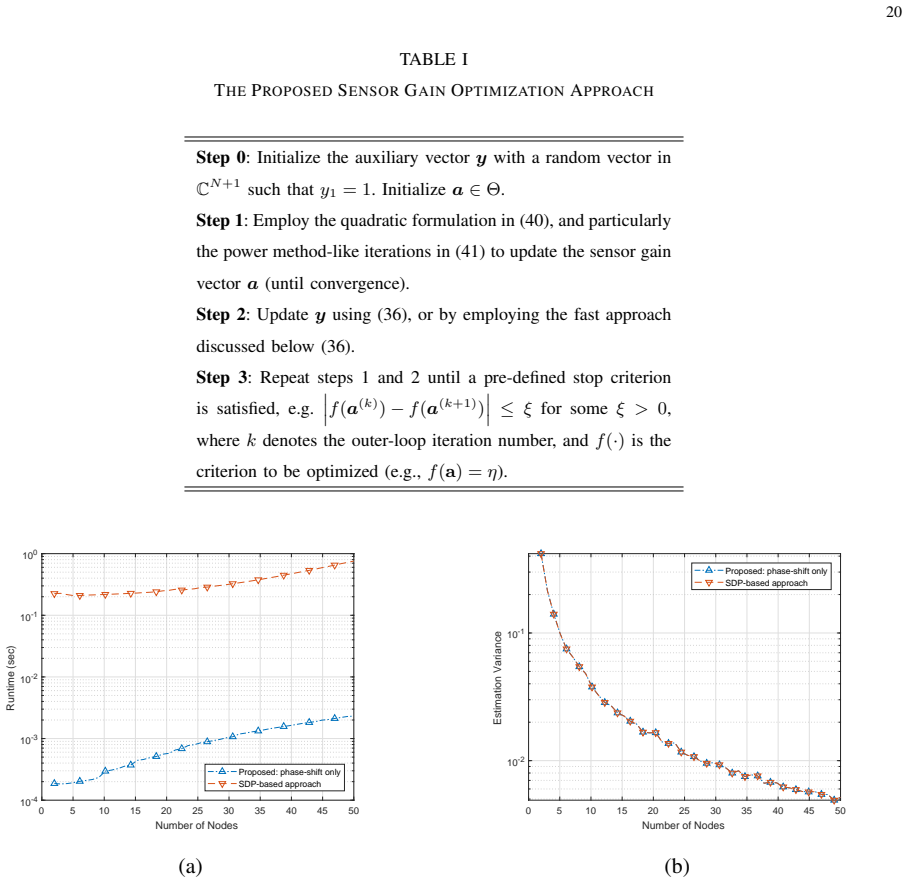
The paper's central claim is that the variance of the maximum-likelihood estimate, $\mathrm{Var}(\hat{\theta}_{\mathrm{ML}}) = \left(a^H H^H (H D V D^H H^H + M)^{-1} H a\right)^{-1}$, can be minimized over the complex gain vector $a$ by minimizing the Rayleigh quotient $y^H R y$ over $a$ and an auxiliary vector $y$ with $y_1 = 1$, where $R$ is the block matrix with $\eta_0$ in the top-left corner, $a^H H^H$ and $H a$ on the off-diagonal blocks, and $H D V D^H H^H + M$ in the bottom-right block. For fixed $a$, the optimal $y$ is a scaled version of the first column of $R^{-1}$ and can be found by a Gram-Schmidt step; for fixed $y$, the problem becomes a quadratic form in $a$ whose update is a power-method-like projection onto the constraint set. Alternating the two updates produces a monotonically decreasing objective, as stated in equation (43). Decentralized estimation is handled by a compression rule that keeps each amplified observation at exactly one neighbor, which decouples the noise covariance and lets ADMM average consensus drive every node to the global MLE. Numerically, the paper reports estimation variance essentially equal to the SDP-based method in [7] with less than 1% of its runtime at $N=50$ and $N=60$ nodes.
Load-bearing premise
The scheme depends on the claim that each node's amplified observation is retained by exactly one neighbor under the local highest-information rule, so that the global noise terms are uncorrelated and the variance formula (27) and the factored MLE (14) are valid; this property is asserted in Remark 1 rather than proven for arbitrary connected graphs.
Editorial extensions
If this is right
- Sensor relays can be re-optimized whenever channels change, because each gain update costs only a matrix-vector product and a projection, instead of a semidefinite program.
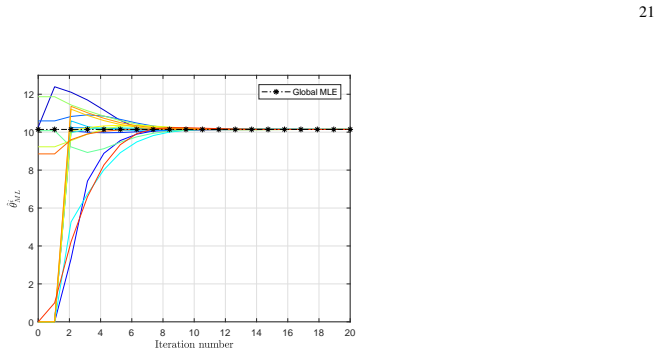
- In the decentralized case, every node's local estimate converges to the global maximum-likelihood estimate, so no fusion center is required and the estimation variance is the same as if all data were collected centrally.
- The same algorithm covers fixed-energy, phase-only, quantized-phase, and K-out-of-N sensor-selection constraints, so one design routine replaces several specialized solvers.
- The runtime advantage grows with network size: the paper reports below 1% of the SDP runtime for $N=50$ decentralized and $N=60$ centralized sensors, which matters for adaptive large-scale networks.
Reading between the lines
- In my reading, the monotone decrease in (43) establishes convergence to a stationary point of the biconvex surrogate, not a certificate of global optimality for the original non-convex gain problem; the near-optimality rests on the numerical match with the SDP baseline.
- The compression rule "keep the neighbor with the highest information value" is one natural choice; a testable extension is whether choosing the retaining node by a global or learned criterion could lower variance further while still keeping the noise covariance block-diagonal.
- The same over-parametrization and alternating Gram-Schmidt/power-method pattern may apply to other unimodular quadratic programs and waveform-design problems where a non-convex quadratic objective is optimized over unit-modulus or sparsity constraints.
Signed reviews
Editorial analysis
A structured set of objections, weighed in public.
Referee Report
Summary. The manuscript considers the design of complex transmission gains (amplitude and phase) in analog wireless sensor networks to minimize the variance of maximum-likelihood parameter estimation, in both a centralized (fusion center) and a decentralized (consensus-based) architecture. The authors propose an over-parametrization of the variance objective, leading to a cyclic optimization over an auxiliary vector y and the gain vector a; the a-update is performed via power-method-like iterations that the paper claims monotonically increase a surrogate objective. A data-compression/diffusion rule is introduced that decouples sensor observations, and an ADMM-based average consensus is used to compute the global MLE distributively. Numerical experiments compare the method with the SDP-based approach of [7] and show comparable estimation variance at drastically lower runtime, especially for large networks.
Significance. If the runtime claims hold, the proposed framework is practically significant for large-scale WSNs where channel statistics vary rapidly. The compression and consensus scheme is a useful contribution, and the algorithm is simple and handles several constraint sets (fixed energy, phase-only, quantized phases, sensor selection). The theoretical contribution is modest: the paper proves monotone decrease of the objective but does not establish global optimality of the power-method iterations; in fact, the optimality claim in Section IV-B is based on an incorrect convexity assertion. The computational complexity analysis (O(N^2) per iteration) is a strength, and the numerical benchmarking against an independent SDP solver gives credible evidence of practical efficiency.
major comments (3)
- [IV-B, text after Fig. 4] The claim that (40) is convex in the finite-energy scenarios and that matching the general-purpose QCQP solver 'verifies the optimality' is incorrect. Problem (40) maximizes the convex quadratic [a;1]^H \tilde{Q} [a;1] over the nonconvex sphere constraint ||a||^2=N; it is a nonconvex QCQP, not a convex program. Consequently, neither the power-method-like iterations nor the general-purpose QCQP solver is guaranteed to find a global optimum, and numerical agreement of the two does not certify optimality. The statement should be removed or replaced with a more modest empirical claim.
- [Remark 2] The assertion that (33) is biconvex in (y,a) is not correct. For fixed y, the objective g(y,a) is quadratic in a with matrix Q in (38), whose block structure has a zero bottom-right block and generally nonzero off-diagonal blocks; such a matrix is indefinite, so the minimization over a is not convex. Hence the cyclic approach is not an 'alternate convex search' as stated. The monotonicity chain in (43) does not rely on biconvexity and remains valid, but Remark 2 should be corrected.
- [Equation (38)] The Hadamard-product identity \tilde{y}^H H D V D^H H^H \tilde{y} = a^H ((H^H \tilde{y}\tilde{y}^H H) \odot V) a is valid only when V is diagonal. The manuscript introduces V = \Sigma in (28) as a general covariance for the centralized case and does not state that it is diagonal; if correlated sensor noise is allowed, the derivation of the subproblem (39) fails. Please state the diagonal-noise assumption explicitly and discuss the correlated case, or restrict the scope accordingly.
minor comments (5)
- [Equation (24)] The limit defining P_c is written with I_i(k) instead of P_i(k); this appears to be a typo.
- [Equation (41)] The dimensions in the norm are inconsistent (a row vector minus a column vector); the intended expression is || [a(t+1);1] - \tilde{Q} [a(t);1] ||^2.
- [Section II-C, definition of N_i] The text says 'including itself' but the set definition {j : {i,j}\in E} excludes i, and the example N_3={1,2,4} is consistent with the latter interpretation; please correct the wording.
- [Equations (12) and (28)] The symbol M is used both for the dimension of the compressed observation vector (M=2|E|-r) and for the noise covariance matrix M=\sigma_n^2 I_M; please use distinct symbols to avoid confusion.
- [Contributions bullet (page 4)] The statement that the method 'demonstrates far better estimation accuracy compared to other methods' is stronger than what Fig. 2(b) and Fig. 4 show for the phase-shift-only comparison; please align the claims with the numerical evidence.
Circularity Check
No circular derivation: core claims are benchmarked against the independent SDP method of [7]; only minor non-load-bearing self-citations to the authors' prior power-method work appear.
full rationale
The paper's central results—estimation-variance matching and sub-1% runtime versus the SDP method—are evaluated against the independent algorithm of [7] (Figs. 2, 4, 5), so they are not fitted inputs renamed as predictions. The monotone-decrease claim in (43) follows from the cyclic minimization inequalities written out in the paper, and the inner power-method monotonicity is cited to the authors' own prior papers [46]-[48]; while this is self-citation, it is transparent and concerns a previously published, parameter-free lemma rather than an assumption that includes the present target result, so it is not load-bearing circularity. The decentralized decoupling asserted in Remark 1 is valid by construction: each parent node retains exactly one selected neighbor, giving each column of H a single nonzero and a diagonal R_w, so (13)-(15) factor as stated. The main weakness is not circularity but the unsupported optimality remark in Section IV-B: (40) maximizes a convex quadratic form over the nonconvex sphere, so it is not a convex program, and matching a general-purpose QCQP solver on the same nonconvex problem does not certify global optimality. That is a correctness concern outside the circularity rubric.
Assumptions & free parameters
free parameters (3)
- ADMM penalty parameter rho =
not specified
- Power-method shift lambda =
lambda > lambda_max(Q)
- Over-parametrization offset eta0 =
eta0 > N ||H||_F^2 / lambda_min(M)
assumptions (6)
- standard math The block matrix R in (32) has a positive Schur complement, ensured by the choice of eta0 in Appendix A.
- standard math The power method-like iterations from [46]-[48] monotonically increase the quadratic objective in (40) when the surrogate matrix is positive semidefinite.
- domain assumption Sensor observation noise is independent across nodes, so V is diagonal and the Hadamard-product identity in (38) holds.
- domain assumption The network graph is connected, time-invariant, and transmissions always succeed.
- ad hoc to paper The compression rule retains each node's observation at exactly one neighbor, making the compressed observations uncorrelated.
- domain assumption The ADMM consensus algorithm of [43] remains valid when the averaged variables are complex as in (20)-(22).
Cite this review
Pith. "Pith review of Optimized Transmission for Parameter Estimation in Wireless Sensor Networks." pith.science (2026). https://pith.science/paper/7VVGH3EI
@misc{pith2026190800600,
  author       = {Pith},
  title        = {Pith review of: Optimized Transmission for Parameter Estimation in Wireless Sensor Networks},
  year         = {2026},
  howpublished = {\url{https://pith.science/paper/7VVGH3EI}},
  note         = {Machine review of arXiv:1908.00600}
}
read the original abstract
A central problem in analog wireless sensor networks is to design the gain or phase-shifts of the sensor nodes (i.e. the relaying configuration) in order to achieve an accurate estimation of some parameter of interest at a fusion center, or more generally, at each node by employing a distributed parameter estimation scheme. In this paper, by using an over-parametrization of the original design problem, we devise a cyclic optimization approach that can handle tuning both gains and phase-shifts of the sensor nodes, even in intricate scenarios involving sensor selection or discrete phase-shifts. Each iteration of the proposed design framework consists of a combination of the Gram-Schmidt process and power method-like iterations, and as a result, enjoys a low computational cost. Along with formulating the design problem for a fusion center, we further present a consensus-based framework for decentralized estimation of deterministic parameters in a distributed network, which results in a similar sensor gain design problem. The numerical results confirm the computational advantage of the suggested approach in comparison with the state-of-the-art methods---an advantage that becomes more pronounced when the sensor network grows large.
Figures

Figures from the paper (3 more)


Reference graph
Works this paper leans on
-
[7]
Estimation in phase-shift and forward wireless sensor networks,
F. Jiang, J. Chen, and A. Swindlehurst, “Estimation in phase-shift and forward wireless sensor networks,” IEEE Transactions on Signal Processing , vol. 61, no. 15, pp. 3840–3851, 2013
work page 2013
-
[46]
Designing unimodular codes via quadratic optimization,
M. Soltanalian and P. Stoica, “Designing unimodular codes via quadratic optimization,” IEEE Transactions on Signal Processing, vol. 62, no. 5, pp. 1221–1234, March 2014
work page 2014
-
[48]
Single-stage transmit beamforming design for MIMO radar,
M. Soltanalian, H. Hu, and P. Stoica, “Single-stage transmit beamforming design for MIMO radar,” Signal Processing, vol. 102, pp. 132–138, 2014
work page 2014
-
[1]
Optimized transmission for consensus in wireless sensor networks,
S. Khobahi and M. Soltanalian, “Optimized transmission for consensus in wireless sensor networks,” in 2018 IEEE International Conference on Acoustics, Speech and Signal Processing (ICASSP) , pp. 3419–3423
work page 2018
-
[2]
Uncoded transmission is exactly optimal for a simple Gaussian “sensor
M. Gastpar, “Uncoded transmission is exactly optimal for a simple Gaussian “sensor” network,” IEEE Trans. Info. Theory, vol. 54, no. 11, pp. 5247–5251, Nov. 2008
work page 2008
-
[3]
Estimation diversity and energy efficiency in distributed sensing,
S. Cui, J.-J. Xiao, A. J. Goldsmith, Z.-Q. Luo, and H. V . Poor, “Estimation diversity and energy efficiency in distributed sensing,” IEEE Trans. Signal Process. , vol. 55, no. 9, pp. 4683–4695, Sep. 2007
work page 2007
-
[4]
Distributed estimation over fading MACs with multiple antennas at the fusion center,
A. D. Smith, M. K. Banavar, C. Tepedelenlioglu, and A. Spanias, “Distributed estimation over fading MACs with multiple antennas at the fusion center,” in Proc. IEEE Asilomar , Nov. 2009, pp. 424–428
work page 2009
-
[5]
On the effectiveness of multiple antennas in distributed detection over fading MACs,
M. K. Banavar, A. D. Smith, C. Tepedelenlioglu, and A. Spanias, “On the effectiveness of multiple antennas in distributed detection over fading MACs,” IEEE Trans. Wireless Commun. , vol. 11, no. 5, pp. 1744–1752, May 2012
work page 2012
Show all 55 references
-
[6]
Estimation over fading channels with limited feedback using distributed sensing,
M. K. Banavar, C. Tepedelenlio ˘glu, and A. Spanias, “Estimation over fading channels with limited feedback using distributed sensing,” IEEE Transactions on Signal Processing , vol. 58, no. 1, pp. 414–425, 2010. August 5, 2019 DRAFT 25
2010
-
[8]
Optimal power allocation for parameter tracking in a distributed amplify-and-forward sensor network,
——, “Optimal power allocation for parameter tracking in a distributed amplify-and-forward sensor network,” IEEE Transactions on Signal Processing , vol. 62, no. 9, pp. 2200–2211, May 2014
2014
-
[9]
Massive MIMO for wireless sensing with a coherent multiple access channel,
F. Jiang, J. Chen, A. Swindlehurst, and J. Lopez-Salcedo, “Massive MIMO for wireless sensing with a coherent multiple access channel,” IEEE Transactions on Signal Processing , vol. 63, no. 12, pp. 3005–3017, June 2015
2015
-
[10]
Energy-efficient routing for signal detection in wireless sensor networks,
Y . Yang, R. S. Blum, and B. M. Sadler, “Energy-efficient routing for signal detection in wireless sensor networks,” IEEE Transactions on Signal Processing , vol. 57, no. 6, pp. 2050–2063, 2009
2009
-
[11]
Empirical studies of bio-inspired self-organized secure autonomous routing protocol,
K. Saleem, N. Fisal, and J. Al-Muhtadi, “Empirical studies of bio-inspired self-organized secure autonomous routing protocol,” IEEE Sensors Journal , vol. 14, no. 7, pp. 2232–2239, 2014
2014
-
[12]
Optimal and near-optimal cooperative routing and power allocation for collision minimization in wireless sensor networks,
F. Mansourkiaie and M. H. Ahmed, “Optimal and near-optimal cooperative routing and power allocation for collision minimization in wireless sensor networks,” IEEE Sensors Journal , vol. 16, no. 5, pp. 1398–1411, 2015
2015
-
[13]
Designing routes for source coding with explicit side information in sensor networks,
H. Luo and G. J. Pottie, “Designing routes for source coding with explicit side information in sensor networks,” IEEE/ACM Transactions on Networking , vol. 15, no. 6, pp. 1401–1413, Dec 2007
2007
-
[14]
Compressive wireless sensing,
W. Bajwa, J. Haupt, A. Sayeed, and R. Nowak, “Compressive wireless sensing,” in Proceedings of the 5th international conference on Information processing in sensor networks . ACM, 2006, pp. 134–142
2006
-
[15]
Joint sourcechannel communication for distributed estimation in sensor networks,
W. U. Bajwa, J. D. Haupt, A. M. Sayeed, and R. D. Nowak, “Joint sourcechannel communication for distributed estimation in sensor networks,” IEEE Transactions on Information Theory , vol. 53, no. 10, pp. 3629–3653, Oct 2007
2007
-
[16]
Asymptotically optimal energy-aware routing for multihop wireless networks with renewable energy sources,
L. Lin, N. B. Shroff, and R. Srikant, “Asymptotically optimal energy-aware routing for multihop wireless networks with renewable energy sources,” IEEE/ACM Transactions on Networking (TON) , vol. 15, no. 5, pp. 1021–1034, 2007
2007
-
[17]
Joint energy management and resource allocation in rechargeable sensor networks,
R.-S. Liu, P. Sinha, and C. E. Koksal, “Joint energy management and resource allocation in rechargeable sensor networks,” in 2010 Proceedings IEEE INFOCOM . IEEE, 2010, pp. 1–9
2010
-
[18]
Dehar: A distributed energy harvesting aware routing algorithm for ad-hoc multi-hop wireless sensor networks,
M. K. Jakobsen, J. Madsen, and M. R. Hansen, “Dehar: A distributed energy harvesting aware routing algorithm for ad-hoc multi-hop wireless sensor networks,” in 2010 IEEE International Symposium on” A World of Wireless, Mobile and Multimedia Networks”(WoWMoM). IEEE, 2010, pp. 1–9
2010
-
[19]
Delay-sensitive opportunistic routing for underwater sensor networks,
C.-C. Hsu, H.-H. Liu, J. L. G. G ´omez, and C.-F. Chou, “Delay-sensitive opportunistic routing for underwater sensor networks,” IEEE sensors journal , vol. 15, no. 11, pp. 6584–6591, 2015
2015
-
[20]
Eecor: An energy-efficient cooperative opportunistic routing protocol for underwater acoustic sensor networks,
M. A. Rahman, Y . Lee, and I. Koo, “Eecor: An energy-efficient cooperative opportunistic routing protocol for underwater acoustic sensor networks,” IEEE Access, vol. 5, pp. 14 119–14 132, 2017
2017
-
[21]
Performance and trade-offs of opportunistic routing in underwater networks,
L. F. M. Vieira, “Performance and trade-offs of opportunistic routing in underwater networks,” in 2012 IEEE Wireless Communications and Networking Conference (WCNC) . IEEE, 2012, pp. 2911–2915
2012
-
[22]
Routing pressure: A channel-related and traffic-aware metric of routing algorithm,
M. Tang, X. Lin, and M. Palesi, “Routing pressure: A channel-related and traffic-aware metric of routing algorithm,” IEEE transactions on Parallel and Distributed Systems , vol. 26, no. 3, pp. 891–901, 2013
2013
-
[23]
Energy harvesting wireless communications: A review of recent advances,
S. Ulukus, A. Yener, E. Erkip, O. Simeone, M. Zorzi, P. Grover, and K. Huang, “Energy harvesting wireless communications: A review of recent advances,” IEEE Journal on Selected Areas in Communications , vol. 33, no. 3, pp. 360–381, 2015
2015
-
[24]
Routing protocols for wireless sensor networks: What the literature says?
A. Sarkar and T. S. Murugan, “Routing protocols for wireless sensor networks: What the literature says?” Alexandria Engineering Journal, vol. 55, no. 4, pp. 3173–3183, 2016
2016
-
[25]
Joint sensor selection and multihop routing for distributed estimation in ad-hoc wireless sensor networks,
S. Shah and B. Beferull-Lozano, “Joint sensor selection and multihop routing for distributed estimation in ad-hoc wireless sensor networks,” IEEE Transactions on Signal Processing , vol. 61, no. 24, pp. 6355–6370, 2013. August 5, 2019 DRAFT 26
2013
-
[26]
Parameter estimation in wireless sensor networks with faulty transducers: A distributed em approach,
S. S. Pereira, R. L ´opez-Valcarce, and A. Pages-Zamora, “Parameter estimation in wireless sensor networks with faulty transducers: A distributed em approach,” Signal Processing, vol. 144, pp. 226–237, 2018
2018
-
[27]
Distributed estimation using reduced-dimensionality sensor observations,
I. D. Schizas, G. B. Giannakis, and Z.-Q. Luo, “Distributed estimation using reduced-dimensionality sensor observations,” IEEE Transactions on Signal Processing , vol. 55, no. 8, pp. 4284–4299, 2007
2007
-
[28]
Nonlinear precoding for multipair relay networks with one-bit ADCs and DACs,
C. Kong, A. Mezghani, C. Zhong, A. L. Swindlehurst, and Z. Zhang, “Nonlinear precoding for multipair relay networks with one-bit ADCs and DACs,” IEEE Signal Processing Letters , vol. 25, no. 2, pp. 303–307, 2018
2018
-
[29]
Massive MIMO downlink 1-bit precoding for frequency selective channels,
H. Jedda, A. Mezghani, J. A. Nossek, and A. L. Swindlehurst, “Massive MIMO downlink 1-bit precoding for frequency selective channels,” in IEEE 7th International Workshop on Computational Advances in Multi-Sensor Adaptive Processing (CAMSAP), 2017
2017
-
[30]
Signal recovery from 1-bit quantized noisy samples via adaptive thresholding,
S. Khobahi and M. Soltanalian, “Signal recovery from 1-bit quantized noisy samples via adaptive thresholding,” in 2018 52nd Asilomar Conference on Signals, Systems, and Computers , Oct 2018, pp. 1757–1761
2018
-
[31]
MIMO communications with low resolution ADCs,
J. Mo, “MIMO communications with low resolution ADCs,” Ph.D. dissertation, University of Texas at Austin, 2018
2018
-
[32]
Deep signal recovery with one-bit quantization,
S. Khobahi, N. Naimipour, M. Soltanalian, and Y . C. Eldar, “Deep signal recovery with one-bit quantization,” in 2019 IEEE International Conference on Acoustics, Speech and Signal Processing (ICASSP) , May 2019, pp. 2987–2991
2019
-
[33]
In a one-bit rush: Low-latency wireless spectrum monitoring with binary sensor arrays,
M. S. Stein and M. Fauß, “In a one-bit rush: Low-latency wireless spectrum monitoring with binary sensor arrays,” arXiv preprint arXiv:1802.03180, 2018
2018 arXiv
-
[34]
A scheme for robust distributed sensor fusion based on average consensus,
L. Xiao, S. Boyd, and S. Lall, “A scheme for robust distributed sensor fusion based on average consensus,” in Proceedings of the 4th International Symposium on Information Processing in Sensor Networks . IEEE Press, 2005, p. 9
2005
-
[35]
An efficient algorithm for unit-modulus quadratic programs with application in beamforming for wireless sensor networks,
C. G. Tsinos and B. Ottersten, “An efficient algorithm for unit-modulus quadratic programs with application in beamforming for wireless sensor networks,” IEEE Signal Processing Letters , vol. 25, no. 2, pp. 169–173, 2018
2018
-
[36]
Distributed optimization and statistical learning via the alternating direction method of multipliers,
S. Boyd, N. Parikh, E. Chu, B. Peleato, and J. Eckstein, “Distributed optimization and statistical learning via the alternating direction method of multipliers,” Foundations and Trends in Machine Learning , vol. 3, no. 1, pp. 1–122, 2011
2011
-
[37]
Consensus in ad hoc WSNs with noisy links part I: Distributed estimation of deterministic signals,
I. D. Schizas, A. Ribeiro, and G. B. Giannakis, “Consensus in ad hoc WSNs with noisy links part I: Distributed estimation of deterministic signals,” IEEE Transactions on Signal Processing , vol. 56, no. 1, pp. 350–364, 2008
2008
-
[38]
Consensus in ad hoc WSNs with noisy links part II: Distributed estimation and smoothing of random signals,
I. D. Schizas, G. B. Giannakis, S. I. Roumeliotis, and A. Ribeiro, “Consensus in ad hoc WSNs with noisy links part II: Distributed estimation and smoothing of random signals,” IEEE Transactions on Signal Processing , vol. 56, no. 4, pp. 1650–1666, 2008
2008
-
[39]
An efficient algorithm for unit-modulus quadratic programs with application in beamforming for wireless sensor networks,
C. G. Tsinos and B. Ottersten, “An efficient algorithm for unit-modulus quadratic programs with application in beamforming for wireless sensor networks,” IEEE Signal Processing Letters , vol. 25, no. 2, pp. 169–173, Feb 2018
2018
-
[40]
Detection in analog sensor networks with a large scale antenna fusion center,
F. Jiang, J. Chen, and A. L. Swindlehurst, “Detection in analog sensor networks with a large scale antenna fusion center,” in 2014 IEEE 8th Sensor Array and Multichannel Signal Processing Workshop (SAM) , June 2014, pp. 245–248
2014
-
[41]
Convex optimization-based beamforming,
A. B. Gershman, N. D. Sidiropoulos, S. Shahbazpanahi, M. Bengtsson, and B. Ottersten, “Convex optimization-based beamforming,” IEEE Signal Processing Magazine , vol. 27, no. 3, pp. 62–75, 2010
2010
-
[42]
Energy efficient collaborative beamforming in wireless sensor networks,
B. B. Haro, S. Zazo, and D. P. Palomar, “Energy efficient collaborative beamforming in wireless sensor networks,” IEEE Transactions on Signal Processing , vol. 62, no. 2, pp. 496–510, 2014
2014
-
[43]
On the linear convergence of the ADMM decentralized consensus optimization
W. Shi, Q. Ling, K. Yuan, G. Wu, and W. Yin, “On the linear convergence of the ADMM decentralized consensus optimization.” IEEE Trans. Signal Processing , vol. 62, no. 7, pp. 1750–1761, 2014
2014
-
[44]
Linear coherent decentralized estimation,
J. Xiao, S. Cui, Z. Luo, and A. J. Goldsmith, “Linear coherent decentralized estimation,” IEEE Transactions on Signal Processing, vol. 56, no. 2, pp. 757–770, Feb 2008. August 5, 2019 DRAFT 27
2008
-
[45]
Stoica and R
P. Stoica and R. Moses, Spectral Analysis of Signals . New Jersey: Prentice Hall, 2005. [Online]. Available: http://user.it.uu.se/˜ps/ref.html
2005
-
[47]
Joint design of the receive filter and transmit sequence for active sensing,
M. Soltanalian, B. Tang, J. Li, and P. Stoica, “Joint design of the receive filter and transmit sequence for active sensing,” IEEE Signal Processing Letters , vol. 20, no. 5, pp. 423–426, 2013
2013
-
[49]
Biconvex sets and optimization with biconvex functions - A survey and extensions,
J. Gorski, F. Pfeuffer, and K. Klamroth, “Biconvex sets and optimization with biconvex functions - A survey and extensions,” Mathematical Methods of Operations Research , vol. 66, no. 3, pp. 373–407, June 2007
2007
-
[50]
A survey on sensor networks,
I. F. Akyildiz, W. Su, Y . Sankarasubramaniam, and E. Cayirci, “A survey on sensor networks,” IEEE Communications Magazine, vol. 40, no. 8, pp. 102–114, 2002
2002
-
[51]
On the feasibility of distributed beamforming in wireless networks,
R. Mudumbai, G. Barriac, and U. Madhow, “On the feasibility of distributed beamforming in wireless networks,” IEEE Transactions on Wireless Communications , vol. 6, no. 5, pp. 1754–1763, 2007
2007
-
[52]
Cyclic minimizers, majorization techniques, and the expectation-maximization algorithm: A refresher,
P. Stoica and Y . Sel ´en, “Cyclic minimizers, majorization techniques, and the expectation-maximization algorithm: A refresher,” IEEE Signal Processing Magazine , vol. 21, no. 1, pp. 112–114, 2004
2004
-
[53]
Rearrangement inequalities,
P. W. Day, “Rearrangement inequalities,” Canad. J. Math , vol. 24, no. 5, pp. 930–943, 1972
1972
-
[54]
Complex quadratic optimization and semidefinite programming,
S. Zhang and Y . Huang, “Complex quadratic optimization and semidefinite programming,” SIAM Journal on Optimization , vol. 16, no. 3, pp. 871–890, 2006
2006
-
[55]
S. J. Wright and J. Nocedal, Numerical Optimization. Springer, New York, 1999. August 5, 2019 DRAFT 28 5 10 15 20 25 3010 −3 10 −2 10 −1 10 0 number of sensors, N estimation variance Proposed: gain optimization Proposed: phase−shift only SDP−based approach No feedback Numerica...
1999
Reviewed August 14, 2026 · model on record in the stance chip above.
Discussion (0). Continue with ORCID to comment.