REVIEW 2 major objections 3 minor 32 references
Scattering of partially coherent radiation by non-Hermitian localized structures having Parity-Time symmetry
T0 review · 2 major / 3 minor · reviewed 2026-08-14 · deepseek-v4-flash
Pith's one-line read Partially coherent light can suppress the asymmetric scattering of PT-symmetric gain–loss structures.
desk verdict A sound Born-approximation result—the qualitative suppression of PT asymmetry by partial coherence survives, but the paper overreaches when it says the model has no divergences. read the letter →
The pith
A machine-rendered reading of the paper's core claim, the machinery that carries it, and where it could break.
The reading
What carries the argument
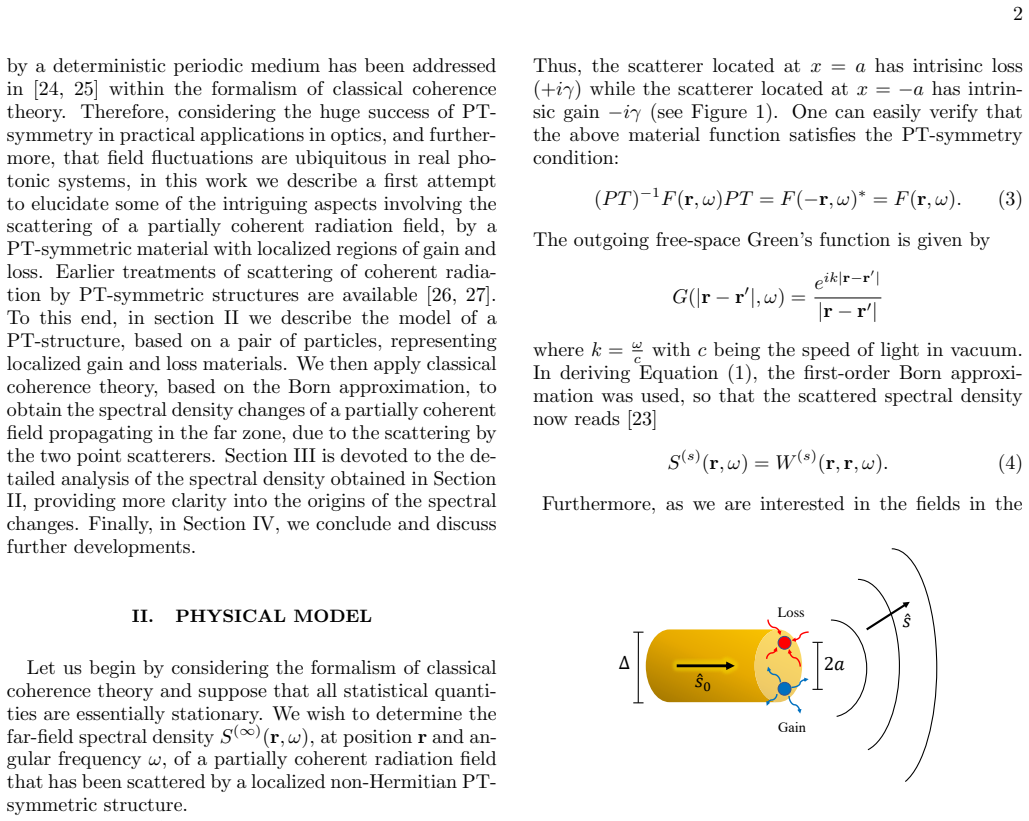
The engine of the calculation is the combination of the PT-symmetric material function $F(\mathbf{r},\omega)=\delta(y)\delta(z)[(\sigma+i\gamma)\delta(x-a)+(\sigma-i\gamma)\delta(x+a)]$, representing a lossy scatterer at $x=a$ and a gain scatterer at $x=-a$, with the Gaussian spectral degree of coherence $\mu^{(i)}(\mathbf{r}_1,\mathbf{r}_2,\omega)=\exp[-(\rho_1-\rho_2)^2/(2\Delta^2)]\,e^{ik\hat{s}_0\cdot(\mathbf{r}_2-\mathbf{r}_1)}$, where $\Delta$ is the coherence length. Substituted into the first-order Born scattering integral, these two objects yield Eq. (7), in which every interference term that carries the non-Hermitian asymmetry is multiplied by the factor $\exp(-2a^2/\Delta^2)$; the gain/loss strength $\gamma$ enters through the coefficients $(\sigma^2-\gamma^2)/(\sigma^2+\gamma^2)$ and $2\sigma\gamma/(\sigma^2+\gamma^2)$. The mechanism is therefore the competition between the scatterer separation $2a$ and the coherence length $\Delta$: when $\Delta$ is comparable to or smaller than $2a$, the cross-correlation between the two scatterers fades and the directional terms vanish.
What would settle it
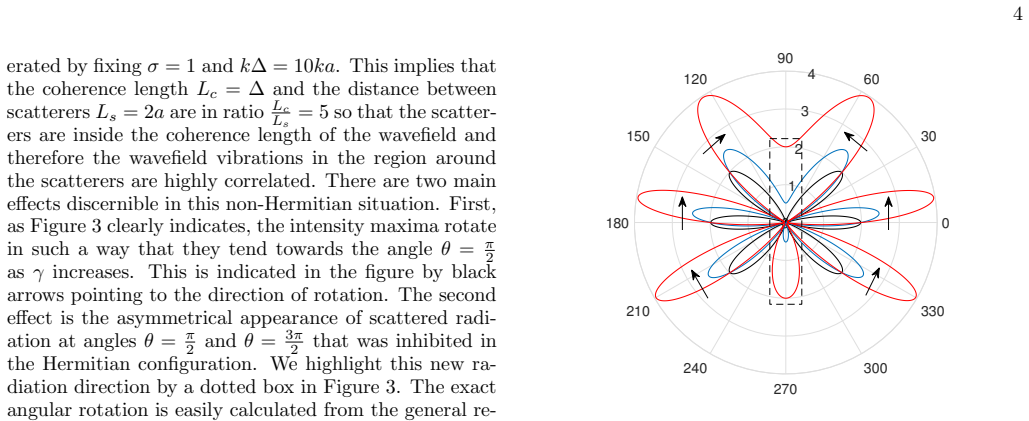
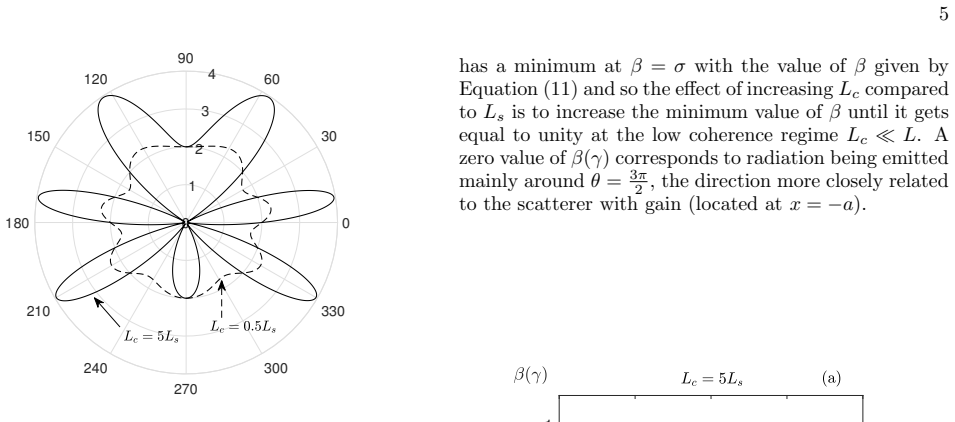
Measure the far-zone angular radiation pattern of two nearby scatterers with balanced gain and loss, holding the separation at $2ka=3\pi$ while sweeping the incident beam's coherence length from $L_c=5L_s$ down to $L_c=L_s/2$; the claim predicts that the left-right asymmetry around $\theta=\pi/2$ and $3\pi/2$ shrinks as $L_c$ drops and disappears at low coherence. A full multiple-scattering calculation with $\gamma\sim\sigma$ that yields a substantially different angular spectrum would also falsify the Born-based prediction.
Extended reading notes
Core claim
For a pair of point scatterers, one with loss $+i\gamma$ at $x=a$ and one with gain $-i\gamma$ at $x=-a$, illuminated by a partially coherent beam with Gaussian spatial correlation and coherence length $\Delta$, the far-zone spectral density is obtained analytically as $$$S^{{(\infty)}}$(\hat{s},\omega)=\frac{$S^{{(i)}}$(\omega)\,2(\$sigma^{2}$+\$gamma^{2}$)}{$r^{2}$}\left\{1+e^{-$2a^{2}$/\$\Delta$^2}\left[\frac{\$sigma^{2}$-\$gamma^{2}$}{\$sigma^{2}$+\$gamma^{2}$}\cos(2ka\,s_x)+\frac{2\$\sigma$\gamma}{\$sigma^{2}$+\$gamma^{2}$}\sin(2ka\,s_x)\right]\right\}.$$ The paper claims that, because the non-Hermitian asymmetric terms are multiplied by the coherence factor $e^{-2a^2/\Delta^2}$, shortening the coherence length suppresses the directional asymmetry without altering the scatterer geometry; at low coherence the structure radiates into directions that were forbidden in the Hermitian case, and the angular spectrum becomes nearly symmetric. It also claims that the cross-spectral density of the scattered field depends sensitively on the spatial distribution of gain and loss, so the non-Hermitian structure can modify the correlation properties of the scattered light.
Load-bearing premise
The derivation assumes first-order Born scattering, meaning each incident photon interacts at most once with the two scatterers, even when the gain/loss parameter $\gamma$ is comparable to the scattering strength $\sigma$; if multiple-scattering paths through the gain region amplify significantly, the predicted coherence-induced suppression of asymmetry could fail in a real PT structure.
Editorial extensions
If this is right
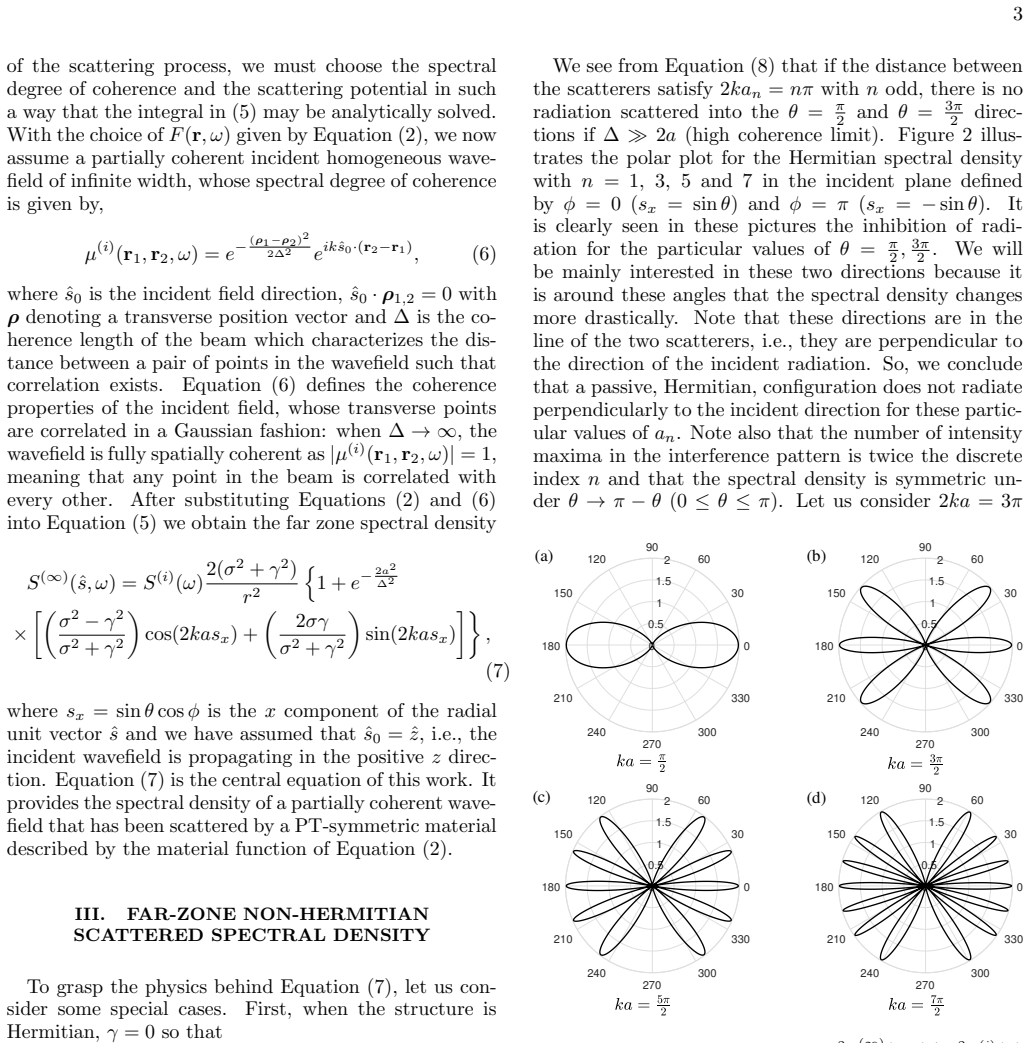
- In the high-coherence limit, the model recovers the known PT-scattering asymmetry: interference fringes rotate with $\gamma$, and radiation appears in directions where the Hermitian two-point scatterer is silent.
- At low coherence ($L_c \le L_s/2$), the factor $\exp(-2a^2/\Delta^2)$ suppresses the sinusoid terms in Eq. (7), so the far-zone spectrum becomes nearly symmetric and radiates into the previously forbidden perpendicular directions.
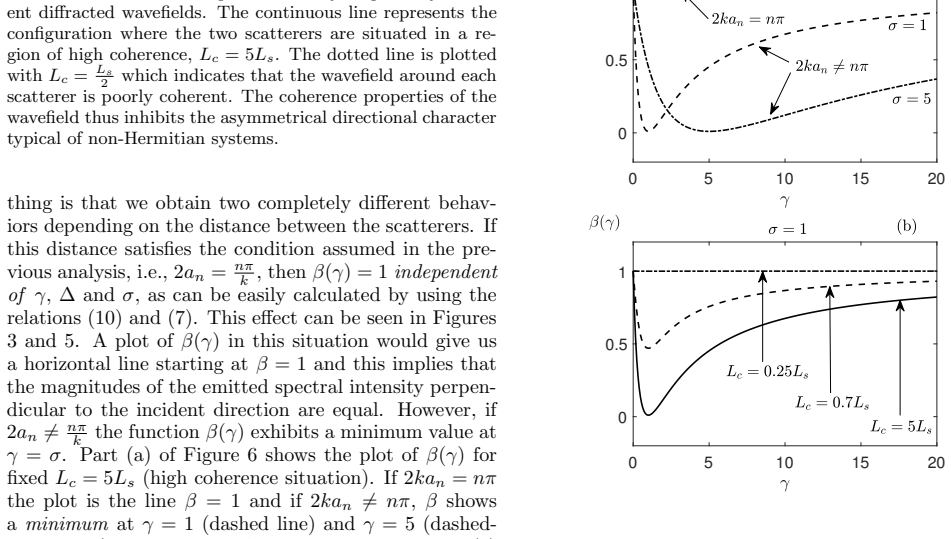
- For separations satisfying $2ka=n\pi$, the perpendicular intensity ratio $\beta(\gamma)$ equals 1 for all $\gamma$, $\Delta$, and $\sigma$; otherwise $\beta(\gamma)$ has a minimum at $\gamma=\sigma$ whose value is independent of $\sigma$.
- The scattered cross-spectral density carries explicit gain/loss dependence, so non-Hermitian scatterers can be used to tailor the spatial coherence of the scattered field.
Reading between the lines
- The same coherence-suppression mechanism should appear in any PT-symmetric scatterer whose response is dominated by two effective scattering centers, suggesting a direct experimental test using a focused partially coherent beam on a coupled gain–loss waveguide pair.
- Because the suppression is controlled by the Gaussian correlation factor, replacing it with a Lorentzian or other correlation function should change the suppression rate but not the qualitative effect; shaped coherence could be used to map the sensitivity.
- If the analysis is extended beyond the Born limit, multiple-scattering paths through the gain region could strengthen or weaken the suppression; a transfer-matrix version would reveal whether exceptional-point effects reappear in the scattered spectrum.
- The cross-spectral density result hints that a PT-symmetric structure can act as a coherence processor: tailoring the gain/loss placement might synthesize desired spatial coherence profiles in the scattered beam.
Signed reviews
Editorial analysis
A structured set of objections, weighed in public.
Referee Report
Summary. The manuscript studies the far-zone spectral density of partially coherent radiation scattered by a two-point non-Hermitian structure with balanced gain and loss, i.e., a PT-symmetric localized scatterer. Working within the first-order Born approximation and classical coherence theory, the authors derive the central analytic result Eq. (7), which shows that the asymmetric, unidirectional term in the scattered spectral density is multiplied by the Gaussian coherence factor exp(-2a^2/Delta^2). They then analyze the Hermitian limit (Eq. (8)), the angular shift of intensity maxima (Eq. (9)), the ratio of intensities in opposite perpendicular directions beta(gamma) (Eqs. (10)-(12)), and the cross-spectral density of the scattered field (Eq. (13)). The main claim is that reducing the coherence length of the incident field suppresses the characteristic non-Hermitian directional asymmetry without changing the geometry of the scatterer.
Significance. If the qualitative claim survives beyond the first-order Born approximation, the paper makes a useful contribution at the interface of classical coherence theory and PT-symmetric photonics: it identifies the coherence length as an external control knob for the directionality of scattering from gain/loss structures. The algebraic core of the paper is transparent and internally consistent: Eq. (7) follows correctly from Eqs. (2), (5) and (6), the Hermitian limit Eq. (8) is correct, and the expressions for beta(gamma) are consistent with Eq. (7). The proposed suppression mechanism is robust in the extreme incoherent limit, where the interference term vanishes by construction. However, several quantitative predictions and the claim of a complete absence of divergences are tied to the first-order Born truncation and require re-scoping.
major comments (2)
- [Section III, paragraph beginning "Generally speaking..."] The statement that "we have found no indication of any divergences for any value of gamma and sigma" is an artifact of the first-order Born truncation, not a property of the two-point PT model. For two point scatterers with amplitudes alpha_1 = sigma + i gamma and alpha_2 = sigma - i gamma, the standard Foldy-Lax equations for the pair contain the denominator D = 1 - alpha_1 alpha_2 G(2a)^2, with G(2a) = exp(2ika)/(2a). This denominator vanishes, for example, when 2ka = m pi and sigma^2 + gamma^2 = 4a^2. Thus a lasing-type threshold is present in the exact multiple-scattering problem, and the paper's broader physical conclusion that no exceptional-point-like behavior appears in this model is unsupported. If the claim is meant only as a property of the first-order formula, it should be stated as such; as written, it is misleading.
- [Section III, Figs. 6 and Eqs. (10)-(12)] The quantitative predictions for beta(gamma) are presented in parameter regimes where the first-order Born approximation is uncontrolled. With the plot value ka = 3 pi/2 (so 2a = 3 pi/k, and in units k=1, a=3 pi/2), the omitted two-scatterer term is |alpha_1 alpha_2 G(2a)^2| = (sigma^2 + gamma^2)/(4a^2). At sigma=5 and gamma=20 this quantity is about 4.8, and even at sigma=5, gamma=5 it is about 0.56; for Fig. 6(b) with sigma=1 and gamma=20 it is about 4.5. In all these cases the first-order Born series is not a controlled expansion, so the beta(gamma) curves, the gamma->infinity form in Eq. (12), and the statement that beta approaches 1 are not reliable model predictions. The qualitative suppression effect in Fig. 5 likely survives an exact treatment, since the coherence factor multiplies the entire interference term, but the quantitative angular patterns and the beta(gamma) curves need either a clearly stated weak-scattering restriction or an exact Foldy-Lax calculation.
minor comments (3)
- [Section III, paragraph after Eq. (11)] The sentence describing the effect of increasing Lc on the minimum of beta is confusing: Eq. (11) shows that beta(gamma=sigma) tends to unity when exp(-2a^2/Delta^2) tends to zero, i.e., in the low-coherence regime Lc << Ls, not when Lc is increased. Please rephrase to avoid the apparent contradiction.
- [Figure 6(b), caption] The caption lists the dotted and dashed-dotted curves both as Lc = 0.25 Ls; one of these values appears to be a typo and should be corrected so that the coherence dependence shown in the figure is unambiguous.
- [Abstract] Minor grammatical issue: "Asymmetric spectral changes ... is also observed" should be "are also observed."
Circularity Check
No circularity: the central spectral-density formula is a direct evaluation of the stated Born scattering integral from the explicitly assumed coherence model, with no fitted parameters and no load-bearing self-citation.
full rationale
The paper's central result, Eq. (7), is obtained by substituting the assumed two-point scatterer potential F(r,ω) of Eq. (2) and the assumed Gaussian spectral degree of coherence μ(i)(r1,r2,ω) of Eq. (6) into the standard first-order Born scattering integral, Eq. (5). This is a direct mathematical evaluation, not a quantity that was fitted or defined in terms of the output. No parameter is fitted to the spectral densities shown in Figs. 2–6, and no prior work by the same authors is cited as load-bearing evidence. The Hermitian limit, Eq. (8), is explicitly compared with the well-known coherence-dependent disappearance of interference, citing Wolf's textbook, so it is not presented as a new result under renamed coordinates. The suppression of the asymmetric directional scattering by reducing the coherence length Δ is a consequence of the assumed model coherence function; calling this 'injected by the ansatz' is not circularity, because every theoretical model prediction follows from its stated assumptions. The only substantive concern is the validity of the first-order Born approximation for large gain/loss parameter γ, especially the Sec. III statement that 'we have found no indication of any divergences for any value of γ and σ.' That statement concerns whether the truncated model misses multiple-scattering or lasing effects, which is a correctness/validity limitation rather than a circular-derivation flaw under the criteria used here. The derivation is self-contained and no circular step can be exhibited.
Assumptions & free parameters
assumptions (4)
- domain assumption First-order Born approximation is valid for the PT-symmetric two-point scatterer.
- domain assumption Incident field is a statistically stationary, homogeneous wavefield of infinite width with Gaussian spectral degree of coherence, Eq. (6).
- ad hoc to paper The scatterer can be represented by delta functions in all three dimensions, Eq. (2), with point-like gain and loss.
- standard math Far-zone limit k|r| to infinity, with the Green function approximated by e^{ikr}/r e^{-ik s_hat dot r'}.
Cite this review
Pith. "Pith review of Scattering of partially coherent radiation by non-Hermitian localized structures having Parity-Time symmetry." pith.science (2026). https://pith.science/paper/S3ZKTL6H
@misc{pith2026190800644,
  author       = {Pith},
  title        = {Pith review of: Scattering of partially coherent radiation by non-Hermitian localized structures having Parity-Time symmetry},
  year         = {2026},
  howpublished = {\url{https://pith.science/paper/S3ZKTL6H}},
  note         = {Machine review of arXiv:1908.00644}
}
read the original abstract
A theoretical model based on two-point scatterers is suggested to investigate scattering of partially coherent radiation by a non-Hermitian localized structure, invariant under the simultaneous symmetry operations of parity inversion and time reversal. Within the first-order Born approximation, and the formalism of classical coherence theory, the spectral density of the scattered field in the far zone is obtained analytically. We find that the unidirectional character of the scattered radiation, which is one of the principal effects present in non-Hermitian structures, may be suppressed due to the coherence properties of the radiation without changing the geometry of the structure. Asymmetric spectral changes of the scattered radiation due to the non-Hermitian character of the material are also observed.
Figures
Figures from the paper (3 more)

Reference graph
Works this paper leans on
-
[1]
C. M. Bender and S. Boettcher, Real Spectra in Non- Hermitian Hamiltonians HavingPT Symmetry, Physical Review Letters, 80, 5243 (1998)
work page 1998
-
[2]
C. M. Bender, S. Boettcher, and P. N. Meisinger, PT- symmetric quantum mechanics, Journal of Mathematical Physics, 40, 2201 (1999)
work page 1999
-
[3]
C. M. Bender, D. C. Brody, and H. F. Jones, Complex Extension of Quantum Mechanics, Physical Review Let- ters, 89, 270401 (2002)
work page 2002
-
[4]
C. M. Bender, D. C. Brody and H. F. Jones, Must a Hamiltonian be Hermitian? American Journal of Physics, 71, 1095 (2003)
work page 2003
-
[5]
C. M. Bender, Making sense of non-Hermitian Hamilto- nians, Reports on Progress in Physics 70, 947 (2007)
2007
-
[6]
C. M. Bender, PT Symmetry: In Quantum and Classical Physics, (World Scientific Publishing, 2018). 7
work page 2018
-
[7]
W. D Heiss, Exceptional points of non-Hermitian oper- ators, Journal of Physics A: Mathematical and General, 37, 2455 (2004)
work page 2004
-
[8]
Rotter, A non-Hermitian Hamilton operator and the physics of open quantum systems
I. Rotter, A non-Hermitian Hamilton operator and the physics of open quantum systems. Journal of Physics A: Mathematical and Theoretical, 42, 153001 (2009)
work page 2009
Show all 32 references
-
[9]
Mostafazadeh, Pseudo-Hermiticity versus PT symme- try: the necessary condition for the reality of the spec- trum of a non-Hermitian Hamiltonian
A. Mostafazadeh, Pseudo-Hermiticity versus PT symme- try: the necessary condition for the reality of the spec- trum of a non-Hermitian Hamiltonian. Journal of Math- ematical Physics, 43, 205 (2002)
2002
-
[10]
Mostafazadeh, Pseudo-Hermiticity versus PT- symmetry
A. Mostafazadeh, Pseudo-Hermiticity versus PT- symmetry. II. A complete characterization of non- Hermitian Hamiltonians with a real spectrum. Journal of Mathematical Physics, 43, 2814 (2002)
2002
-
[11]
Mostafazadeh, Pseudo-Hermiticity versus PT- symmetry III: Equivalence of pseudo-Hermiticity and the presence of antilinear symmetries
A. Mostafazadeh, Pseudo-Hermiticity versus PT- symmetry III: Equivalence of pseudo-Hermiticity and the presence of antilinear symmetries. Journal of Mathematical Physics, 43, 3944 (2002)
2002
-
[12]
X. Zhu, L. Feng, P. Zhang, X. Yin, and X. Zhang, One- way invisible cloak using parity-time symmetric transfor- mation optics, Optics Letters 38, 2821 (2013)
2013
-
[13]
X. Zhu, H. Ramezani, C. Shi, J. Zhu, and X. Zhang, PT -symmetric Acoustics, Physical Review X 4, 031042 (2014)
2014
-
[14]
D. L. Sounas, R. Fleury and A. Al` u, Unidirectional cloak- ing based on metasurfaces with balanced loss and gain, Physical Review Applied, 4, 014005 (2015)
2015
-
[15]
C. E. R¨ uter, K. G. Makris, R. El-Ganainy, D. N. Christodoulides, M. Segev, and D. Kip, Observation of parity-time symmetry in optics, Nature physics, 6, 192 (2010)
2010
-
[16]
El-Ganainy, K
R. El-Ganainy, K. G. Makris, D. N. Christodoulides, and Z. H. Musslimani, Theory of coupled optical PT- symmetric structures, Optics Letters, 32, 2632 (2007)
2007
-
[17]
A. Guo, G. J. Salamo, D. Duchesne, R. Morandotti, M. Volatier-Ravat, V. Aimez, G. A. Siviloglou, and D. N. Christodoulides, Observation ofPT -Symmetry Breaking in Complex Optical Potentials, Physical Review Letters, 103, 093902 (2009)
2009
-
[18]
J. Ren, H. Hodaei, G. Harari, A. U. Hassan, W. Chow, M. Soltani, D. Christodoulides, and M. Khajavikhan, Ul- trasensitive micro-scale parity-time-symmetric ring laser gyroscope, Optics Letters 42, 1556 (2017)
2017
-
[19]
Longhi, PT -symmetric laser absorber, Physical Re- view A 82, 031801(R) (2010)
S. Longhi, PT -symmetric laser absorber, Physical Re- view A 82, 031801(R) (2010)
2010
-
[20]
Y. D. Chong, Li Ge, and A. D. Stone, PT -Symmetry Breaking and Laser-Absorber Modes in Optical Scat- tering Systems, Physical Review Letters, 106, 093902 (2011)
2011
-
[21]
Longhi, Parity-time symmetry meets photonics: A new twist in non-Hermitian optics
S. Longhi, Parity-time symmetry meets photonics: A new twist in non-Hermitian optics. EPL (Europhysics Letters), 120, 64001 (2018)
2018
-
[22]
S. K. ¨Ozdemir, S. Rotter, F. Nori and L. Yang, Par- itytime symmetry and exceptional points in photonics, Nature materials, in press, (2019)
2019
-
[23]
Wolf, Introduction to the Theory of Coherence and Po- larization of Light (Cambridge University Press, 2007)
E. Wolf, Introduction to the Theory of Coherence and Po- larization of Light (Cambridge University Press, 2007)
2007
-
[24]
Dusek, Diffraction of partially coherent beams on three-dimensional periodic structures and the angular shifts of the diffraction maxima, Physical Review E, 52, 6833 (1995)
M. Dusek, Diffraction of partially coherent beams on three-dimensional periodic structures and the angular shifts of the diffraction maxima, Physical Review E, 52, 6833 (1995)
1995
-
[25]
Wolf, Diffraction of radiation of any state of spatial co- herence on media with periodic structure, Optics letters, 38, 4023 (2013)
E. Wolf, Diffraction of radiation of any state of spatial co- herence on media with periodic structure, Optics letters, 38, 4023 (2013)
2013
-
[26]
Hurwitz, and G
E. Hurwitz, and G. Gbur, Localized PT-symmetric di- rectionally invisible scatterers, Physical Review A, 93 041803 (2016)
2016
-
[27]
M. Miri, M. A. Eftekhar, M. Facao, A. F. Abouraddy, A. Bakry, M. A. N. Razvi, A. Alshahrie, A. Al` u and D. N. Christodoulides, Scattering properties of PT -symmetric objects, Journal of Optics, 18, 075104 (2016)
2016
-
[28]
K. G. Makris, R. El-Ganainy, D. N. Christodoulides, and Z. H. Musslimani, Beam Dynamics in PT Symmetric Optical Lattices, Physical Review Letters 100, 103904 (2008)
2008
-
[29]
F. Gao, Y. Liu, X. Tian, C. Cui, and J. Wu, Intrinsic link of asymmetric reflection and diffraction in non-Hermitian gratings, Optics Express, 26, 33818 (2018)
2018
-
[30]
Xue-Yi Zhu, Ye-Long Xu, Yi Zou, Xiao-Chen Sun, Cheng He, Ming-Hui Lu, Xiao-Ping Liu, and Yan-Feng Chen, Asymmetric diffraction based on a passive parity-time grating, Applied Physics Letters, 11, 111101 (2016)
2016
-
[31]
T. Shui, W. X. Yang, S. Liu, L. Li, Z. Zhu, Asymmetric diffraction by atomic gratings with optical PT symme- try in the Raman-Nath regime, Physical Review A, 97, 033819 (2018)
2018
-
[32]
Mohammad-Ali Miri, R. S. Duggan and A. Al` u, Parity- Time Symmetry and its Applications (Springer, 2018)
2018
Reviewed August 14, 2026 · model on record in the stance chip above.
Discussion (0). Continue with ORCID to comment.