REVIEW 2 major objections 4 minor 56 references
Non-Hermitian spectral changes in the scattering of partially coherent radiation by periodic structures
T0 review · 2 major / 4 minor · reviewed 2026-08-14 · deepseek-v4-flash
Pith's one-line read Adding balanced gain and loss to a periodic grating lets a partially coherent light beam keep diffraction side-peaks that an ordinary grating would wash out.
desk verdict Correct within its model, but the strong-gain predictions rest on an unjustified first-order Born approximation. read the letter →
The pith
A machine-rendered reading of the paper's core claim, the machinery that carries it, and where it could break.
The reading
What carries the argument
The carrier of the argument is the Fourier decomposition of the PT-symmetric potential, $v(x) = \frac{1}{2} + v_r\cos(2\pi x/a) + i v_i\sin(2\pi x/a)$, whose only nonzero Fourier coefficients are $c_0 = 1/2$ and $c_{\pm 1} = (v_r \pm v_i)/2$. Inserting this expansion into the spectral-density integral of Eq. (1), together with a Gaussian spectral degree of coherence of width $\sigma$, turns the problem into three closed-form Gaussian integrals. The resulting expression, Eq. (6), displays the three peaks directly, with the squared coefficients $|c_{\pm 1}|^2 = (v_r \pm v_i)^2/4$ controlling the secondary maxima; hence the gain/loss parameter $v_i$ enters as a continuous tuning knob for the diffraction pattern.
What would settle it
Measure the far-field angular spectral density of a shallow PT-symmetric grating at fixed $v_r$, sweeping $v_i$ from 0 to values above $v_r$, and check that the outer secondary peak intensity follows $(v_r - v_i)^2$ and vanishes exactly at $v_i = v_r$; any residual intensity at that point, or a growth of the central peak with $v_i$, would contradict Eq. (6).
Extended reading notes
Core claim
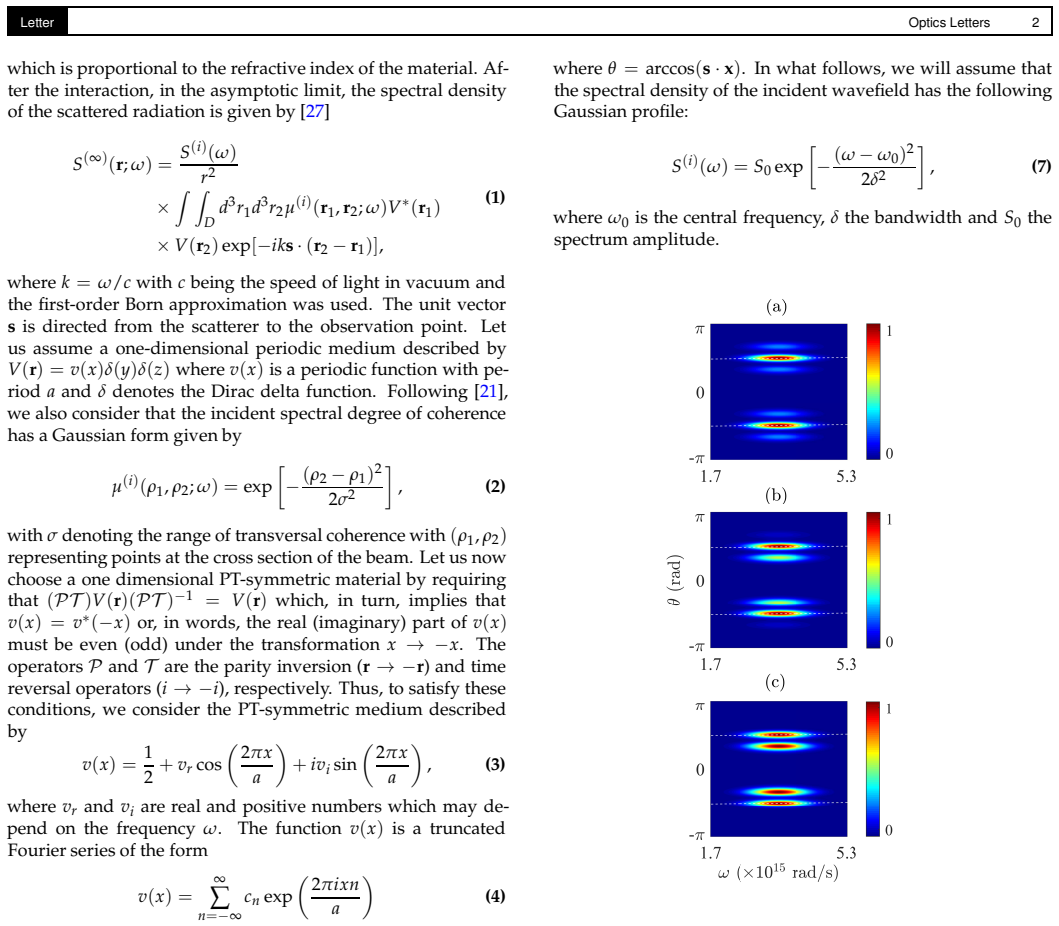
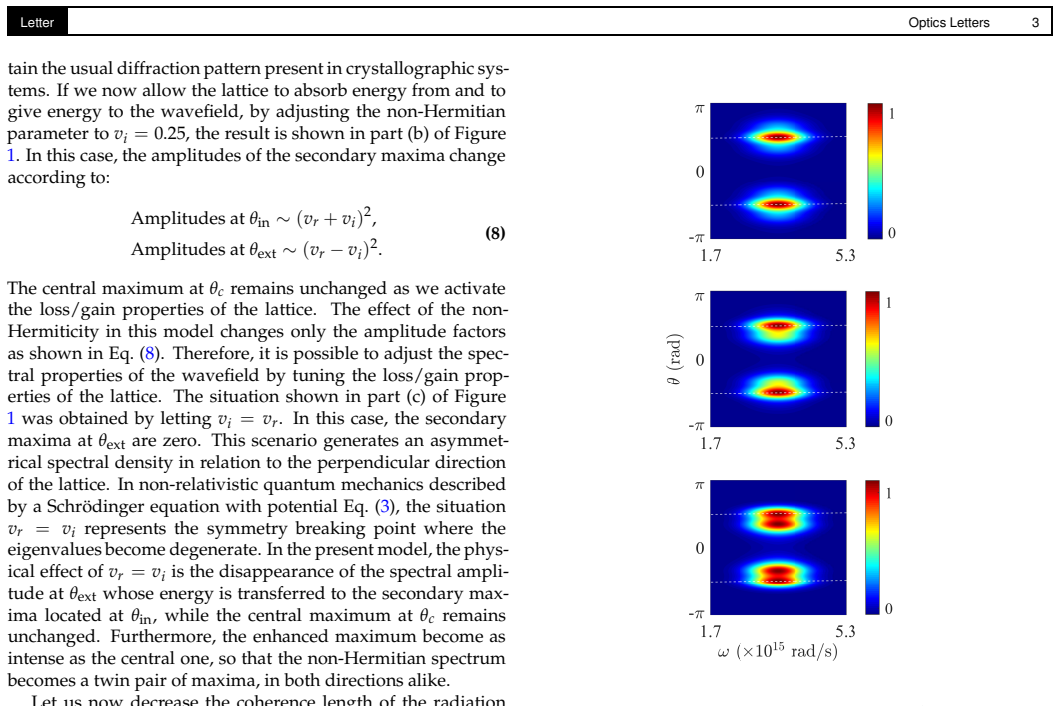
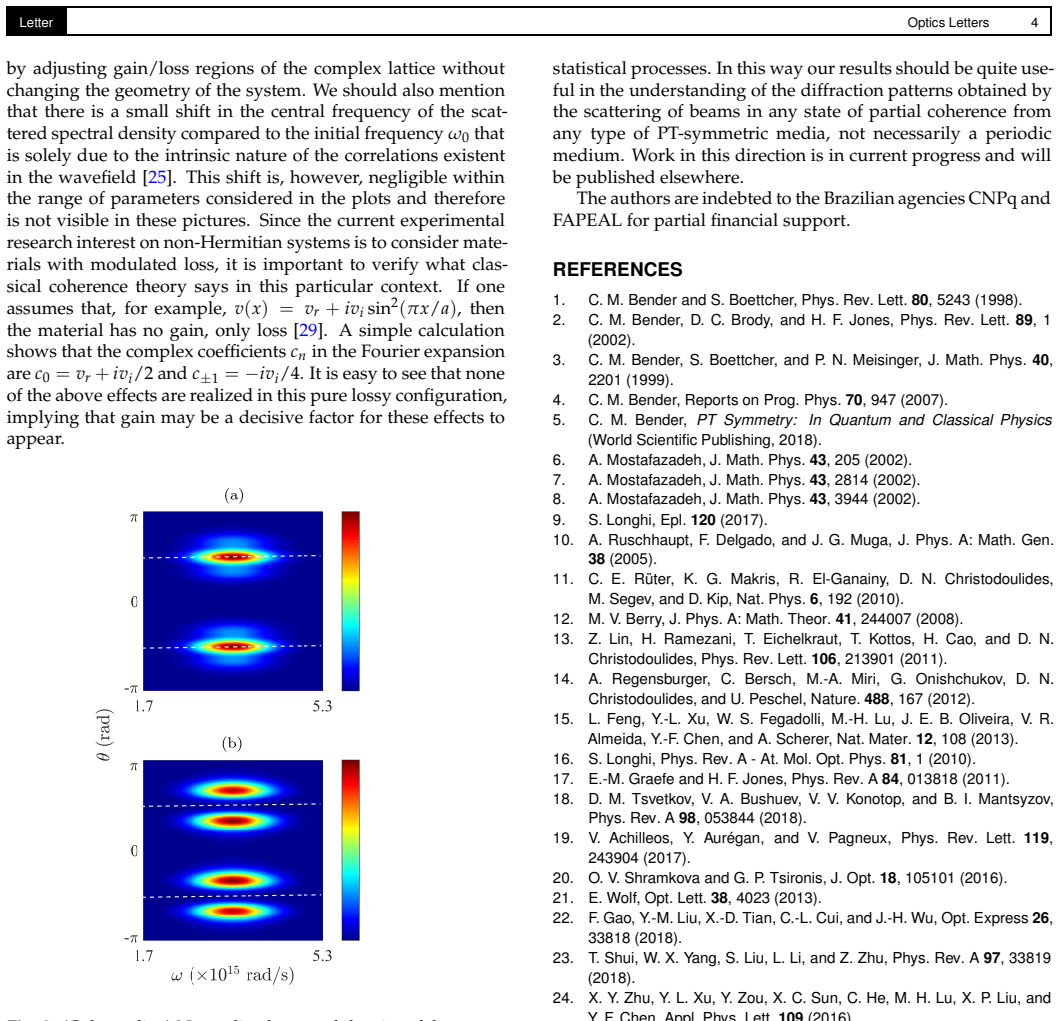
The central result is the closed-form spectral density for a PT-symmetric sinusoidal grating, Eq. (6): the far-field spectrum consists of a central peak, independent of $v_i$, plus two secondary peaks at $\theta_{\mathrm{in}}$ and $\theta_{\mathrm{ext}}$ whose amplitudes are $(v_r+v_i)^2$ and $(v_r-v_i)^2$. At the symmetry-breaking threshold $v_i = v_r$, the outer secondary maximum vanishes completely and the inner one grows to match the central peak, producing a twin-peak spectrum. When the coherence length drops to $\sigma = 5/k$, a Hermitian grating loses its secondary maxima, but the non-Hermitian grating retains them, and in the strong-gain limit $v_i \gg v_r$ the central maximum becomes negligible, leaving a symmetric pair of secondary maxima whose amplitude grows as $v_i^2$. The same analysis shows that a purely lossy modulated potential produces none of these effects, indicating that gain is the decisive ingredient.
Load-bearing premise
The load-bearing premise is that the first-order Born approximation remains valid for all gain/loss strengths considered, including the strong-gain limit $v_i \gg v_r$ where the scattered spectral density grows as $v_i^2$ and may no longer be weak compared with the incident field; the paper gives no small-parameter condition for this.
Editorial extensions
If this is right
- Setting $v_i = v_r$ makes the outer secondary maxima vanish, transferring their energy to the inner pair, which become as intense as the central peak.
- In the low-coherence regime $\sigma = 5/k$, a Hermitian grating shows no secondary maxima, but a PT-symmetric grating with the same geometry does; the appearance of side peaks becomes a signature of the non-Hermitian nature of the lattice.
- The far-field spectral density shows no divergent symmetry-breaking point as $v_i$ passes $v_r$; in the strong-gain limit it grows as $v_i^2$ and develops a symmetric twin-peak profile in which the central maximum is negligible.
- Tuning $v_i$ at fixed geometry and fixed coherence gives continuous control of spectral diffraction intensities, which the authors suggest could be useful in spectroscopy and grating diffraction research.
- A purely lossy realization of the same profile does not produce any of these effects, so gain, not merely absorption, is required.
Reading between the lines
- Because Eq. (6) is frequency-resolved through the incident spectrum, the angular reshaping should also appear as a change in the scattered spectrum's shape at fixed observation angle; a frequency-resolved angular scan would map the $(v_r \pm v_i)^2$ weights directly.
- The Fourier-coefficient argument extends naturally to higher harmonics: a grating with additional Fourier components would produce additional side peaks with analogous $|c_n|^2$ weights, so the same loss/gain tuning could sculpt multi-peak angular patterns rather than only two side peaks.
- Since the derivation assumes a weakly scattering structure, a natural experimental test would use a shallow-index PT-symmetric photonic lattice; with stronger gratings, multiple-scattering corrections could alter the exact $(v_r \pm v_i)^2$ scalings, so the clean prediction is best tested in the weak-scattering limit.
- The claim that visible secondary maxima persist in low-coherence light could serve as a coherence-resilient diagnostic: for beams with unknown coherence, the appearance of side peaks at a PT-symmetric grating would reveal the lattice's non-Hermitian character even when the incident coherence is too low for an ordinary grating to resolve its structure.
Signed reviews
Editorial analysis
A structured set of objections, weighed in public.
Referee Report
Summary. The paper studies scattering of partially coherent radiation by a one-dimensional PT-symmetric periodic medium. Within the first-order Born approximation, the authors derive an analytic expression for the far-field spectral density, Eq. (6), for a potential of the form v(x) = 1/2 + vr cos(2πx/a) + i vi sin(2πx/a). They show that the amplitudes of the two first-order diffraction maxima scale as (vr - vi)^2 and (vr + vi)^2, while the central maximum is independent of vi. In the low-coherence regime (σ = 5/k), the Hermitian lattice (vi = 0) loses its secondary maxima as distinct peaks, whereas the non-Hermitian lattice can retain them for sufficient gain/loss strength. The strong-gain limit vi ≫ vr is described by Eq. (9), and the authors claim there is no indication of a divergent symmetry-breaking behavior. A pure-loss configuration with v(x) = vr + i vi sin^2(πx/a) is shown not to produce the asymmetric effects, indicating the importance of gain.
Significance. If the results are valid, the paper extends Wolf's theory of partially coherent scattering from periodic media to PT-symmetric (complex) potentials and provides a closed-form, parameter-free expression for the spectral density. The algebra from Eq. (1) to Eq. (6) is consistent, the Hermitian limit vi = 0 reproduces the known result of ref. 21, and the amplitude scalings (vr ± vi)^2 are exact consequences of the Fourier coefficients in the model. The prediction that gain/loss can restore diffraction peaks in the low-coherence regime is concrete and testable, and the pure-loss comparison offers a useful cross-check. However, the physical significance is tempered by the fact that the first-order Born approximation is used without a stated validity condition, particularly in the strong-gain regime where the predictions of Eq. (9) may not be reliable.
major comments (2)
- [Eqs. (1) and (9), and the paragraph after Eq. (9)] The first-order Born approximation is introduced at Eq. (1) without any statement of its validity condition, and the same approximation underlies the strong-gain limit (9) and the claim that no divergent symmetry-breaking behavior occurs. For the parameters used in Fig. 2(c) (vr = vi = 0.5), the Fourier coefficients (vr ± vi)/2 are of order unity, so the scattering is not weak and higher-order Born terms may contribute. Please specify the small parameter that justifies keeping only the first Born term (for example, that the scattered field amplitude is much smaller than the incident amplitude), and either restrict the physical claims to that regime or explicitly state that Eq. (9) is a formal limit of the first-order model and may not describe the actual strong-gain system.
- [Discussion of Fig. 2, Eq. (6) with vi = 0] The statement that the Hermitian secondary maxima 'disappear' in the low-coherence regime (σ = 5/k) is imprecise: Eq. (6) with vi = 0 still has sideband terms with amplitude vr^2 = 0.25, but these contributions do not appear as distinct local maxima because of the tails of the central Gaussian. As the non-Hermitian visibility of sidebands is a central claim, please provide a cross-section of the spectral density at fixed frequency (or a quantitative criterion for what counts as a discernible maximum) for both the Hermitian and non-Hermitian cases.
minor comments (4)
- [Introduction, first paragraph] The text contains typos: 'Nowadays, is has been well established' should read 'it has been well established,' and 'syntethic' should be 'synthetic.'
- [Eq. (6) and Fig. 1 caption] The angle θ is defined as arccos(s·x), which lies in [0, π], but the text refers to θ = ±π/2, ±π/3, etc.; please clarify the convention (e.g., considering both signs of s_x).
- [Eq. (9) and Fig. 3] The text says 'vi ≫ vr = 0.5' but does not state the actual value of vi used in the figure; please specify the value and note that Eq. (9) is obtained by neglecting the first term in Eq. (6), which requires vi^2 ≫ 1.
- [Notation] The notation S(∞)(r;ω) in Eq. (6) becomes S∞(θ,ω) in Eq. (9); please use a consistent notation throughout.
Circularity Check
No significant circularity: Eq. (6) and the amplitude relations follow by direct substitution from the assumed potential and coherence model; the only self-citation is background and not load-bearing.
full rationale
The derivation chain is self-contained. The paper starts from Wolf's standard scattering formula (Eq. 1), assumes a Gaussian spectral degree of coherence (Eq. 2), and chooses an explicit PT-symmetric potential (Eq. 3) whose Fourier coefficients are c±1 = (vr ± vi)/2 and c0 = 1/2 (Eq. 4). Substitution into Eq. (5) and evaluating the Gaussian integrals yields the closed-form spectral density in Eq. (6). The amplitude relations in Eq. (8), the invariance of the central maximum, and the vi ≫ vr limit of Eq. (9) are all immediate algebraic consequences of Eq. (6) and the chosen coefficients; they are not fitted to data, nor are they assumed as inputs. The low-coherence visibility claim for non-Hermitian lattices is a direct consequence of evaluating the Gaussian factors at the relevant diffraction angles with σ = 5/k, not an independent prediction equivalent to the model's definition. No parameter is fitted to a subset of data and then renamed as a prediction, and no uniqueness theorem is imported. The only self-citation (ref. 28) is used to describe the usual PT-symmetry-breaking growth of propagating amplitudes, and the paper explicitly contrasts and disclaims its relevance to the present scattering setup; it is not load-bearing for Eq. (6). Concerns about the validity of the first-order Born approximation for strong gain are correctness or applicability risks, not circular reasoning.
Assumptions & free parameters
free parameters (6)
- vr =
0.5 (in plots)
- vi =
0, 0.25, 0.5, and vi >> 0.5 in plots
- sigma =
10/k and 5/k
- lattice period a =
2 lambda (in plots)
- central frequency omega0 =
3.54e15 rad/s (lambda0 = 532 nm)
- bandwidth delta =
0.1 omega0
assumptions (5)
- domain assumption The scattering is weak enough that the first-order Born approximation is valid (Eq. 1).
- domain assumption The incident field is a stationary random process with a Gaussian spectral degree of coherence (Eq. 2).
- domain assumption The medium is a one-dimensional periodic grating represented by V(r) = v(x) δ(y) δ(z).
- ad hoc to paper The PT-symmetric potential is given by the truncated Fourier series v(x) = 1/2 + vr cos(2πx/a) + i vi sin(2πx/a) (Eq. 3).
- domain assumption The incident spectral density is Gaussian (Eq. 7).
Cite this review
Pith. "Pith review of Non-Hermitian spectral changes in the scattering of partially coherent radiation by periodic structures." pith.science (2026). https://pith.science/paper/6WD3T3PJ
@misc{pith2026190800645,
  author       = {Pith},
  title        = {Pith review of: Non-Hermitian spectral changes in the scattering of partially coherent radiation by periodic structures},
  year         = {2026},
  howpublished = {\url{https://pith.science/paper/6WD3T3PJ}},
  note         = {Machine review of arXiv:1908.00645}
}
read the original abstract
The physical aspects of partially coherent radiation interacting with deterministic non-Hermitian periodic materials remain largely unexplored in the statistical optics literature. Here, we consider the scattering of partially coherent radiation by a deterministic periodic medium, symmetric under the simultaneous transformations of parity inversion and time reversal, that is, a parity-time (PT)-symmetric periodic medium. Taking into account light fluctuations, one is able to describe the spectrum changes on propagation and the influence of the coherence-driven angular divergence effect. The far-field spectral density profile is found to depend crucially on the loss/gain properties of the material, giving rise to unexpected and contrasting spectral diffraction profiles when compared to the Hermitian ones.
Figures
Reference graph
Works this paper leans on
-
[1]
C. M. Bender and S. Boettcher, Phys. Rev. Lett. 80, 5243 (1998)
1998
-
[2]
C. M. Bender, D. C. Brody, and H. F . Jones, Phys. Rev. Lett. 89, 1 (2002)
work page 2002
-
[3]
C. M. Bender, S. Boettcher, and P . N. Meisinger, J. Math. Ph ys. 40, 2201 (1999)
work page 1999
-
[4]
C. M. Bender, Reports on Prog. Phys. 70, 947 (2007)
work page 2007
-
[6]
Mostafazadeh, J
A. Mostafazadeh, J. Math. Phys. 43, 205 (2002)
2002
-
[7]
Mostafazadeh, J
A. Mostafazadeh, J. Math. Phys. 43, 2814 (2002)
2002
-
[8]
Mostafazadeh, J
A. Mostafazadeh, J. Math. Phys. 43, 3944 (2002)
2002
- [9]
Show all 56 references
-
[10]
Ruschhaupt, F
A. Ruschhaupt, F . Delgado, and J. G. Muga, J. Phys. A: Math . Gen. 38 (2005)
2005
-
[11]
C. E. Rüter, K. G. Makris, R. El-Ganainy, D. N. Christodou lides, M. Segev, and D. Kip, Nat. Phys. 6, 192 (2010)
2010
-
[12]
M. V . Berry, J. Phys. A: Math. Theor. 41, 244007 (2008)
2008
-
[13]
Z. Lin, H. Ramezani, T . Eichelkraut, T . Kottos, H. Cao, an d D. N. Christodoulides, Phys. Rev. Lett. 106, 213901 (2011)
2011
-
[14]
Regensburger, C
A. Regensburger, C. Bersch, M.-A. Miri, G. Onishchukov, D. N. Christodoulides, and U. Peschel, Nature. 488, 167 (2012)
2012
-
[15]
Feng, Y .-L
L. Feng, Y .-L. Xu, W. S. Fegadolli, M.-H. Lu, J. E. B. Olive ira, V . R. Almeida, Y .-F . Chen, and A. Scherer, Nat. Mater.12, 108 (2013)
2013
-
[16]
Longhi, Phys
S. Longhi, Phys. Rev. A - At. Mol. Opt. Phys. 81, 1 (2010)
2010
-
[17]
Graefe and H
E.-M. Graefe and H. F . Jones, Phys. Rev. A 84, 013818 (2011)
2011
-
[18]
D. M. Tsvetkov, V . A. Bushuev, V . V . Konotop, and B. I. Mant syzov, Phys. Rev. A 98, 053844 (2018)
2018
-
[19]
Achilleos, Y
V . Achilleos, Y . Aurégan, and V . Pagneux, Phys. Rev. Lett . 119, 243904 (2017)
2017
-
[20]
O. V . Shramkova and G. P . Tsironis, J. Opt. 18, 105101 (2016)
2016
-
[21]
Wolf, Opt
E. Wolf, Opt. Lett. 38, 4023 (2013)
2013
-
[22]
Gao, Y .-M
F . Gao, Y .-M. Liu, X.-D. Tian, C.-L. Cui, and J.-H. Wu, Opt . Express 26, 33818 (2018)
2018
-
[23]
T . Shui, W. X. Y ang, S. Liu, L. Li, and Z. Zhu, Phys. Rev. A 97, 33819 (2018)
2018
-
[24]
X. Y . Zhu, Y . L. Xu, Y . Zou, X. C. Sun, C. He, M. H. Lu, X. P . Liu , and Y . F . Chen, Appl. Phys. Lett.109 (2016)
2016
-
[25]
Wolf, Phys
E. Wolf, Phys. Rev. Lett. 63, 2220 (1989)
1989
-
[26]
Dušek, Phys
M. Dušek, Phys. Rev. E 52, 6833 (1995)
1995
-
[28]
Brandão and S
P . Brandão and S. Cavalcanti, Phys. Rev. A 96 (2017)
2017
-
[29]
Berry and D
M. Berry and D. O’Dell, J. Phys. A: Math. Gen. 31, 2093 (1998). Letter Optics Letters 5 FULL REFERENCES
1998
-
[30]
Real spectra in non-hermit ian hamil- tonians having PT symmetry,
C. M. Bender and S. Boettcher, “Real spectra in non-hermit ian hamil- tonians having PT symmetry,” Phys. Rev. Lett. 80, 5243–5246 (1998)
1998
-
[31]
Complex Extensi on of Quantum Mechanics,
C. M. Bender, D. C. Brody, and H. F . Jones, “Complex Extensi on of Quantum Mechanics,” Phys. Rev. Lett. 89, 1–4 (2002)
2002
-
[32]
PT -symme tric quan- tum mechanics,
C. M. Bender, S. Boettcher, and P . N. Meisinger, “PT -symme tric quan- tum mechanics,” J. Math. Phys. 40, 2201–2229 (1999)
1999
-
[33]
Making sense of non-Hermitian Hamiltonian s,
C. M. Bender, “Making sense of non-Hermitian Hamiltonian s,” Reports on Prog. Phys. 70, 947–1018 (2007)
2007
-
[34]
C. M. Bender, PT Symmetry: In Quantum and Classical Physics (World Scientific Publishing, 2018)
2018
-
[35]
Pseudo-Hermiticity versus PT symmetr y: The nec- essary condition for the reality of the spectrum of a non-Her mitian Hamiltonian,
A. Mostafazadeh, “Pseudo-Hermiticity versus PT symmetr y: The nec- essary condition for the reality of the spectrum of a non-Her mitian Hamiltonian,” J. Math. Phys. 43, 205–214 (2002)
2002
-
[36]
Pseudo-Hermiticity versus PT -symmet ry. II: A com- plete characterization of non-Hermitian Hamiltonians wit h a real spec- trum,
A. Mostafazadeh, “Pseudo-Hermiticity versus PT -symmet ry. II: A com- plete characterization of non-Hermitian Hamiltonians wit h a real spec- trum,” J. Math. Phys. 43, 2814–2816 (2002)
2002
-
[37]
Pseudo-Hermiticity versus PT -symmet ry III: Equiv- alence of pseudo-Hermiticity and the presence of antilinea r symme- tries,
A. Mostafazadeh, “Pseudo-Hermiticity versus PT -symmet ry III: Equiv- alence of pseudo-Hermiticity and the presence of antilinea r symme- tries,” J. Math. Phys. 43, 3944–3951 (2002)
2002
-
[38]
Parity-time symmetry meets photonics: A new t wist in non- Hermitian optics,
S. Longhi, “Parity-time symmetry meets photonics: A new t wist in non- Hermitian optics,” Epl. 120 (2017)
2017
-
[39]
Physical real ization of PT -symmetric potential scattering in a planar slab waveguide,
A. Ruschhaupt, F . Delgado, and J. G. Muga, “Physical real ization of PT -symmetric potential scattering in a planar slab waveguide,” J. Phys. A: Math. Gen. 38 (2005)
2005
-
[40]
Observation of parity-time symmetry i n optics,
C. E. Rüter, K. G. Makris, R. El-Ganainy, D. N. Christodou lides, M. Segev, and D. Kip, “Observation of parity-time symmetry i n optics,” Nat. Phys. 6, 192–195 (2010)
2010
-
[41]
Optical lattices with PT symmetry are not tr ansparent,
M. V . Berry, “Optical lattices with PT symmetry are not tr ansparent,” J. Phys. A: Math. Theor. 41, 244007 (2008)
2008
-
[42]
Unidirectional invisibility induced b y P T -symmetric periodic structures,
Z. Lin, H. Ramezani, T . Eichelkraut, T . Kottos, H. Cao, an d D. N. Christodoulides, “Unidirectional invisibility induced b y P T -symmetric periodic structures,” Phys. Rev. Lett. 106, 213901 (2011)
2011
-
[43]
Parity–time synthetic p hotonic lat- tices,
A. Regensburger, C. Bersch, M.-A. Miri, G. Onishchukov, D. N. Christodoulides, and U. Peschel, “Parity–time synthetic p hotonic lat- tices,” Nature. 488, 167 (2012)
2012
-
[44]
Experimental demonst ration of a unidirectional reflectionless parity-time metamaterial at optical fre- quencies,
L. Feng, Y .-L. Xu, W. S. Fegadolli, M.-H. Lu, J. E. B. Olive ira, V . R. Almeida, Y .-F . Chen, and A. Scherer, “Experimental demonst ration of a unidirectional reflectionless parity-time metamaterial at optical fre- quencies,” Nat. Mater. 12, 108–113 (2013)
2013
-
[45]
Spectral singularities and Bragg scatterin g in complex crystals,
S. Longhi, “Spectral singularities and Bragg scatterin g in complex crystals,” Phys. Rev. A - At. Mol. Opt. Phys. 81, 1–6 (2010)
2010
-
[46]
P T -symmetric sinusoidal optical lat- tices at the symmetry- breaking threshold,
E.-M. Graefe and H. F . Jones, “ P T -symmetric sinusoidal optical lat- tices at the symmetry- breaking threshold,” Phys. Rev. A 84, 013818 (2011)
2011
-
[47]
Broadband quasi-P T -symmetry sustained by inhomogeneous broad- ening of the spectral line,
D. M. Tsvetkov, V . A. Bushuev, V . V . Konotop, and B. I. Mant syzov, “Broadband quasi-P T -symmetry sustained by inhomogeneous broad- ening of the spectral line,” Phys. Rev. A 98, 053844 (2018)
2018
-
[48]
Scattering by finite periodic P T -symmetric structures,
V . Achilleos, Y . Aurégan, and V . Pagneux, “Scattering by finite periodic P T -symmetric structures,” Phys. Rev. Lett. 119, 243904 (2017)
2017
-
[49]
Scattering properti es ofPT- sym- metric layered periodic structures,
O. V . Shramkova and G. P . Tsironis, “Scattering properti es ofPT- sym- metric layered periodic structures,” J. Opt. 18, 105101 (2016)
2016
-
[50]
Diffraction of radiation of any state of spatia l coherence on media with periodic structure,
E. Wolf, “Diffraction of radiation of any state of spatia l coherence on media with periodic structure,” Opt. Lett. 38, 4023 (2013)
2013
-
[51]
In trinsic link of asymmetric reflection and diffraction in non-Hermitian gra tings,
F . Gao, Y .-M. Liu, X.-D. Tian, C.-L. Cui, and J.-H. Wu, “In trinsic link of asymmetric reflection and diffraction in non-Hermitian gra tings,” Opt. Express 26, 33818 (2018)
2018
-
[52]
Asymmetric d iffraction by atomic gratings with optical PT symmetry in the Raman-Nath r egime,
T . Shui, W. X. Y ang, S. Liu, L. Li, and Z. Zhu, “Asymmetric d iffraction by atomic gratings with optical PT symmetry in the Raman-Nath r egime,” Phys. Rev. A 97, 33819 (2018)
2018
-
[53]
Asymmetric diffraction based on a passive parity-ti me grating,
X. Y . Zhu, Y . L. Xu, Y . Zou, X. C. Sun, C. He, M. H. Lu, X. P . Liu, and Y . F . Chen, “Asymmetric diffraction based on a passive parity-ti me grating,” Appl. Phys. Lett. 109 (2016)
2016
-
[54]
Correlation-induced doppler-type frequency shifts of spectral lines,
E. Wolf, “Correlation-induced doppler-type frequency shifts of spectral lines,” Phys. Rev. Lett. 63, 2220–2223 (1989)
1989
-
[55]
Diffraction of partially coherent beams on th ree- dimensional periodic structures and the angular shifts of t he diffraction maxima,
M. Dušek, “Diffraction of partially coherent beams on th ree- dimensional periodic structures and the angular shifts of t he diffraction maxima,” Phys. Rev. E 52, 6833–6840 (1995)
1995
-
[56]
Wolf, Introduction to the Theory of Coherence and Polarization of Light (Cambridge University Press, 2007)
E. Wolf, Introduction to the Theory of Coherence and Polarization of Light (Cambridge University Press, 2007)
2007
-
[57]
Bragg-induced power osci llations in PT -symmetric periodic photonic structures,
P . Brandão and S. Cavalcanti, “Bragg-induced power osci llations in PT -symmetric periodic photonic structures,” Phys. Rev. A 96 (2017)
2017
-
[58]
Diffraction by volume gratings w ith imaginary potentials,
M. Berry and D. O’Dell, “Diffraction by volume gratings w ith imaginary potentials,” J. Phys. A: Math. Gen. 31, 2093 (1998)
1998
Reviewed August 14, 2026 · model on record in the stance chip above.
Discussion (0). Continue with ORCID to comment.