REVIEW 2 major objections 5 minor 12 references
Erdos-Gallai Stability Theorem for Linear Forests
T0 review · 2 major / 5 minor · reviewed 2026-08-14 · deepseek-v4-flash
Pith's one-line read A minimum-degree threshold forces every linear forest into a large connected graph unless the graph belongs to a short list of explicit exceptions.
desk verdict The results are a genuine extension in minimum-degree stability for linear forests, but the proof as posted is unsound at Lemma 2.4(iii), so it needs major revision before I would rely on it. read the letter →
The pith
A machine-rendered reading of the paper's core claim, the machinery that carries it, and where it could break.
The reading
What carries the argument
The central object is the parameter $h=\sum_i a_i+\sum_i b_i-1$, which is half the total number of vertices of $F$ minus one. The proof mechanism is a longest-cycle analysis: Lemma 2.2 forces a cycle of length at least $2h$ in a 2-connected graph with $\delta(G)\ge h$, while the forbidden path $P_{2h+4}$ bounds the cycle length above. Lemma 2.4(iii) then asserts that when the longest cycle has length $2h+2$ and $P_{2h+4}$ is absent, all vertices outside the cycle have the same neighborhood on the cycle, of size $h$ or $h+1$. Lemma 4.2 uses this to reduce the cycle length to $2h$ or $2h+1$, and Corollaries 4.4–4.7 classify the residual structure into the exceptional families; in the cut-vertex case the same parameter controls end-block sizes, producing the clique-necklace graphs.
What would settle it
Search for a connected graph $G$ with $\delta(G)\ge 3$, longest cycle $C_8$, no path $P_{10}$, and two vertices outside $C_8$ whose neighborhoods on $C_8$ differ; if such a graph exists, Lemma 2.4(iii) fails and the exception list must be enlarged. The proof of Lemma 2.4(iii) in Section 2 asserts the identical-neighborhood conclusion rather than deriving it, so an explicit example or contradiction at this point settles the hinge.
Extended reading notes
Core claim
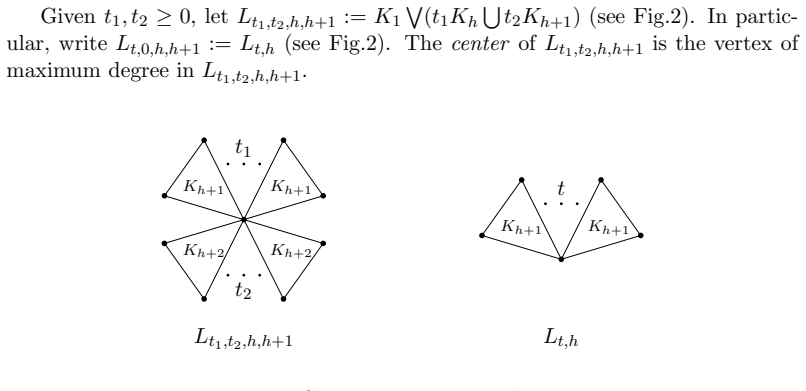
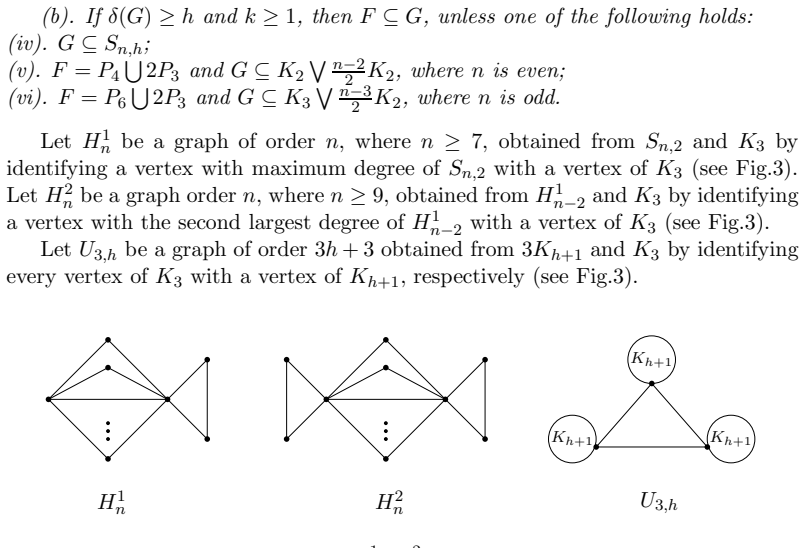
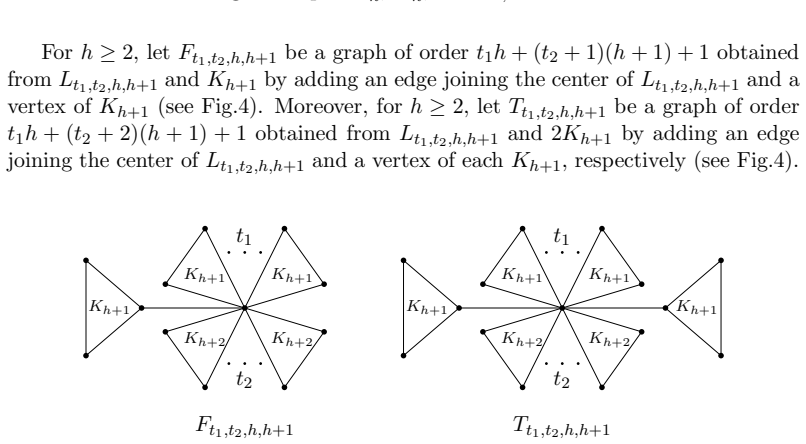
Theorems 1.8–1.11 assert the following. Let $F=(\bigcup_{i=1}^k P_{2a_i})\cup(\bigcup_{i=1}^2 P_{2b_i+1})$ be a linear forest with $k\ge 0$ and at most two odd paths, and set $h=\sum_i a_i+\sum_i b_i-1$. If $G$ is connected (or 2-connected) of sufficiently large order $n$ and $\delta(G)\ge h$, then $F\subseteq G$ unless $G$ is one of the listed exceptions: $S_{n,h}=K_h\vee \overline{K}_{n-h}$, $S^+_{n,h}=K_h\vee(K_2\cup \overline{K}_{n-h-2})$, $L_{t,h}=K_1\vee tK_h$, the parity-sensitive joins $K_2\vee \frac{n-2}{2}K_2$ and $K_3\vee \frac{n-3}{2}K_2$ in specific cases, or the cut-vertex families $H^1_n$, $H^2_n$, $U_{3,h}$, $L_{t_1,t_2,h,h+1}$, $F_{t_1,t_2,h,h+1}$, and $T_{t_1,t_2,h,h+1}$. The paper also constructs examples showing that lowering the minimum degree to $h-1$ admits infinitely many $F$-free graphs outside every listed exception, so the bound $h$ is tight.
Load-bearing premise
The classification hinges on Lemma 2.4(iii): when the longest cycle has length $2h+2$ and $P_{2h+4}$ is absent, every vertex outside the cycle must have the same neighbors on the cycle, and that common neighborhood has size $h$ or $h+1$; this is stated without a full derivation and the 2-connected theorems collapse if it is false.
Editorial extensions
If this is right
- The minimum-degree condition $\delta(G)\ge h$ is sharp for every family considered: dropping to $h-1$ creates infinitely many $F$-free graphs outside all listed exceptions, as shown by the $L_{(n-1)/(h-1),h-1}$ examples in Remarks 1 and 2.
- For a pure even forest ($l=0$), only two exceptions occur, $S_{n,h}$ and $L_{t,h}$, so the stability description is nearly trivial.
- For a forest with one odd path, the exceptions add the parity-sensitive join $K_2\vee \frac{n-2}{2}K_2$ and the $L_{t,h}$ case with two special path-length pairs.
- For two odd paths and no even path, the cut-vertex theorem produces a finite catalogue $U_{3,h}$, $L_{t_1,t_2,h,h+1}$, $F_{t_1,t_2,h,h+1}$, $T_{t_1,t_2,h,h+1}$, plus $H^1_n$ and $H^2_n$ in the small case.
- The combined result strengthens the edge-count extremal theorem for linear forests to a minimum-degree stability statement, with the same main exceptions reappearing in the 2-connected case.
Reading between the lines
- Not asserted in the paper: the same mechanism should extend to forests with more than two odd paths, with an exception list built from larger joins of cliques, keeping $h$ as half the total length minus one.
- Not asserted in the paper: the longest-cycle classification suggests an analogous stability theorem for disjoint unions of cycles, with the threshold equal to the sum of cycle half-lengths minus one.
- Not asserted in the paper: the exceptional families in the 2-connected theorems depend on the parity of $n$, so an explicit parity-dependent version for every $n$, rather than only sufficiently large $n$, is plausible.
- Not asserted in the paper: if Lemma 2.4(iii) fails for some $h$, the likely fix is a single added exception family where outside vertices split between two alternating neighborhoods on the long cycle.
Signed reviews
Editorial analysis
A structured set of objections, weighed in public.
Referee Report
Summary. The paper proves stability versions of the Erdős–Gallai theorem for linear forests consisting of an arbitrary number of even paths together with at most two odd paths. For a connected or 2-connected graph G of sufficiently large order n with minimum degree at least h = (sum of half path lengths) - 1, the authors claim that F embeds in G unless G belongs to one of several explicitly listed exceptional families, including S_{n,h}, S^+_{n,h}, L_{t,h}, joins of K_2 or K_3 with a matching, H^1_n, H^2_n, U_{3,h}, F_{t1,t2,h,h+1}, and T_{t1,t2,h,h+1}. The proofs use longest cycles, block decompositions, and a common-neighborhood lemma of Lidický–Liu–Palmer, and the paper includes sharpness examples for the minimum degree condition.
Significance. If the main theorems are correct, they unify and extend prior results of Ali–Staton for even paths and Yuan–Nikiforov for odd paths to linear forests with up to two odd components, and they provide a fairly complete stability classification. The paper is commendably explicit about the exceptional families and includes minimum-degree sharpness constructions. The stability argument is self-contained apart from standard external tools, and the statements are precise and falsifiable. However, the proof currently rests on a stated lemma that is false, so the significance is contingent on repairing that part of the argument.
major comments (2)
- [Section 2, Lemma 2.4(iii)] Lemma 2.4(iii) is false as stated. For h=3, take a cycle C8 on v1,...,v8, add independent vertices x,y with N(x)={v2,v4,v6} and N(y)={v2,v4,v8}, and add the chords v1v4, v3v6, v5v8, v7v2. The resulting graph is bipartite with parts {v1,v3,v5,v7,x,y} and {v2,v4,v6,v8}, so every cycle has length at most 8 and every path has at most 9 vertices; in particular P10 is absent. Each vertex has degree at least 3, U={x,y} is independent, and N_C(x) differs from N_C(y), so the hypotheses of Lemma 2.4(iii) hold while the conclusion fails. The proof's step claiming that N_C(u1) lies in a path of 2h-1 consecutive vertices and hence d_C(u1) ≤ h-1 is invalid: that path has independence number h, not h-1. This lemma is load-bearing: Lemma 4.2 uses it to rule out l=2h+2, and Lemma 4.1(ii) Case 4 uses it for the l=6 case; consequently the proofs of Theorems 1.10 and parts of Lemma 4.1 are unsound as written.
- [Section 4, Lemma 4.10 and Theorem 4.11(b)] Lemma 4.10 is stated only for b1,b2 ≥ 3, but Theorem 4.11(b) requires the conclusion for all b1 ≥ b2 ≥ 1. The proof of Theorem 4.11(b) simply invokes Lemma 4.10, so the cases b2=1 and b2=2 are not covered. Moreover, the h=2 branch inside Lemma 4.10's proof is inconsistent with the lemma's own assumptions: if b1,b2 ≥ 3 and k ≥ 1, then h ≥ 1+3+3-1 = 6, so h=2 cannot occur. That branch also cites Lemma 4.1(ii), which concerns P5 ∪ P3, whereas the case F = P2 ∪ 2P3 needs Lemma 4.1(iii). Thus Theorem 4.11(b) is not proved for the small odd-path cases it claims to cover.
minor comments (5)
- [Abstract and Introduction] The abstract contains a grammatical error: 'extends and strengths' should be 'extends and strengthens'.
- [Theorem 4.11 proof] In the proof of Theorem 4.11(a), the citations to 'Lemma 4.6 (i)' and 'Lemma 4.6 (ii)' should be to Lemma 4.1(i) and Lemma 4.1(ii), respectively; there is no Lemma 4.6 with parts (i) and (ii) in the stated form.
- [Lemma 2.7(iii) proof] In the proof of Lemma 2.7(iii), the notation NP6(v) is written inconsistently as {v2,v4}, {v2,v5}, {u2}, {u4}, {u5}; the path vertices are denoted u1,...,u6, so these should all use the u notation.
- [Lemma 4.9 proof] The first sentence of the proof of Lemma 4.9 contains a leftover summation index: since k=0 in that lemma, the displayed sum should be Σ_{i=1}^2 (2b_i+1) = 2h+4 rather than Σ_{i=1}^k 2a_i + Σ_{i=1}^2 (2b_i+1).
- [Theorem 1.11(b)] The statement of Theorem 1.11(b) has a typo: 'δ(G) ≥ h ≥ 2 an k ≥ 1' should read 'δ(G) ≥ h ≥ 2 and k ≥ 1'.
Circularity Check
No significant circularity: all load-bearing lemmas are prior external results or direct case arguments; the sole flagged issue is a proof gap in Lemma 2.4(iii), not a circular reduction.
full rationale
The derivation is self-contained against external benchmarks. Theorems 1.8–1.11 are proved from classical external black boxes (Erdős–Gallai [6] as Lemma 2.1, Dirac [5] as Lemma 2.2, and Lidický–Liu–Palmer [8] as Lemma 2.3) plus new case analyses; no parameter is fitted to data and no target statement is assumed in a lemma. The self-citations [4] and [11] appear only as background references and are not load-bearing. The only questionable step is Lemma 2.4(iii), whose proof that P_{2h+4}-freeness forces N_C(u1) to lie in 2h−1 consecutive cycle vertices, then jumps from 'no two consecutive neighbors on the cycle' to d_C(u1) ≤ h−1; since a no-two-consecutive subset of 2h−1 vertices can have h elements, the intended bound is not derived. This makes Lemma 4.2's use of Lemma 2.4(iii) a soundness risk, but it is not a circularity: it does not redefine an input as an output, fit a parameter, or rely on the authors' prior claims. Accordingly the circularity score is 0.
Assumptions & free parameters
assumptions (3)
- standard math Erdős-Gallai Lemma 2.1: a 2-connected graph with all vertices except possibly u1 of degree at least h contains a path of order min{n,2h} with end vertex u1.
- standard math Dirac's theorem Lemma 2.2: a 2-connected graph with minimum degree at least h contains a cycle of length at least 2h.
- standard math Lidický-Liu-Palmer Lemma 2.3: for large n, large bipartite edge density between a small set and its complement forces a large common neighborhood.
Cite this review
Pith. "Pith review of Erdos-Gallai Stability Theorem for Linear Forests." pith.science (2026). https://pith.science/paper/23XYCYUL
@misc{pith2026190800665,
  author       = {Pith},
  title        = {Pith review of: Erdos-Gallai Stability Theorem for Linear Forests},
  year         = {2026},
  howpublished = {\url{https://pith.science/paper/23XYCYUL}},
  note         = {Machine review of arXiv:1908.00665}
}
abstract
The Erd\H{o}s-Gallai Theorem states that every graph of average degree more than $l-2$ contains a path of order $l$ for $l\ge 2$. In this paper, we obtain a stability version of the Erd\H{o}s-Gallai Theorem in terms of minimum degree. Let $G$ be a connected graph of order $n$ and $F=(\bigcup_{i=1}^kP_{2a_i})\bigcup(\bigcup_{i=1}^lP_{2b_i+1})$ be $k+l$ disjoint paths of order $2a_1, \ldots, 2a_{k}, 2b_1+1, \ldots, 2b_l+1,$ respectively, where $k\ge 0$, $0\le l\le 2$, and $k+l\geq 2$. If the minimum degree $\delta(G)\ge \sum_{i=1}^ka_i+\sum_{i=1}^lb_i-1$, then $F\subseteq G$ except several classes of graphs for sufficiently large $n$, which extends and strengths the results of Ali and Staton for an even path and Yuan and Nikiforov for an odd path.
Figures

Figures from the paper (1 more)
Reference graph
Works this paper leans on
-
[1]
Andrasfai, Paths, Circuits, and Loops of Graphs, (Hungarian) Mat
B. Andrasfai, Paths, Circuits, and Loops of Graphs, (Hungarian) Mat. Lapok 13 (1962) 95-107
work page 1962
- [2]
-
[3]
N. Bushaw and N. Kettle, Tur\' a n numbers of multiple paths and equibipartite forests, Combin. Probab. Comput. 20 (2011) 837--853
work page 2011
-
[4]
M.-Z. Chen and X.-D. Zhang, The number of edges, spectral radius and Hamilton-connectedness of graphs, J. Comb. Optim. 35 (2018) 1104--1127
work page 2018
-
[5]
Dirac, Some theorems on abstract graphs, Proc
G.A. Dirac, Some theorems on abstract graphs, Proc. London Math Soc. 2 (1952) 69--81
work page 1952
-
[6]
P. Erd o s and T. Gallai, On maximal paths and circuits of graphs, Acta Math. Acad. Sci. Hungar. 10 (1959) 337--356
work page 1959
-
[7]
u redi, A. Kostochka, J. Verstra\
Z. F\" u redi, A. Kostochka, J. Verstra\" e te, Stability in the Erd o s--Gallai Theorems on cycles and paths, J. Combin. Theory Ser. B, 121 (2016) 197-228
work page 2016
-
[8]
Gorgol, Tur\' a n number for disjoint copies of graphs, Graphs Combin
I. Gorgol, Tur\' a n number for disjoint copies of graphs, Graphs Combin. 27 (2011) 661-667
work page 2011
Show all 12 references
-
[9]
Lidick\' y , H
B. Lidick\' y , H. Liu, C. Palmer, On the Tur\' a n number of forests, Electron. J. Combin. 20 (2) (2013) Paper 62, 13 pp
2013
-
[10]
Nikiforov and X.Y
V. Nikiforov and X.Y. Yuan, Maxima of the Q -index: graphs without long paths, Electron. J. Linear Algebra 27 (2014) 504--514
2014
-
[11]
West, Introduction to Graph Theory, Prentice-Hall, London, 2001
D.B. West, Introduction to Graph Theory, Prentice-Hall, London, 2001
2001
-
[12]
Yuan and X.-D Zhang, The Tur\' a n number of disjoint copies of path, Discrete Math
L.-T. Yuan and X.-D Zhang, The Tur\' a n number of disjoint copies of path, Discrete Math. 340 (2) (2017) 132-139
2017
Reviewed August 14, 2026 · model on record in the stance chip above.
Discussion (0). Continue with ORCID to comment.