REVIEW 2 major objections 5 minor 34 references
Origin of magnetic anisotropy in the spin ladder compound (C$_5$H$_{12}$N)$_2$CuBr$_4$
T0 review · 2 major / 5 minor · reviewed 2026-08-14 · deepseek-v4-flash
Pith's one-line read The splitting of BPCB's spin-triplet band comes from the weak leg bonds, not the strong rungs.
desk verdict A genuinely new high-resolution neutron result with a clear qualitative message, but the claim that rung Ising anisotropy is negligible outruns the models actually fitted. read the letter →
The pith
A machine-rendered reading of the paper's core claim, the machinery that carries it, and where it could break.
The reading
What carries the argument
The carrying object is the strong-coupling expansion of the one-triplet dispersion for an $S=1/2$ ladder with anisotropic exchange, built on the small parameter $\lambda = J_{\parallel}/J_{\perp} \approx 0.28$. Starting from isolated rung singlets and triplets, the calculation produces analytic expressions $\epsilon_{\sigma}(k)$ for the three triplet branches in each anisotropy scenario; the $\sigma=0$ branch and the $\sigma=\pm$ branches respond differently to leg versus rung anisotropy. This turns the small measured splitting into a fingerprint that excludes rung Ising anisotropy and attributes the anisotropy to the legs.
What would settle it
Measure the triplet splitting as a function of the direction and magnitude of a small applied magnetic field: the Ising-only, DM-only, and superexchange-combined leg models predict distinct field-orientation responses, so a dataset that matches none of them would falsify the claim that leg exchange anisotropy is the dominant source.
Extended reading notes
Core claim
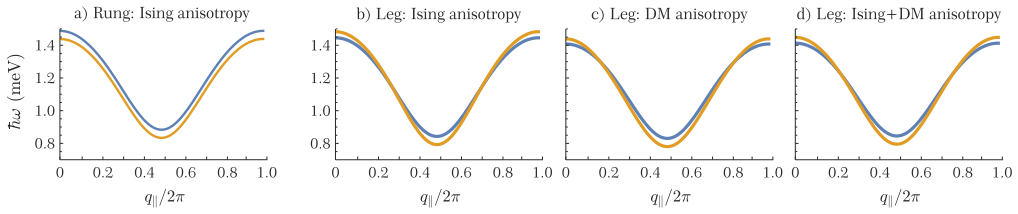
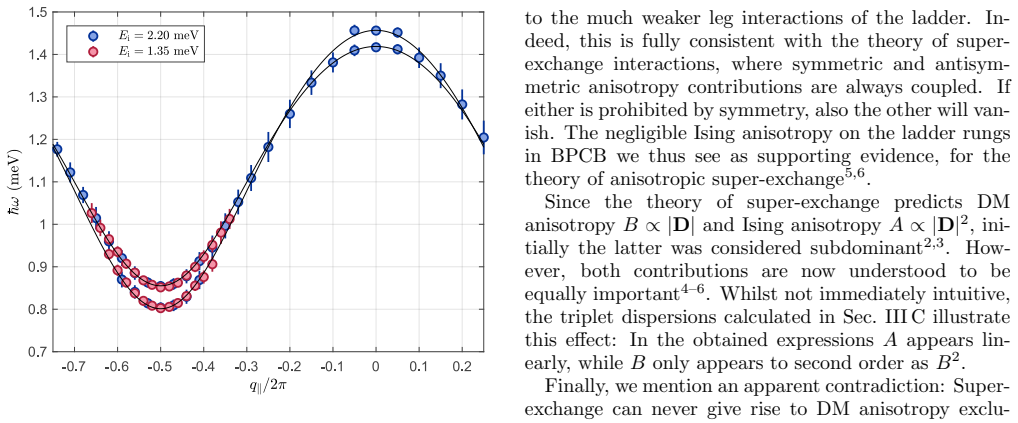
The central claim is that the very small (about 0.6 K) magnetic anisotropy of BPCB lives on the ladder legs. Treating the ladder as strongly coupled rung dimers and adding anisotropic exchange perturbatively, the authors calculate the triplet dispersion up to third order in $\lambda = J_{\parallel}/J_{\perp}$. The rung-Ising case is qualitatively incompatible with the measured band shape, while all leg-anisotropy cases give the observed pattern: a doubly degenerate band with smaller bandwidth, a non-degenerate band with larger bandwidth, and a splitting slightly larger at the band minimum than at the band maximum. Because the Cu$^{2+}$ ions are $S=1/2$, single-ion anisotropy is absent on symmetry grounds, and the estimated dipolar contribution is below 1 \mu eV, so the observed splitting must be exchange anisotropy. Since only the combined Ising-plus-DM leg model is consistent with the microscopic superexchange picture, the paper concludes that weakly anisotropic leg interactions dominate, with the rungs contributing negligibly.
Load-bearing premise
The argument depends on the third-order strong-coupling expansion in $\lambda = J_{\parallel}/J_{\perp}$ being quantitatively reliable for the anisotropic triplet dispersions; the paper itself notes that the predicted maximum splitting shifts from second to third order, so the expansion may not be fully converged at the experimental precision.
Editorial extensions
If this is right
- The anisotropy axis and the ratio of the band-minimum to band-maximum splitting in BPCB are determined by the leg exchange bonds, not by the much stronger rung bonds.
- Ising-type anisotropy on the rungs is negligible, consistent with the inversion symmetry at rung centers and with superexchange theory.
- Zero-field neutron data cannot distinguish Ising-only, DM-only, or combined leg anisotropy; the paper's combined model is the only one with microscopic superexchange justification.
- A fit to the leg-anisotropy model gives $D_{\parallel}/k_B = 1.44(2)$ K, but this value should not be read as the anisotropy magnitude; the physical scale is the roughly 0.6 K band splitting.
- Measuring the triplet dispersion under a small applied magnetic field is the proposed route to identify which leg-anisotropy term is actually present.
Reading between the lines
- If leg-bond anisotropy sets the anisotropy in BPCB, then in other strong-rung ladders the anisotropy axis may be determined by the weakest exchange paths, so estimates based on the strongest bonds could be misdirected.
- The near-degeneracy of the Ising-only, DM-only, and combined leg dispersions suggests that many published 'pure DM' fits to neutron data may in fact be compatible with the full superexchange ratio; field-orientation measurements could separate them.
- A testable extension is to compare the predicted $\lambda$-dependence of the splitting ratio with a series of isostructural ladders in which $J_{\parallel}$ is varied systematically.
Editorial analysis
A structured set of objections, weighed in public.
Referee Report
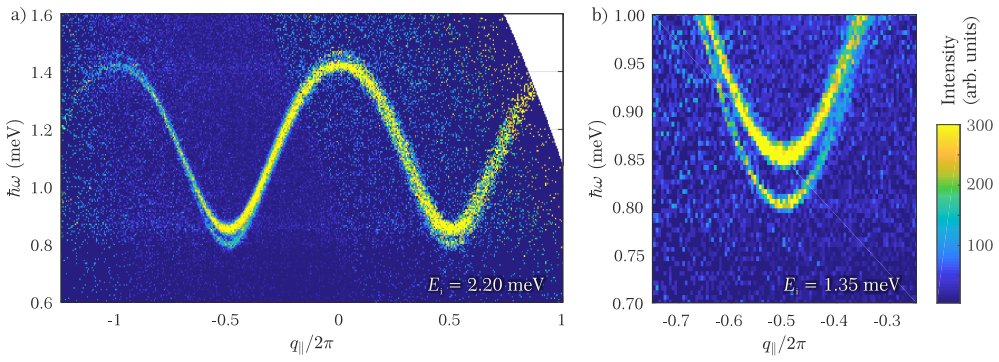
Summary. The paper reports high-resolution inelastic neutron scattering on the S=1/2 spin ladder compound BPCB, resolving a splitting of the triplet band of 50(1) μeV at the band minimum and 40(2) μeV at the band maximum. The authors derive a strong-coupling expansion for the triplet dispersion of a spin ladder with anisotropic rung or leg exchange and compare four models: rung Ising, leg Ising, leg DM, and both DM plus Ising on the legs. The rung-Ising model is excluded because it yields a nearly k-independent splitting, whereas the data show a clear k-dependence. All three leg-anisotropy models reproduce the data, and the authors conclude that weakly anisotropic leg interactions dominate the magnetic anisotropy in BPCB, with the rung Ising anisotropy 'negligible'. This conclusion is used to support the theory of anisotropic superexchange.
Significance. The experimental achievement is significant: the 50/40 μeV splittings are well resolved given the reported 19/36 μeV resolution, and the Gaussian-fit analysis is standard. The strong-coupling calculation for anisotropic ladders is a useful contribution that will be of interest to the quantum magnetism community. The paper is honest about the degeneracy of the three leg-anisotropy models and about the residual perturbation-order dependence (footnote 31). However, the central interpretive claim that rung Ising anisotropy is negligible is not established by the presented fits, because no combined model is fitted. As a result, the paper's strongest conclusion goes beyond its model space. With a combined fit bounding the rung contribution, or with appropriately softened claims, the paper would be a valuable case study in identifying exchange anisotropy in quantum magnets.
major comments (2)
- [Sections IV.C, IV.D, V and the abstract] The conclusion that rung Ising anisotropy is 'negligible' is not supported by the fitted model space. Only the rung-only model (case a) and leg-only models (cases b, c, d) are compared; no fit with both the rung Ising parameter C in Eq. (3) and the leg parameters A, B in Eq. (6) is reported. From Eqs. (4)-(5), a rung Ising term contributes a splitting that is k-independent to first order and has only a weak k-dependence at third order, while leg terms produce a strongly k-dependent splitting. A combined model can reproduce the observed 50/40 μeV pattern with the rung term providing most of the splitting: for example, in the notation of Sec. III, values around C≈0.33 and A≈0.02 give a rung contribution of roughly 50 μeV and a leg contribution that accounts for the ~10 μeV difference between the two extrema. The data alone therefore do not bound C. The statement that rung Ising anisotropy is 'negligible' in Sec. IV.D and V, and the superexchange-support argument built on it, assumes the leg-only parametrization is complete. I recommend fitting a combined model with C free and reporting a bound on C, or explicitly restricting the conclusion to 'leg anisotropy is required to explain the k-dependence of the splitting' and removing the 'negligible' wording.
- [Footnote 31 and Sec. IV.C] The quantitative comparison to the leg-anisotropy models is affected by the truncation of the strong-coupling expansion. The footnote states that the predicted Δmax values (37, 32, 35 μeV for cases b, c, d) differ from the measured 40(2) μeV, and that the dispersion still changes from second to third order. Since the 'excellent agreement' of the leg models is part of the evidence for the central conclusion, the authors should either demonstrate that the second-to-third-order shift does not affect the discrimination between rung and leg models, or present the comparison with a clear statement of the theoretical uncertainty. The qualitative exclusion of the rung-only model is likely robust because its splitting is k-independent already at first order, but the quantitative agreement claim for the leg models should be calibrated against the perturbative uncertainty.
minor comments (5)
- [Equation (9)] The third-order coefficient for cos(3k) is printed as '1/8 cos(3k)', but in the limit A=B=0 Eq. (9) should reduce to Eq. (2), which contains 'cos(3k)' with coefficient 1. The printed '1/8' is inconsistent with the isotropic limit and is presumably a typo; it should be corrected because the dispersion expression is central to the model comparison.
- [Sec. IV.C, Fig. 5] The text states that all three leg-anisotropy models give 'excellent agreement' but shows only the fit for case d. Showing the fits or residual plots for cases b and c would substantiate this claim.
- [Appendix and Sec. III.C] The statement in the appendix that 'all H′ commute with Sz' is not immediately obvious for the DM term HLeg,DM in Eq. (7); a one-sentence demonstration that e_z·(S×S) preserves total Sz would help the reader.
- [Figure 4 caption] For case d, the anisotropy is specified by two parameters A and B, whereas the caption refers to 'the anisotropy parameter' singular. The caption should state how A and B are related via Eq. (11) when plotting case d.
- [Sec. IV.A] The sentence 'inter-ladder interactions were previously estimated on the order of a few 10s of mK 18 (a few μeV)' would be clearer as 'a few tens of mK'.
Circularity Check
No significant circularity: leg-anisotropy identification rests on the k-dependent splitting shape, not on the fitted amplitude.
full rationale
The paper's central claim is not circular. The measured splitting is used in two distinct ways. The overall anisotropy strength is fitted: 'In all four cases the anisotropy parameter was chosen such that the triplet splitting at the band minimum amounts to 50 μeV.' That fit sets the scale, but the discrimination between rung-Ising and leg-anisotropy models is based on the functional form of the splitting along the dispersion: the rung-Ising splitting is nearly k-independent (Eqs. 4-5), while the leg-anisotropy splittings are strongly k-dependent (Eqs. 8-9). This shape comparison does not reduce to the fitted amplitude; the ratio Δ_max/Δ_min is a parameter-free consequence of λ=J∥/J⊥ and the chosen anisotropy operator once the overall scale is fixed. The Heisenberg exchange constants J⊥/kB=12.7 K and J∥/kB=3.54 K are taken from the authors' prior PRL (Ref. 21), but that was an independent measurement based on isotropic-ladder fits to earlier neutron data, not on the anisotropy splitting analyzed here; it is therefore independent support and does not create a self-citation loop. The strong-coupling expansion follows the external method of Reigrotzki, Tsunetsugu, and Rice (Ref. 27). The only caveat is that no combined rung-plus-leg anisotropy model is fitted, so 'rung Ising negligible' is inferred by comparing single-source models rather than by bounding C in a joint fit. That is a completeness gap in model selection, not a circular reduction: no equation or fitted parameter is defined in terms of the conclusion, and no load-bearing claim is justified solely by a self-citation.
Assumptions & free parameters
free parameters (3)
- J_perp (rung exchange) =
12.77(1) K (case d fit)
- J_par (leg exchange) =
3.55(1) K (case d fit)
- D_par (leg DM vector component) =
1.44(2) K
assumptions (5)
- domain assumption Third-order strong-coupling perturbation theory in lambda = J_par/J_perp is quantitatively accurate for lambda ~ 0.28.
- domain assumption The only relevant anisotropy mechanisms are the four symmetry-compatible cases: rung Ising, leg Ising, leg DM, and combined leg Ising plus DM.
- domain assumption The rung Ising anisotropy is uniaxial, described by a single parameter C.
- standard math For each leg bond, the anisotropic superexchange is given by Eq. 11, where a single vector D determines both the DM and Ising terms.
- domain assumption Inter-ladder magnetic coupling is negligible.
Cite this review
Pith. "Pith review of Origin of magnetic anisotropy in the spin ladder compound (C$_5$H$_{12}$N)$_2$CuBr$_4$." pith.science (2026). https://pith.science/paper/Q2JDBMJN
@misc{pith2026190800724,
  author       = {Pith},
  title        = {Pith review of: Origin of magnetic anisotropy in the spin ladder compound (C$_5$H$_12$N)$_2$CuBr$_4$},
  year         = {2026},
  howpublished = {\url{https://pith.science/paper/Q2JDBMJN}},
  note         = {Machine review of arXiv:1908.00724}
}
abstract
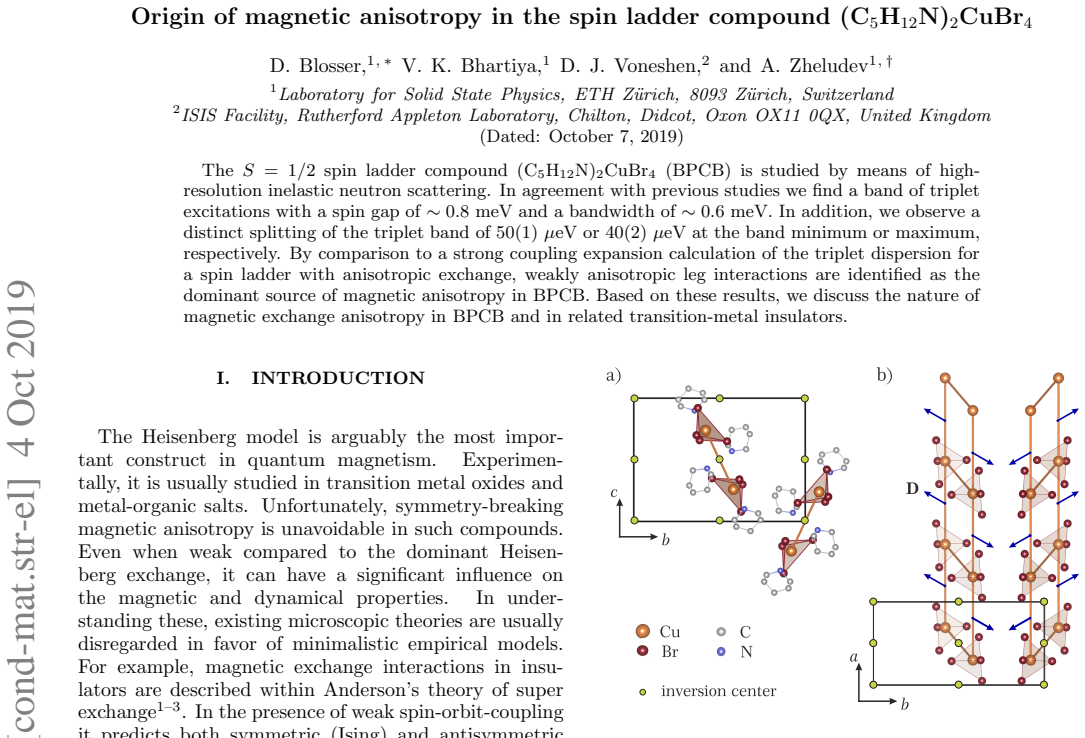
The $S=1/2$ spin ladder compound (C$_5$H$_{12}$N)$_2$CuBr$_4$ (BPCB) is studied by means of high-resolution inelastic neutron scattering. In agreement with previous studies we find a band of triplet excitations with a spin gap of $\sim0.8$~meV and a bandwidth of $\sim0.6$~meV. In addition, we observe a distinct splitting of the triplet band of $50(1)$~$\mu$eV or $40(2)$~$\mu$eV at the band minimum or maximum, respectively. By comparison to a strong coupling expansion calculation of the triplet dispersion for a spin ladder with anisotropic exchange, weakly anisotropic leg interactions are identified as the dominant source of magnetic anisotropy in BPCB. Based on these results, we discuss the nature of magnetic exchange anisotropy in BPCB and in related transition-metal insulators.
Figures

Figures from the paper (3 more)
Reference graph
Works this paper leans on
-
[1]
author author P. W. \ Anderson ,\ 10.1103/PhysRev.115.2 journal journal Phys. Rev. \ volume 115 ,\ pages 2 ( year 1959 ) NoStop
-
[2]
Moriya ,\ 10.1103/PhysRevLett.4.228 journal journal Phys
author author T. Moriya ,\ 10.1103/PhysRevLett.4.228 journal journal Phys. Rev. Lett. \ volume 4 ,\ pages 228 ( year 1960 a ) NoStop
-
[3]
Moriya ,\ 10.1103/PhysRev.120.91 journal journal Phys
author author T. Moriya ,\ 10.1103/PhysRev.120.91 journal journal Phys. Rev. \ volume 120 ,\ pages 91 ( year 1960 b ) NoStop
-
[4]
author author T. A. \ Kaplan ,\ 10.1007/BF01301591 journal journal Zeitschrift f \"u r Physik B Condensed Matter \ volume 49 ,\ pages 313 ( year 1983 ) NoStop
-
[5]
author author L. Shekhtman , author O. Entin-Wohlman , \ and\ author A. Aharony ,\ 10.1103/PhysRevLett.69.836 journal journal Phys. Rev. Lett. \ volume 69 ,\ pages 836 ( year 1992 ) NoStop
-
[6]
author author L. Shekhtman , author A. Aharony , \ and\ author O. Entin-Wohlman ,\ 10.1103/PhysRevB.47.174 journal journal Phys. Rev. B \ volume 47 ,\ pages 174 ( year 1993 a ) NoStop
-
[7]
author author M. Oshikawa \ and\ author I. Affleck ,\ 10.1103/PhysRevLett.79.2883 journal journal Phys. Rev. Lett. \ volume 79 ,\ pages 2883 ( year 1997 ) NoStop
-
[8]
author author I. Affleck \ and\ author M. Oshikawa ,\ 10.1103/PhysRevB.60.1038 journal journal Phys. Rev. B \ volume 60 ,\ pages 1038 ( year 1999 ) NoStop
Show all 34 references
-
[9]
author author S. A. \ Zvyagin , author A. K. \ Kolezhuk , author J. Krzystek , \ and\ author R. Feyerherm ,\ 10.1103/PhysRevLett.93.027201 journal journal Phys. Rev. Lett. \ volume 93 ,\ pages 027201 ( year 2004 ) NoStop
2004 doi
-
[10]
Coldea , author D
author author R. Coldea , author D. A. \ Tennant , author K. Habicht , author P. Smeibidl , author C. Wolters , \ and\ author Z. Tylczynski ,\ 10.1103/PhysRevLett.88.137203 journal journal Phys. Rev. Lett. \ volume 88 ,\ pages 137203 ( year 2002 ) NoStop
-
[11]
H\"alg , author W
author author M. H\"alg , author W. E. A. \ Lorenz , author K. Y. \ Povarov , author M. M nsson , author Y. Skourski , \ and\ author A. Zheludev ,\ 10.1103/PhysRevB.90.174413 journal journal Phys. Rev. B \ volume 90 ,\ pages 174413 ( year 2014 ) NoStop
-
[12]
Kenzelmann , author A
author author M. Kenzelmann , author A. Zheludev , author S. Raymond , author E. Ressouche , author T. Masuda , author P. B\"oni , author K. Kakurai , author I. Tsukada , author K. Uchinokura , \ and\ author R. Coldea ,\ 10.1103/PhysRevB.64.054422 journal journal Phys. Rev. B ...
-
[13]
Jacobsen , author S
author author H. Jacobsen , author S. M. \ Gaw , author A. J. \ Princep , author E. Hamilton , author S. T\'oth , author R. A. \ Ewings , author M. Enderle , author E. M. H. \ Wheeler , author D. Prabhakaran , \ and\ author A. T. \ Boothroyd ,\ 10.1103/PhysRevB.97.144401 journ...
-
[14]
Bettler , author F
author author S. Bettler , author F. Landolt , author O. M. \ Aksoy , author Z. Yan , author S. Gvasaliya , author Y. Qiu , author E. Ressouche , author K. Beauvois , author S. Raymond , author A. N. \ Ponomaryov , author S. A. \ Zvyagin , \ and\ author A. Zheludev ,\ 10.1103/...
-
[15]
author author B. R. \ Patyal , author B. L. \ Scott , \ and\ author R. D. \ Willett ,\ 10.1103/PhysRevB.41.1657 journal journal Phys. Rev. B \ volume 41 ,\ pages 1657 ( year 1990 ) NoStop
1990 doi
-
[16]
author author A. T. \ Savici , author G. E. \ Granroth , author C. L. \ Broholm , author D. M. \ Pajerowski , author C. M. \ Brown , author D. R. \ Talham , author M. W. \ Meisel , author K. P. \ Schmidt , author G. S. \ Uhrig , \ and\ author S. E. \ Nagler ,\ 10.1103/PhysRevB...
-
[17]
R\"uegg , author K
author author C. R\"uegg , author K. Kiefer , author B. Thielemann , author D. F. \ McMorrow , author V. Zapf , author B. Normand , author M. B. \ Zvonarev , author P. Bouillot , author C. Kollath , author T. Giamarchi , author S. Capponi , author D. Poilblanc , author D. Bine...
-
[18]
Klanj s s ek , author H
author author M. Klanj s s ek , author H. Mayaffre , author C. Berthier , author M. Horvati c \' c , author B. Chiari , author O. Piovesana , author P. Bouillot , author C. Kollath , author E. Orignac , author R. Citro , \ and\ author T. Giamarchi ,\ 10.1103/PhysRevLett.101.13...
-
[19]
uegg , author H. M. \ R nnow , author A. M. \ L\
author author B. Thielemann , author C. R\"uegg , author H. M. \ R nnow , author A. M. \ L\"auchli , author J.-S. \ Caux , author B. Normand , author D. Biner , author K. W. \ Kr\"amer , author H.-U. \ G\"udel , author J. Stahn , author K. Habicht , author K. Kiefer , author M...
-
[20]
amer , author C. R\
author author E. C C i z z m\'ar , author M. Ozerov , author J. Wosnitza , author B. Thielemann , author K. W. \ Kr\"amer , author C. R\"uegg , author O. Piovesana , author M. Klanj s s ek , author M. Horvati c \' c , author C. Berthier , \ and\ author S. A. \ Zvyagin ,\ 10.11...
-
[21]
Blosser , author V
author author D. Blosser , author V. K. \ Bhartiya , author D. J. \ Voneshen , \ and\ author A. Zheludev ,\ 10.1103/PhysRevLett.121.247201 journal journal Phys. Rev. Lett. \ volume 121 ,\ pages 247201 ( year 2018 a ) NoStop
2018 doi
-
[22]
fig:structure are based on renderings generated by the VESTA software package VESTA2011
note The crystal structure plots shown in Fig. fig:structure are based on renderings generated by the VESTA software package VESTA2011 . Stop
-
[23]
Dzyaloshinsky ,\ https://doi.org/10.1016/0022-3697(58)90076-3 journal journal Journal of Physics and Chemistry of Solids \ volume 4 ,\ pages 241 ( year 1958 ) NoStop
author author I. Dzyaloshinsky ,\ https://doi.org/10.1016/0022-3697(58)90076-3 journal journal Journal of Physics and Chemistry of Solids \ volume 4 ,\ pages 241 ( year 1958 ) NoStop
1958 doi
-
[24]
Bewley , author J
author author R. Bewley , author J. Taylor , \ and\ author S. Bennington. ,\ http://dx.doi.org/10.1016/j.nima.2011.01.173 journal journal Nuclear Instruments and Methods in Physics Research Section A: Accelerators, Spectrometers, Detectors and Associated Equipment \ volume 637...
2011 doi
-
[25]
note The raw data is available in the STFC Research Data Repository DataISIS_BPCB . Stop
-
[26]
Zheludev , author V
author author A. Zheludev , author V. O. \ Garlea , author L.-P. \ Regnault , author H. Manaka , author A. Tsvelik , \ and\ author J.-H. \ Chung ,\ 10.1103/PhysRevLett.100.157204 journal journal Phys. Rev. Lett. \ volume 100 ,\ pages 157204 ( year 2008 ) NoStop
-
[27]
Reigrotzki , author H
author author M. Reigrotzki , author H. Tsunetsugu , \ and\ author T. M. \ Rice ,\ http://stacks.iop.org/0953-8984/6/i=43/a=021 journal journal Journal of Physics: Condensed Matter \ volume 6 ,\ pages 9235 ( year 1994 ) NoStop
1994
-
[28]
author author P. Fazekas ,\ 10.1142/2945 title Lecture Notes on Electron Correlation and Magnetism \ ( publisher WORLD SCIENTIFIC ,\ year 1999 )\ http://arxiv.org/abs/https://www.worldscientific.com/doi/pdf/10.1142/2945 https://www.worldscientific.com/doi/pdf/10.1142/2945 NoStop
1999 doi
-
[29]
Koshibae , author Y
author author W. Koshibae , author Y. Ohta , \ and\ author S. Maekawa ,\ 10.1103/PhysRevLett.71.467 journal journal Phys. Rev. Lett. \ volume 71 ,\ pages 467 ( year 1993 ) NoStop
1993 doi
-
[30]
Shekhtman , author O
author author L. Shekhtman , author O. Entin-Wohlman , \ and\ author A. Aharony ,\ 10.1103/PhysRevLett.71.468 journal journal Phys. Rev. Lett. \ volume 71 ,\ pages 468 ( year 1993 b ) NoStop
1993 doi
-
[31]
fig:DispAniso the anisotropy parameter was chosen so as to ensure _ min =50 eV
note In Fig. fig:DispAniso the anisotropy parameter was chosen so as to ensure _ min =50 eV. For the different models of leg anisotropy (Ising only, DM only, both), this gives _ max =37,32 and 35 eV. However, since from 2 nd to 3 rd order perturbation expansion the dispersion ...
-
[32]
Zheludev , author S
author author A. Zheludev , author S. Maslov , author I. Tsukada , author I. Zaliznyak , author L. P. \ Regnault , author T. Masuda , author K. Uchinokura , author R. Erwin , \ and\ author G. Shirane ,\ 10.1103/PhysRevLett.81.5410 journal journal Phys. Rev. Lett. \ volume 81 ,...
-
[33]
Momma \ and\ author F
author author K. Momma \ and\ author F. Izumi ,\ 10.1107/S0021889811038970 journal journal Journal of Applied Crystallography \ volume 44 ,\ pages 1272 ( year 2011 ) NoStop
2011 doi
-
[34]
Blosser , author V
author author D. Blosser , author V. K. \ Bhartiya , \ and\ author A. Zheludev ,\ 10.5286/ISIS.E.87813753 journal journal RB1720009, STFC ISIS Facility \ ( year 2018 b ),\ 10.5286/ISIS.E.87813753 NoStop
2018 doi
Reviewed August 14, 2026 · model on record in the stance chip above.
Discussion (0). Continue with ORCID to comment.