REVIEW 3 major objections 4 minor 29 references
Environmentally-induced exceptional points in elastodynamics
T0 review · 3 major / 4 minor · reviewed 2026-08-14 · deepseek-v4-flash
Pith's one-line read Two identical aluminum pillars, coupled only through their base plate, reach an exceptional point when one is subjected to purely dissipative differential loss, with the eigenfrequency splitting following the square-root law near the…
desk verdict Environment-mediated EPs in elastodynamics is a plausible and genuinely new platform, but the experimental square-root confirmation is partly model-dependent; the COMSOL simulation carries the load. read the letter →
The pith
A machine-rendered reading of the paper's core claim, the machinery that carries it, and where it could break.
The reading
What carries the argument
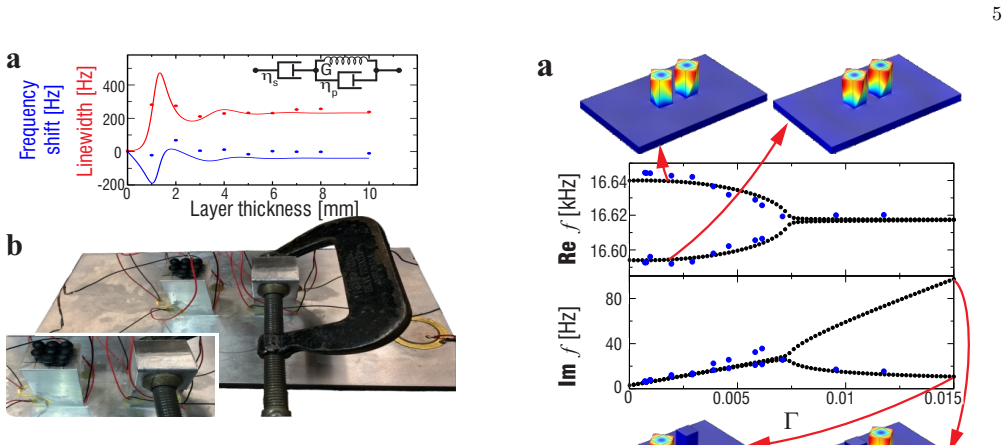
The central object is the two-mode coupled-mode theory Hamiltonian in the weak-coupling limit (Eq. 5 of the paper), which maps the unequal-loss mechanical dimer onto an effective $2\times 2$ matrix with the same square-root singularity structure as a parity-time-symmetric dimer. The pivotal linearization is $1-u^2 \approx -2\Delta$ with $u=1+\Delta$, and the Appendix derives the exceptional point position $\Gamma_\mathrm{EP}=2(\sqrt{1+2\kappa}-1)+\gamma_d$ and the splitting $\Delta\omega/\omega_0 = \tfrac{2}{3}\kappa^{3/2}$. A three-level coupled-mode model (Eq. 4), adding one explicit environmental level with detuning $\nu$ and couplings $\lambda_1,\lambda_2$, shows how a nearby plate mode qualitatively modifies the two-level exceptional-point behavior. On the experimental side, a viscoelastic boundary-layer model of the putty layer gives the key constitutive relation that damping can be added without mass loading, which is what keeps the loss contrast tunable while preserving the resonator frequencies.
What would settle it
Measure both the real and imaginary parts of the two torsional eigenfrequencies with fine steps of the loss parameter through the would-be exceptional point: the claim requires the two real parts to become exactly equal and the two imaginary parts to become exactly equal at a single value of $\Gamma$, with the splitting scaling as $|\Gamma-\Gamma_\mathrm{EP}|^{1/2}$ in the neighborhood. If instead the real parts show an avoided crossing or the imaginary parts retain a finite difference at the closest approach, the singularity is not present. This test is achievable with the paper's own transmission-fitting method, which currently loses linewidth resolution just beyond the exceptional point.
Extended reading notes
Core claim
Using a pair of aluminum torsion pillars sharing a base plate, the paper shows that an exceptional point — a non-Hermitian degeneracy where two eigenfrequencies and their eigenvectors coalesce — can be induced by purely dissipative differential losses. The inter-pillar coupling is not a direct spring but is mediated by the elastic modes of the base plate, and the loss is introduced as a boundary layer of putty that adds damping with negligible mass loading. Experiment and COMSOL simulation both show that, as the imposed loss $\Gamma$ increases, the real parts of the two torsional eigenfrequencies merge and the splitting obeys $\Delta f \sim \sqrt{1-\Gamma/\Gamma_\mathrm{EP}}$ near the exceptional point, with the imaginary parts becoming equal in the exact phase. A coupled-mode theory in the weak-coupling limit and a three-level version including one explicit environmental mode reproduce the observed behavior, and the authors note that a strict exceptional point for unequal positive losses exists only in this weak-coupling approximation, which their device enforces with a small coupling splitting ($\kappa \approx 45$ Hz at $\omega_0 \approx 2\pi\times 16.29$ kHz).
Load-bearing premise
The entire demonstration relies on the pillar-pillar coupling being weak enough that the unequal-loss system can be linearized into a strict exceptional point; if the coupling is not kept small (here about 45 Hz compared with 16.29 kHz), no true coalescence of eigenvalues occurs and the square-root splitting law is lost.
Editorial extensions
If this is right
- Near the exceptional point, a small change in loss contrast $\Gamma$ produces a large, square-root response in the eigenfrequency splitting, so the structure acts as a sensitive transducer for dissipation and contact.
- Because the coupling is mediated by plate modes, modifying the plate (for example, adding an indent) changes the exceptional-point characteristics without touching the pillars, giving a new control knob labeled 'environmental mode control.'
- In the weak-coupling limit the unequal-loss mechanical dimer is mathematically equivalent to a PT-symmetric dimer, so established PT-symmetric sensing and transport designs can, in principle, be ported to elastodynamic structures.
- The three-level model indicates that a single nearby environmental mode can qualitatively shift or distort the exceptional point, meaning the base-plate mode spectrum can be used to engineer EP behavior in mechanical devices.
Reading between the lines
- A testable extension the authors do not pursue: sweeping both loss terms (or loss and coupling) along a closed loop around the EP should produce a chiral mode swap, turning this pair of pillars into a mechanical analog of topological mode transfer.
- An experiment the paper does not run: place a phononic band-gap lattice in the base plate so that no environmental mode lies near the pillar frequency; the model predicts the EP would then disappear or move, which would confirm the causal role of the environmental mode.
- A scaling question left open: the putty boundary-layer mechanism is specific to the 16 kHz scale, and extending the same idea to MEMS resonators would require a material whose boundary-layer dynamics remains loss-dominated without mass loading at much higher frequencies.
- A practical consequence the authors do not state: if the square-root law holds, the same measurement curve of $\Delta f$ versus $\Gamma$ contains both the coupling strength $\kappa$ and the intrinsic damping $\gamma_d$, so the EP calibration could be used as a non-invasive way to extract these mechanical parameters from a single transmission measurement.
Signed reviews
Editorial analysis
A structured set of objections, weighed in public.
Referee Report
Summary. The manuscript reports a non-Hermitian elastodynamic platform in which two identical torsion pillars on an aluminum plate are coupled only through plate (environmental) modes. The authors use a coupled-mode model with one environment mode, COMSOL eigenfrequency simulations with complex shear moduli, and transmission measurements with variable putty-induced differential loss to argue that the system exhibits an exceptional point. The central experimental claim is that the measured frequency splitting scales as Δf ∼ sqrt(1 − Γ/Γ_EP), confirming an EP in the weak-coupling regime. The paper also proposes applications in atomic force microscopy and surface-integrity sensing.
Significance. If the central claim is correct, this is a useful extension of EP physics to mechanical/elastodynamic systems and supports a distinct route to EP control via environmental modes. The strengths are the physically credible geometry, the independent COMSOL calculations, explicit weak-coupling analytic results in the Appendix, and the careful calibration of putty-induced damping. The experimental verification is weakened by the model-dependent extraction of eigenfrequencies and by an exponent mismatch, so the current manuscript does not yet provide a quantitatively decisive confirmation of the square-root singularity.
major comments (3)
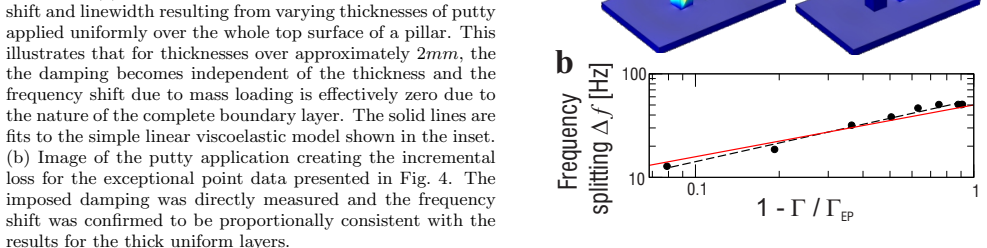
- [Section IV, Fig. 4(a), Eq. (6)] The experimental eigenfrequencies in Fig. 4(a) are not directly measured quantities; they are the poles of Eq. (6), the transmission function of the same weak-coupling coupled-oscillator model that contains the exceptional point. Fitting each spectrum to this function therefore builds the EP structure into the extracted eigenvalue trajectories, and the good agreement with the COMSOL simulation does not remove the circularity for the experimental confirmation. I recommend an independent check: report the raw transmission data at selected Γ values together with the COMSOL prediction using the measured Γ and no free resonance parameters, or extract resonance positions and linewidths directly from the spectra and compare them with the CMT/COMSOL curves.
- [Section IV, Fig. 4(b)] The claimed square-root law is not actually demonstrated by the fit shown. The text states Δf ∼ sqrt(1 − Γ/Γ_EP), but the best linear fit to the log-log plot is reported as (1 − Γ/Γ_EP)^α with α ≈ 0.6, and no error bars, residuals, or confidence intervals are given for α, Γ, or Δf. Given that α = 0.6 differs from 0.5 by 20%, the data are at best consistent with a near-square-root singularity, not a confirmation of the square-root law. The authors should (i) report the uncertainty in α, (ii) fit the data with a fixed exponent 0.5 and show the residuals, and (iii) mark the broken-phase points that are not constrained because the linewidths are unresolved, as stated in Section IV.
- [Appendix, after Eq. (8)] The Appendix explicitly states that a strict exceptional point exists only when γ0 = 0, and that in the experimental situation with unequal positive losses the EP is restored only in the weak-coupling limit where the frequency dependence of the loss terms is linearized. The experiment's validity therefore depends on the smallness of the neglected terms in Eq. (8), but the paper does not quantify this. I ask for a quantitative check: using the fitted values of κ, γd, and Γ, evaluate the exact eigenvalues of Eq. (8) and compare their coalescence behavior with the CMT prediction of Eq. (5); or estimate the relative magnitude of the neglected γΔ and κ^2 terms. Without this check, one cannot distinguish a true branch-point singularity from an avoided crossing rounded by the neglected terms.
minor comments (4)
- [Throughout] There are typographical errors including 'EXEPTIONAL' in the Section IV heading, 'epansion' near Eq. (2), and 'differential' in the abstract; these should be corrected.
- [Section IV] The value of Poisson's ratio used in the COMSOL simulations is said to have been fixed earlier but is never reported; please state it explicitly in Section IV or in the Methods.
- [Fig. 1] Fig. 1(c)–(e) are difficult to read because the panels share axes and the labels overlap; the caption also does not clearly identify which plotted quantities correspond to the real and imaginary eigenfrequency axes in each panel. Please redraw or annotate.
- [Eq. (6)] The fitting parameters in Eq. (6) (t0, A, φ, ε, γd, κ, Γ) are numerous; at minimum the uncertainties in κ and Γ, which enter the EP position and the exponent α, should be reported.
Circularity Check
The square-root EP confirmation is partly inherited from the fitting model: the eigenfrequencies in Fig. 4(b) are extracted from Eq. (6), a coupled-oscillator response whose un-driven poles already contain the EP.
-
fitted input called prediction
[Section IV, Eq. (6) and Fig. 4]
"The experimental transmission spectra from the weakly damped side to the damped side was measured, and fit to the function … (6) … The eigenfrequencies, extracted from the equivalent un-driven modes using the same parameters are reported with blue dots in Fig. 4(a). … By considering the logarithmic behavior of this curve, we find that the frequency splitting Δf near the exceptional point scales as Δf∼√(1−Γ/Γ_EP), thus confirming the existence of an EP singularity at a critical value Γ_EP in the case of weak coupling."
Equation (6) is the response function of the same two-damped-oscillator CMT model whose un-driven poles undergo an EP with square-root splitting in the weak-coupling limit. The paper fits each measured transmission spectrum to Eq. (6) and then reads off the eigenfrequencies from the equivalent un-driven modes using the same fitted parameters. Those blue-dot eigenfrequencies are therefore not directly measured resonances; they are the poles of the assumed model, and they carry the model's EP branch structure by construction. Plotting those extracted points as Δf versus Γ and announcing Δf∼√(1−Γ/Γ_EP) returns the fitting function's own pole law as an empirical finding.
full rationale
The paper's broad claim of an environment-mediated EP in elastodynamics is not wholly circular: the COMSOL solution of the continuum elastodynamic structure is an independent numerical check, and the raw transmission spectra show resonance broadening and merging near the expected parameter range. However, the specific quantitative confirmation of the square-root law in Fig. 4(b) is obtained from eigenfrequencies that are outputs of a fit to Eq. (6), the coupled-oscillator response function whose un-driven poles already contain the EP. Thus the Δf∼√(1−Γ/Γ_EP) statement is partly an output of the fitting model rather than an independent measurement. The Appendix's own limitation—that a strict EP exists only in the weak-coupling, linearized limit when γ0=0—further constrains but is not itself a circular step. No load-bearing self-citation chain or imported uniqueness theorem is present. Score 6 reflects the model-inherited square-root confirmation while crediting the independent COMSOL support and direct spectral evidence.
Assumptions & free parameters
free parameters (6)
- kappa (CMT inter-oscillator coupling) =
6.14e-3 (COMSOL, Fig. 1e); ~2.8e-3 (experiment, 45 Hz / 16.29 kHz)
- lambda1, lambda2 (torsion-environment couplings) =
±0.9e-3
- nu (environmental mode detuning) =
-2e-3
- Transmission fit parameters t0, A, phi, epsilon, gamma_d, kappa, Gamma =
Not tabulated; fitted per spectrum
- Putty viscoelastic constants G, eta0, eta1 =
G=15.8 MPa, eta0=72.6 MPoise, eta1=54.9 MPoise
- Poisson ratio of aluminum =
Not stated numerically, previously fixed to best match
assumptions (5)
- domain assumption Weak-coupling linearization u = 1 + Delta, keeping only first order in Delta, kappa, and gamma (Appendix, Eq. 7).
- ad hoc to paper The environment is represented by a single nearby mode plus a spectrally distant background sea parameterized by kappa (Eq. 4).
- domain assumption Pillar torsion modes are described by a 1D wave equation with solid-body rotation of each cross section (Eq. 14).
- standard math Aluminum is an isotropic elastodynamic medium with shear modulus G0 = 25 GPa (Section III).
- domain assumption Putty behaves as a combined Maxwell-Voigt viscoelastic medium (Appendix).
Cite this review
Pith. "Pith review of Environmentally-induced exceptional points in elastodynamics." pith.science (2026). https://pith.science/paper/XKEM3QS2
@misc{pith2026190800793,
  author       = {Pith},
  title        = {Pith review of: Environmentally-induced exceptional points in elastodynamics},
  year         = {2026},
  howpublished = {\url{https://pith.science/paper/XKEM3QS2}},
  note         = {Machine review of arXiv:1908.00793}
}
read the original abstract
We study the nature of an environment-induced exceptional point in a non-Hermitian pair of coupled mechanical oscillators. The mechanical oscillators are a pair of pillars carved out of a single isotropic elastodynamic medium made of aluminum and consist of carefully controlled differential losses. The inter-oscillator coupling originates exclusively from background modes associated with the "environment", that portion of the structure which, if perfectly rigid, would support the oscillators without coupling. We describe the effective interaction in terms of a coupled mode framework where only one nearby environmental mode can qualitatively reproduce changes to the exceptional point characteristics. Our experimental and numerical demonstrations illustrates new directions utilizing environmental mode control for the implementation of exceptional point degeneracies. Potential applications include a new type of non-invasive, dfferential atomic force microscopy and hypersensitive sensors for the structural integrity of surfaces.
Figures


Figures from the paper (1 more)
Reference graph
Works this paper leans on
-
[1]
L. Feng, R. El-Ganainy, L. Ge, Non-Hermitian photonics based on paritytime symmetry, Nat. Photonics 11, 752762 (2017)
work page 2017
-
[2]
R, El-Ganainy, K. G. Makris, M. Khajavikhan, Z. H. Musslimani, S. Rotter, D. N. Christodoulides, Non- Hermitian Physics and PT symmetry , Nat. Phys. 14, 11 (2018)
work page 2018
-
[3]
Alu, Exceptional points in optics and pho- tonics, Science 363, 42 (2019)
M Ali-Miri, A. Alu, Exceptional points in optics and pho- tonics, Science 363, 42 (2019)
work page 2019
- [4]
-
[5]
J. L. Miller, Exceptional points make for exceptional sen- sors, Phys. Today 70, 30 (2017)
work page 2017
-
[6]
W Chen, S. K ¨Ozdemir, G Zhao, J Wiersig, L Yang, Exceptional points enhance sensing in an optical micro- 8 cavity, Nature 548, 192 (2017)
work page 2017
-
[7]
J. Wiersig, Enhancing the sensitivity of frequency and en- ergy splitting detection by using exceptional points: appli- cation to microcavity sensors for single particle detection, Phys. Rev. Lett. 112, 203901 (2014)
work page 2014
-
[8]
H. Hodaei, M.-A. Miri, M. Heinrich, D. N. Christodoulides, M. Khajavikhan, Parity-time- symmetric microring lasers , Science 346, 975 (2014)
work page 2014
Show all 29 references
-
[9]
L. Feng, Z. J. Wong, R. M. Ma, Y. Wang, X. Zhang, Single-mode laser by parity-time symmetry breaking , Sci- ence 346, 972 (2014)
2014
-
[10]
Hodaei, MA Miri, A
H. Hodaei, MA Miri, A. U. Hassan, W. E. Hayenga, M. Heinrich, D. N. Christodoulides, M. Khajavikhan, Sin- gle mode lasing in transversely multimoded PTsymmet- ric microring resonators Laser Photonics Rev. 10, 494 (2016)
2016
-
[11]
Lin, et al
Z. Lin, et al. , Unidirectional invisibility induced by PT- symmetric periodic structures , Phys. Rev. Lett. 106, 213901 (2011)
2011
-
[12]
Peng, et al., Paritytime-symmetric whispering-gallery microcavities, Nat
B. Peng, et al., Paritytime-symmetric whispering-gallery microcavities, Nat. Phys. 10, 394 (2014)
2014
-
[13]
J Schindler, Z Lin, JM Lee, H Ramezani, FM Ellis, T Kottos, PT -symmetric electronics , J. Phys. A: Math. Theor. 45, 444029 (2012)
2012
-
[14]
S Assawaworrarit, X Yu, S Fan, Robust wireless power transfer using a nonlinear paritytime-symmetric circuit , Nature 546, 387 (2017)
2017
-
[15]
H. Li, M. Chitsazi, R. Thomas, F. M. Ellis, and T. Kot- tos,PT -Symmetry and Non- Hermitian Wave Transport in Microwaves and RF Circuits , in Parity-Time Sym- metry and Its Applications , Springer Tracts in Modern Physics 280, Edt. D. Christodoulides and J. Yang (2018)
2018
-
[16]
COMSOL Multiphysics R©, www.comsol.com
-
[17]
Fleury, D
R. Fleury, D. L. Sounas, A. Al´ u, Parity-Time Symme- try in Acoustics: Theory, Devices, and Potential Appli- cations, IEEE Journal of Selected Topics in Quantum Electronics 22, 5000809 (2016)
2016
-
[18]
C. Shi, M. Dubois, Y. Chen, L. Cheng, H. Ramezani, Y. Wang, X. Zhang, Accessing the exceptional points of parity-time symmetric acoustics , Nature Communica- tions 7, 11110 (2016)
2016
-
[19]
Aur´ egan and V
Y. Aur´ egan and V. Pagneux, PT-Symmetric Scattering in Flow Duct Acoustics , Phys. Rev. Lett. 118, 174301 (2017)
2017
-
[20]
P. Peng, W. Cao, C. Shen, W. Qu, J. Wen, L. Jiang and Y. Xiao, Anti-paritytime symmetry with flying atoms , Nature Phys. 12, 1139 (2016)
2016
-
[21]
C. Hang, G. Huang, Parity-time symmetry with coherent atomic gases, Advances in Physics 2, 737 (2017)
2017
-
[22]
Kato, Perturbation theory for linear operators (Springer-Verlag, Berlin, 1966), p.p
T. Kato, Perturbation theory for linear operators (Springer-Verlag, Berlin, 1966), p.p. 63-64
1966
-
[23]
W. D. Heiss, The physics of exceptional points , J. Phys. A: Math. Theor. 45, 444016 (2012)
2012
-
[24]
C. M. Bender, S. Boettcher, Real spectra in non- Hermitian Hamiltonians having PT symmetry , Phys. Rev. Lett. 80, 5243 (1998)
1998
-
[25]
Bender, Making sense of non-Hermitian Hamiltoni- ans, Rep
M. Bender, Making sense of non-Hermitian Hamiltoni- ans, Rep. Prog. Phys. 70, 947 (2007)
2007
-
[26]
Moiseyev, Non-Hermitian Quantum Mechanics , (Cambridge Univ
N. Moiseyev, Non-Hermitian Quantum Mechanics , (Cambridge Univ. Press, 2011)
2011
-
[27]
K. F. Graff, Wave motion in elastic solid (Dover Publi- cations, Inc., New York, 1991)
1991
-
[28]
St¨ ockmann, Quantum Chaos: An Introduction , Cambridge University Press (March 5, 2007)
H.-J. St¨ ockmann, Quantum Chaos: An Introduction , Cambridge University Press (March 5, 2007)
2007
-
[29]
R. N. Thurston, in Physical Acoustics (Academic Press, New York, 1964), V. I, Part A., p. 89
1964
Reviewed August 14, 2026 · model on record in the stance chip above.
Discussion (0). Continue with ORCID to comment.