REVIEW 2 major objections 6 minor 22 references
A full and synthetic model for Asset-Liability Management in life insurance, and analysis of the SCR with the standard formula
T0 review · 2 major / 6 minor · reviewed 2026-08-14 · deepseek-v4-flash
Pith's one-line read A synthetic ALM model shows shifted interest-rate models, not Hull-White, remain meaningful after regulatory shocks.
desk verdict A careful and practically motivated ALM model with a genuinely useful cash-flow-matching feature; the interest-rate-model comparison is clear but depends on a calibration convention that needs a robustness check before the conclusions are taken as general. read the letter →
The pith
A machine-rendered reading of the paper's core claim, the machinery that carries it, and where it could break.
The reading
What carries the argument
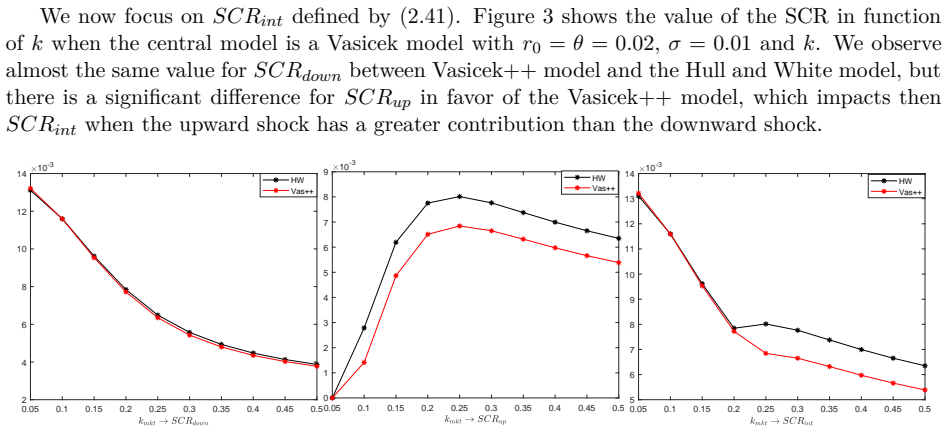
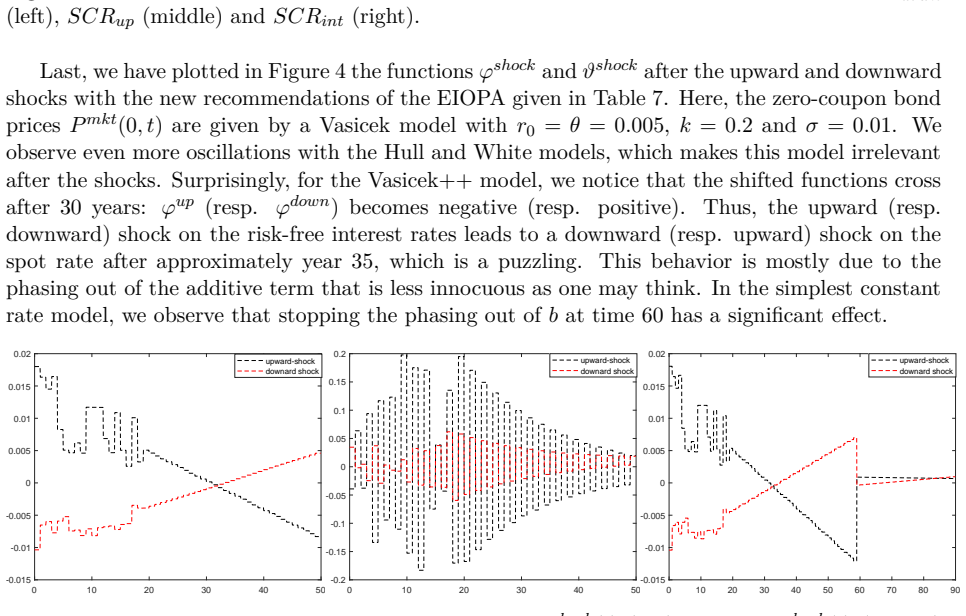
The article's main device is the shifted short-rate model of Vasicek++ type, written $r_t = x_t + \phi(t)$, where $x_t$ is a mean-reverting Ornstein-Uhlenbeck process and $\phi$ is a piecewise-constant deterministic shift. The comparison of models relies on the convention that after a regulatory shock the parameters $(x_0, \theta, k, \sigma_r)$ stay fixed and only $\phi$ is recalibrated to the shocked yield curve, whereas Hull-White achieves the fit by adjusting its mean-reversion target $\vartheta(t)$; because Hull-White transmits changes through a damped integral of $\vartheta$, the required $\vartheta$ oscillates sharply, while the Vasicek++ shift changes smoothly. The second carrying mechanism is the equally weighted basket of bonds with maturities $1, \dots, n$, whose maturing nominal value is matched to the structural surrender rate, giving cash-flow matching without storing the trading history.
What would settle it
Calibrate the Hull-White model to the same shocked yield curve with a smoothing or full-recalibration convention, such as a piecewise-linear mean-reversion target or a re-estimated mean-reversion speed, and check whether the fitted curve still oscillates; if it does not, the paper's main modeling recommendation would not be supported.
Extended reading notes
Core claim
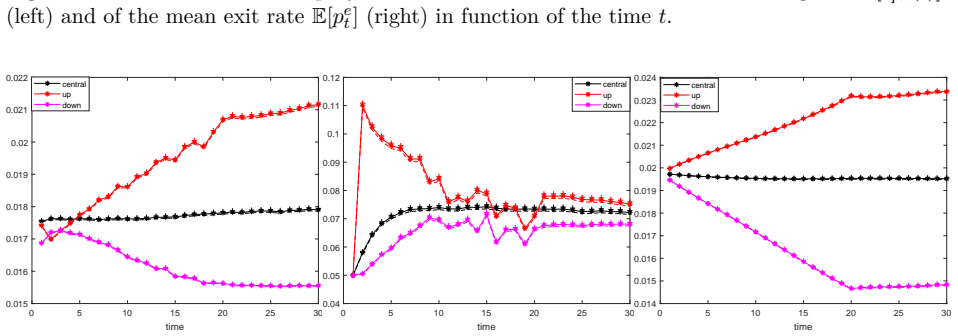
The paper's central claim is that a faithful ALM model for life insurance needs to represent book and market values separately and needs a realistic crediting-rate rule, and once these are in place, the standard-formula SCR depends sensitively on two modeling choices: the short-rate model family and the maturity structure of the bond portfolio. Under the convention that a regulatory shock is implemented by re-fitting only the deterministic shift function, the shifted Vasicek++ model reacts to upward and downward regulatory shocks with stable shifts, whereas Hull-White, which mean-reverts to a parametric curve, requires a violently oscillating theta to hit the shocked curve, making post-shock valuations unreliable. The paper quantifies the consequence: in a 2% rate environment, the basket-of-bonds model gives a downward-shock SCR of 0.0078 and an upward-shock SCR of 0.0063, while a single-bond proxy gives 0.0113 and 0.0154, respectively. In a 0.5% environment, the optimal basket maturity moves from n=20 to n=12. A further finding is a discontinuity in the standard-formula aggregation factor when the upward shock becomes the binding one, which the paper argues is unfair and can be exploited by choosing bond maturity.
Load-bearing premise
The paper's comparison of rate models rests on the convention that after a regulatory shock the main parameters stay fixed and only the curve-fitting shift is changed; if the whole model were re-calibrated instead, the oscillating behavior that disqualifies Hull-White might disappear.
Editorial extensions
If this is right
- Insurers using Hull-White or other mean-reverting curve models to set the initial term structure may get unstable and economically meaningless post-shock valuations; shifted models such as Vasicek++ or CIR++ are safer choices for the standard formula.
- The maximal bond maturity $n$ is a genuine capital-management lever: in the moderate-rate setting approximately $n=20$ minimizes the interest-rate SCR, while in the low-rate setting approximately $n=12$ is optimal, so the practice of setting $n=1/p$ is not always SCR-minimizing.
- Cash-flow matching through a bond ladder reduces the interest-rate SCR substantially in the paper's runs (upward SCR falls from 0.0154 to 0.0063 and downward SCR from 0.0113 to 0.0078), because it avoids realizing latent gains or losses when surrenders must be paid.
- The standard formula's mean-based aggregation does not reward the lower variance of the Basic Own-Funds distribution produced by cash-flow matching, and its discontinuous correlation factor makes the SCR jump when an upward shock becomes the binding one, which can be triggered by small changes in $n$.
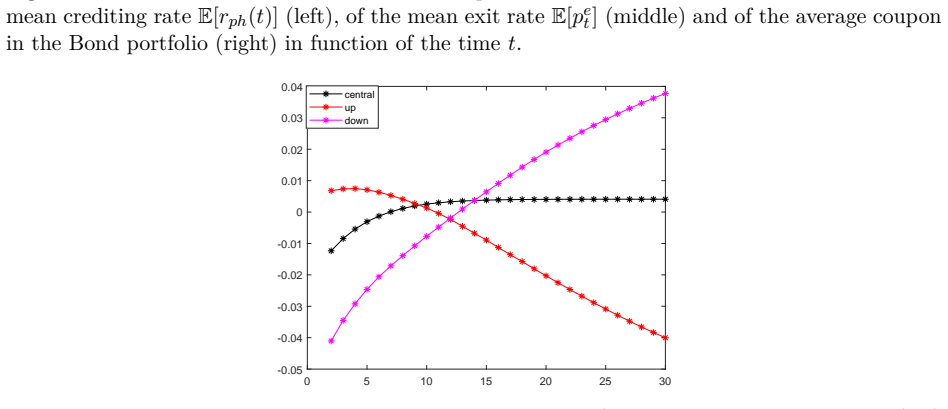
- In low-rate regimes, the additive shock factors produce crossing shift functions in Vasicek++ after about 30 years, so even a well-behaved shifted model can show counterintuitive long-maturity rate movements and non-monotone crediting rates.
Reading between the lines
- Beyond the paper: because the Hull-White oscillation is driven by fixing $(r_0, k, \sigma_r)$ and re-fitting only $\vartheta$, a robustness check with full recalibration or a different $\vartheta$ parametrization would test whether the paper's model recommendation survives.
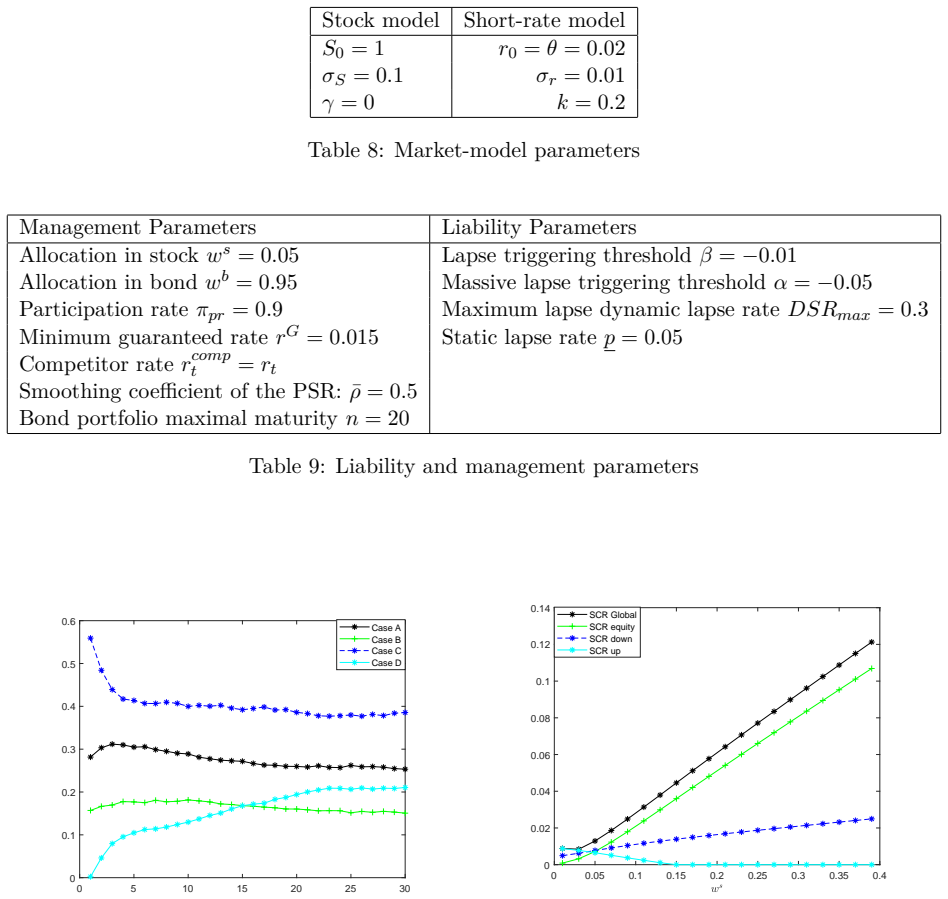
- Beyond the paper: the relative frequencies of the four crediting-rate cases A-D could be published as an ALM distress indicator, since cases C and D signal that the insurer is falling short of the competitor or guaranteed rate and thereby trigger dynamic surrenders.
- Beyond the paper: the shift of the optimal basket maturity from roughly $n=20$ in the 2% regime to roughly $n=12$ in the 0.5% regime hints that a rate-dependent or dynamic bond-ladder policy could outperform any fixed choice of $n$.
Signed reviews
Editorial analysis
A structured set of objections, weighed in public.
Referee Report
Summary. The paper proposes a synthetic Asset-Liability Management (ALM) model for French general-account life insurance, tracking market and book values, a crediting-rate rule based on regulatory, competitor, and profit-sharing constraints, and a bond basket that matches a fraction of surrender cash flows. The model is used to compute the Solvency Capital Requirement (SCR) under the standard formula, for both the 2012 multiplicative shocks and the 2018 additive low-rate recommendation. Two main claims are made: (i) after regulatory interest-rate shocks, shifted models such as Vasicek++ are more meaningful than mean-reverting curve models such as Hull-White; and (ii) the bond-basket cash-flow matching materially reduces the interest-rate SCR, as shown by comparing the full model with a single-bond proxy model.
Significance. If the results are robust, the paper is useful for life insurers and regulators: it provides a practical ALM framework with the main accounting and behavioral features, and its cash-flow-matching analysis makes a decision-relevant point that the bond basket maturity can be used to reduce SCR. Strengths include a self-contained balance-sheet recursion with explicit steps, a correct and useful Lemma 2.3, the use of common random numbers for central and shocked scenarios, and a clear separation of the Vasicek++ and Hull-White parametrizations. The paper also usefully highlights a discontinuity in the standard-formula aggregation rule. The main limitation is that the central model-ranking claim is conditional on the chosen recalibration convention, and the cash-flow-matching conclusion depends on an ad hoc proxy model; both need robustness support before the quantitative recommendations can be taken at face value.
major comments (2)
- [Section 3, Eqs. (3.3)-(3.5), Figures 1-4] The paper's central modeling recommendation—that Vasicek++ is more meaningful than Hull-White after EIOPA shocks—is established only under a specific recalibration convention. In Section 3, after a shock the authors keep (x0, theta, k, sigma_r) fixed in Vasicek++ and keep (k, sigma_r) fixed in Hull-White, re-fitting only phi_shock or theta_shock; since Eq. (3.5) connects the two classes only when phi is differentiable, Figure 1 compares a piecewise-constant shift with a piecewise-constant mean-reversion level, i.e., two different smoothness assumptions rather than two models. The authors themselves flag a counter-intuitive artifact on the Vasicek++ side in Figure 4 (the upward shock lowers the spot rate after about 30 years). To make the claim robust, the paper should show that the oscillations persist under alternative parametrizations (piecewise-linear theta, spline theta, or re-estimated k) or justify the piecewise-constant rule from regulatory practice. As written, the SCR differences in Figure 3 and Tables 10-11 are conditional on this convention.
- [Section 4.2, Eqs. (4.1)-(4.2), Tables 10-11] The quantitative conclusion that cash-flow matching changes the SCR (Table 11) rests on the proxy model for a no-cash-flow-matching world, but the proxy is defined by ad hoc choices. The maturity n_p = n/2 is chosen "after numerical investigation", and Eq. (4.2) adjusts the bond position to force the same initial shock size; no sensitivity analysis is reported for n_p or for the approximation that the roll-over in the proxy model realizes no capital gain or loss. Since the magnitude of the SCR reduction is a central result, the authors should provide robustness tests (e.g., varying n_p, using an alternative single-bond model, or checking the no-CGL approximation) before claiming that the bond basket substantially reduces the SCR.
minor comments (6)
- [Table 6] In the sdown row for maturity t=7, the entry is "39%" without a minus sign; this appears to be a typo for "-39%", given the adjacent values and the text.
- [Table 10] The 95% confidence interval for the central Basket BOF is printed as "[0.0206,0.02010]"; the upper bound "0.02010" is likely a typo for "0.0210" or a misprinted precision.
- [Section 2.2.3, after Eq. (2.9)] The model assumes MV_t > 0 and explicitly does not model the case MV_t <= 0; because the paper studies regulatory stress scenarios, the authors should either model this boundary case or report its probability of occurrence in the simulations.
- [Tables 8-9 and 12-13] All model parameters are hand-set rather than calibrated to market data; the paper should state more explicitly that the numerical SCR values are illustrative and that conclusions such as the optimal n = 20 versus n = 12 are parameter-dependent.
- [Figure 4 and surrounding text] The text says the shift functions cross after 30 years, but the right-hand panel shows the constant-rate example; the crossing for the low-rate Vasicek++ model is visible in the left and middle panels, so the figure labels and caption should be clarified.
- [Table 11] The SCR values in Table 11 are reported without Monte Carlo error bars; given the nontrivial sampling noise visible in the BOF confidence intervals in Table 10, adding standard errors to the SCR differences would improve the comparability of the basket and proxy results.
Circularity Check
No circularity: the Vasicek++ versus Hull-White ranking and the SCR results follow from explicitly stated recalibration rules and pre-chosen parameters, not from fitted outputs or self-citations.
full rationale
No load-bearing step in this paper derives its target result from its own fitted constants, and no central claim is justified by a self-citation chain. The ALM model equations in Sections 2–3 are constructed from explicit balance-sheet identities, legal reserve rules, and the standard-formula shock tables; the crediting rate determination is a decision rule, not an identity fitted to output. The interest-rate model comparison is an analytical consequence of the stated recalibration convention: after a shock, the authors freeze the mean-reversion parameters and recalibrate only the piecewise-constant shift functions, then show that Hull-White produces oscillating shifts while Vasicek++ does not. This is a clearly disclosed modeling convention, not a claim that the result is forced by the data or by a self-referential definition. The Vasicek++ versus Hull-White equivalence in Eq. (3.5) is taken from the external textbook Brigo-Mercurio [8], and the paper explicitly notes that the two parametrizations cease to be equivalent once piecewise-constant shifts are imposed, so the comparison is coherent rather than circular. The numerical SCR analysis in Section 4 uses parameters chosen before simulation and common random paths across central and shocked scenarios, so the SCR values are not fitted to the modules they are used to compute. The proxy-model comparison in Section 4.2 explicitly equalizes the initial shock size via Eqs. (4.1)–(4.2), controlling for the first-order effect rather than fitting the final SCR, and the remaining BOF/SCR differences reflect the cash-flow-matching mechanism. The paper itself flags the post-30-year sign crossing of the Vasicek++ shifts as puzzling, which is an honest limitation of the convention rather than a circular justification. The only substantive weakness, the one-sided recalibration convention, is an assumption about how a modeler applies regulatory shocks; it affects robustness and interpretation of the model ranking, but it is not circular because the comparison does not presuppose the conclusion through a parameter fitted to that conclusion. The paper is self-contained against institutional benchmarks (EIOPA tables, delegated regulation), and no step reduces to its own inputs by construction.
Assumptions & free parameters
free parameters (17)
- Equity allocation weight ws =
0.05 (moderate), 0.08 (low)
- Bond allocation weight wb =
0.95 (moderate), 0.92 (low)
- Equity volatility sigma_S =
0.1
- Interest rate volatility sigma_r =
0.01
- Mean reversion speed k =
0.2
- Correlation gamma =
0
- Central rate level r0 and theta =
0.02 (moderate), 0.005 (low)
- Participation rate pi_pr =
0.9
- Guaranteed rate rG =
0.015 (moderate), 0 (low)
- PSR distribution fraction bar_rho =
0.5
- Bond basket maximum maturity n =
20 (moderate), 10 (low)
- Maximum dynamic surrender DSRmax =
0.3
- Massive lapse threshold alpha =
-0.05
- Triggering surrender threshold beta =
-0.01
- Structural lapse rate p =
0.05 (moderate), 0.1 (low)
- Time horizon T =
30 years
- Number of Monte Carlo paths N =
not reported
assumptions (9)
- standard math Assets are priced under a risk-neutral measure Q with a standard Brownian motion; equity follows Black-Scholes with drift r_t.
- standard math Zero-coupon bond prices in Vasicek++ and Hull-White use the closed-form formulas from Brigo and Mercurio.
- domain assumption French GAAP reserves (MR, CR, PSR) and Solvency II BOF/BEL definitions, plus the EIOPA shock tables, are taken as given institutional rules.
- ad hoc to paper Policyholders exit uniformly on (t,t+1) and are paid the guaranteed rate pro-rata (Eq. 2.7).
- ad hoc to paper Book values are updated by proportional reduction rather than FIFO (Eqs. 2.10 and 2.16).
- ad hoc to paper For interest-rate shocks, recalibration changes only the deterministic shift function while keeping other model parameters fixed.
- domain assumption The portfolio is in run-off with no new policies, and the terminal liquidation follows Section 2.3.
- ad hoc to paper The market value of assets is assumed positive; the MV_t less than or equal to 0 case is noted but not modeled in detail.
- ad hoc to paper The proxy model in Section 4.2 approximates the no-cash-flow-matching world with a single bond and adjusts the position to match the shock size.
Cite this review
Pith. "Pith review of A full and synthetic model for Asset-Liability Management in life insurance, and analysis of the SCR with the standard formula." pith.science (2026). https://pith.science/paper/KTVZ43EE
@misc{pith2026190800811,
  author       = {Pith},
  title        = {Pith review of: A full and synthetic model for Asset-Liability Management in life insurance, and analysis of the SCR with the standard formula},
  year         = {2026},
  howpublished = {\url{https://pith.science/paper/KTVZ43EE}},
  note         = {Machine review of arXiv:1908.00811}
}
read the original abstract
The aim of this paper is to introduce a synthetic ALM model that catches the main specificity of life insurance contracts. First, it keeps track of both market and book values to apply the regulatory profit sharing rule. Second, it introduces a determination of the crediting rate to policyholders that is close to the practice and is a trade-off between the regulatory rate, a competitor rate and the available profits. Third, it considers an investment in bonds that enables to match a part of the cash outflow due to surrenders, while avoiding to store the trading history. We use this model to evaluate the Solvency Capital Requirement (SCR) with the standard formula, and show that the choice of the interest rate model is important to get a meaningful model after the regulatory shocks on the interest rate. We discuss the different values of the SCR modules first in a framework with moderate interest rates using the shocks of the present legislation, and then we consider a low interest framework with the latest recommandation of the EIOPA on the shocks. In both cases, we illustrate the importance of matching cash-flows and its impact on the SCR.
Figures


Figures from the paper (9 more)



Reference graph
Works this paper leans on
-
[1]
Asset-liability management for long-term insurance business
Hansjörg Albrecher, Daniel Bauer, Paul Embrechts, Damir Filipović, Pablo Koch-Medina, Ralf Korn, Stéphane Loisel, Antoon Pelsser, Frank Schiller, Hato Schmeiser, and Joël Wagner. Asset-liability management for long-term insurance business. European Actuarial Journal, 8(1):9–25, Jun 2018
work page 2018
-
[2]
Anna Rita Bacinello. Fair pricing of life insurance participating policies with a minimum interest rate guaranteed.ASTIN Bulletin, 31(2):275–297, 2001. 33
work page 2001
-
[3]
The effects of a low interest rate environment on life insurers
Elia Berdin and Helmut Gründl. The effects of a low interest rate environment on life insurers. The Geneva Papers on Risk and Insurance - Issues and Practice, 40(3):385–415, Jul 2015
work page 2015
-
[4]
A stochastic forward-looking model to assess the profitability and solvency of European insurers
Elia Berdin, Christoffer Kok, and Cosimo Pancaro. A stochastic forward-looking model to assess the profitability and solvency of European insurers. ICIR Working Paper Series 21/16, Goethe University Frankfurt, International Center for Insurance Regulation (ICIR), 2016
work page 2016
-
[5]
Tim J. Boonen. Solvency ii solvency capital requirement for life insurance companies based on expected shortfall.European Actuarial Journal, 7(2):405–434, Dec 2017
work page 2017
-
[6]
Fabrice Borel-Mathurin, Pierre-Emmanuel Darpeix, Quentin Guibert, and Stéphane Loisel. Main Determinants of Profit-Sharing Policy in the French Life Insurance Industry.Geneva Papers on Risk and Insurance - Issues and Practice, 43(3):420–455, July 2018
work page 2018
-
[7]
Alexander Braun, Hato Schmeiser, and Florian Schreiber. Solvency ii’s market risk standard formula: Howcredibleistheproclaimedruinprobability? Journal of Insurance Issues, 38(1):1– 30, 2015
work page 2015
-
[8]
Interest rate models—theory and practice
Damiano Brigo and Fabio Mercurio. Interest rate models—theory and practice. Springer Finance. Springer-Verlag, Berlin, second edition, 2006. With smile, inflation and credit
work page 2006
Show all 22 references
-
[9]
On the risk of insurance liabilities: Debunking some common pitfalls
Eric Briys and François de Varenne. On the risk of insurance liabilities: Debunking some common pitfalls. The Journal of Risk and Insurance, 64(4):673–694, 1997
1997
-
[10]
Delegated Regulation (EU) 2015/35.Official Journal of the European Union, Jan 2015
European Commission. Delegated Regulation (EU) 2015/35.Official Journal of the European Union, Jan 2015
2015
-
[11]
Fair valuation of insurance liability cash-flow streams in continuous time: Applications.ASTIN Bulletin, 49(2):299–333, 2019
Lukasz Delong, Jan Dhaene, and Karim Barigou. Fair valuation of insurance liability cash-flow streams in continuous time: Applications.ASTIN Bulletin, 49(2):299–333, 2019
2019
-
[12]
Inside the solvency 2 black box: Net asset values and solvency capital requirements with a least-squares monte-carlo approach
Anthony Floryszczak, Olivier Le Courtois, and Mohamed Majri. Inside the solvency 2 black box: Net asset values and solvency capital requirements with a least-squares monte-carlo approach. Insurance: Mathematics and Economics, 71:15 – 26, 2016
2016
-
[13]
Quantifying credit and market risk under solvency ii: Standard approach versus internal model.Insurance: Mathematics and Economics, 51(3):649 – 666, 2012
Nadine Gatzert and Michael Martin. Quantifying credit and market risk under solvency ii: Standard approach versus internal model.Insurance: Mathematics and Economics, 51(3):649 – 666, 2012
2012
-
[14]
A gen- eral asset-liability management model for the efficient simulation of portfolios of life insurance policies
Thomas Gerstner, Michael Griebel, Markus Holtz, Ralf Goschnick, and Marcus Haep. A gen- eral asset-liability management model for the efficient simulation of portfolios of life insurance policies. Insurance: Mathematics and Economics, 42(2):704 – 716, 2008
2008
-
[15]
Anders Grosen and Peter Løchte Jørgensen. Fair valuation of life insurance liabilities: The im- pact of interest rate guarantees, surrender options, and bonus policies.Insurance: Mathematics and Economics, 26(1):37 – 57, 2000
2000
-
[16]
Revised technical speci- fications for the solvency ii valuation and solvency capital requirements calculations (part i)
EIOPA (European Insurance and Occupational Pensions Authority). Revised technical speci- fications for the solvency ii valuation and solvency capital requirements calculations (part i). EIOPA-DOC-12/467, Dec 2012. 34
2012
-
[17]
Eiopa’s second set of advice to the european commission on specific items in the solvency ii delegated regulation
EIOPA (European Insurance and Occupational Pensions Authority). Eiopa’s second set of advice to the european commission on specific items in the solvency ii delegated regulation. EIOPA-BoS-18/075, Feb 2018
2018
-
[18]
Rising interest rates and liquidity risk in the life insurance sector
Christian Kubitza, Elia Berdin, and Helmut Gründl. Rising interest rates and liquidity risk in the life insurance sector. ICIR Working Paper Series 29/17, 2019
2019
-
[19]
Optimum consumption and portfolio rules in a continuous-time model
Robert C Merton. Optimum consumption and portfolio rules in a continuous-time model. Journal of Economic Theory, 3(4):373 – 413, 1971
1971
-
[20]
Macroeconomics determinants of the correlation between stocks and bonds
Marcello Pericoli. Macroeconomics determinants of the correlation between stocks and bonds. Temi di discussione, Banca d’Italia, 1198, 2018
2018
-
[21]
A century of stock-bond correlations.Reserve bank of Australia bulletin, September Quarter, 2014
Ewan Rankin and Muhummed Shah Idil. A century of stock-bond correlations.Reserve bank of Australia bulletin, September Quarter, 2014
2014
-
[22]
Market inconsisten- cies of market-consistent european life insurance economic valuations: pitfalls and practical solutions
Julien Vedani, Nicole El Karoui, Stéphane Loisel, and Jean-Luc Prigent. Market inconsisten- cies of market-consistent european life insurance economic valuations: pitfalls and practical solutions. European Actuarial Journal, 7(1):1–28, Jul 2017. 35
2017
Reviewed August 14, 2026 · model on record in the stance chip above.
Discussion (0). Continue with ORCID to comment.