REVIEW 3 major objections 4 minor 41 references
Isogeometric collocation on planar multi-patch domains
T0 review · 3 major / 4 minor · reviewed 2026-08-14 · deepseek-v4-flash
Pith's one-line read The paper constructs a globally C2-smooth isogeometric spline space whose dimension is independent of the geometry, and uses collocation on it to solve the Poisson equation over planar bilinear multi-patch domains.
desk verdict A useful, honest C^2 multi-patch collocation paper whose main construction is plausible and well tested, but whose dimension/basis claim needs proof before I'd fully trust it. read the letter →
The pith
A machine-rendered reading of the paper's core claim, the machinery that carries it, and where it could break.
The reading
What carries the argument
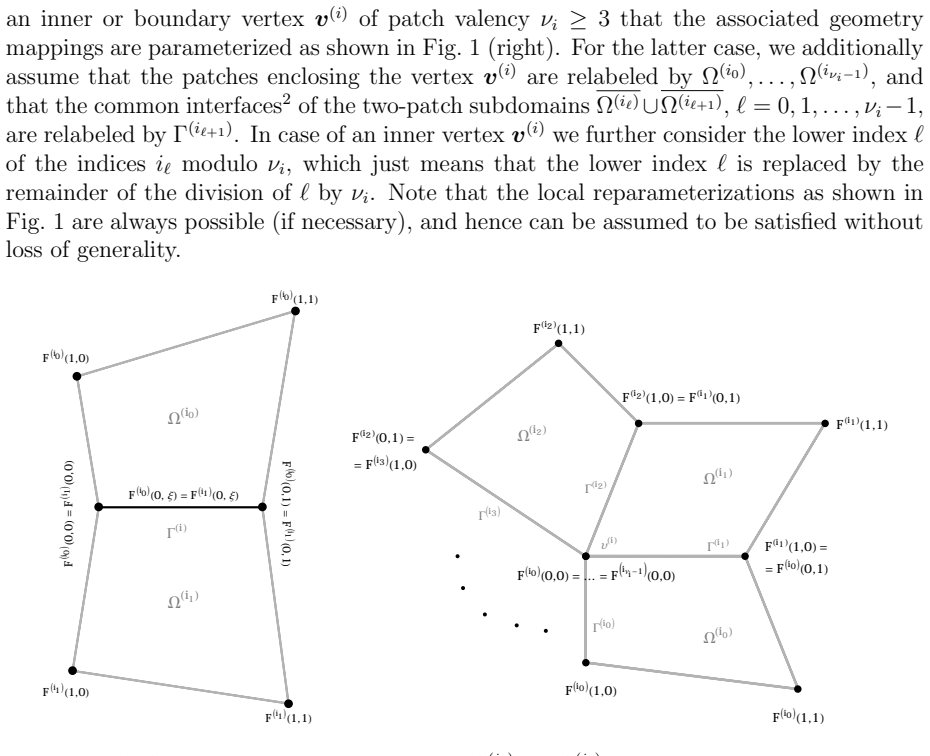
The load-bearing object is the direct-sum decomposition W = (sum of patch subspaces) ⊕ (sum of edge subspaces) ⊕ (sum of vertex subspaces) of the C2-smooth space, with each subspace spanned by locally supported functions. C2-smoothness across interfaces is enforced through the geometric-continuity conditions (1)-(3), expressed via the functions α and β that describe how adjacent bilinear parameterizations meet. The vertex subspaces are modified by requiring C4-smoothness at the vertex, which fixes their dimension to 15 (or 18 for valency-2 boundary vertices) and makes the total dimension (19) geometry-independent. The collocation system is assembled by mapping either Greville abscissae or clustered superconvergent points through each patch geometry, leading to an overdetermined linear system solved by least squares.
What would settle it
Compute, for a small concrete configuration (for example the three-patch domain of Fig. 6(a) with p=5, r=2, k=2), the actual rank of the matrix whose columns are the evaluations of the candidate basis functions at a sufficiently large set of sample points; if the rank is strictly less than the value from (19), the basis and direct-sum claim fails. Alternatively, rerun Example 3 with a manufactured solution and check whether the L2 error for p=5 with clustered superconvergent points decreases as O($h^{5}$); an O($h^{4}$) rate would indicate that the claimed convergence behavior is not reproduced.
Extended reading notes
Core claim
The paper's central claim is that for any planar bilinearly parameterized multi-patch domain one can construct, by explicit local formulas or small linear systems, a basis of locally supported C2-smooth isogeometric functions whose dimension is given by formula (19) and is independent of the geometry. The basis comprises functions associated with patches, edges, and vertices; vertex functions are forced to be C4 at the corresponding vertex, which removes the geometry-dependent degrees of freedom present in earlier constructions. With this space as ansatz, collocation for the Poisson equation with Dirichlet boundary conditions yields the reported convergence rates under h-refinement, and the same rates as the one-patch case are observed for the tested degrees p=5 and p=6 and regularities r=2,3.
Load-bearing premise
The load-bearing premise is that the collection of locally supported functions built in Section 2.3 is genuinely a basis: linear independence of each family and trivial pairwise subspace intersections are asserted rather than proved, and the same holds for the C4-smoothness of the vertex functions; without this, the dimension count (19) and the nonsingularity of the least-squares system are not guaranteed.
Editorial extensions
If this is right
- A C2-smooth collocation solve on multi-patch domains can be assembled without special treatment of interfaces, unlike methods that only couple patches with C0 continuity.
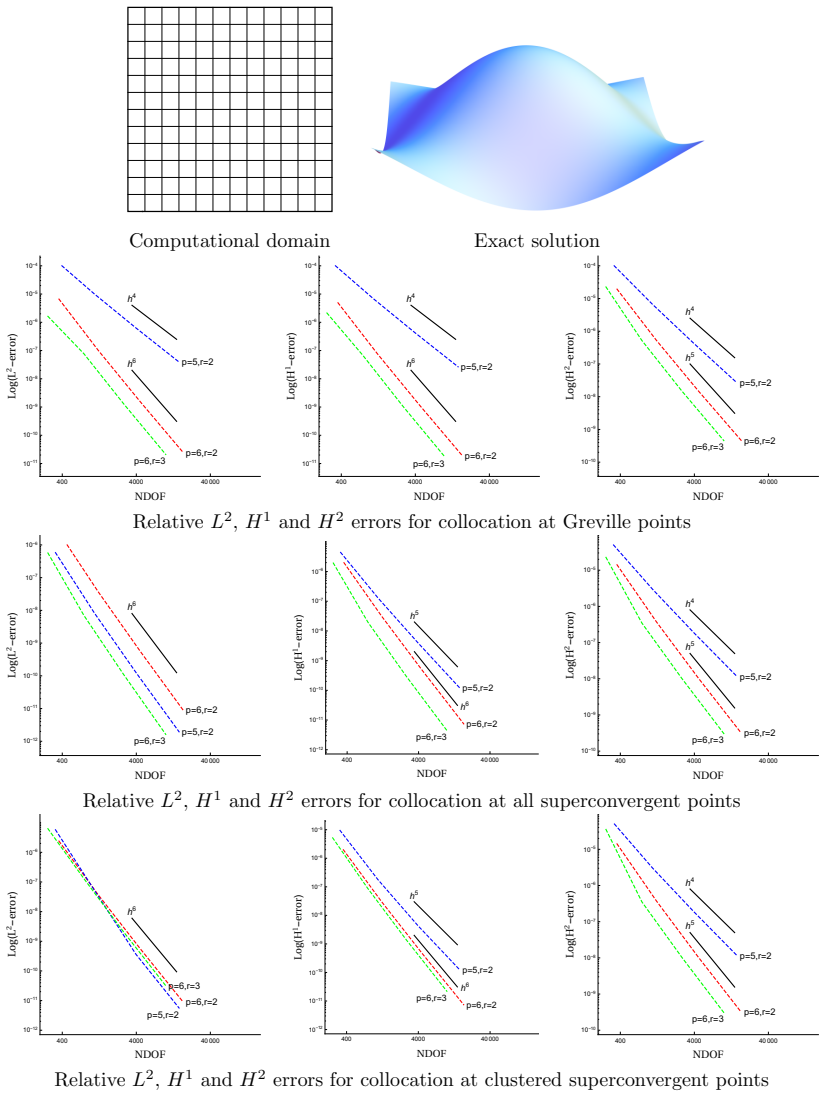
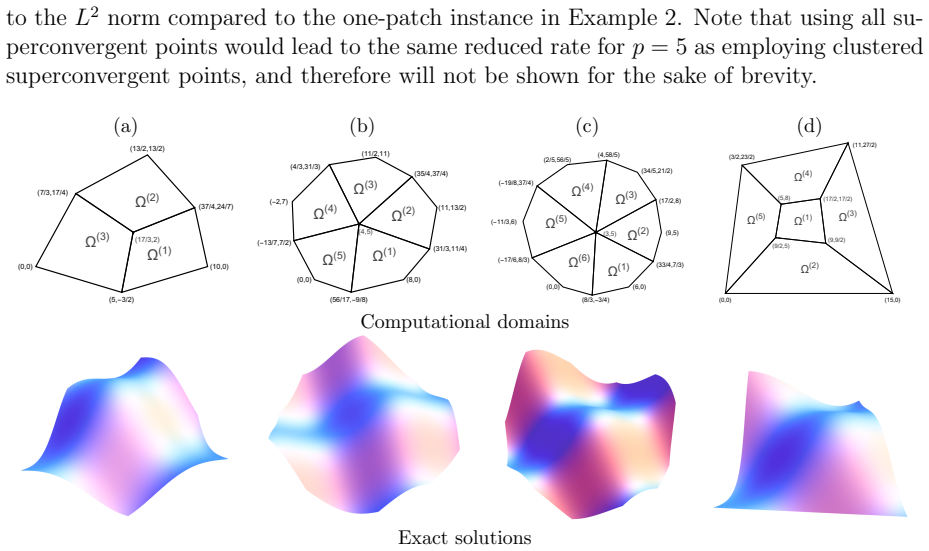
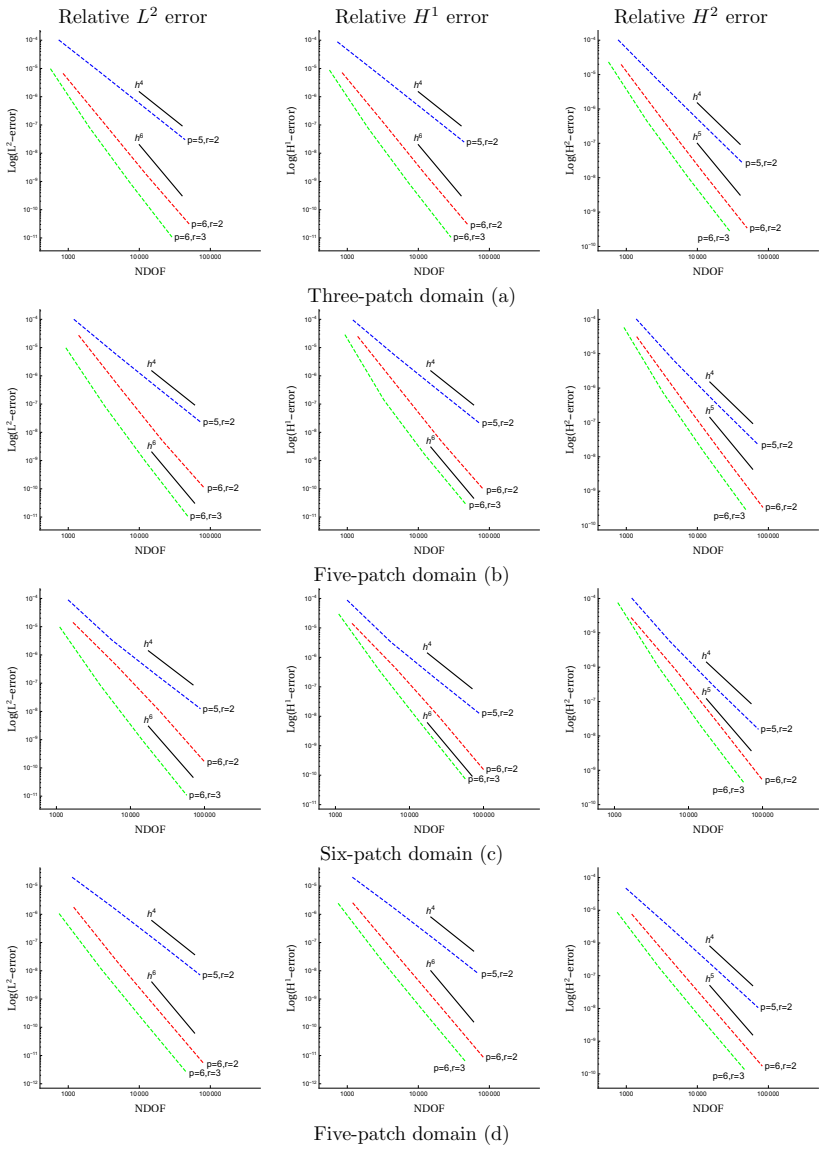
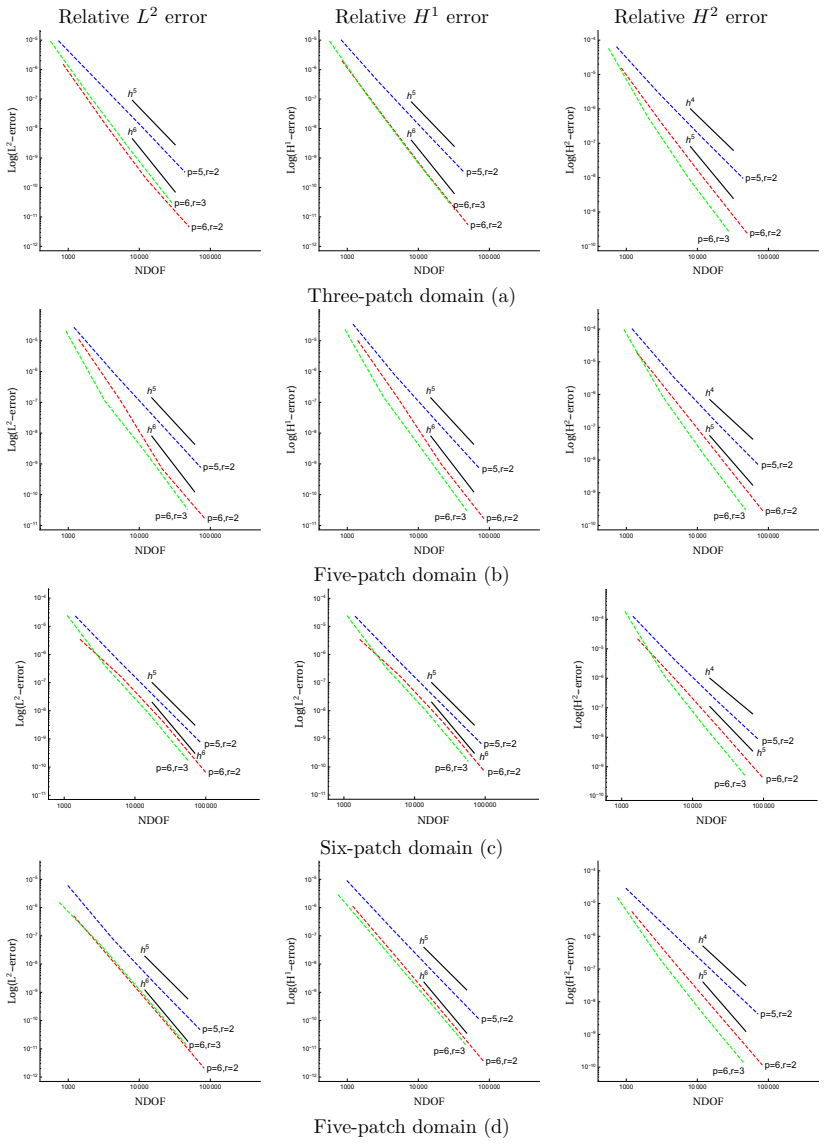
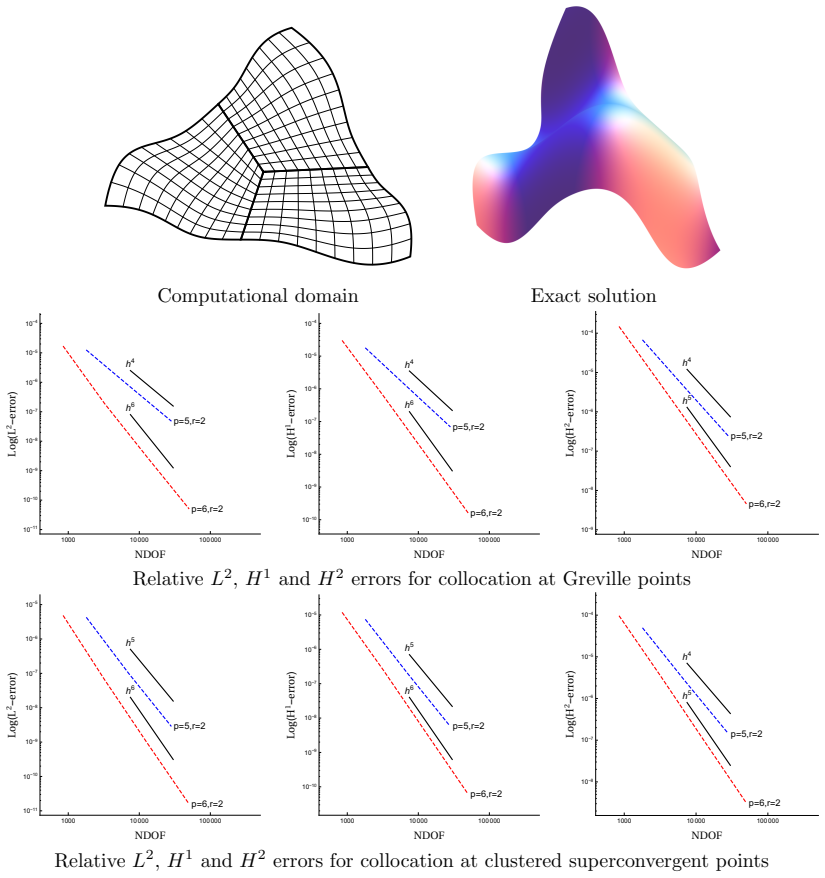
- For the tested spaces (p,r) in {(5,2),(6,2),(6,3)}, Greville points give the same suboptimal odd-degree rates as in the one-patch case, while clustered superconvergent points recover O(h^p) in L2 and H1 and O(h^{p-1}) in H2.
- The dimension formula (19) lets users predict the number of degrees of freedom before solving, regardless of the patch layout.
- The method applies to any planar bilinear multi-patch domain and also to a bicubic three-patch geometry that is bilinear close to the patch interfaces, since the construction only needs bilinear behavior near interfaces.
Reading between the lines
- The C4-at-vertices trick is a general dimension-stabilization mechanism and could likely be reused to make C1 or C3 multi-patch spline spaces geometry-independent in the same fashion.
- The polynomial roots for superconvergent points (for example 15x^4 - 12x^2 + 1 for p=5, r=2) may serve as building blocks for other reduced-regularity spline spaces, not only the three cases tested.
- Since the collocation system is overdetermined, a natural next step not pursued in the paper is to search for a square subset of points that keeps the convergence rates, which would remove the least-squares solve.
- The observed loss of one L2 order for p=5 with superconvergent points on multi-patch domains suggests that the vertex or interface coupling, rather than the point selection, is the limiting factor; testing a single-patch analog with the same reduced regularity would isolate the cause.
Signed reviews
Editorial analysis
A structured set of objections, weighed in public.
Referee Report
Summary. The paper presents an isogeometric collocation framework for the Poisson equation on planar bilinearly parameterized multi-patch domains. The discretization space is a globally C2-smooth spline space W defined as the direct sum of patch, edge, and vertex subspaces; the vertex construction is modified by enforcing C4-smoothness at vertices so that the space dimension is independent of the initial geometry (Eq. 19). Two choices of collocation points are investigated: tensor-product Greville abscissae and clustered superconvergent points. Numerical experiments on several multi-patch domains (Section 4) report convergence rates of O(h^p), O(h^p), and O(h^{p-1}) in the L2, H1, and H2 norms for the superconvergent points, with one observed reduction to O(h^5) for p=5 in the L2 norm.
Significance. If the construction is sound, the paper makes a useful contribution to isogeometric collocation for multi-patch domains: it provides a uniform, locally supported basis for a C2-smooth space whose dimension is independent of the geometry, and it extends superconvergent-point collocation from one-patch to multi-patch settings. The numerical results support the claimed convergence rates for the tested configurations, and the authors are explicit about the one suboptimal case. The main weakness is that the theoretical foundation of the space construction—the linear independence and direct-sum decomposition in Section 2.4—is asserted rather than proved, and this is exactly the part that is new relative to the authors' prior work [27].
major comments (3)
- [§2.4] The claim that the collection of functions (5)–(18) forms a basis of W, and the resulting dimension formula (19), rests on the assertion that the decomposition (4) is a direct sum and that the individual functions are linearly independent. This is not proved for the new vertex subspaces constructed in §2.3.2. In particular, the cited [27, Theorem 1] does not cover the newly added C4 vertex conditions or the interpolation systems (13)–(14). The authors need to show that the systems (14) are nonsingular for all admissible valencies and bilinear parameterizations, that the 15 (or 18) vertex functions are linearly independent, and that no vertex function is a nontrivial linear combination of edge functions with overlapping support near the vertex. Without this, the dimension formula (19) and the well-posedness of the collocation system (21) are not established.
- [§2.3.2] The sentence after Eq. (14) states that the first set of interpolation conditions 'uniquely determine all coefficients a^{Γ(i_l)}_{j1,j2}' and that the second set determines all a^{(i_l)}_{j1,j2}. No argument is given for the count of independent conditions versus unknowns, nor for the invertibility of the resulting linear systems for the geometry-dependent coefficients α and β. Since this is the mechanism that defines the vertex basis functions, a proof or a reference to a published proof is needed; the assertion that the construction 'works' is precisely the point that the stress-test identifies as load-bearing.
- [§3.2.3, Table 1] The superconvergent point polynomials (15x^4−12x^2+1 and 99x^5−130x^3+31x) are stated without derivation or reference for the regularity cases r=2 and r=3. These points are used for all multi-patch numerical experiments, so their derivation from the 1D model problem (23) should be documented, or a reference provided. This is not a flaw in the method itself, but it makes the convergence claims in Section 4 harder to verify independently.
minor comments (4)
- [§2.3.1] In the definition of the interface edge subspace, the index range 'j2 = 5−j1,...,n_{j1}+j1−6' appears to contain a typo; the subscript on n is unexplained and the same expression is garbled in §2.4 as 'n j1 +j1−6'.
- [§2.3.2] For boundary vertices of valency ν_i ≥ 3, the text says that g^{(i0)}_{Γ(i0);j1,j2}(ξ2,ξ1) is 'just defined as standard B-splines' N^{p,r}_{j1,j2}(ξ2,ξ1); this notation is confusing because the same symbol is used for interface edge functions in Eq. (8), and the argument ordering should be stated more carefully.
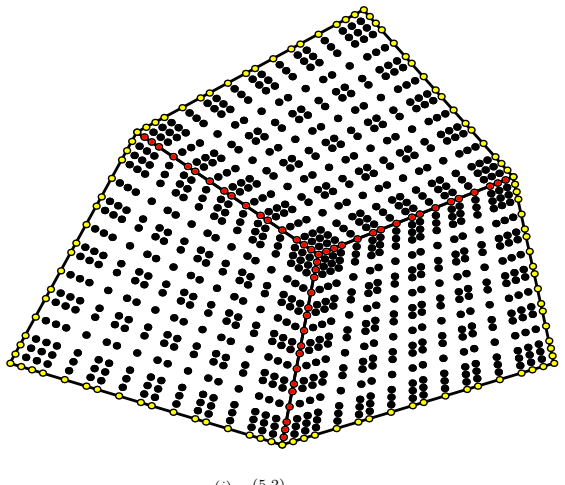
- [Example 1] The count of Greville collocation points, |J| = ν n^2 − ν n + 1, is stated without derivation; it would be helpful to explain how repetitions along interfaces and at the central vertex are counted.
- [§3.2.3] For (p,r)=(6,2), the text first says 'we have even to add two points' and then states that 'the set of all superconvergent points coincides with the set of clustered superconvergent points'; this phrasing is confusing and should be clarified.
Circularity Check
No significant circularity: the C2-space construction relies on published prior theorems, and the convergence claims are empirical or derived from an independent 1D model problem.
full rationale
The paper's central derivation is the construction of the C2-smooth space W and its use in isogeometric collocation. The patch/edge subspaces and the C2 interface conditions are taken from the authors' prior works [26,27]; those are published, parameter-free mathematical results, cited as such, and do not incorporate the present paper's numerical outputs, so they constitute independent support rather than circular input. The genuinely new part, the vertex subspaces in Section 2.3.2, is asserted to produce 15 linearly independent C4-at-vertex functions leading to the dimension formula (19), but this is an unproved linear-independence/direct-sum assertion and a potential correctness gap, not a reduction of the conclusion to the assumptions; it is not an instance of a fitted parameter being renamed as a prediction. The superconvergent points in Section 3.2.3 are obtained from an independent 1D model Poisson problem (23) and an asymptotic analysis, not fitted to the multi-patch results, so the convergence rates reported in Section 4 are not forced by construction. No equation in the paper is equivalent by definition to its claimed output, and no cited uniqueness theorem is used to forbid alternatives in a way that would make the choice circular. Therefore the appropriate finding is no significant circularity.
Assumptions & free parameters
free parameters (1)
- Clustered superconvergent point selection rule S_k =
For (5,2): depends on k mod 4; for (6,3): omit all inner knots except first and last; for (6,2): add second and…
assumptions (7)
- domain assumption Local reparameterizations of the geometry mappings as in Fig. 1 are always possible without loss of generality.
- standard math An isogeometric function is C2-smooth on a multi-patch domain if and only if its associated graph surface patches are G2-smooth (cf. [16,28]).
- standard math The conditions (1)-(3) from [26, Lemma 1] characterize C2-smoothness across a single interface.
- domain assumption The assumptions p>=5, 2<=r<=p-3, and k>=(9-p)/(p-r-2) ensure that the constructed C2-smooth spaces are h-refinable and well-defined (see [26,27]).
- ad hoc to paper The vertex functions exist, are uniquely determined by the interpolation conditions (13), and are C2-smooth on the domain and C4-smooth at the vertex.
- ad hoc to paper The functions listed in Section 2.4 are linearly independent and the decomposition (4) is a direct sum, giving the dimension formula (19).
- domain assumption Superconvergent points computed from the 1D model problem (23) retain their superconvergence for the 2D multi-patch collocation problem.
Cite this review
Pith. "Pith review of Isogeometric collocation on planar multi-patch domains." pith.science (2026). https://pith.science/paper/WACWMRFH
@misc{pith2026190800813,
  author       = {Pith},
  title        = {Pith review of: Isogeometric collocation on planar multi-patch domains},
  year         = {2026},
  howpublished = {\url{https://pith.science/paper/WACWMRFH}},
  note         = {Machine review of arXiv:1908.00813}
}
abstract
We present an isogeometric framework based on collocation to construct a $C^2$-smooth approximation of the solution of the Poisson's equation over planar bilinearly parameterized multi-patch domains. The construction of the used globally $C^2$-smooth discretization space for the partial differential equation is simple and works uniformly for all possible multi-patch configurations. The basis of the $C^2$-smooth space can be described as the span of three different types of locally supported functions corresponding to the single patches, edges and vertices of the multi-patch domain. For the selection of the collocation points, which is important for the stability and convergence of the collocation problem, two different choices are numerically investigated. The first approach employs the tensor-product Greville abscissae as collocation points, and shows for the multi-patch case the same convergence behavior as for the one-patch case [2], which is suboptimal in particular for odd spline degree. The second approach generalizes the concept of superconvergent points from the one-patch case (cf. [1, 15, 32]) to the multi-patch case. Again, these points possess better convergence properties than Greville abscissae in case of odd spline degree.
Figures
Figures from the paper (7 more)


Reference graph
Works this paper leans on
-
[27]
M. Kapl and V. Vitrih. Solving the triharmonic equation over multi-patch planar domains using isogeometric analysis. J. Comput. Appl. Math. , 358:385–404, 2019. 29
work page 2019
-
[1]
Anitescu, Y
C. Anitescu, Y. Jia, Y. J. Zhang, and T. Rabczuk. An isogeometric collocation method using superconvergent points. Comput. Methods Appl. Mech. Engrg. , 284:1073–1097, 2015
2015
-
[2]
F. Auricchio, L. Beir˜ ao da Veiga, T. J. R. Hughes, A. Reali, and G. Sangalli. Iso- geometric collocation methods. Math. Models Methods Appl. Sci. , 20(11):2075–2107, 2010
work page 2010
-
[3]
F. Auricchio, L. Beir˜ ao da Veiga, T.J.R. Hughes, A. Reali, and G. Sangalli. Isoge- ometric collocation for elastostatics and explicit dynamics. Comput. Methods Appl. Mech. Engrg., 249–252:2 – 14, 2012
work page 2012
-
[4]
L. Beir˜ ao da Veiga, A. Buffa, G. Sangalli, and R. V´ azquez. Mathematical analysis of variational isogeometric methods. Acta Numerica, 23:157–287, 5 2014
work page 2014
-
[5]
L. Beir˜ ao da Veiga, C. Lovadina, and A. Reali. Avoiding shear locking for the Timo- shenko beam problem via isogeometric collocation methods. Comput. Methods Appl. Mech. Engrg., 241–244:38 – 51, 2012
work page 2012
-
[6]
M. Bercovier and T. Matskewich. Smooth B´ ezier Surfaces over Unstructured Quadri- lateral Meshes. Lecture Notes of the Unione Matematica Italiana, Springer, 2017
work page 2017
- [7]
Show all 41 references
-
[8]
C.L. Chan, C. Anitescu, and T. Rabczuk. Isogeometric analysis with strong multipatch C1-coupling. Comput. Aided Geom. Design , 62:294–310, 2018
2018
-
[9]
Collin, G
A. Collin, G. Sangalli, and T. Takacs. Analysis-suitable G 1 multi-patch parametriza- tions for C 1 isogeometric spaces. Comput. Aided Geom. Des. , 47:93 – 113, 2016
2016
-
[10]
J. A. Cottrell, T. J. R. Hughes, and Y. Bazilevs. Isogeometric Analysis: Toward Integration of CAD and FEA . John Wiley & Sons, Chichester, England, 2009
2009
-
[11]
De Lorenzis, J
L. De Lorenzis, J. A. Evans, T. J. R Hughes, and A. Reali. Isogeometric collocation: Neumann boundary conditions and contact. Comput. Methods Appl. Mech. Engrg. , 284:21 – 54, 2015
2015
-
[12]
J. Deng, F. Chen, X. Xin Li, C. Hu, W. Tong, Z. Yang, and Y. Feng. Polynomial splines over hierarchical T-meshes. Graphical Models, 70(4):76–86, 2008
2008
-
[13]
J. A. Evans, R. R. Hiemstra, T. J. R. Hughes, and A. Reali. Explicit higher-order accurate isogeometric collocation methods for structural dynamics. Comput. Methods Appl. Mech. Engrg., 338:208–240, 2018. 28
2018
-
[14]
Fahrendorf, L
F. Fahrendorf, L. De Lorenzis, and H. Gomez. Reduced integration at superconvergent points in isogeometric analysis. Comput. Methods Appl. Mech. Engrg. , 328:390–410, 2018
2018
-
[15]
Gomez and L
H. Gomez and L. De Lorenzis. The variational collocation method. Comput. Methods Appl. Mech. Engrg., 309:152–181, 2016
2016
-
[16]
Groisser and J
D. Groisser and J. Peters. Matched G k-constructions always yield C k-continuous isogeometric elements. Comput. Aided Geom. Des. , 34:67 – 72, 2015
2015
-
[17]
Hoschek and D
J. Hoschek and D. Lasser. Fundamentals of computer aided geometric design . A K Peters Ltd., Wellesley, MA, 1993
1993
-
[18]
T. J. R. Hughes, J. A. Cottrell, and Y. Bazilevs. Isogeometric analysis: CAD, finite elements, NURBS, exact geometry and mesh refinement. Comput. Methods Appl. Mech. Engrg., 194(39-41):4135–4195, 2005
2005
-
[19]
Y. Jia, C. Anitescu, Y. J. Zhang, and T. Rabczuk. An adaptive isogeometric analysis collocation method with a recovery-based error estimator. Comput. Methods Appl. Mech. Engrg., 345:52–74, 2019
2019
-
[20]
M. Kapl, F. Buchegger, M. Bercovier, and B. J¨ uttler. Isogeometric analysis with geo- metrically continuous functions on planar multi-patch geometries. Comput. Methods Appl. Mech. Engrg., 316:209 – 234, 2017
2017
-
[21]
M. Kapl, G. Sangalli, and T. Takacs. Dimension and basis construction for analysis- suitable G1 two-patch parameterizations. Comput. Aided Geom. Des. , 52–53:75 – 89, 2017
2017
-
[22]
M. Kapl, G. Sangalli, and T. Takacs. Isogeometric analysis with C1 functions on unstructured quadrilateral meshes. Technical Report 1812.09088, arXiv.org, 2018
2018 arXiv
-
[23]
M. Kapl, G. Sangalli, and T. Takacs. An isogeometric C1 subspace on unstructured multi-patch planar domains. Comput. Aided Geom. Des. , 69:55–75, 2019
2019
-
[24]
Kapl and V
M. Kapl and V. Vitrih. Space of C 2-smooth geometrically continuous isogeometric functions on planar multi-patch geometries: Dimension and numerical experiments. Comput. Math. Appl. , 73(10):2319–2338, 2017
2017
-
[25]
Kapl and V
M. Kapl and V. Vitrih. Space of C 2-smooth geometrically continuous isogeometric functions on two-patch geometries. Comput. Math. Appl. , 73(1):37 – 59, 2017
2017
-
[26]
Kapl and V
M. Kapl and V. Vitrih. Dimension and basis construction for C2-smooth isogeometric spline spaces over bilinear-like G2 two-patch parameterizations. J. Comput. Appl. Math., 335:289–311, 2018
2018
-
[28]
M. Kapl, V. Vitrih, B. J¨ uttler, and K. Birner. Isogeometric analysis with geometrically continuous functions on two-patch geometries. Comput. Math. Appl. , 70(7):1518 – 1538, 2015
2015
-
[29]
Karˇ ciauskas, T
K. Karˇ ciauskas, T. Nguyen, and J. Peters. Generalizing bicubic splines for modeling and IGA with irregular layout. Comput.-Aided Des., 70:23 – 35, 2016
2016
-
[30]
Kiendl, E
J. Kiendl, E. Marino, and L. De Lorenzis. Isogeometric collocation for the Reissner- Mindlin shell problem. Comput. Methods Appl. Mech. Engrg. , 325:645–665, 2017
2017
-
[31]
Marino, J
E. Marino, J. Kiendl, and L. De Lorenzis. Explicit isogeometric collocation for the dynamics of three-dimensional beams undergoing finite motions. Comput. Methods Appl. Mech. Engrg., 343:530–549, 2019
2019
-
[32]
Montardini, G
M. Montardini, G. Sangalli, and L. Tamellini. Optimal-order isogeometric collocation at Galerkin superconvergent points. Comput. Methods Appl. Mech. Engrg. , 316:741– 757, 2017
2017
-
[33]
Mourrain, R
B. Mourrain, R. Vidunas, and N. Villamizar. Dimension and bases for geometrically continuous splines on surfaces of arbitrary topology. Comput. Aided Geom. Des. , 45:108 – 133, 2016
2016
-
[34]
Nguyen and J
T. Nguyen and J. Peters. Refinable C1 spline elements for irregular quad layout. Comput. Aided Geom. Des. , 43:123 – 130, 2016
2016
-
[35]
J. Peters. Geometric continuity. In Handbook of computer aided geometric design , pages 193–227. North-Holland, Amsterdam, 2002
2002
-
[36]
Reali and T
A. Reali and T. J. R. Hughes. An introduction to isogeometric collocation methods. In Isogeometric Methods for Numerical Simulation , pages 173–204. Springer, 2015
2015
-
[37]
Schillinger, M
D. Schillinger, M. J. Borden, and H. K. Stolarski. Isogeometric collocation for phase- field fracture models. Comput. Methods Appl. Mech. Engrg. , 284:583 – 610, 2015
2015
-
[38]
Schillinger, J
D. Schillinger, J. A. Evans, A. Reali, M. A. Scott, and T. J.R. Hughes. Isogeometric collocation: Cost comparison with Galerkin methods and extension to adaptive hi- erarchical NURBS discretizations. Comput. Methods Appl. Mech. Engrg. , 267:170 – 232, 2013
2013
-
[39]
Toshniwal, H
D. Toshniwal, H. Speleers, R. Hiemstra, and T. J. R. Hughes. Multi-degree smooth polar splines: A framework for geometric modeling and isogeometric analysis.Comput. Methods Appl. Mech. Engrg. , 2016
2016
-
[40]
Toshniwal, H
D. Toshniwal, H. Speleers, and T. J. R. Hughes. Analysis-suitable spline spaces of arbitrary degree on unstructured quadrilateral meshes. Technical Report 16, Institute for Computational Engineering and Sciences (ICES), 2017. 30
2017
-
[41]
Toshniwal, H
D. Toshniwal, H. Speleers, and T. J. R. Hughes. Smooth cubic spline spaces on unstructured quadrilateral meshes with particular emphasis on extraordinary points: Geometric design and isogeometric analysis considerations. Comput. Methods Appl. Mech. Engrg., 327:411–458, 2017. 31
2017
Reviewed August 14, 2026 · model on record in the stance chip above.
Discussion (0). Continue with ORCID to comment.