REVIEW 3 major objections 4 minor 20 references
A k-nearest neighbors approach to the design of radar detectors
T0 review · 3 major / 4 minor · reviewed 2026-08-14 · deepseek-v4-flash
Pith's one-line read This paper proves that a k-nearest-neighbors classifier fed by standard radar statistics can be a constant-false-alarm-rate detector with closed-form performance.
desk verdict A genuinely new CFAR result for KNN radar detectors, honestly presented, but the 'closed-form' claim outruns what is actually computed. read the letter →
The pith
A machine-rendered reading of the paper's core claim, the machinery that carries it, and where it could break.
The reading
What carries the argument
The key object is the decomposition of classical radar detectors (Kelly, AMF, ACE, and related statistics) into two common statistics: $\tilde{t} = t_{\mathrm{Kelly}}/(1-t_{\mathrm{Kelly}})$ and $\beta = 1/(1 + z^H S^{-1} z - |z^H S^{-1} v|^2/(v^H S^{-1} v))$. The feature vector takes the form $x = [d_1 \tilde{t} b[1], \dots, d_m \tilde{t} b[m]]^T$ with $b[j] = f_j(\beta)$ and a nonnegative diagonal weight matrix $D = \mathrm{diag}(d_1,\dots,d_m)$. The argument relies on distributional facts imported from the radar-detection literature: under the null hypothesis, $\tilde{t}$ follows a complex central F distribution with $1$ and $K-N+1$ degrees of freedom, $\beta$ follows a complex central $\beta$ distribution with $K-N+2$ and $N-1$ degrees of freedom, and the two are independent, regardless of $C$; under the alternative, noncentral versions are parameterized by the training SNR (and, under mismatch, by $\mathrm{SNR}_p \beta \cos^2\theta$ and $\mathrm{SNR}_p \sin^2\theta$). These facts let the paper express $p_0$ and $p_1$ as integrals over the $\beta$ density with F cumulative distribution functions, which is what makes the CFAR property and the stated $P_d$ dependence visible.
What would settle it
Simulate the proposed CFAR KNN detector (feature vector from eq. 20, say) with a fixed training SNR but two substantially different noise covariance matrices, for example one with one-lag correlation 0.95 and one with correlation 0.1 or a diagonal matrix, keeping all other parameters fixed. If the empirically measured probability of false alarm, over enough trials (e.g., $10^5$), changes materially between the two setups beyond Monte Carlo error, Proposition 2 is contradicted.
Extended reading notes
Core claim
Proposition 2 is the paper's central claim: a KNN detector whose feature vector is a weighted stack of classical radar statistics, all expressible through the common pair $\tilde{t}$ and $\beta$, has a probability of false alarm that depends only on the signal-to-noise ratio used to generate the training data and is otherwise independent of the actual noise covariance matrix $C$. Thus the detector possesses the constant false alarm rate property. The detection probability depends only on the training SNR, on the actual target SNR $\mathrm{SNR}_p$, and on the cosine-squared angle $\cos^2\theta$ between the nominal and actual steering vectors. The paper derives closed-form expressions for the elementary probabilities $p_0$ and $p_1$ in Appendix A, from which $P_{fa}$ and $P_d$ follow through the general KNN performance formula in Proposition 1.
Load-bearing premise
The proof imports exact distributional results from the radar-detection literature: under the noise-only hypothesis the two statistics that build each feature are independent, with the first following a complex F distribution and the second a complex beta distribution, regardless of the noise covariance. If those distributions, or that independence, fail for the actual noise or feature model, the CFAR property and the stated detection-probability formula do not follow.
Editorial extensions
If this is right
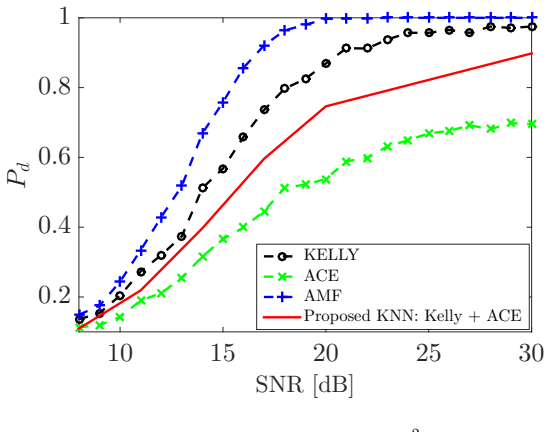
- A KNN detector built on a two-dimensional feature vector containing Kelly and AMF statistics can match Kelly's detection power in matched conditions while behaving more robustly under steering-vector mismatch, all while preserving CFAR.
- By adjusting the weights in the diagonal matrix $D$, the designer can interpolate between robust behavior (AMF-like) and selective behavior (Kelly- or ACE-like) without losing the constant false alarm rate property.
- The closed-form expressions for $P_{fa}$ and $P_d$ allow performance prediction and threshold setting for KNN radar detectors without Monte Carlo simulation.
- The raw-data KNN detector, using $S^{-1/2}z$ as a feature, is not strictly CFAR but its false alarm probability shows only mild sensitivity to changes in noise correlation, as illustrated by the numerical examples.
- Since the training set can be generated artificially from a design covariance and a design SNR, the proposed CFAR KNN detector does not require a collection phase of real radar data for training.
Reading between the lines
- Editorial inference: the same decomposition trick should extend to other detectors that share the $\tilde{t}$ and $\beta$ dependence, such as W-ABORT, enabling a broader family of tunable CFAR KNN detectors beyond the two examples shown.
- Editorial inference: the CFAR property is tied to training data generated from a nominal SNR; if training examples are collected from real scenes rather than synthesized, a mismatch between the training distribution and the design distribution could break the constant false alarm rate, so synthetic training is the safer route in practice.
- Editorial inference: Proposition 1 is a fully general performance formula for any KNN classifier, and the closed-form evaluation demonstrated here could be applied to other feature spaces where distance comparisons reduce to known distributions, making the approach useful beyond radar detection.
- Editorial inference: a natural testable extension is to optimize the weights in $D$ from the closed-form formulas to maximize detection probability under a false-alarm constraint, producing detectors tuned for a specific robustness-selectivity tradeoff.
Signed reviews
Editorial analysis
A structured set of objections, weighed in public.
Referee Report
Summary. The paper proposes a k-nearest neighbors (KNN) approach to radar detection. The authors first derive a general expression (Proposition 1) for the probability that a KNN decision statistic exceeds a threshold, in terms of an expectation over feature-space events. They then specialize to radar detectors whose feature vectors are stacks of the classical statistics t-tilde and beta, possibly weighted by a diagonal matrix D and passed through arbitrary functions of beta. For this class they claim (Proposition 2) that the false alarm probability is independent of the actual noise covariance matrix, i.e., the detector is CFAR, and that the detection probability depends only on the training SNR, the actual SNR, and cos^2 theta. The proof in Appendix A reduces the required probabilities to integrals involving complex central and noncentral F and beta distributions imported from reference [20]. Simulations compare KNN detectors using raw data, Kelly+AMF features, and Kelly+ACE features against conventional detectors.
Significance. If Proposition 2 is valid, the paper provides a useful design framework: KNN detectors can be made CFAR while retaining robustness or selectivity tunable through the weights D, and their performance is comparable to classical receivers such as Kelly's detector and the AMF. The general performance decomposition in Proposition 1 is a contribution that goes beyond the specific radar application. The paper is also refreshingly honest about the non-CFAR behavior of the raw-data KNN detector. However, the central CFAR and detection-probability claims rest on distributional facts that are quoted from [20] rather than proved or numerically verified in the present setting, and the 'closed-form' performance expressions are never evaluated or compared with Monte Carlo results. The significance is therefore contingent on filling these gaps.
major comments (3)
- [Appendix A / Proposition 2] The CFAR claim and the Pd parameter dependence are not established within the manuscript: the proof imports from [20] the exact joint laws of (t-tilde, beta) under H0, matched H1, and mismatched H1, together with the independence of t-tilde and beta under H0, and the stated noncentrality parameters in the mismatched case. Since all cancellations of the covariance matrix C in Pfa, and all reductions of Pd to SNR, SNRp, and cos^2 theta, are algebraic consequences of those imported facts, this is the load-bearing step. Please state the imported results as a lemma with a precise and complete citation (section or theorem in [20]), or prove them from model (12) and the definition of S, and add a Monte Carlo verification for the actual model of Section 3: under H0, matched H1, and mismatched H1 with z=alpha p+n, check the marginal and conditional laws of t-tilde and beta, including the claimed noncentrality parameters and the independence property. Without such verification, Proposition 2 is an unproved assertion.
- [Section 2.2 and Appendix A (abstract claim of closed-form characterization)] The abstract and Section 2.2 state that Pfa and Pd are 'characterized in closed-form', but the final expression in Proposition 1 is a high-dimensional expectation over y whose dimension is m + m(k-M) + m(NT-M), and the Appendix A expressions for p0 and p1 are one-dimensional integrals over beta with integrands depending on roots r1,...,r4 that are only implicitly defined through discriminants and continuous functions of x and the training vectors. These expressions are never evaluated numerically, nor are they compared with Monte Carlo estimates for any of the feature vectors used in Section 3, such as (20) or (21). Please either provide a tractable evaluation for the cases actually simulated (for example by numerical integration or by specializing to m=1 or m=2) and a validation plot against the empirical Pfa/Pd, or revise the terminology to 'integral representations' rather than 'closed-form'.
- [Section 3.2, Figures 4-7] The CFAR property asserted in Proposition 2 is not demonstrated empirically anywhere in the paper for the feature-vector detectors. For the feature vectors (20) and (21), the authors should report estimated Pfa under at least two different noise covariance matrices, e.g., the Gaussian-shaped C with one-lag correlation 0.95 and 0.5 used in Section 3.1, at a fixed threshold and fixed training SNR, and show that the Pfa is unchanged. The current simulations only show Pd curves and do not provide evidence that the detector is CFAR rather than merely insensitive to C in the tested cases. Such a test would also directly support the imported distributional assumptions.
minor comments (4)
- [Section 1 and Section 3.2] There are several typos: 'stastistics' in the introduction, 'CF AR' in the Section 3.2 heading, and the notation 'min ||x1_r, x||' in Appendix A contains a misplaced comma.
- [Appendix A] The symbols b0[j] and b1[j] are used without definition; please define them consistently, e.g., b0[j]=f_j(beta0) and b1[j]=f_j(beta1), following the notation for a generic b[j]=f_j(beta) in Eq. (18).
- [Proposition 1] The proof of Proposition 1 implicitly relies on exchangeability of the training vectors to justify multiplying by the binomial coefficients; this assumption should be stated explicitly before the result is used.
- [Section 3.1] The reported empirical Pfa values, such as Pfa = 0.0048 and Pfa = 0.0062, are given without confidence intervals; given that they are based on 10^5 trials, a brief statement of the associated binomial uncertainty would help the reader interpret small differences.
Circularity Check
No significant circularity: Proposition 2 is a derivation from independently established distributional facts, not a re-statement of fitted inputs.
full rationale
The paper's central claim, Proposition 2, is that for the feature vector in Eq. (18) the KNN detector is CFAR and that Pd depends only on the training SNR, SNRp, and cos^2(theta). This is derived in Appendix A from distributional facts quoted from reference [20]: under H0, t~ is complex central F(1,K-N+1) and beta is complex central beta(K-N+2,N-1), independent of C; under H1, t~ given beta is noncentral F with noncentrality proportional to SNR, SNR*beta, or SNRp*beta*cos^2(theta), and beta is central or noncentral beta. These cited results do not presuppose the CFAR property or the target claim; they are parameter-free statements about the statistics of Kelly-type and beta variables and are externally established in the radar detection literature. The KNN design parameters k, M, D, and the training SNR are chosen by the designer, not fitted to the evaluated Pfa/Pd curves. The paper does not fit a parameter to the benchmark detectors' false-alarm rates; for the raw-data detector it explicitly reports a non-CFAR behavior (Pfa = 0.0048 vs 0.0062 for different noise correlation), which shows the analysis is not inflated to force a CFAR conclusion. The only mild self-citation is reliance on [20], which includes one of the present authors, but the cited distributional laws are classical and independent of the paper's conclusions, so this does not constitute circularity. The derivation chain is therefore self-contained conditional on standard distributional results.
Assumptions & free parameters
free parameters (3)
- Design weights D = diag(d1,...,dm) =
d1=1, d2=0.7 (Kelly+AMF example); d2=0.8 (Kelly+ACE example)
- Training SNR used to generate artificial T1 =
12 dB
- KNN hyperparameters (k, M, NT) =
k=50, M=25, NT=1000 per class (raw-data example); N=16, KS=32 for CFAR examples
assumptions (3)
- domain assumption Complex Gaussian noise model for primary and secondary data, with identical covariance C under H0 and signal-plus-noise under H1 (eq. (12)).
- domain assumption Known distributions of t~ and beta from [20]: under H0 t~ ~ CF(1,K-N+1), beta ~ CBeta(K-N+2,N-1), independent; under H1, noncentral versions with noncentrality parameter SNR*beta.
- domain assumption Training set contains NT independent realizations under H0 and H1, generated according to the same model with preassigned design parameters.
Cite this review
Pith. "Pith review of A k-nearest neighbors approach to the design of radar detectors." pith.science (2026). https://pith.science/paper/IIOKSJS6
@misc{pith2026190800870,
  author       = {Pith},
  title        = {Pith review of: A k-nearest neighbors approach to the design of radar detectors},
  year         = {2026},
  howpublished = {\url{https://pith.science/paper/IIOKSJS6}},
  note         = {Machine review of arXiv:1908.00870}
}
read the original abstract
A k-nearest neighbors (KNN) approach to the design of radar detectors is investigated. The idea is to start with either raw data or well-known radar receiver statistics as feature vector to be fed to the KNN decision rule. In the latter case, the probability of false alarm and probability of detection are characterized in closed-form; moreover, it is proved that the detector possesses the constant false alarm rate (CFAR) property and the relevant performance parameters are identified. Simulation examples are provided to illustrate the effectiveness of the proposed approach.
Figures


Figures from the paper (4 more)


Reference graph
Works this paper leans on
-
[16]
Radar detection in K-distributed clutter plus thermal noise based on KNN methods,
A. Coluccia, G. Ricci, “Radar detection in K-distributed clutter plus thermal noise based on KNN methods,” IEEE Radar Conference, Boston, MA, USA, 22-26 Apr. 2019
work page 2019
-
[20]
Advanced Radar Detection Schemes Under Mismatched Signal Models,
F. Bandiera, D. Orlando, G. Ricci, “Advanced Radar Detection Schemes Under Mismatched Signal Models,” Synthesis Lectures on Signal Process- ing No. 8, Morgan & Claypool Publishers , 2009. 30
work page 2009
-
[1]
An Adaptive Detection Algorithm,
E. J. Kelly, “An Adaptive Detection Algorithm,” IEEE Trans. Aerosp. and Electron. Syst. , Vol. 22, No. 2, Mar. 1986
work page 1986
-
[2]
Performance of an Adaptive Detection Algorithm; Rejection of Unwanted Signals,
E. J. Kelly, “Performance of an Adaptive Detection Algorithm; Rejection of Unwanted Signals,” IEEE Trans. Aerosp. and Electron. Syst. , Vol. 25, No. 2, Mar. 1989. 27
work page 1989
-
[3]
A CFAR Adap- tive Matched Filter Detector,
F. C. Robey, D. L. Fuhrman, E. J. Kelly, R. Nitzberg, “A CFAR Adap- tive Matched Filter Detector,” IEEE Trans. Aerosp. and Electron. Syst. , Vol. 29, No. 1, Jan. 1992
work page 1992
-
[4]
Asymptotically Optimum Radar Detection in Compound Gaussian Noise,
E. Conte, M. Lops, G. Ricci, “Asymptotically Optimum Radar Detection in Compound Gaussian Noise,” IEEE Trans. Aerosp. and Electron. Syst. , Vol. 31, No. 2, April 1995
work page 1995
-
[5]
The CFAR adaptive subspace detector is a scale- invariant GLRT,
S. Kraut, L. L. Scharf, “The CFAR adaptive subspace detector is a scale- invariant GLRT,” IEEE Trans. Signal Process., Vol. 47, No. 9, Sept. 1999
work page 1999
-
[6]
Adaptive Beamformer Orthogonal Rejec- tion Test,
N. B. Pulsone, C. M. Rader, “Adaptive Beamformer Orthogonal Rejec- tion Test,” IEEE Trans. Signal Process. , Vol. 49, No. 3, Mar. 2001
work page 2001
Show all 20 references
-
[7]
Spatial Adaptive Subspace Detection in OTH Radar,
G. A. Fabrizio, A. Farina, M. D. Turley, “Spatial Adaptive Subspace Detection in OTH Radar,” IEEE Trans. Aerosp. and Electron. Syst. , Vol. 39, No. 4, Oct. 2003
2003
-
[8]
An ABORT-Like Detector With Im- proved Mismatched Signals Rejection Capabilities,
F. Bandiera, O. Besson, G. Ricci, “An ABORT-Like Detector With Im- proved Mismatched Signals Rejection Capabilities,” IEEE Trans. Signal Process., Vol. 56, No. 1, Jan. 2008
2008
-
[9]
A Tunable W-ABORT-like Detector with Im- proved Detection vs Rejection Capabilities Trade-Off,
A. Coluccia, G. Ricci, “A Tunable W-ABORT-like Detector with Im- proved Detection vs Rejection Capabilities Trade-Off,” IEEE Signal Pro- cess. Lett., Vol. 22, No. 6, Jun. 2015
2015
-
[10]
Gener- alized likelihood ratio test for detection of Gaussian rank-one signals in Gaussian noise with unknown statistics,
O. Besson, A. Coluccia, E. Chaumette, G. Ricci, F. Vincent, “Gener- alized likelihood ratio test for detection of Gaussian rank-one signals in Gaussian noise with unknown statistics,” IEEE Trans. Signal Process. , Vol. 65, No. 4, 15 Feb. 2017. 28
2017
-
[11]
Low signal-to-noise ratio radar target detection using Lin- ear Support Vector Machines (L-SVM),
J. E. Ball, “Low signal-to-noise ratio radar target detection using Lin- ear Support Vector Machines (L-SVM),” 2014 IEEE Radar Conference , Cincinnati, OH, USA, 19-23 May 2014
2014
-
[12]
Intelligent CFAR Detector Based on Sup- port Vector Machine,
L. Wang, D. Wang, C. Hao, “Intelligent CFAR Detector Based on Sup- port Vector Machine,” IEEE Access, Vol. 5, 16 Nov. 2017
2017
-
[13]
Machine learning techniques for cooperative spectrum sensing in cognitive radio networks,
K.M. Thilina, K.W. Choi, N. Saquib, E. Hossain, “Machine learning techniques for cooperative spectrum sensing in cognitive radio networks,” IEEE J. Sel. Areas in Commun. , Vol. 31, No. 11, Nov 2013
2013
-
[14]
Mobile col- laborative spectrum sensing for heterogeneous networks: A Bayesian machine learning approach,
Y. Xu, P. Cheng, Z. Chen, Y. Li, B. Vucetic, “Mobile col- laborative spectrum sensing for heterogeneous networks: A Bayesian machine learning approach,” IEEE Trans. Signal Process. , Vol. 66, No. 21, Nov 2018
2018
-
[15]
Spectrum sensing by higher-order SVM-based detection
A. Coluccia, A. Fascista, G. Ricci, “Spectrum sensing by higher-order SVM-based detection”, 27th European Signal Processing Conference (EU- SIPCO 2019) , A Coru˜ na, Spain, 2-6 Sep. 2019
2019
-
[17]
Deep radar detectors,
D. Brodeski, I. Bilik, R. Giryes, “Deep radar detectors,” IEEE Radar Conference, Boston, MA, USA, 22-26 Apr. 2019
2019
-
[18]
Deep learning-based object classification on automotive radar spectra,
K. Patel, K. Rambach, T. Visentin, D. Rusev, M. Pfeiffer, B. Yang, “Deep learning-based object classification on automotive radar spectra,” IEEE Radar Conference , Boston, MA, USA, 22-26 Apr. 2019. 29
2019
-
[19]
A neural net- work approach for waveform generation and selection with multi-mission radar,
J. M. Kurdzo, J. Y. N. Cho, B. L. Cheong, R. D. Palmer, “A neural net- work approach for waveform generation and selection with multi-mission radar,” IEEE Radar Conference , Boston, MA, USA, 22-26 Apr. 2019
2019
Reviewed August 14, 2026 · model on record in the stance chip above.
Discussion (0). Continue with ORCID to comment.