REVIEW 3 major objections 4 minor 20 references
Asynchronous Network Formation in Unknown Unbounded Environments
T0 review · 3 major / 4 minor · reviewed 2026-08-14 · deepseek-v4-flash
Pith's one-line read A leader-driven search, CIRCLE-TAG, propagates a message to all robots in unbounded unknown terrain with competitive ratio $O(H \cdot \max\{M, \sqrt{MH}\})$ for arbitrary deployments and $O(M)$ for uniform random ones, where $M$ and $H$…
desk verdict Genuine extension of online network formation to unbounded environments, but the main proofs sit in an inaccessible tech report, so the ratios are plausible rather than verifiable. read the letter →
The pith
A machine-rendered reading of the paper's core claim, the machinery that carries it, and where it could break.
The reading
What carries the argument
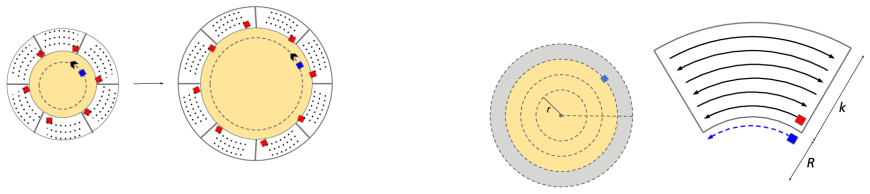
The load-bearing object is the pair $(M,H)$ of the Euclidean MST on the initial robot positions, combined with CIRCLE-TAG's two-motion schedule: the leader's Concentric-Circles-Search (CCS), whose radius in round $i$ increases by the number of active robots, and the Block-Cover sweeps, in which each active robot covers a cut-circle-sector block with $k_i$ concentric arcs. Proposition 1, that a round completes in at most twice the Block-Cover time of a single block, $2C(b_{i,k})$, is what converts geometry into the phase sums that bound the solution. The MST supplies the lower bound $M$ on the optimal offline time, bounds the phase radius differences ($\Delta^-<2M$), and bounds the number of phases by $2H$; in the random case, the same machinery is fed by ring counts and the random-geometric-graph connectivity threshold.
What would settle it
Run CIRCLE-TAG on a line configuration with robots spaced $M$ apart and measure, in each round, the true round duration against $2C(b_{i,k})$, the doubled Block-Cover time of a single assigned block. If any round exceeds that doubled coverage time, Proposition 1 is false and the sums in the proof do not bound the solution; looking for such an instance in simulation would settle the load-bearing premise directly.
Extended reading notes
Core claim
The central discovery is that the online network formation problem in unbounded environments is governed by two structural parameters of the initial configuration: the largest edge length $M$ of the Euclidean MST built on the robot positions, and the MST's height $H$. CIRCLE-TAG's search has completion time $O(M^2 H)$ in sparse configurations and $O(\max\{M^2H, (MH)^{3/2}\})$ in dense ones; since the optimal offline strategy needs at least $M$ time units, this yields the $O(H \cdot \max\{M, \sqrt{MH}\})$ competitive ratio of Theorem 1. For random deployments over an unknown disk of radius $L$, analysis by concentric rings and the connectivity threshold of random geometric graphs ($M=O(L\sqrt{\log n/n})$) gives an expected solution time $O(L^2\log n/n)$, which is $O(M)$-competitive by Theorem 2. The same algorithm and bounds cover the asynchronous setting, where robots need not start together.
Load-bearing premise
The entire runtime analysis rests on Proposition 1, which claims that each round of CIRCLE-TAG finishes in no more than twice the time one active robot needs to sweep its assigned block; the proof is deferred to a self-authored technical report whose URL is a placeholder, and if this bound fails, the phase sums and both competitive ratios no longer follow.
Editorial extensions
If this is right
- For arbitrary deployments, the message reaches all robots in time within $O(H \cdot \max\{M, \sqrt{MH}\})$ of the optimal offline strategy, so the guarantee worsens only with the widest initial gap and the MST's height, not with the area or boundary of the environment.
- For uniformly random deployments, the expected competitive ratio is $O(M)$, a clear improvement over the arbitrary-deployment bound as the number of robots grows.
- The algorithm is asynchronous and uses no global position knowledge, so robots can start at different times and still execute the same strategy successfully.
- The only gap left in the arbitrary-deployment analysis is the $\sqrt{MH}$ factor; removing it is explicitly identified as future work.
Reading between the lines
- An implication left implicit is a natural policy threshold at $n \approx M$: sparse configurations are dominated by the leader's search time, dense ones by block coverage. A hybrid that switches the radius-increment rule at this threshold could plausibly remove the $\sqrt{MH}$ term, but the paper does not propose or test it.
- Because distances are normalized by the communication range, the same ratios apply across physical scales; the field experiment using UAVs at $h=40$ m, step $60$ m, and range $50$ m is one concrete instantiation of that scale invariance.
- The expanding-circles leader motion is the classic symmetric rendezvous strategy, so the block-cover machinery may transfer to multi-robot rendezvous with unknown initial distances, a problem outside this paper's scope.
Signed reviews
Editorial analysis
A structured set of objections, weighed in public.
Referee Report
Summary. The paper considers the Online Network Formation Problem (ONFP): a single active robot must propagate information to all other robots in an unbounded environment, with no prior knowledge of robot locations and a bounded communication range. The authors propose CIRCLE-TAG, a round-based algorithm in which the leader performs concentric-circle searches and active robots cover assigned circular-sector blocks. For arbitrary deployments they claim an O(H·max{M,√(MH)})-competitive ratio, where M is the longest edge of the Euclidean MST on the initial configuration and H is its height. For uniform random deployments over a disk of unknown radius L, they claim an improved O(M)-competitive ratio. The paper also reports MATLAB simulations and a three-UAV field experiment.
Significance. If the claimed bounds are correct, the paper makes a useful contribution: it gives the first online algorithm for network formation in unbounded environments with a competitive-ratio guarantee, and it includes both simulation and field validation. The algorithm is natural and the analysis is not curve-fitted; there are no free parameters. The arbitrary-deployment bound is structurally plausible, and the random-deployment result, if properly established, would be a meaningful improvement. However, the manuscript's central proofs are deferred to a self-authored technical report, and the proof of Theorem 2 as written appears to use the wrong direction of an inequality. These issues prevent the claims from being independently verified from the submitted text, despite the otherwise sensible high-level strategy.
major comments (3)
- [Section IV-A, Proposition 1 and Section IV-B.2, Lemma 2] The proof of Proposition 1, the proof of Lemma 2, and the proofs of Propositions 2–4 are all deferred to the self-authored technical report [5], whose URL contains the placeholder '18-00XX'. Proposition 1 is load-bearing: Equation (1) in Section IV-B.1 and Equation (2) in Lemma 3 both sum round times under the premise that each round completes in at most twice the block-coverage time. Without an accessible proof, the sums in Equations (1) and (2) cannot be verified, and the asymptotic bounds in Theorems 1 and 2 are not independently checkable. Please include the proofs in the manuscript or make the technical report publicly available and ensure it is cited with a working URL.
- [Section IV-C, Theorem 2 proof] The proof of Theorem 2 is not valid as written. Lemma 4 states that a random geometric graph is connected with high probability when r ≥ √(2 log n / n), which gives an upper bound on the critical connectivity radius and hence an upper bound on M, namely M = O(L√(log n/n)). But to lower-bound OPT in order to upper-bound SOL/OPT, one needs a lower bound on M, i.e., M = Ω(L√(log n/n)) with high probability. An upper bound on M cannot lower-bound OPT. The proof should either establish the matching lower bound (for example, from the existence of isolated vertices when r is below the threshold) or state and prove a different, formally correct argument for the O(M) competitive ratio. The paper should also clarify whether the competitive ratio is meant in expectation, with high probability, or for every instance, since the input is random in this section.
- [Section IV-B.1, Sparse configurations] The assertion that the worst-case configuration is a path with equal spacing M and the leader at an endpoint, justified by 'the maximum furthest pairwise distance,' is not proved. Maximum pairwise distance does not by itself determine CIRCLE-TAG's makespan, since the algorithm's rounds depend on the leader's own distances and on the number of active robots at each phase. This unproved extremal claim is used to bound the number of phases by D ≤ 2H and to derive Equation (1). Please provide a rigorous argument that this configuration maximizes the algorithm's completion time among sparse configurations, or replace the step with a direct bound on the radii R_t in terms of M and H that does not rely on the asserted extremal configuration.
minor comments (4)
- [References] Reference [5] has a placeholder URL ('18-00XX'); this should be updated to the actual technical report number.
- [Section IV-C, after Equation (2)] The phrase 'Mn ≥ 2L' would be clearer as 'nM ≥ 2L', since the product of the number of robots and the longest MST edge is meant.
- [Section V, Figure 6] The caption states that the arbitrary-deployments bound 'fits nicely' on random deployments, but the plotted quantity and the error bars or confidence intervals are not described; adding this information would make the comparison easier to assess.
- [Throughout] The typesetting of 'CIRCLE -TAG' with a stray space appears repeatedly; this should be corrected to 'CIRCLE-TAG'.
Circularity Check
Load-bearing proofs for Proposition 1, Lemma 2, and Propositions 2-4 are deferred to the authors' own unavailable technical report, so the competitive-ratio claims are not self-contained.
-
self citation load bearing
[Section IV-A, Proposition 1 (used in Eq. (1), Lemma 3, and Theorems 1-2); reference [5]]
"Proposition 1: Consider a round i with k_i active robots, and let C(b_{i,k}) denote the coverage time of a block b_{i,k} using Block-Cover. The time it takes to complete the round is no more than 2C(b_{i,k}). The proof is presented in an accompanying technical report [5]."
The factor-2 round-time bound is the premise behind the per-round sums in Eq. (1) and Eq. (2), and hence behind Lemmas 1-3 and both theorems. Its proof is not given in this paper; it is assigned to the authors' own technical report [5], whose URL is 'https://www.cs.umn.edu/research/technical_reports/view/18-00XX' (a placeholder). The central runtime claim therefore rests on an unverified self-citation rather than on a proof the reader can check. This is load-bearing self-citation: if the report is absent or Proposition 1 fails, the competitive ratios collapse. It is not a construction identity and no parameter is fitted, so the paper still has independent algorithmic content if the deferred proofs are eventually supplied.
-
self citation load bearing
[Section IV-B.2, Lemma 2 sketch; Section IV-C, Propositions 2-4; reference [5]]
"Sketch of Proof: After bounding the value of R_t, we upper bound the number of rounds for the part where k_t >= M. The full proof is presented in [5]. The proofs of Propositions 2, 3 and 4 are given in [5]."
The dense-configuration upper bound in Lemma 2, needed for Theorem 1, is only a sketch here; the complete proof is in [5]. The random-deployment analysis in Lemma 3 additionally depends on Propositions 2-4, all proofs of which are in [5]. Reference [5] is the same two authors' technical report with the same title, not an independent external result, and the URL is a placeholder ('18-00XX'). The competitive-ratio theorems for both dense and random deployments therefore inherit key quantitative content from an unverifiable self-citation. This raises the circularity/self-support score, though it is not a by-construction equality.
full rationale
No fitted parameters are renamed as predictions, no quantity is defined in terms of its own target, and Lemma 4 is an external random-geometric-graph result (Boyd et al. and Gupta-Kumar), so the random-deployment lower bound is not self-referential. However, the core per-round timing premise, Proposition 1, is load-bearing for Eq. (1), Eq. (2), Lemmas 1-3, and both theorems, and its proof is deferred entirely to the authors' own technical report [5], whose URL is a placeholder. The dense-case proof of Lemma 2 and the random-case Propositions 2-4 are likewise deferred to [5]. Because these are same-author citations for the central quantitative claims, the paper is not self-contained and its correctness cannot be independently checked from the manuscript alone. This is a self-citation-support problem rather than a definitional circularity, so the score is moderate (4) rather than 6-10. Any mathematical objections to the use of Lemma 4 are correctness concerns, not circularity, and do not further raise this score.
Assumptions & free parameters
assumptions (5)
- standard math The Euclidean minimum spanning tree max edge M bounds the nearest-neighbor distance of every robot
- domain assumption Robots are point robots moving at constant speed, with communication range r, and distances measured in units of r
- standard math A 2D geometric random graph G(n,r) is connected with probability at least 1 - 1/n^2 when r >= sqrt(2 log n/n)
- ad hoc to paper The worst-case configuration for CIRCLE-TAG is a path with equal spacing M with the leader at an endpoint
- domain assumption For random deployments, expected robot counts can be computed as if the leader is at the center, with off-center positions changing the bound by at most a factor of four
Cite this review
Pith. "Pith review of Asynchronous Network Formation in Unknown Unbounded Environments." pith.science (2026). https://pith.science/paper/SMQUZKB7
@misc{pith2026190800914,
  author       = {Pith},
  title        = {Pith review of: Asynchronous Network Formation in Unknown Unbounded Environments},
  year         = {2026},
  howpublished = {\url{https://pith.science/paper/SMQUZKB7}},
  note         = {Machine review of arXiv:1908.00914}
}
abstract
In this paper, we study the Online Network Formation Problem (ONFP) for a mobile multi-robot system. Consider a group of robots with a bounded communication range operating in a large open area. One of the robots has a piece of information which has to be propagated to all other robots. What strategy should the robots pursue to disseminate the information to the rest of the robots as quickly as possible? The initial locations of the robots are unknown to each other, therefore the problem must be solved in an online fashion. For this problem, we present an algorithm whose competitive ratio is $O(H \cdot \max\{M,\sqrt{M H}\})$ for arbitrary robot deployments, where $M$ is the largest edge length in the Euclidean minimum spanning tree on the initial robot configuration and $H$ is the height of the tree. We also study the case when the robot initial positions are chosen uniformly at random and improve the ratio to $O(M)$. Finally, we present simulation results to validate the performance in larger scales and demonstrate our algorithm using three robots in a field experiment.
Figures


Figures from the paper (3 more)


Reference graph
Works this paper leans on
-
[5]
Asynchronous network formation in unknown unbounded environments
Selim Engin and V olkan Isler. Asynchronous network formation in unknown unbounded environments. https://www.cs.umn.edu/ research/technical_reports/view/18-00XX, 2018
work page 2018
-
[1]
Steve Alpern. The rendezvous search problem. SIAM Journal on Control and Optimization , 33(3):673–683, 1995
work page 1995
-
[2]
The freeze-tag problem: how to wake up a swarm of robots
Esther M Arkin, Michael A Bender, S ´andor P Fekete, Joseph SB Mitchell, and Martin Skutella. The freeze-tag problem: how to wake up a swarm of robots. Algorithmica, 46(2):193–221, 2006
work page 2006
-
[3]
Stephen Boyd, Arpita Ghosh, Balaji Prabhakar, and Devavrat Shah. Randomized gossip algorithms. IEEE Transactions on Information Theory, 52(6):2508–2530, 2006
work page 2006
-
[4]
Robust rendezvous for mobile autonomous agents via proximity graphs in arbitrary dimensions
Jorge Cort ´es, Sonia Mart´ınez, and Francesco Bullo. Robust rendezvous for mobile autonomous agents via proximity graphs in arbitrary dimensions. IEEE Transactions on Automatic Control , 51(8):1289– 1298, 2006
work page 2006
-
[6]
Minimizing movement to establish the connectivity of randomly deployed robots
Selim Engin and V olkan Isler. Minimizing movement to establish the connectivity of randomly deployed robots. In Twenty-Eighth International Conference on Automated Planning and Scheduling , 2018
work page 2018
-
[7]
Critical power for asymp- totic connectivity in wireless networks
Piyush Gupta and Panganamala R Kumar. Critical power for asymp- totic connectivity in wireless networks. In Stochastic Analysis, Control, Optimization and Applications , pages 547–566. Springer, 1999
work page 1999
-
[8]
Mikael Hammar, Bengt J Nilsson, and Mia Persson. The online freeze-tag problem. In Latin American Symposium on Theoretical Informatics, pages 569–579. Springer, 2006
work page 2006
Show all 20 references
-
[9]
Distributed coordination control of multiagent systems while preserving connectedness
Meng Ji and Magnus Egerstedt. Distributed coordination control of multiagent systems while preserving connectedness. IEEE Transac- tions on Robotics , 23(4):693–703, 2007
2007
-
[10]
Multi- target rendezvous search
Malika Meghjani, Sandeep Manjanna, and Gregory Dudek. Multi- target rendezvous search. In 2016 IEEE/RSJ International Conference on Intelligent Robots and Systems (IROS) , pages 2596–2603. IEEE, 2016
2016
-
[11]
Probabilistic network for- mation through coverage and freeze-tag
Eric Meisner, Wei Yang, and V olkan Isler. Probabilistic network for- mation through coverage and freeze-tag. Intelligent Service Robotics , 2(4):265–273, 2009
2009
-
[12]
Randomized algorithms
Rajeev Motwani and Prabhakar Raghavan. Randomized algorithms . Chapman & Hall/CRC, 2010
2010
-
[13]
Symmetric rendezvous search on the line with an unknown initial distance
Deniz Ozsoyeller, Andrew Beveridge, and V olkan Isler. Symmetric rendezvous search on the line with an unknown initial distance. IEEE Transactions on Robotics , 29(6):1366–1379, 2013
2013
-
[14]
Rendezvous in planar environments with obstacles and unknown initial distance
Deniz Ozsoyeller, Andrew Beveridge, and V olkan Isler. Rendezvous in planar environments with obstacles and unknown initial distance. Artificial Intelligence, 2019
2019
-
[15]
Latency analysis of coales- cence for robot groups
Sameera Poduri and Gaurav S Sukhatme. Latency analysis of coales- cence for robot groups. In IEEE International Conference on Robotics and Automation, pages 3295–3300. IEEE, 2007
2007
-
[16]
Collaborative robot exploration and rendezvous: Algorithms, performance bounds and observations
Nicholas Roy and Gregory Dudek. Collaborative robot exploration and rendezvous: Algorithms, performance bounds and observations. Autonomous Robots, 11(2):117–136, 2001
2001
-
[17]
Gossip algorithms
Devavrat Shah. Gossip algorithms. Foundations and Trends in Networking, 3(1):1–125, 2009
2009
-
[18]
Multi-agent coordination under connectivity constraints
Kunal Srivastava and Mark W Spong. Multi-agent coordination under connectivity constraints. In American Control Conference, 2008, pages 2648–2653. IEEE, 2008
2008
-
[19]
Graph-theoretic connectivity control of mobile robot networks
Michael M Zavlanos, Magnus B Egerstedt, and George J Pappas. Graph-theoretic connectivity control of mobile robot networks. Pro- ceedings of the IEEE , 99(9):1525–1540, 2011
2011
-
[20]
Controlling connectivity of dynamic graphs
Michael M Zavlanos and George J Pappas. Controlling connectivity of dynamic graphs. In 44th Conference on Decision and Control, European Control Conference CDC-ECC’05, pages 6388–6393. IEEE, 2005
2005
Reviewed August 14, 2026 · model on record in the stance chip above.
Discussion (0). Continue with ORCID to comment.