REVIEW 2 major objections 4 minor 25 references
Searches for Ultra-High Energy Neutrinos with ANITA
T0 review · 2 major / 4 minor · reviewed 2026-08-14 · deepseek-v4-flash
Pith's one-line read ANITA's third and fourth balloon flights set the most stringent limits to date on the diffuse ultra-high-energy neutrino flux above $10^{19.5}$ eV.
desk verdict Useful proceedings summary of ANITA-III/IV diffuse UHE neutrino limits, but the ANITA-IV result rests on a duplicate reference and an incompletely characterized detector response. read the letter →
The pith
A machine-rendered reading of the paper's core claim, the machinery that carries it, and where it could break.
The reading
What carries the argument
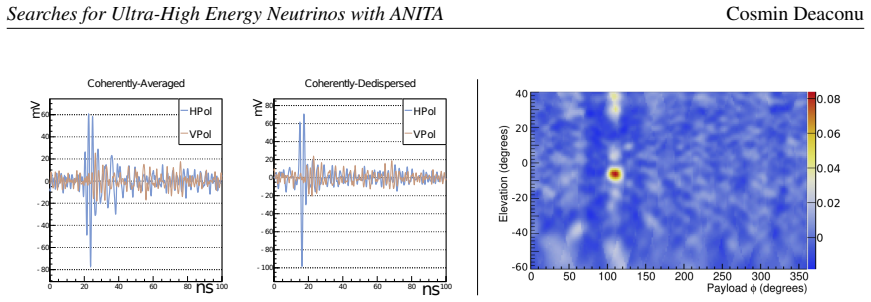
The physical mechanism is the Askaryan effect: particle showers in dense media emit coherent radio Cherenkov radiation because of a negative charge excess, and ice's long radio attenuation length makes the Antarctic ice sheet a huge target volume. The detection machinery is an interferometric array of 48 dual-polarization horn antennas that reconstruct arrival directions by computing the correlation between antenna pairs for every trial direction; polarization then separates neutrino candidates from air showers. The analysis is made quantitative by Monte Carlo simulations that model neutrino interactions in ice, radio propagation, the trigger logic, and the digitizer path for each specific flight, so that acceptance and expected backgrounds can be computed before unblinding.
What would settle it
A direct in-ice measurement of the radio attenuation length and birefringence along ANITA's flight path that disagrees with the values used in the Monte Carlo simulation by more than the quoted uncertainties would directly change the derived exposure and shift the limit curves; likewise, a dedicated re-flight with identical trigger logic that records several times the expected background of isolated impulsive vertically polarized events would falsify the background model.
Extended reading notes
Core claim
The central claim is that if the one vertically polarized candidate event from ANITA-III (on an expected background of $0.7^{+0.5}_{-0.3}$) and the one candidate from ANITA-IV (on $0.64^{+0.69}_{-0.45}$) are interpreted as background, the combined ANITA data set places the strongest existing upper limits on the diffuse flux of ultra-high-energy neutrinos above $10^{19.5}$ eV. Because Askaryan neutrino showers are expected to be primarily vertically polarized while air showers are primarily horizontally polarized, only vertically polarized impulsive events are treated as neutrino candidates. Both candidates are consistent with the estimated background, dominated by isolated impulsive anthropogenic events, so no neutrino signal is claimed. The same flights also detected 20-30 extensive air showers, including an ANITA-III event with inverted polarity whose interpretation as a tau neutrino decay is disfavored by the paper on the grounds of diffuse flux tension.
Load-bearing premise
The load-bearing premise is that the Monte Carlo simulations accurately predict how often real neutrinos would trigger the detector; if the simulated trigger efficiency, radio attenuation in the ice, or the expected background rates ($0.7$ and $0.64$ events) are wrong, the quoted limit curves shift.
Editorial extensions
If this is right
- If the limits are correct, the true diffuse ultra-high-energy neutrino flux above $10^{19.5}$ eV lies below the quoted curves, which constrains models of cosmogenic neutrino production.
- The single candidate events cannot be claimed as a detection; if real neutrinos, the implied flux is close to the limit and would need much more exposure to confirm.
- ANITA-IV's lower threshold, reduced CW contamination, and longer flight produced a significantly larger expected exposure than ANITA-III, and combining all four flights gives the best limit.
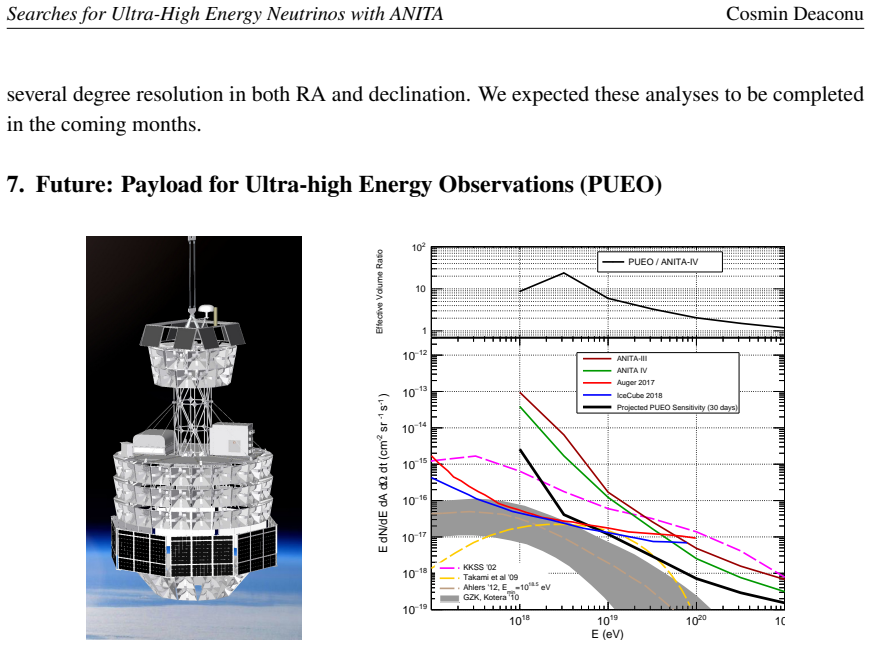
- The proposed PUEO payload's 120 antennas and beamforming trigger would reduce the trigger threshold by a factor of 2.5 and substantially improve sensitivity, especially at lower energies, making a detection feasible if the flux is near current limits.
Reading between the lines
- A direct corollary the paper does not spell out: because the limit is set by interpreting one event as background, a second similar event in a longer PUEO exposure would flip the interpretation from limit to discovery, so the candidate events define an approximate discovery zone just above the quoted curves.
- The same analysis pipeline, with the vertical-polarization-versus-horizontal-polarization separation, could be applied to other in-ice radio detectors as a cross-check, though the background environment would differ.
- If the single candidate events are real astrophysical neutrinos, the implied flux would sit near the boundary set by other experiments' limits; this tension is the most direct target for PUEO to resolve.
Signed reviews
Editorial analysis
A structured set of objections, weighed in public.
Referee Report
Summary. This ICRC 2019 proceedings paper summarizes the searches for ultra-high-energy neutrinos with the ANITA-III (2014-2015) and ANITA-IV (2016) balloon flights. The core physics result is the report of one candidate vertically polarized Askaryan-like event per flight, on expected backgrounds of 0.7 (ANITA-III) and 0.64 (ANITA-IV), which the authors interpret as background in order to set upper limits on the diffuse ultra-high-energy neutrino flux. The abstract and Section 5 claim that these are the most stringent limits above 10^19.5 eV to date. The paper also describes the ANITA instrument, calibration and simulation chain, ongoing multimessenger searches, and the proposed PUEO successor experiment.
Significance. If the quoted limits are correct, they provide the strongest direct constraints on the diffuse ultra-high-energy neutrino flux near and above 10^19.5 eV, complementing the lower-energy limits from IceCube and the Auger observatory. The proceedings format is appropriate for reporting experimental progress, and the paper is transparent in giving the observed candidate counts and expected backgrounds. A notable strength is that the ANITA-III result is consistent with the published archival analysis, and the authors explicitly flag the ANITA-IV calibration caveats rather than overstating the maturity of that analysis. However, because the 'most stringent to date' claim depends essentially on the ANITA-IV limit, and that limit rests on a system response that the paper itself describes as incompletely characterized, the central claim is not yet fully secure.
major comments (2)
- [Abstract and Section 5] The central claim that ANITA-III and ANITA-IV set the most stringent diffuse flux limits above 10^19.5 eV rests on the ANITA-IV analysis. However, the reference given for the ANITA-IV result, Ref. [9], is identical to Ref. [8] (both P. W. Gorham et al., Phys. Rev. D 98, 022001 (2018)), so there is no independent published source for the ANITA-IV limit cited in this paper. Please either cite the correct ANITA-IV archival paper, or, if the ANITA-IV limit is not yet published, state explicitly that this result is preliminary and give the expected range of systematic uncertainty.
- [Section 6] Section 6 states that the ANITA-IV system response is not fully characterized: the tunable notch filters changed the response during flight and the antenna/frontend interaction is 'still in progress.' Because the acceptance and efficiency estimates in Section 3 rely on simulations of the trigger logic and digitizer path, an uncharacterized system response can shift the simulated trigger efficiency and the expected background of 0.64 events, thereby moving the quoted limit curve. The paper should provide a quantitative systematic uncertainty on the exposure for the ANITA-IV limit, or explicitly label the ANITA-IV result as preliminary pending completion of these calibration studies.
minor comments (4)
- [References [8] and [9]] References [8] and [9] are duplicates; please replace one with the intended ANITA-IV publication or mark the result as in preparation in the text.
- [Figure 3(c) caption] The caption for Figure 3(c) lists references '[3] [19] [20] [21]' but the plot legend shows 'Auger 2017', 'IceCube 2018', 'ANITA-III', 'ANITA IV', and 'ANITA I-IV'; please align the legend entries with the corresponding references and identify each curve in the caption.
- [Section 5] The paper states that an upper limit is set by interpreting the candidate events as background, but it does not state the confidence level of the limit or the exact energy range over which the 'most stringent' claim applies; please specify the confidence level (e.g., 90% CL) and the energy interval.
- [Section 6] The sentence describing the 'more complicated interaction between the antenna response and the rest of the system response' is vague; please specify which components of the signal chain are not yet characterized and what effect this has on the neutrino acceptance calculation.
Circularity Check
No significant circularity: the ANITA-III/IV diffuse neutrino limits are derived from simulated acceptance and pre-unblinding background estimates, with no fitted parameter renamed as a prediction.
full rationale
The paper's central claim is that ANITA-III and ANITA-IV set the most stringent diffuse UHE neutrino flux limits above 10^19.5 eV. The derivation chain is: simulations of neutrino interactions, radio emission, propagation, trigger logic, and digitizer path produce an acceptance estimate (Section 3); analyses are optimized on calibration data and simulated datasets; backgrounds and efficiencies are set before unblinding (Section 4: 'The background estimate and analysis efficiency are determined prior to unblinding'); one candidate per flight is then interpreted as background to set an upper limit (Section 5). The expected backgrounds quoted (0.7 and 0.64) are computed independently of the observed candidate events, so the limit does not reduce to the input data by construction. The comparison with external measurements from Auger and IceCube provides independent context. The duplicated references [8] and [9] (both PRD 98, 022001) are an editorial/attribution error, not a circular argument, because the cited analyses are published peer-reviewed results and the conference paper is a summary rather than a new derivation resting on those citations. Section 6's admission that the ANITA-IV system response is not fully characterized (tunable notch filters requiring post-hoc calibration, antenna/amplifier interaction 'still in progress') is a legitimate systematic-uncertainty limitation, but it does not make the claim circular; it affects the reliability of the simulated acceptance, not whether the prediction is identical to the input. No fitted parameter is renamed as a prediction, no uniqueness theorem is imported from the authors, and no known result is repackaged as a derivation. The analysis is self-contained against external benchmarks and the appropriate finding is no significant circularity.
Assumptions & free parameters
assumptions (5)
- domain assumption Askaryan radio emission from neutrino-induced showers is coherent and detectable in ice.
- domain assumption The Antarctic ice sheet has a sufficiently long radio attenuation length (O(1 km)) for a balloon-borne detector.
- domain assumption The geomagnetic field in Antarctica is primarily vertical, so cosmic-ray air showers are Hpol and Askaryan neutrino signals are Vpol.
- domain assumption The icemc simulation and the independent simulation accurately model neutrino interactions, radio propagation, and trigger logic.
- domain assumption Candidate events can be treated as background when setting the upper limit.
Cite this review
Pith. "Pith review of Searches for Ultra-High Energy Neutrinos with ANITA." pith.science (2026). https://pith.science/paper/FQCIOABY
@misc{pith2026190800923,
  author       = {Pith},
  title        = {Pith review of: Searches for Ultra-High Energy Neutrinos with ANITA},
  year         = {2026},
  howpublished = {\url{https://pith.science/paper/FQCIOABY}},
  note         = {Machine review of arXiv:1908.00923}
}
abstract
The ANtarctic Impulsive Transient Antenna (ANITA) long-duration balloon experiment flies an interferometric radio array over Antarctica with a primary goal of detecting impulsive Askaryan radio emission from ultra-high-energy neutrinos interacting in the ice sheet. The third and fourth ANITA flights were completed in January 2015 and December 2016, respectively, obtaining the most stringent limits on the diffuse ultra-high-energy neutrino flux above 10$^{19.5}$ eV to date. We also discuss ongoing analyses and the proposed Payload for Ultrahigh Energy Observations (PUEO), the successor to the ANITA program. PUEO's larger number of antennas and improved trigger would significantly improve sensitivity compared to ANITA-IV.
Figures

Reference graph
Works this paper leans on
-
[9]
P. W. Gorham et al., (ANITA), Phys. Rev. D 98, 022001 (2018)
work page 2018
-
[1]
G. T. Zatsepin and V . A. Kuzmin, JETP Lett. 4, 78 (1966)
work page 1966
-
[2]
Greisen, Phys
K. Greisen, Phys. Rev. Lett. 16, 748 (1966)
1966
- [3]
- [4]
- [5]
-
[6]
S. Hoover et al., (ANITA), Phys. Rev. Lett. 105, 151101 (2010)
work page 2010
-
[7]
P. W. Gorham et al., (ANITA), Phys. Rev. Lett. 117, 071101 (2016)
work page 2016
Show all 25 references
-
[10]
G. S. Varner et al., Nucl. Instrum. Methods A 583, 447 (2007)
2007
-
[11]
Allison et al., (ANITA), Nucl
P. Allison et al., (ANITA), Nucl. Instrum. Methods A 894, 47 (2018)
2018
-
[12]
P. W. Gorham et al., (ANITA), J. Astron. Inst. 6, 1740002 (2017)
2017
-
[13]
Prohira et al., (ANITA), Nucl
S. Prohira et al., (ANITA), Nucl. Instrum. Methods A 918, 60 (2019)
2019
-
[14]
Cremonesi et al., (ANITA), Submitted to J
L. Cremonesi et al., (ANITA), Submitted to J. Instrum. (2019), arxiv:1903.11043
2019 arXiv
-
[15]
Romero-Wolf et al., (ANITA), Astropart
A. Romero-Wolf et al., (ANITA), Astropart. Phys. 60, 72 (2015)
2015
-
[16]
P. W. Gorham et al., (ANITA), Phys. Rev. Lett. 121, 161102 (2018)
2018
-
[17]
Romero-Wolf et al., Phys
A. Romero-Wolf et al., Phys. Rev. D99, 063011 (2019), 1811.07261
2019 arXiv
-
[18]
Wissel et al., (ANITA), PoS ICRC2019 (2019)
S. Wissel et al., (ANITA), PoS ICRC2019 (2019)
2019
-
[19]
Ahlers and F
M. Ahlers and F. Halzen, Phys. Rev. D 86, 083010 (2012)
2012
-
[20]
M. G. Aartsen et al., (IceCube), Phys. Rev. Lett. 119, 259902 (2017)
2017
-
[21]
Zas, (Pierre Auger), PoS ICRC2017, 972 (2018)
E. Zas, (Pierre Auger), PoS ICRC2017, 972 (2018)
2018
-
[22]
M. G. Aartsen et al., (IceCube), Science 361 (2018)
2018
-
[23]
M. G. Aartsen et al., (IceCube), Science 361, 147 (2018)
2018
-
[24]
A. Romero-Wolf, Interferometric techniques for radio impulses from ultra-high energy particle showers, in 6th International Workshop on Acoustic and Radio EeV Neutrino Detection Activities (ARENA 2014) Annapolis, MD, June 9-12, 2014 , 2014
2014
-
[25]
Allison et al., (ARA), Nucl
P. Allison et al., (ARA), Nucl. Instrum. Meth. A930, 112 (2019)
2019
-
[26]
J. M. Roberts et al., Nucl. Instrum. Meth. A925, 92 (2019). 7
2019
Reviewed August 14, 2026 · model on record in the stance chip above.
Discussion (0). Continue with ORCID to comment.