REVIEW 3 major objections 4 minor 28 references
Positive scalar curvature on manifolds with odd order abelian fundamental groups
T0 review · 3 major / 4 minor · reviewed 2026-08-14 · deepseek-v4-flash
Pith's one-line read This paper proves that nonspin manifolds of dimension at least five with odd-order abelian fundamental group admit a positive scalar curvature metric when they are p-atoral for every prime dividing the group order.
desk verdict A serious, likely correct theorem with a genuinely new machine; the one load-bearing algebraic step in Section 7 needs a referee's undivided attention before the paper can be accepted. read the letter →
The pith
A machine-rendered reading of the paper's core claim, the machinery that carries it, and where it could break.
The reading
What carries the argument
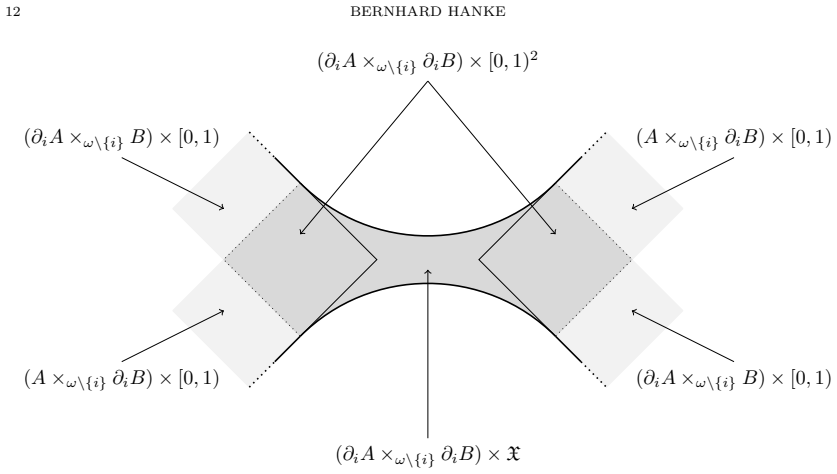
The machinery has three layers. The geometric layer is the theory of Baas-Sullivan manifolds, i.e. manifolds with prescribed even-dimensional singular strata, equipped with $Q$-compatible positive metrics and with 'admissible products' that resolve the corner singularities of Cartesian products; this yields a positive homology subgroup $H^{Q,+}_*$ whose elements are represented by Baas-Sullivan manifolds with positive scalar curvature. The analytic tool is the shrinking-one-factor principle (Proposition 4.7), which makes cross products and many Toda brackets of positive classes positive. The algebraic layer is the almost representable homology $RH_*(B\Gamma;\mathbb{Z}/p^\alpha)$, the submodule killed by the Bockstein and by operations $\partial_{(\kappa,\ell)}$ derived from truncated Brown-Peterson theory; Proposition 7.9 identifies it with the span of generalized products of lens spaces, and that identification carries the proof of Theorem 1.6.
What would settle it
Take a finite abelian $p$-group $\Gamma$ and compute the subgroup $RH_*(B\Gamma;\mathbb{Z}/p^\alpha)$ of classes killed by the Bockstein and by all operations $\partial_{(\kappa,\alpha)}$; check whether every element reduces modulo $p$ to a sum of fundamental classes of products of standard $\mathbb{Z}/p^\alpha$-lens spaces. A single class that survives the operations but is not such a generalized product would disprove Proposition 7.9 and collapse Theorem 1.6.
Extended reading notes
Core claim
The central claim, Theorem 1.1, is that for $M$ as above, a positive scalar curvature metric exists. The proof's backbone is a homological invariance principle (Theorem 1.5): for a nonspin closed connected manifold of dimension $d\geq 5$ with odd-order fundamental group, $M$ admits such a metric if and only if the class $\varphi_*([M])$ in $H_d(B\pi_1(M);\mathbb{Z})$ lies in the positive homology subgroup $H^{Q,+}_d$. The paper shows (Theorem 1.6) that for every finite abelian $p$-group $\Gamma$ with $p$ odd, every p-atoral class in the image of $\Omega^{\mathrm{SO}}_*(B\Gamma)\to H_*(B\Gamma;\mathbb{Z})$ is positive. The obstacle of Toda brackets involving degree-one classes, whose positivity cannot be established directly, is bypassed by proving that the 'almost representable' homology of $B\Gamma$ with $\mathbb{Z}/p^\alpha$ coefficients is generated by generalized products of lens spaces; this generation statement is what finally feeds into positivity.
Load-bearing premise
The load-bearing premise is the algebraic classification in Section 7: every homology class of a finite abelian $p$-group that is killed by the Bockstein and by the relevant Brown-Peterson operations is a linear combination of generalized products of lens spaces; if that classification failed, the proof would not reach all p-atoral classes in the image of oriented bordism.
Editorial extensions
If this is right
- Every nonspin closed connected manifold of dimension at least five with odd-order abelian fundamental group and no p-toral fundamental class carries a positive scalar curvature metric.
- The proof reduces the existence question to membership in a positive homology group, giving one criterion that covers all p-atoral cases rather than treating each group family separately.
- The earlier elementary-abelian p-group results are subsumed: p-atorality can be checked after passing to Sylow p-subgroups, so the new theorem applies to all finite abelian p-groups.
- The remaining obstruction to the full odd-order Gromov-Lawson-Rosenberg conjecture in these dimensions is isolated to toral classes and to homology classes not represented by smooth manifolds.
Reading between the lines
- The same strategy could be pushed toward the spin case if the 'almost representable' generation result were proved in real connective K-homology rather than ordinary homology; the paper leaves this as an open problem.
- If p-toral classes for odd p indeed never admit positive scalar curvature, as the paper floats as a possibility, then p-atorality would become a complete obstruction and Theorem 1.1 would be an if-and-only-if statement for this class.
- The algebraic identification in Section 7 may give an independent, purely algebraic route to the Conner-Floyd conjecture for elementary abelian p-groups, an application the paper suggests but does not pursue.
Signed reviews
Editorial analysis
A structured set of objections, weighed in public.
Referee Report
Summary. The paper proves Theorem 1.1: every closed connected smooth manifold of dimension at least 5 with odd order abelian fundamental group, nonspin, and p-atoral for all primes p dividing the order of the fundamental group admits a Riemannian metric of positive scalar curvature. The proof develops a theory of positive scalar curvature metrics on manifolds with Baas–Sullivan singularities, establishes a homology invariance principle (Theorem 1.5), studies admissible products and homological Toda brackets (Sections 4–5), and then analyzes the homology of finite abelian p-groups (Sections 6–7). The key reduction is Theorem 1.6, asserting that all p-atoral classes in the image of oriented bordism in H_*(BΓ; Z) are positive for finite abelian p-groups Γ. Theorem 1.6 is proved by showing, via Proposition 7.9, that the relevant homology classes are generated by generalized products of lens spaces, combined with positivity results for Toda brackets. The paper explicitly identifies an unresolved Toda bracket positivity question (Question 6.10) and bypasses it by restricting to classes in the image of oriented bordism.
Significance. If the proof is correct, Theorem 1.1 is a substantial advance on the Gromov–Lawson–Rosenberg conjecture, covering a new class of finite fundamental groups that are odd order abelian. The paper is honest and carefully structured: the unresolved Question 6.10 is explicitly flagged, and the restriction to the image of oriented bordism is a methodologically sound way to bypass that question. The manuscript also contains useful technical contributions of independent interest: a geometric construction of admissible products for Baas–Sullivan manifolds with a controlled factor 2^n in the cross product, positivity results for Toda brackets under suitable hypotheses, and an algebraic identification of 'almost representable homology' via natural operations ∂(κ,ℓ) and Bockstein operations. No fitted parameters or ad-hoc assumptions are introduced, and the main theorem is not assumed in the proof. The main risk is the completeness of the algebraic induction in Section 7, specifically the balancing step in Proposition 7.14(i), on which Proposition 7.16, Proposition 7.9, and hence Theorem 1.6 depend.
major comments (3)
- [Section 7, proof of Proposition 7.14(i)] The surjectivity of π : D^{n+1,n-1}_* → (N_*)^n ⊗ L_* is the load-bearing step of the algebraic induction, but its proof contains the assertion: 'Using the induction assumption again several times in order to balance ∂_(j)(c^(κ)) for j = κ+1,...,n−1 we can arrange furthermore that ∂_(j)(c^(κ)) = 0 for κ < j ≤ n−1.' No induction is actually written out, no bound on the number of balancing operations is given, and it is not verified that the balancing preserves the already arranged vanishings ∂_(j)(c^(κ)) = 0 for j < κ and the degree bounds. Since this surjectivity is used immediately to define ∂_(n), to prove its surjectivity, and to identify ker(∂_(n)) in part (ii), and since part (iii) and Proposition 7.16 depend on part (ii), the equality C^{n,∞}_* = L^n_* and hence Proposition 7.9 rest on this unproved balancing claim.
- [Section 7, Proposition 7.14(ii) and (iii)] The dimension count in part (ii) relies on the surjectivity of ∂_(n) established in part (i). If the balancing step in (i) is not justified, the asserted isomorphism ker(∂_(n)) ≅ (N_*)^n ⊗ L_{<p^n} is unsupported, and the conclusion D^{n+1,n}_* = D^{n+1,∞}_* in part (iii) does not follow. Corollary 7.15 and the induction proof of Proposition 7.16 then inherit the same gap. The author should either provide a fully explicit induction proving the balancing assertion, or identify a different argument that establishes surjectivity of π without this step.
- [Section 8, proof of Proposition 8.1] The proof of Proposition 8.1 invokes Proposition 7.9 in order to represent the reduction of c′ modulo p by generalized products of lens spaces and then concludes that c′ is positive modulo a p-divisible p-atoral cycle. This is valid only if Proposition 7.9 is fully established. Given the dependence of Proposition 7.9 on the balancing step in Proposition 7.14(i), the proof of Theorem 1.6 is conditional on that algebraic claim. I am not requesting a new result, but the manuscript should make the Section 7 induction complete and self-contained before Theorem 1.6 can be regarded as proved.
minor comments (4)
- [Section 3, proof of Proposition 3.11] In the sentence 'such that Theorem 3.11 follows from the usual bordism principle', the reference should be to Proposition 3.11, not Theorem 3.11.
- [References] Reference [16] contains a corrupted author name 'S/suppress lawomir Kwasik'; it should read 'Slawomir Kwasik'.
- [Section 4, Figure 2 and Definition 4.6] The hexagonal manifold X in Figure 2 is not labelled with side lengths or the orientation convention; adding these labels would make the metric construction in Definition 4.6 easier to follow.
- [Section 8, proof of Proposition 8.1] The sentence 'We can therefore assume that in the generalized products of lens spaces appearing before the case m1 = ... = mk = 1 does not occur' is grammatically confusing; please rewrite and explicitly state that the exclusion of all m_i = 1 uses p-atorality.
Circularity Check
No circularity: the main theorem is not assumed; self-citations are contextual and the Section 7 algebra is self-contained, though non-explicit in places.
full rationale
The derivation chain is not circular. Theorem 1.1 is obtained from the homology criterion (Theorem 1.5), whose converse is proved by surgery and bordism propagation (Proposition 3.11) rather than by assuming positive scalar curvature on M, and from Theorem 1.6, which is proved in Section 8 using algebraic properties of the operations ∂(κ,ℓ). Those operations are defined from the Atiyah-Hirzebruch spectral sequence of BP(κ,ℓ) and vanish on classes coming from Ω^SO_*; Proposition 7.9 proves a converse, namely that classes in RH are generated by generalized lens-space products, and does not assume that converse. The delicate identification C^{n,∞}=L^n_* (Proposition 7.16) is proved by induction through Proposition 7.14; the cited 'balancing' step in the proof of Proposition 7.14(i) is non-explicit, but it is an inductive construction, not an appeal to Theorem 1.6 or Theorem 1.1, so any gap would be a correctness issue rather than circularity. The self-citations that appear are not load-bearing: [12] is mentioned as background and as a proof technique for α=1, while Proposition 7.9 is stated and proved here for all α, and Proposition 7.16 explicitly says its argument does not rely on the Conner-Floyd conjecture used in earlier work. Question 6.10 is explicitly left open and is bypassed by restricting to the image of Ω^SO_*(BΓ), not by assuming its answer. No fitted parameter is renamed as a prediction, and no input is defined in terms of the target output.
Assumptions & free parameters
assumptions (5)
- standard math Surgeries of codimension at least three preserve the existence of positive scalar curvature metrics (Gromov-Lawson, Schoen-Yau).
- standard math Baas-Sullivan bordism with singularities in the family Q is naturally isomorphic to singular homology after inverting 2.
- standard math The oriented bordism ring modulo torsion is polynomial on generators Q_i of dimensions 4i, and each Q_i can be chosen with a positive scalar curvature metric.
- standard math Brown-Peterson theory BP and the derived theories BP(kappa,ell) exist as multiplicative homology theories with the stated coefficient rings.
- domain assumption The Atiyah-Hirzebruch spectral sequence for BP(kappa,ell) has the stated nonvanishing differentials and convergence properties.
Cite this review
Pith. "Pith review of Positive scalar curvature on manifolds with odd order abelian fundamental groups." pith.science (2026). https://pith.science/paper/JKO5VR77
@misc{pith2026190800944,
  author       = {Pith},
  title        = {Pith review of: Positive scalar curvature on manifolds with odd order abelian fundamental groups},
  year         = {2026},
  howpublished = {\url{https://pith.science/paper/JKO5VR77}},
  note         = {Machine review of arXiv:1908.00944}
}
read the original abstract
We introduce Riemannian metrics of positive scalar curvature on manifolds with Baas-Sullivan singularities, prove a corresponding homology invariance principle and discuss admissible products. Using this theory we construct positive scalar curvature metrics on closed smooth manifolds of dimension at least five which have odd order abelian fundamental groups, are nonspin and atoral. This solves the Gromov-Lawson-Rosenberg conjecture for a new class of manifolds with finite fundamental groups.
Figures

Reference graph
Works this paper leans on
-
[12]
Bernhard Hanke, Bordism of elementary abelian groups via inessential Brown -Peterson homology , J. Topol. 9 (2016), no. 3, 725–746
work page 2016
-
[1]
Nils Andreas Baas, On bordism theory of manifolds with singularities , Math. Scand. 33 (1973), 279–302 (1974)
work page 1973
-
[2]
Besse, Einstein manifolds , Classics in Mathematics, Springer-Verlag, Berlin, 2008
Arthur L. Besse, Einstein manifolds , Classics in Mathematics, Springer-Verlag, Berlin, 2008. Reprint of the 1987 edition
work page 2008
-
[3]
170, Cambridge Universit y Press, Cambridge, 1992
Boris Botvinnik, Manifolds with singularities and the Adams-Novikov spectr al sequence, London Mathematical Society Lecture Note Series, vol. 170, Cambridge Universit y Press, Cambridge, 1992. [4] , Manifolds with singularities accepting a metric of positiv e scalar curvature , Geom. Topol. 5 (2001), 683–718
work page 2001
-
[5]
Boris Botvinnik and Jonathan Rosenberg, The Yamabe invariant for non-simply connected manifolds , J. Differential Geom. 62 (2002), no. 2, 175–208
work page 2002
-
[6]
, Positive scalar curvature for manifolds with elementary ab elian fundamental group , Proc. Amer. Math. Soc. 133 (2005), no. 2, 545–556
work page 2005
-
[7]
Brown, Cohomology of groups , Graduate Texts in Mathematics, vol
Kenneth S. Brown, Cohomology of groups , Graduate Texts in Mathematics, vol. 87, Springer-Verlag, New York, 1994. Corrected reprint of the 1982 original
work page 1994
-
[8]
Ulrich Bunke, Index theory, eta forms, and Deligne cohomology , Mem. Amer. Math. Soc. 198 (2009), no. 928, vi+120
work page 2009
Show all 28 references
-
[9]
Samuel Eilenberg and Saunders Mac Lane, On the groups H(Π, n ). II. Methods of computation , Ann. of Math. (2) 60 (1954), 49–139
1954
-
[10]
Sven F¨ uhring,A smooth variation of Baas-Sullivan theory and positive sca lar curvature, Math. Z. 274 (2013), no. 3–4, 1029–1046
2013
-
[11]
Blaine Lawson Jr., The classification of simply connected manifolds of positiv e scalar curvature, Ann
Mikhael Gromov and H. Blaine Lawson Jr., The classification of simply connected manifolds of positiv e scalar curvature, Ann. of Math. (2) 111 (1980), no. 3, 423–434
1980
-
[13]
Bernhard Hanke, Dieter Kotschick, and Jan Wehrheim,Dissolving four-manifolds and positive scalar curvature , Math. Z. 245 (2003), no. 3, 545–555
2003
-
[14]
Stephen Wilson, The Brown-Peterson homology of elementary p-groups, Amer
David Copeland Johnson and W. Stephen Wilson, The Brown-Peterson homology of elementary p-groups, Amer. J. Math. 107 (1985), no. 2, 427–453
1985
-
[15]
Dominic Joyce, A generalization of manifolds with corners , Adv. Math. 299 (2016), 760–862
2016
-
[16]
S/suppress lawomir Kwasik and Reinhard Schultz,Positive scalar curvature and periodic fundamental groups , Comment. Math. Helv. 65 (1990), no. 2, 271–286. POSITIVE SCALAR CUR V ATURE AND ODD ORDER ABELIAN FUNDAMENTA L GROUPS 31
1990
-
[17]
I , Amer
John Milnor, On the cobordism ring Ω∗ and a complex analogue. I , Amer. J. Math. 82 (1960), 505–521
1960
-
[18]
Mironov, Existence of multiplicative structures in the theory of cob ordism with singularities , Izv
Oleg K. Mironov, Existence of multiplicative structures in the theory of cob ordism with singularities , Izv. Akad. Nauk SSR Ser. Mat. 39 (1975), no. 5, 1065–1092
1975
-
[19]
Mitchell, A proof of the Conner-Floyd conjecture , Amer
Stephen A. Mitchell, A proof of the Conner-Floyd conjecture , Amer. J. Math. 106 (1984), no. 4, 889–891
1984
-
[20]
3, 177–186
Jack Morava, A product for the odd-primary bordism of manifolds with sing ularities, Topology 18 (1979), no. 3, 177–186
1979
-
[21]
Novikov, Some problems in the topology of manifolds connected with th e theory of Thom spaces , Soviet Math
Sergei P. Novikov, Some problems in the topology of manifolds connected with th e theory of Thom spaces , Soviet Math. Dokl. 1 (1960), 717–720
1960
-
[22]
III , Topology 25 (1986), no
Jonathan Rosenberg, C∗ -algebras, positive scalar curvature, and the Novikov conj ecture. III , Topology 25 (1986), no. 3, 319–336
1986
-
[23]
, Manifolds of positive scalar curvature: a progress report , Surveys in differential geometry. Vol. XI, Int. Press, Somerville, MA, 2007, pp. 259–294
2007
-
[24]
Ravenel and W
Douglas C. Ravenel and W. Stephen Wilson, The Morava K-theories of Eilenberg-Mac Lane spaces and the Conner-Floyd conjecture, Amer. J. Math. 102 (1980), no. 4, 691–748
1980
-
[25]
2, Princeton Univ
Jonathan Rosenberg and Stephan Stolz, Metrics of positive scalar curvature and connections with s urgery, Surveys on surgery theory, Vol. 2, Princeton Univ. Press, Pr inceton, NJ, 2001, pp. 353–386
2001
-
[26]
28 (1979), no
Richard Schoen and Shing-Tung Yau, On the structure of manifolds with positive scalar curvatur e, Manuscripta Math. 28 (1979), no. 1–3, 159–183
1979
-
[27]
Nobuo Shimada and Nobuaki Yagita, Multiplications in the complex bordism theory with singula rities, Publ. Res. Inst. Math. Sci. 12 (1976/77), no. 1, 259–293
1976
-
[28]
1, 2 (Z¨ urich, 1994), Birkh¨ auser, Basel, 1995, pp
Stephan Stolz, Positive scalar curvature metrics–existence and classific ation questions , Proceedings of the International Congress of Mathematicians, Vol. 1, 2 (Z¨ urich, 1994), Birkh¨ auser, Basel, 1995, pp. 625–636
1994
-
[29]
Ren´ e Thom,Quelques propri´ et´ es globales des vari´ et´ es diff´ erentiables, Comment. Math. Helv. 28 (1954), 17–86. Institut f ¨ur Mathematik, Universit ¨at Augsburg, D-86135 Augsburg, Germany Email address : hanke@math.uni-augsburg.de
1954
Reviewed August 14, 2026 · model on record in the stance chip above.
Discussion (0). Continue with ORCID to comment.