REVIEW 2 major objections 5 minor 42 references
A local direct method for module identification in dynamic networks with correlated noise
T0 review · 2 major / 5 minor · reviewed 2026-08-14 · deepseek-v4-flash
Pith's one-line read For dynamic networks with correlated node noise, a local module can be consistently estimated with maximum-likelihood properties by embedding it in a MIMO prediction-error setup.
desk verdict A principled, honest extension of local module identification to correlated noise, with the main gap—data-informativity—left explicitly open rather than solved. read the letter →
The pith
A machine-rendered reading of the paper's core claim, the machinery that carries it, and where it could break.
The reading
What carries the argument
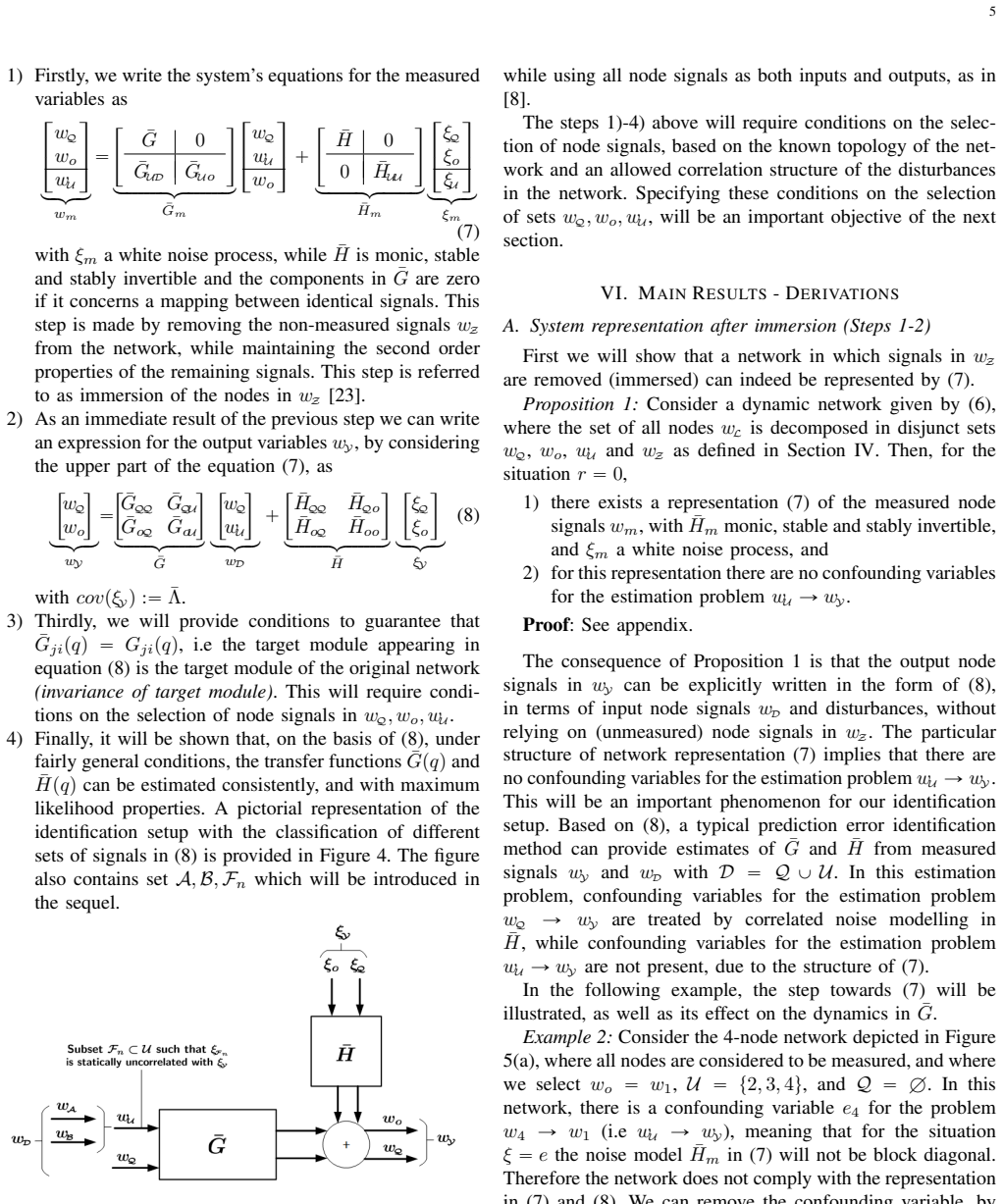
The load-bearing object is the transformed network representation (8), built by first removing unmeasured node signals $w_Z$ (immersion) and then reshaping the noise model so that no confounding variables remain for the estimation problem $w_U \to w_Y$. A confounding variable is an unmeasured noise component that has paths to both an input and an output of the estimation problem. The node sets are decomposed as $Y = Q \cup \{o\}$, $D = Q \cup U$, and $U = A \cup B$, and the main conditions are Condition 1 (parallel path and loop condition), which keeps the target module invariant under immersion, and Condition 2 (no confounding variables for $w_A \to w_Y$ and $w_A \to w_B$), which keeps it invariant under the noise reshaping. Theorem 1 combines these into the module invariance result; Theorem 2 adds data-informativity, expressed as $\Phi_\kappa(\omega) > 0$, and delay-in-path conditions for consistency; Theorem 3 gives the maximum-likelihood estimate. The three selection algorithms in Sections VII–IX operationalize these conditions.
What would settle it
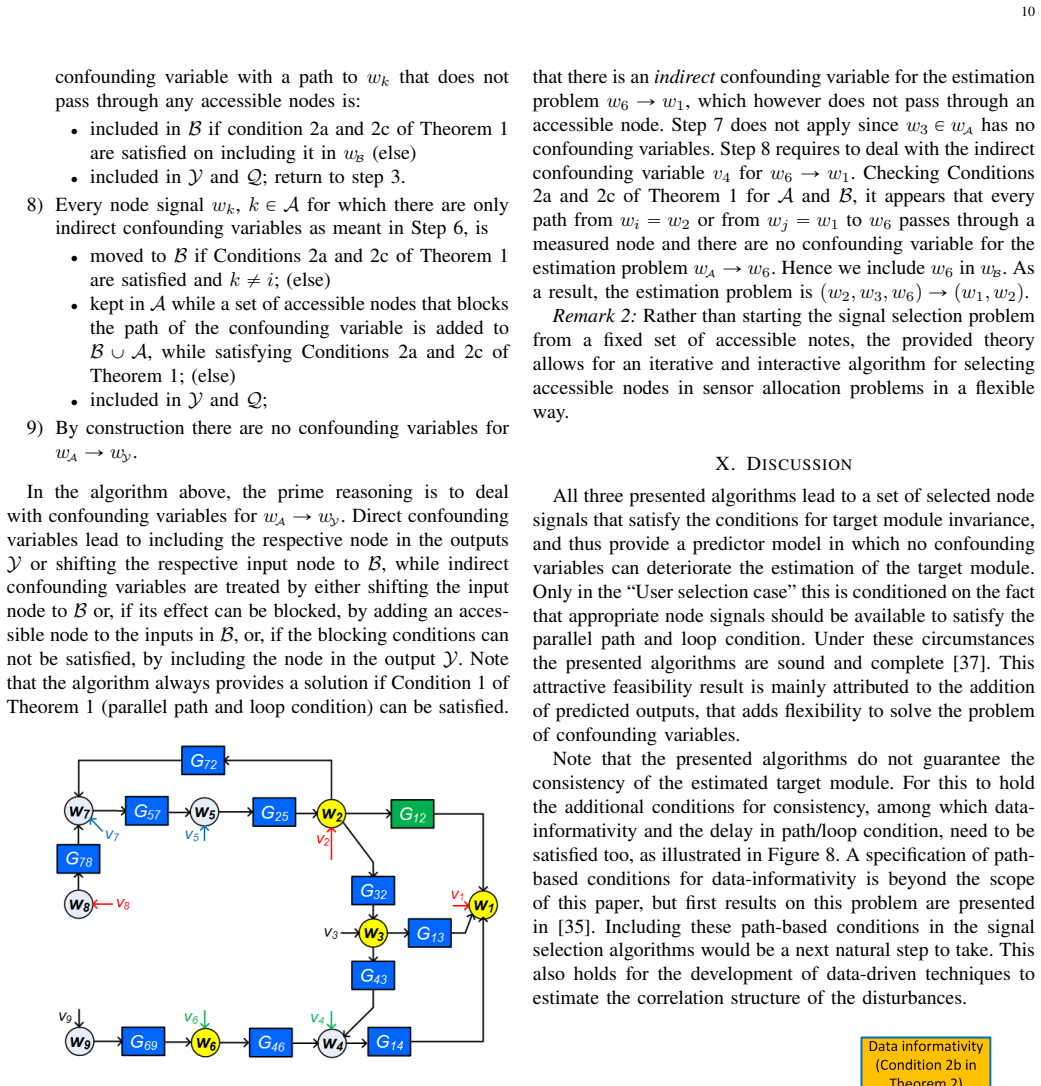
Simulate the paper's two-node example with dynamically correlated $v_1$ and $v_2$: a SISO direct-method estimate of $G_{21}$ should be biased, while the MIMO setup with both nodes as outputs should become unbiased and approach the asymptotic variance bound as record length grows. A single network satisfying all conditions of Theorems 1 and 2 in which the MIMO direct estimate stays biased would refute the central claim; likewise, a misspecified Boolean correlation pattern that nevertheless yields unbiased estimates would show the knowability assumption is not necessary.
Extended reading notes
Core claim
On the paper's own terms, the discovery is that a single module in a dynamic network with known topology can be identified locally, with consistency and asymptotic maximum-likelihood (minimum-variance) properties, even when process noises are correlated across nodes, provided the identification problem is reformulated as a MIMO prediction-error estimation. The target module $G_{ji}$ is embedded in an estimation problem with predictor inputs $w_D$ and predicted outputs $w_Y$, where some signals act as both input and output; the correlation in the noise is absorbed by a full multivariate noise model. The paper proves that if the selected node sets satisfy the parallel path and loop condition, the no-confounding conditions of Theorem 1, data-informativity, and the delay conditions of Theorem 2, then the target module appearing in the transformed equations is exactly the original module and is estimated consistently, with the maximum-likelihood formula of Theorem 3. Three algorithms—full input, minimum input, and user selection—construct such setups from the network topology and the Boolean noise correlation structure.
Load-bearing premise
The argument assumes the user knows in advance exactly which pairs of node noises are correlated (the zero/nonzero pattern of the noise spectrum); if that pattern is missing or wrong, the selected node sets can violate Condition 2 and the invariance, consistency, and maximum-likelihood guarantees no longer follow.
Editorial extensions
If this is right
- The target module can be estimated consistently with maximum-likelihood properties even when node noises are correlated, provided the selected node signals satisfy the invariance, informativity, and delay conditions.
- Correlated noise no longer forces a choice between consistency (indirect or two-stage methods) and minimum variance: the MIMO direct method delivers both.
- Each of the three selection algorithms (full input, minimum input, user selection) yields a valid identification setup under the stated conditions, so users can trade measurement cost against setup complexity.
- Only local measurements are needed; the method avoids collecting node signals far from the target module and avoids identifying unnecessary modules.
Reading between the lines
- Editorial inference: The paper's conditions are purely graphical once the Boolean correlation structure is known, so the signal-selection step should be automatable at scale; the paper mentions this possibility but does not implement it.
- Editorial inference: In practice the correlation structure would often be estimated from data, and the method's guarantees would then inherit the estimation error in that structure; the invariance and consistency results would need to be re-derived under estimated rather than known correlation patterns.
- Editorial inference: Because the three algorithms produce different experimental setups, the variance of the final module estimate will generally differ across them; a user could in principle select a setup by comparing the asymptotic variance bounds, a comparison the paper leaves for future work.
Signed reviews
Editorial analysis
A structured set of objections, weighed in public.
Referee Report
Summary. The paper considers the identification of a single module G_ji in a dynamic network with known topology, when process noises at different nodes are correlated. The authors propose a local direct method in which the target module is embedded in a MIMO prediction-error setup with suitably chosen predictor inputs w_D and predicted outputs w_Y, allowing correlated noise to be modeled by a full noise spectral density. The main theoretical results are: (i) a module invariance theorem (Theorem 1) giving conditions under which the target module appearing in the transformed identification model equals the original G_ji; (ii) a consistency theorem (Theorem 2) for the MIMO prediction-error estimate, requiring model-set membership, a data-informativity condition on Φ_κ, and delay conditions on paths/loops; and (iii) a maximum-likelihood result (Theorem 3) under Gaussian innovations. Three algorithms are presented for selecting the node signals in the full-input, minimum-input, and user-selection cases, each illustrated on examples. Proofs are collected in an appendix.
Significance. If the stated conditions are satisfied, the paper offers a systematic way to obtain consistent, asymptotically efficient estimates of a local module without identifying the entire network, extending earlier MISO results to the correlated-noise case. The explicit treatment of direct and indirect confounding variables, the block-structured transformation into a representation without confounding variables, and the three signal-selection algorithms are useful and nontrivial contributions to the dynamic-network identification literature. A notable strength is that the paper is transparent about the limitations: Section X explicitly states that the algorithms do not by themselves guarantee consistency and that path-based data-informativity conditions are beyond the scope of the paper. The appendix proofs are detailed, and the paper correctly distinguishes between the invariance guarantee and the conditional consistency result.
major comments (2)
- [Section X, Theorem 2(b)] The data-informativity condition in Theorem 2(b), Φ_κ(ω) > 0 with κ = [w_D^T, ξ_Q^T, w_o^T]^T, involves the unmeasured innovation ξ_Q, and Section X explicitly states that 'a specification of path-based conditions for data-informativity is beyond the scope of this paper.' Consequently, the three algorithms of Sections VII–IX guarantee only module invariance (Theorem 1) and, through Proposition 2, the delay conditions; they do not ensure that the selected setup is informative. The paper's central claim that the target module can be consistently estimated with maximum-likelihood properties therefore holds only under an additional, unverified spectral condition that cannot be checked from measured data alone. The authors should either provide constructive, checkable conditions for data-informativity (for example, conditions on the external excitation r) or, at minimum, reframe the main contribution as invariance plus conditional consistency and add a detailed discussion of how a user might verify or satisfy this condition in practice.
- [Theorem 3] The maximum-likelihood result is not derived in the paper; the proof is deferred by stating 'Can be shown by following a similar reasoning as in Theorem 1 of [8].' Since the present identification setup differs from [8] in important respects—signals in the set Q act simultaneously as inputs and outputs, and the noise model has the block-diagonal structure (43)—the applicability of the argument in [8] is not immediate. The authors should include a self-contained proof or a precise reduction of the present setup to that of [8, Theorem 1]. Without this, the ML claim is not independently verifiable and the reader cannot judge whether the particular parametrization and the presence of the block-diagonal noise model affect the result.
minor comments (5)
- [Section II] The assumption that the Boolean correlation structure of Φ_v is known a priori is strong and is used explicitly by all three algorithms. The paper should add a brief discussion of how the results degrade if this structure is misspecified, even though data-driven estimation is deferred to future work.
- [Theorem 2(c), Proposition 2(c)] The notation 'w_YYF' is unclear and likely a typesetting artifact; it should be written as w_Y ∪ w_F or similar. The same issue appears in the reformulated condition in Proposition 2.
- [Example 4] There is a typo: 'maximum likehood' should be 'maximum likelihood.'
- [Section VIII] The statement that the minimum-input algorithm 'adds the smallest number of additional signals to be measured' is plausible but not proven. A formal argument or a counterexample discussion would strengthen the claim.
- [Proof of Theorem 1] The text 'conditon 2b' should be 'condition 2b.'
Circularity Check
No significant circularity: the core module-invariance and consistency arguments are conditional derivations, not fits renamed as predictions.
full rationale
The paper's central contribution is a graph-based selection procedure: given the network topology and the Boolean correlation structure of the disturbances, it constructs sets Q, A, B, Y, D so that the target module remains invariant in the immersed and transformed network. No model parameter is fitted to data and then reported as a prediction; the selected signals are chosen by the stated Conditions 1 and 2 and by Theorem 1. The invariance proof in Appendix B is a derivation from the immersion formulas (16)-(17) and the spectral factorization structure, not an assumption of the conclusion. The consistency claim in Theorem 2 is explicitly conditional on standard prediction-error conditions: model set contains the true system, data-informativity Phi_kappa > 0, and delay conditions. The paper honestly states in Section X that 'A specification of path-based conditions for data-informativity is beyond the scope of this paper' and that 'the presented algorithms do not guarantee the consistency of the estimated target module.' This is an uncharacterized sufficient condition, i.e. a limitation or gap, not a circular reduction. The self-citations, including the proof of Theorem 3 referring to 'Theorem 1 of [8]', cite separate published results with stated assumptions that do not include the present target theorem; they are proof shortcuts rather than inputs that are equivalent to the claimed output. Overall, the derivation is self-contained in structure and the strongest claim is honestly conditioned, so the circularity score is low.
Assumptions & free parameters
assumptions (8)
- domain assumption The network is represented as w = Gw + Rr + He with H square, stable, monic, minimum-phase, and e white noise with covariance Lambda > 0.
- domain assumption The network is stable and well-posed, i.e., (I-G)^-1 is stable.
- domain assumption The Boolean correlation structure of disturbances, i.e., the zero pattern of Phi_v, is known a priori.
- domain assumption Standard regularity conditions for prediction error identification hold, including bounded moments of order higher than 4.
- domain assumption Data-informativity condition: Phi_kappa(omega) > 0 for a sufficiently high number of frequencies.
- domain assumption Delay conditions: all paths and loops from w_Y union F to w_Y in the network and in the parameterized model have at least a delay, with analogous conditions for F_n per Theorem 2c.
- standard math Spectral factorization of rational matrices exists (Youla).
- domain assumption For Theorem 3, xi_Y is normally distributed and zero initial conditions apply.
Cite this review
Pith. "Pith review of A local direct method for module identification in dynamic networks with correlated noise." pith.science (2026). https://pith.science/paper/CVBINORA
@misc{pith2026190800976,
  author       = {Pith},
  title        = {Pith review of: A local direct method for module identification in dynamic networks with correlated noise},
  year         = {2026},
  howpublished = {\url{https://pith.science/paper/CVBINORA}},
  note         = {Machine review of arXiv:1908.00976}
}
read the original abstract
The identification of local modules in dynamic networks with known topology has recently been addressed by formulating conditions for arriving at consistent estimates of the module dynamics, under the assumption of having disturbances that are uncorrelated over the different nodes. The conditions typically reflect the selection of a set of node signals that are taken as predictor inputs in a MISO identification setup. In this paper an extension is made to arrive at an identification setup for the situation that process noises on the different node signals can be correlated with each other. In this situation the local module may need to be embedded in a MIMO identification setup for arriving at a consistent estimate with maximum likelihood properties. This requires the proper treatment of confounding variables. The result is a set of algorithms that, based on the given network topology and disturbance correlation structure, selects an appropriate set of node signals as predictor inputs and outputs in a MISO or MIMO identification setup. Three algorithms are presented that differ in their approach of selecting measured node signals. Either a maximum or a minimum number of measured node signals can be considered, as well as a preselected set of measured nodes.
Figures


Figures from the paper (5 more)



Reference graph
Works this paper leans on
-
[8]
Prediction error identification of linear dynamic networks with rank-reduced noise,
H. H. M. Weerts, P. M. J. Van den Hof, and A. G. Dankers, “Prediction error identification of linear dynamic networks with rank-reduced noise,” Automatica, vol. 98, pp. 256–268, December 2018. 16
work page 2018
-
[1]
On the problem of reconstructing an unknown topology via locality properties of the Wiener filter,
D. Materassi and M. Salapaka, “On the problem of reconstructing an unknown topology via locality properties of the Wiener filter,” IEEE Trans. Automatic Control, vol. 57, no. 7, pp. 1765–1777, 2012
work page 2012
-
[2]
B. Sanandaji, T. Vincent, and M. Wakin, “Exact topology identifica- tion of large-scale interconnected dynamical systems from compressive observations,” in Proc. American Control Conference (ACC) , San Fran- cisco, CA, USA, 2011, pp. 649–656
work page 2011
-
[3]
Topological identification in networks of dynamical systems,
D. Materassi and G. Innocenti, “Topological identification in networks of dynamical systems,” IEEE Trans. Automatic Control , vol. 55, no. 8, pp. 1860–1871, 2010
work page 2010
-
[4]
A Bayesian approach to sparse dynamic network identification,
A. Chiuso and G. Pillonetto, “A Bayesian approach to sparse dynamic network identification,” Automatica, vol. 48, no. 8, pp. 1553—-1565, 2012
work page 2012
-
[5]
Bayesian topology identification of linear dynamic networks,
S. Shi, G. Bottegal, and P. M. J. Van den Hof, “Bayesian topology identification of linear dynamic networks,” in Proc. 2019 European Control Conference, Napels, Italy, 2019, pp. 2814–2819
work page 2019
-
[6]
Subspace identication of large-scale inter- connected systems,
A. Haber and M. Verhaegen, “Subspace identication of large-scale inter- connected systems,” IEEE Transactions on Automatic Control , vol. 59, no. 10, pp. 2754–2759, 2014
work page 2014
-
[7]
Hierarchical PO- MOESP subspace identification for directed acyclic graphs,
P. Torres, J. W. van Wingerden, and M. Verhaegen, “Hierarchical PO- MOESP subspace identification for directed acyclic graphs,” Intern. J. Control, vol. 88, no. 1, pp. 123–137, 2015
work page 2015
Show all 42 references
-
[9]
Identification of dynamic networks operating in the presence of algebraic loops,
——, “Identification of dynamic networks operating in the presence of algebraic loops,” in Proc. 55nd IEEE Conf. on Decision and Control (CDC). IEEE, 2016, pp. 4606–4611
2016
-
[10]
Sparse plus low rank network identification: a nonparametric approach,
M. Zorzi and A. Chiuso, “Sparse plus low rank network identification: a nonparametric approach,” Automatica, vol. 76, pp. 355–366, 2017
2017
-
[11]
Iden- tifiability of dynamical networks: which nodes need to be measured?
A. S. Bazanella, M. Gevers, J. M. Hendrickx, and A. Parraga, “Iden- tifiability of dynamical networks: which nodes need to be measured?” in Proc. 56th IEEE Conference on Decision and Control (CDC) , 2017, pp. 5870–5875
2017
-
[12]
Necessary and sufficient conditions for dynamical structure reconstruction of LTI networks,
J. Gonc ¸alves and S. Warnick, “Necessary and sufficient conditions for dynamical structure reconstruction of LTI networks,” IEEE Trans. Automatic Control, vol. 53, no. 7, pp. 1670–1674, Aug. 2008
2008
-
[13]
Identifi- ability of linear dynamic networks,
H. H. M. Weerts, P. M. J. Van den Hof, and A. G. Dankers, “Identifi- ability of linear dynamic networks,” Automatica, vol. 89, pp. 247–258, March 2018
2018
-
[14]
Identifiability of dynamical networks with partial node measurements,
J. Hendrickx, M. Gevers, and A. Bazanella, “Identifiability of dynamical networks with partial node measurements,” IEEE Trans. Autom. Control, vol. 64, no. 6, pp. 2240–2253, 2019
2019
-
[15]
Identification of dynamic models in complex networks with prediction error methods - basic methods for consistent module estimates,
P. M. J. Van den Hof, A. G. Dankers, P. S. C. Heuberger, and X. Bombois, “Identification of dynamic models in complex networks with prediction error methods - basic methods for consistent module estimates,” Automatica, vol. 49, no. 10, pp. 2994–3006, 2013
2013
-
[16]
Errors-in-variables identification in dynamic networks – consistency results for an instrumental variable approach,
A. G. Dankers, P. M. J. Van den Hof, X. Bombois, and P. S. C. Heuberger, “Errors-in-variables identification in dynamic networks – consistency results for an instrumental variable approach,” Automatica, vol. 62, pp. 39–50, 2015
2015
-
[17]
Identification of systems with unknown inputs using indirect input measurements,
J. Linder and M. Enqvist, “Identification of systems with unknown inputs using indirect input measurements,” International Journal of Control , vol. 90, no. 4, pp. 729–745, 2017
2017
-
[18]
Local module identification in dynamic networks using regularized kernel- based methods,
K. R. Ramaswamy, G. Bottegal, and P. M. J. Van den Hof, “Local module identification in dynamic networks using regularized kernel- based methods,” in Proc. 57th IEEE Conf. on Decision and Control (CDC), Miami Beach, FL, 2018, pp. 4713–4718
2018
-
[19]
An empirical bayes approach to identification of modules in dynamic networks,
N. Everitt, G. Bottegal, and H. Hjalmarsson, “An empirical bayes approach to identification of modules in dynamic networks,”Automatica, vol. 91, pp. 144–151, 5 2018
2018
-
[20]
A practical method for the consistent identification of a module in a dynamical network,
M. Gevers, A. Bazanella, and G. Vian da Silva, “A practical method for the consistent identification of a module in a dynamical network,” IFAC-PapersOnLine, vol. 51-15, pp. 862–867, 2018
2018
-
[21]
Ljung, System Identification: Theory for the User
L. Ljung, System Identification: Theory for the User. Englewood Cliffs, NJ: Prentice-Hall, 1999
1999
-
[22]
Identification of network components in presence of unobserved nodes,
D. Materassi and M. Salapaka, “Identification of network components in presence of unobserved nodes,” in Proc. 2015 IEEE 54th Conf. Decision and Control, Osaka, Japan , 2015, pp. 1563–1568
2015
-
[23]
Identification of dynamic models in complex networks with prediction error methods: Predictor input selection,
A. G. Dankers, P. M. J. Van den Hof, P. S. C. Heuberger, and X. Bombois, “Identification of dynamic models in complex networks with prediction error methods: Predictor input selection,” IEEE Trans. on Automatic Control , vol. 61, no. 4, pp. 937–952, 2016
2016
-
[24]
Signal selection for estimation and identification in networks of dynamic systems: a graphical model approach,
D. Materassi and M. V . Salapaka, “Signal selection for estimation and identification in networks of dynamic systems: a graphical model approach,” IEEE Trans. Automatic Control , vol. 65, no. 10, pp. 4138– 4153, october 2020
2020
-
[25]
From closed-loop identification to dynamic networks: generalization of the direct method,
P. M. J. Van den Hof, A. G. Dankers, and H. H. M. Weerts, “From closed-loop identification to dynamic networks: generalization of the direct method,” in Proc. 56nd IEEE Conf. on Decision and Control (CDC). Melbourne, Australia: IEEE, 2017, pp. 5845–5850
2017
-
[26]
Conditions for handling confounding variables in dynamic networks,
A. G. Dankers, P. M. J. Van den Hof, D. Materassi, and H. H. M. Weerts, “Conditions for handling confounding variables in dynamic networks,” IFAC-PapersOnLine, vol. 50, no. 1, pp. 3983–3988, 2017, proc. 20th IFAC World Congress
2017
-
[27]
Local module identification in dynamic networks with correlated noise: the full input case,
P. M. J. Van den Hof, K. R. Ramaswamy, A. G. Dankers, and G. Botte- gal, “Local module identification in dynamic networks with correlated noise: the full input case,” in Proc. 58th IEEE Conf. on Decision and Control (CDC), 2019, 5494-5499
2019
-
[28]
System identification in dynamic networks,
A. G. Dankers, “System identification in dynamic networks,” PhD dissertation, Delft University of Technology, 2014
2014
-
[29]
Pearl, Causality: Models, Reasoning, and Inference
J. Pearl, Causality: Models, Reasoning, and Inference . New York: Cambridge University Press, 2000
2000
-
[30]
Abstractions of linear dynamic networks for input selection in local module identification,
H. H. M. Weerts, J. Linder, M. Enqvist, and P. M. J. Van den Hof, “Abstractions of linear dynamic networks for input selection in local module identification,” Automatica, vol. 117, 2020
2020
-
[31]
Identification in dynamic networks: identifiability and experiment design issues,
M. Gevers and A. S. Bazanella, “Identification in dynamic networks: identifiability and experiment design issues,” in Proc. 54th IEEE Con- ference on Decision and Control (CDC) . IEEE, 2015, pp. 4005–4010
2015
-
[32]
Topological conditions for identifiabaility of dynamical networks with partial node measure- ments,
H. J. van Waarde, P. Tesi, and M. K. Camlibel, “Topological conditions for identifiabaility of dynamical networks with partial node measure- ments,” IFAC-PapersOnLine, vol. 51-23, pp. 319–324, 2018, proc. 7th IFAC Workshop on Distrib. Estim. and Control in Networked Systems
2018
-
[33]
Single module identifiability in linear dynamic networks,
H. H. M. Weerts, P. M. J. Van den Hof, and A. G. Dankers, “Single module identifiability in linear dynamic networks,” in Proc. 57th IEEE Conf. on Decision and Control (CDC) . Miami Beach, FL: IEEE, 2018, pp. 4725–4730
2018
-
[34]
Allocation of excitation signals for generic identifiability of dynamic networks,
X. Cheng, S. Shi, and P. M. J. Van den Hof, “Allocation of excitation signals for generic identifiability of dynamic networks,” in Proc. 58th IEEE Conf. on Decision and Control (CDC) , Nice, France, 2019, pp. 5507–5512
2019
-
[35]
Path-based data- informativity conditions for single module identification in dynamic networks,
P. M. J. Van den Hof and K. R. Ramaswamy, “Path-based data- informativity conditions for single module identification in dynamic networks,” in Proc. 59th IEEE Conf. Decision and Control , Jeju Island, Republic of Korea, 2020, to appear
2020
-
[36]
Gener- alized sensing and actuation schemes for local module identification in dynamic networks,
K. R. Ramaswamy, P. M. J. Van den Hof, and A. G. Dankers, “Gener- alized sensing and actuation schemes for local module identification in dynamic networks,” in Proc. 58th IEEE Conf. on Decision and Control (CDC), 2019, pp. 5519–5524
2019
-
[37]
Kroening and O
D. Kroening and O. Strichmann, Decision Procedures - An algorithmic point of view , 2nd ed. Springer, 2016
2016
-
[38]
A sequential least squares algorithm for ARMAX dynamic network identification,
H. H. M. Weerts, M. Galrinho, G. Bottegal, H. Hjalmarsson, and P. M. J. Van den Hof, “A sequential least squares algorithm for ARMAX dynamic network identification,” IFAC-PapersOnLine, vol. 51-15, pp. 844–849, 2018, proc. 18th IFAC Symp. System Identification
2018
-
[39]
Parametric identification using weighted null-space fitting,
M. Galrinho, C. R. Rojas, and H. Hjalmarsson, “Parametric identification using weighted null-space fitting,” IEEE Trans. Automatic Control , vol. 64, no. 7, pp. 2798–2813, 2019
2019
-
[40]
On the factorization of rational matrices,
D. Youla, “On the factorization of rational matrices,” IRE Trans. Information Theory, vol. 7, pp. 172–189, 1961
1961
-
[41]
Dynamic networks: repre- sentations, abstractions and well-posedness,
N. Woodbury, A. Dankers, and S. Warnick, “Dynamic networks: repre- sentations, abstractions and well-posedness,” in Proc. 57th IEEE Conf. on Decision and Control , Miami Beach, FL, 2018, pp. 4719–4724. Karthik Raghavan Ramaswamy was born in 1989. He received his Bachelor’s in ...
2018
-
[2017]
Currently, he is a PhD researcher with the Control Systems research group, Department of Electrical Engineering, TU Eindhoven, The Netherlands
From 2011 to 2015 he was Control & Automa- tion engineer at Larsen & Toubro. Currently, he is a PhD researcher with the Control Systems research group, Department of Electrical Engineering, TU Eindhoven, The Netherlands. His research interests are in the area of data driven mo...
2011
Reviewed August 14, 2026 · model on record in the stance chip above.
Discussion (0). Continue with ORCID to comment.